
2027 Most Affordable RN to BSN to MSN Online Bridge Programs

Co-Founder and Chief Data Scientist
Choosing an online RN to BSN to MSN program is usually a cost, time, and career decision all at once. Licensed registered nurses may want the BSN for broader professional mobility and the MSN for leadership, education, advanced practice, or quality-focused roles—but paying for two degrees separately can be difficult while working full time.
According to the US Bureau of Labor Statistics (BLS), there were 3,300,100 employed registered nurses (RNs) in 2023. As healthcare employers continue to rely on nurses with advanced preparation, bridge programs can help RNs move from associate-level preparation to graduate-level nursing without repeating unnecessary coursework.
This guide reviews the most affordable online RN to BSN to MSN programs for 2027 and explains how to compare them. You will learn what these programs include, how long they take, what they cost, which specializations are available, what careers they can support, and how to avoid common mistakes before enrolling.
Quick answer: Is an online RN to BSN to MSN program worth considering?
An online RN to BSN to MSN program can be a practical option for licensed RNs who want a faster, more flexible route to graduate nursing roles than earning a BSN and MSN separately. The strongest fit is usually an RN with an ADN, an active license, steady clinical experience, and a clear goal such as nurse leadership, nurse education, quality improvement, or an advanced practice track.
- Graduates may qualify for advanced roles such as nurse practitioners (NPs), nurse anesthetists, clinical nurse specialists, nurse educators, nurse leaders, and healthcare quality specialists, depending on specialization and licensure requirements.
- The median annual wage for nurse anesthetists, nurse midwives, and NPs was $132,050 in May 2024, according to the BLS.
- Online delivery can help working RNs keep earning income while completing coursework, but students should still plan for clinical hours, practicum expectations, and state authorization rules.
What is an online RN to BSN to MSN program?
An online RN to BSN to MSN program is a bridge pathway for licensed RNs who want to move from an associate degree in nursing to both a Bachelor of Science in Nursing and a Master of Science in Nursing. Instead of applying to separate BSN and MSN programs, students complete an integrated curriculum that connects undergraduate nursing foundations with graduate-level study.
These programs are often built for working nurses. Many use asynchronous online courses, part-time enrollment plans, accelerated terms, and practicum experiences arranged near the student’s location. However, “online” does not always mean fully remote. Most nursing programs still require clinical, practicum, capstone, or field experiences that must be completed in approved healthcare or educational settings.
Common graduate-level subjects include advanced health assessment, nursing leadership, evidence-based practice, healthcare policy, informatics, quality improvement, and population health. At the MSN stage, students typically select a concentration such as family nurse practitioner, nurse educator, nurse executive, patient safety, or healthcare quality.
| Program feature | What it usually means for students |
| Best for | Licensed RNs with an ADN who want both BSN-level preparation and MSN-level advancement |
| Typical format | Online didactic courses with local or approved clinical, practicum, or capstone experiences |
| Common pace | Full-time or part-time, depending on work schedule and transfer credits |
| Typical completion time | About three to five years, depending on prior credits, course load, and specialization |
| Key decision point | Whether the MSN track aligns with the student’s licensure, certification, and career goals |
Where can graduates work after an RN to BSN to MSN program?
Graduates can pursue roles across hospitals, outpatient clinics, private practices, community health agencies, long-term care organizations, home healthcare agencies, and specialized units such as intensive care, neonatal, psychiatric, and primary care settings. Nurses interested in mental health specialization can also compare bridge pathways with options such as the most affordable online PMHNP certificate programs.
An MSN can also support non-bedside career movement. Graduates may work in nursing education, public health, insurance, care coordination, healthcare consulting, policy support, quality improvement, risk management, or administrative leadership. The best career outcome depends heavily on the MSN concentration, state scope-of-practice rules, certification eligibility, and the student’s clinical background.
How much can graduates earn after an RN to BSN to MSN program?
An MSN can improve earning potential, especially when it leads to advanced practice, leadership, or specialized roles. As of May 2024, BLS data shows that NPs, nurse anesthetists, and nurse midwives earn a median annual wage of $132,050. NPs specifically had a median annual salary of around $128,500, with top earners making over $160,000 depending on their location and specialty.
Pay varies by state, employer type, specialty, experience, certification, shift expectations, and local demand. Nurses in outpatient care centers and specialty hospitals may earn more than those in educational services or government roles. Leadership positions such as nurse administrators or directors of nursing can command annual salaries ranging from $90,000 to over $150,000. These figures are useful for planning, but they should not be treated as guaranteed outcomes.
- Most Affordable Online RN to BSN to MSN Programs for 2027
- How long does an online RN to BSN to MSN program take?
- Online vs. campus RN to BSN to MSN programs: which format fits you?
- How much does an online RN to BSN to MSN program cost?
- Financial aid options for online RN to BSN to MSN students
- Admissions requirements and prerequisites
- Common RN to BSN to MSN courses
- Available MSN specializations
- How to choose the best affordable online RN to BSN to MSN program
- How to evaluate return on investment
- Career paths after graduation
- Why faculty and clinical partnerships matter
- Job market outlook for graduates
- Academic quality and student support in online programs
- Direct entry NP programs vs. RN to BSN to MSN programs
- Common challenges in online bridge programsKey insights
Most Affordable Online RN to BSN to MSN Programs for 2027
How do we rank schools?
Affordability matters, but low tuition alone does not make a nursing program the right choice. Research.com evaluates programs using a transparent methodology designed to help prospective students compare cost, academic quality, institutional data, and program value. You can review the full methodology here.
To support accuracy, the ranking process uses established sources such as the IPEDS database, Peterson’s database (Distance Learning Licensed Data Set), College Scorecard, and the National Center for Education Statistics. Students should still verify current tuition, state authorization, clinical placement policies, and accreditation directly with each school before applying.
1. University of Rochester
The University of Rochester offers an online MSN option designed for nurses interested in clinical leadership, patient safety, and care quality. Its fast-track online entry can help working RNs move into graduate coursework while maintaining professional responsibilities. The program is housed in the School of Nursing and combines flexible study with expectations for strong clinical and quality-improvement preparation.
- Program Length: ~24 months full-time
- Tracks: Patient Safety and Healthcare Quality
- Cost per Credit: ~$1,740
- Required Credits: ~36
- Accreditation: Commission on Collegiate Nursing Education (CCNE)
2. University of Southern Maine
The University of Southern Maine provides an accelerated blended RN to MSN pathway developed in partnership with the University of Maine Fort Kent. The curriculum connects BSN-level study with online MSN coursework in areas such as population health, evidence-based practice, and healthcare leadership. It is structured for employed nurses who need a more flexible and affordable route to graduate preparation.
- Program Length: 24 months
- Tracks: Nursing Administration and Leadership, Nursing Education
- Cost per Credit: $509 e‑tuition
- Required Credits: ~40
- Accreditation: CCNE
3. Rivier University
Rivier University offers a fully online MSN focused on nursing leadership, quality improvement, systems thinking, informatics, and regulatory expectations. Students complete a project-based capstone connected to patient safety or organizational improvement. The program’s smaller learning environment and faculty guidance may appeal to RNs preparing for healthcare administration or quality-focused roles.
- Program Length: ~Two years
- Tracks: Healthcare Leadership and Quality
- Cost per Credit: ~$700
- Required Credits: ~36
- Accreditation: CCNE
4. Ottawa University
Ottawa University delivers a CCNE-accredited MSN through eight-week modules for RNs pursuing leadership or education roles. The online program includes a capstone and practicum experiences aligned with student goals. Its competency-based structure, Christian mission, and emphasis on servant leadership may fit adult learners who want a values-based program with an adaptable schedule.
- Program Length: ~18 to 24 months
- Tracks: Nurse Educator, Nurse Leadership
- Cost per Credit: $499
- Required Credits: 33 to 36
- Accreditation: CCNE
5. University of Maryland-Baltimore
The University of Maryland-Baltimore offers an online program with optional residencies for RNs preparing for executive, systems leadership, and quality improvement work. Students study evidence-based practice, healthcare finance, policy, and organizational leadership. Access to mentorship opportunities and the University of Maryland Medical System can be valuable for nurses aiming to lead within large healthcare organizations or public institutions.
- Program Length: 24 to 30 months
- Tracks: Nursing Leadership and Administration
- Cost per Credit: ~ $1,200
- Required Credits: ~36
- Accreditation: CCNE
6. Jacksonville University
Jacksonville University offers a fully online MSN pathway for nurses seeking administrative, quality, and policy-oriented responsibilities. Coursework addresses quality metrics, budgeting, healthcare systems, and leadership decision-making. Capstone projects are completed with faculty mentorship, and students have access to online library and research resources throughout the program.
- Program Length: Two to three years
- Tracks: Administration and Quality Improvement
- Cost per Credit: ~ $850
- Required Credits: ~36
- Accreditation: CCNE
7. Goodwin University
Goodwin University provides an online asynchronous program emphasizing leadership, safety initiatives, informatics, organizational behavior, and advanced nursing concepts. Students complete a capstone connected to patient safety strategy. The program may be a strong fit for RNs who want academic advising, career support, and preparation for interdisciplinary team leadership or administrative transition.
- Program Length: 24 to 30 months
- Tracks: Healthcare Leadership and Safety
- Cost per Credit: ~$600
- Required Credits: ~36
- Accreditation: CCNE
8. Southern New Hampshire University
SNHU offers a 100% online, CCNE-accredited MSN with coursework in patient safety, performance improvement, regulatory compliance, and safety culture. The program’s asynchronous design and 24/7 access to academic resources can help working nurses manage graduate study around changing schedules. It may suit RNs interested in risk management, compliance, process improvement, or healthcare quality roles.
- Program Length: ~20 months
- Tracks: Patient Safety and Quality
- Cost per Credit: $627 ($1,881/course)
- Required Credits: 30 to 33
- Accreditation: CCNE
9. Drexel University
Drexel University offers an online MSN with a 30-credit curriculum and a capstone that can be completed at the student’s workplace. The program combines legal, ethical, leadership, quality, safety, and risk-management content. Drexel’s quarter-based calendar may support faster progress for students who can handle an intensive academic pace.
- Program Length: ~12 to 18 months accelerated
- Tracks: Quality, Safety, Risk Management
- Cost per Credit: ~$1,200 to $1,400
- Required Credits: 30
- Accreditation: CCNE
10. University of Texas at Tyler
The University of Texas at Tyler offers a CCNE-accredited online MSN centered on informatics, leadership, and healthcare quality improvement. The program uses asynchronous modules, faculty-led discussions, case-based learning, and practical applications for working RNs. Graduates are prepared to support quality initiatives in hospitals, outpatient settings, and long-term care organizations.
- Program Length: ~18 months
- Tracks: Healthcare Quality and Safety
- Cost per Credit: ~ $550
- Required Credits: ~33
- Accreditation: CCNE
How long does it take to complete an online RN to BSN to MSN program?
Completion time depends on your starting point, transfer credits, enrollment pace, bridge requirements, and MSN specialization. RNs with an associate degree in nursing commonly need two and a half to three years of full-time study to complete both the BSN and MSN portions in a streamlined online format. Part-time students may need four years or more, especially if they continue working full time or choose a track with substantial clinical expectations.
Accelerated options may use shorter academic terms, continuous enrollment, and condensed sequencing. They can reduce calendar time, but they also require strong time management. Nurses planning to become family nurse practitioners may also compare future options such as a 12-month FNP program online, particularly if they already have an MSN and need a targeted practitioner pathway.
| Student situation | Time consideration | What to verify |
| ADN-prepared RN entering a bridge program | Often completes BSN and MSN coursework in one planned sequence | How many ADN credits transfer and whether bridge courses are required |
| Full-time working RN | May need a part-time plan to avoid overload | Weekly workload, clinical schedule flexibility, and course availability |
| Student choosing an NP track | Clinical-hour requirements can affect completion time | State authorization, preceptor rules, and certification eligibility |
| Student choosing leadership or education | May complete practicum or capstone experiences rather than direct advanced practice clinicals | Whether practicum sites can be arranged near home or work |
Online vs. campus RN to BSN to MSN programs: which format fits you?
Online and campus-based RN to BSN to MSN programs can meet the same accreditation expectations, but the student experience is different. The best format depends on your schedule, learning style, clinical placement needs, local program access, and comfort with online technology.
Online and on-campus comparison
| Factor | Online RN to BSN to MSN | On-campus RN to BSN to MSN |
| Schedule | Often asynchronous or hybrid, which can help nurses working shifts | Usually follows set class meeting times and campus calendars |
| Location | Can reduce commuting and relocation barriers | Requires regular access to campus or affiliated facilities |
| Clinical or practicum work | Often completed at approved local sites, depending on program policy | May use established university-affiliated clinical sites |
| Peer and faculty interaction | Uses learning platforms, video meetings, discussion boards, and virtual office hours | Offers in-person interaction, labs, campus events, and face-to-face advising |
| Best fit | Working RNs who need flexibility and can stay organized independently | Students who prefer structured schedules and in-person support |
Students who already hold an MSN and want to move into family practice can also review online MSN to FNP programs. These programs can provide location flexibility, but students should confirm clinical placement expectations before enrolling.
How much does an online RN to BSN to MSN program cost?
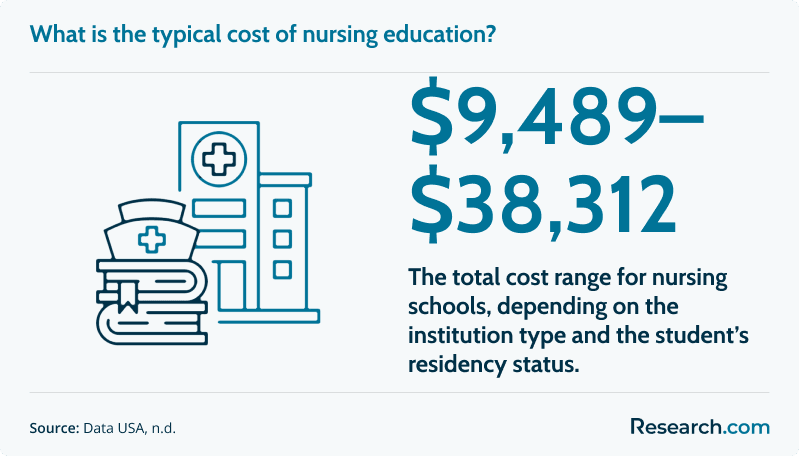
Online RN to BSN to MSN tuition varies by school type, residency status, transfer credit acceptance, program length, technology fees, course materials, and clinical or residency requirements. According to Data USA, the total cost typically ranges from $9,489 to $38,312.
Public universities may offer lower tuition to in-state students, while private institutions may have one online tuition rate regardless of residence. Online study can also reduce commuting, relocation, housing, and some campus-based costs, but students should not assume that online programs are automatically cheaper.
| Cost factor | Why it matters | Question to ask |
| Tuition per credit | A low per-credit rate may still be expensive if the program requires many credits | What is the total tuition for the entire bridge pathway? |
| Transfer credits | Accepted credits can reduce both cost and completion time | How many ADN, general education, or prior BSN-level credits can transfer? |
| Fees | Technology, clinical, graduation, and course fees can raise the final bill | What fees are mandatory for online nursing students? |
| Clinical or residency travel | Some programs require campus visits or approved site travel | Are any in-person residencies required? |
| Work schedule impact | Reduced work hours can affect total affordability | Can the program be completed while maintaining current employment? |
If cost is the main barrier, nurses may also compare stand-alone most affordable online RN to BSN programs before committing to a full RN to BSN to MSN sequence.
Financial aid options for online RN to BSN to MSN students
Students in accredited online nursing programs may be eligible for several forms of aid. Availability depends on the school, enrollment level, degree status, citizenship or residency criteria, employer policies, and whether the program meets federal financial aid rules.
- Federal Student Aid: Eligible students can submit the FAFSA to be considered for federal aid, including Pell Grants, Direct Subsidized/Unsubsidized Loans, and Graduate PLUS Loans.
- Employer Tuition Reimbursement: Hospitals, health systems, clinics, and long-term care employers may help pay for nursing education when the degree supports workforce needs.
- Scholarships and Fellowships: Nursing organizations, universities, foundations, and specialty groups may offer awards for students pursuing leadership, education, advanced practice, or underserved-area roles.
- State-Specific Nursing Grants: Some state programs support nursing students who agree to work in shortage areas or high-need specialties.
- Military Benefits and VA Education Assistance: Active-duty service members, veterans, and eligible dependents may qualify for tuition assistance and housing-related benefits.
Students comparing multiple healthcare careers should examine aid rules by field. A respiratory therapy and nursing degree programs comparison can help clarify how program costs, credentials, and aid structures differ across allied health and nursing routes.
Admissions requirements and prerequisites for online RN to BSN to MSN programs
Admission standards vary, but most online RN to BSN to MSN programs look for evidence that applicants are licensed, academically prepared, and ready for upper-division and graduate nursing work. Common requirements include:
- Active, unencumbered RN license
- Completion of an ADN
- Minimum GPA, commonly 2.5 or higher
- Prerequisite coursework in statistics, anatomy, and microbiology
- Letters of recommendation and a personal statement
Some schools may ask for recent clinical experience, a resume, an interview, undergraduate bridge courses, or proof of specific state authorization. If you are concerned about the academic jump, this guide to how hard RN to BSN online programs are can help you understand workload expectations before moving into a combined bridge program.
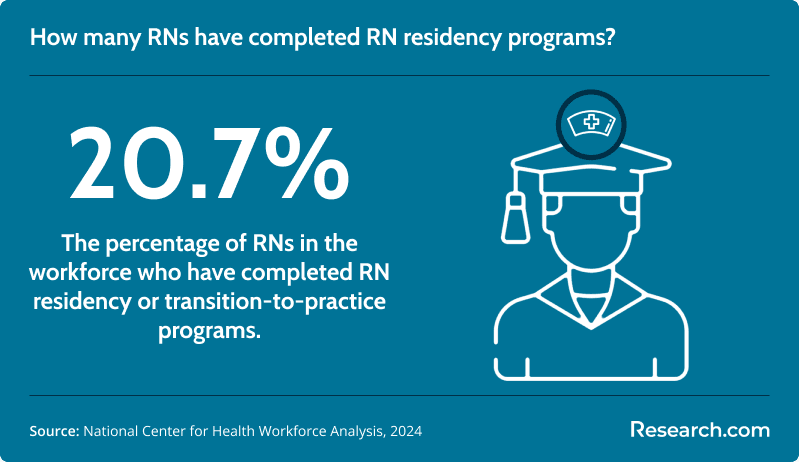
Mentorship also matters. The National Center for Health Workforce Analysis reports that 901,763 RNs (20.7% of the workforce) have completed an RN residency or transition-to-practice program. Of these, 93.3% were assigned a preceptor. Nurses who have had structured onboarding, preceptor support, or strong workplace mentoring may be better prepared for the self-directed demands of online bridge study.
What courses are typically included in an online RN to BSN to MSN program?
Curricula usually move through three layers: BSN completion courses, MSN core courses, and specialization courses. The exact sequence depends on whether the program is designed for leadership, education, advanced practice, healthcare quality, or another graduate focus.
BSN-level courses
- Health Assessment and Promotion
- Community and Public Health Nursing
- Evidence-Based Practice
- Nursing Leadership and Management
- Pathophysiology and Pharmacology
MSN core courses
- Advanced Health Assessment
- Nursing Informatics
- Healthcare Policy and Ethics
- Advanced Pharmacology
- Population Health
Specialization or elective courses
- Primary Care for Families
- Mental Health Nursing
- Healthcare Systems and Quality Improvement
Course selection should match your credential goal. For example, nurses comparing APRN vs NP roles should look closely at clinical-hour requirements, certification preparation, and whether the curriculum meets state licensure expectations.
What MSN specializations are available in online RN to BSN to MSN programs?
Specialization is one of the most important choices in a bridge program because it determines what roles the degree can realistically support. Some concentrations prepare nurses for direct advanced practice, while others focus on teaching, leadership, administration, quality improvement, or systems-level care. Nurses interested in acute care for adult and older adult populations may also compare options such as an affordable online adult-gerontology ACNP graduate certificate.
Common specializations
- FNP
- Nurse Educator
- Nurse Administrator
- Adult-Gerontology NP (AGNP)
- Psychiatric-Mental Health NP (PMHNP)
- Pediatric NP (PNP)
| Specialization | Best for nurses who want to | Important consideration |
| FNP | Provide primary care across the lifespan | Must confirm certification and state licensure alignment |
| Nurse Educator | Teach in academic, clinical, or staff-development settings | May require teaching practicum or education-focused capstone work |
| Nurse Administrator | Move into management, operations, budgeting, or executive support | Leadership experience can strengthen post-graduation opportunities |
| AGNP | Care for adult and older adult populations | Acute care and primary care tracks may lead to different scopes of practice |
| PMHNP | Focus on psychiatric and mental health care | Clinical placement availability can be a major factor |
| PNP | Work with pediatric populations | Students should verify pediatric clinical access before enrolling |
According to BLS, nurse anesthetists, nurse midwives, and NPs held about 349,600 jobs in 2023, distributed as follows:
- NPs: 292,500
- Nurse anesthetists: 49,900
- Nurse midwives: 7,200
These employment figures show that advanced practice nursing includes several distinct career paths. Students should choose a specialization based on certification eligibility, clinical interests, local demand, and long-term career fit—not only on salary expectations.
How to choose the best affordable online RN to BSN to MSN program
The best affordable program is not always the one with the lowest advertised tuition. A strong choice should be accredited, licensure-aligned, realistically paced, transparent about clinical requirements, and affordable after all fees and transfer credits are considered.
- Total Cost of Attendance: Add tuition, required credits, fees, books, software, clinical costs, background checks, uniforms, travel, and lost work hours if applicable.
- Transfer Credit Policy: Ask how many credits from your ADN and prior college coursework will apply to the bridge pathway.
- Program Accreditation: Confirm recognition from CCNE or ACEN, especially if you plan to seek certification, licensure, or employer tuition assistance.
- Clinical Placement Support: Determine whether the school finds sites, assists with placement, or expects students to secure preceptors independently.
- Residency Requirements: Check whether the program requires campus visits, intensives, labs, or other in-person experiences.
- State Authorization: Verify that the program can enroll students in your state and that it meets requirements where you plan to practice.
- Student Support: Look for advising, tutoring, library access, technology help, writing support, and career services for online learners.
| Common mistake | Why it can hurt students | Better approach |
| Choosing only by tuition per credit | Fees, credit requirements, and transfer limits can make the total cost higher | Compare full program cost, not just per-credit tuition |
| Ignoring accreditation | May affect aid eligibility, certification options, employer recognition, or licensure pathways | Verify institutional and nursing program accreditation before applying |
| Assuming “online” means no clinicals | Nursing programs often require in-person practicum or clinical work | Ask exactly where and how clinical or practicum hours are completed |
| Overlooking state rules | A program may not meet requirements in every state | Confirm state authorization and licensure alignment in writing |
| Relying only on rankings | A highly ranked program may not match your schedule, specialization, or budget | Use rankings as a starting point, then evaluate fit |
How does an online RN to BSN to MSN program deliver return on investment?
Return on investment depends on more than future salary. A realistic ROI review compares total program cost, time to completion, work schedule impact, employer reimbursement, career advancement potential, certification eligibility, and local job demand. The strongest value usually comes from programs that keep debt manageable while clearly connecting the MSN track to roles the student actually wants.
Students should also compare the bridge pathway with less expensive or shorter alternatives. For example, reviewing cheap RN programs can help nurses understand how different nursing education options affect cost, timeline, and credential outcomes. If the goal is leadership or education, an MSN bridge may be efficient. If the goal is a specific NP role, certification alignment and clinical placement support become central to ROI.
What career paths are available after an online RN to BSN to MSN program?
Graduates can pursue clinical, leadership, educational, administrative, and policy-related roles depending on their specialization. Some nurses later continue to doctoral study; for example, those interested in women’s health may compare graduate pathways with the cheapest online DNP women’s health nurse practitioner options.
- NP
- Clinical Nurse Leader
- Nurse Educator
- Nurse Administrator
- Health Policy Analyst
- Case Manager or Care Coordinator
According to BLS, the largest employers of nurse anesthetists, nurse midwives, and NPs are:
- Offices of physicians: 49%
- Hospitals (state, local, and private): 25%
- Outpatient care centers: 8%
- Offices of other health practitioners: 4%
- Educational services: 3%
| Career direction | Typical focus | Best MSN fit |
| Advanced practice | Assessment, diagnosis, treatment, and patient management within scope-of-practice rules | NP, nurse midwifery, or nurse anesthesia pathways where available and appropriate |
| Nursing education | Teaching students, onboarding staff, developing curriculum, and supporting clinical learning | Nurse Educator |
| Administration | Staffing, budgeting, operations, quality metrics, and unit or system leadership | Nurse Administrator, Nurse Executive, Leadership |
| Quality and safety | Process improvement, patient safety, risk management, compliance, and outcomes measurement | Healthcare Quality, Patient Safety, Risk Management |
| Care coordination | Managing transitions of care, chronic disease support, and interdisciplinary planning | Population Health, Leadership, Case Management-related pathways |
Why do faculty expertise and clinical partnerships matter?
Faculty background and clinical partnerships can directly affect the quality of an online RN to BSN to MSN experience. Experienced faculty can connect coursework to real patient care, leadership decisions, policy issues, and current nursing standards. Strong healthcare partnerships may also improve access to practicum opportunities, mentoring, networking, and capstone projects that produce usable workplace results.
Before enrolling, review faculty profiles, certification areas, publication or practice experience, and the school’s approach to clinical placement. Ask whether the program has formal relationships with healthcare organizations or whether students are responsible for finding sites on their own. Students comparing alternate routes into advanced practice may also review direct entry nurse practitioner programs for non nurses online to understand how clinical partnerships differ for students entering nursing from outside the profession.
What is the job market like for online RN to BSN to MSN graduates?
The job market for MSN-prepared nurses remains strong in many settings because healthcare organizations need clinicians, educators, managers, and advanced practice professionals who can support patient care, workforce development, and system improvement. Demand will vary by state, specialty, certification, and local employer needs.
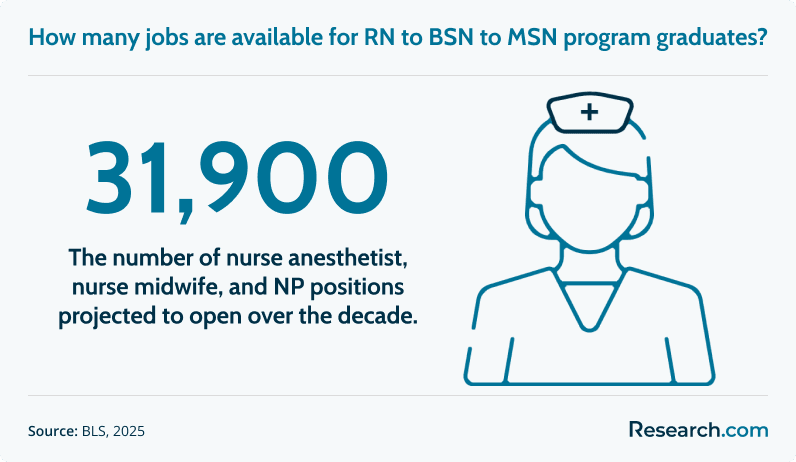
Approximately 31,900 openings for nurse anesthetists, nurse midwives, and NPs are projected each year, on average, over the next decade. These openings reflect both occupational growth and replacement needs as workers retire or move into other roles.
For students, the practical takeaway is clear: job outlook is important, but program choice still matters. A program with the right specialization, clinical support, accreditation, and licensure alignment can be more valuable than a cheaper program that does not prepare you for your intended role.
What should students ask before enrolling?
Before applying, speak with admissions staff, nursing faculty, financial aid officers, and—if possible—current students or alumni. The goal is to confirm that the program’s advertised flexibility, cost, and outcomes match your real situation.
- Is the nursing program accredited by CCNE or ACEN?
- Is the institution authorized to enroll students from my state?
- Does the MSN track meet certification or licensure requirements where I plan to practice?
- How many of my prior credits will transfer?
- What is the total estimated cost, including fees and clinical-related expenses?
- Are clinical placements guaranteed, supported, or student-arranged?
- How many hours per week should I expect to study?
- Are courses asynchronous, synchronous, or hybrid?
- What happens if I need to slow down because of work or family obligations?
- What student support services are available to online learners?
How do online RN to BSN to MSN programs support academic quality and student success?
High-quality online programs do more than upload lectures. They provide structured advising, responsive faculty access, library resources, writing support, technical help, tutoring, clinical coordination, and career guidance. They also review curriculum regularly and maintain accreditation standards so students can trust that coursework reflects professional expectations.
Some programs use alternative structures for specific student goals. For instance, nurses comparing BSN completion options may review RN to BSN online no clinicals programs, particularly if they are focused on theory, leadership, and degree completion rather than additional bedside clinical hours. In a full RN to BSN to MSN pathway, however, students should still expect graduate practicum, capstone, or clinical requirements depending on the track.
What is the difference between direct entry online nurse practitioner programs and RN to BSN to MSN programs?
RN to BSN to MSN programs are designed for people who are already licensed RNs. They build on existing nursing education and clinical experience, then add BSN and MSN coursework in a planned sequence. Direct entry nurse practitioner programs are different because they serve students who do not have a traditional nursing background and need foundational nursing preparation before advanced practice study.
The right pathway depends on your starting credential. Licensed RNs usually compare RN to BSN to MSN, RN to MSN, BSN to MSN, or post-master’s options. Non-nurses should examine entry requirements, clinical intensity, state rules, and certification preparation carefully. For more detail, review direct entry online nurse practitioner programs.
What challenges do students face in online RN to BSN to MSN programs?
Online bridge programs can be flexible, but they are not easy. Students often balance graduate-level assignments with long shifts, family responsibilities, unpredictable clinical schedules, and self-directed online learning. Clinical placement can also be stressful if local sites are limited or if the school expects students to identify preceptors independently.
The best way to reduce risk is to plan before enrollment. Build a weekly study schedule, ask your employer about flexible scheduling or tuition reimbursement, confirm clinical policies, strengthen academic writing skills, and talk with advisors early if you fall behind. Students who want to move beyond the MSN into advanced clinical leadership may later compare DNP programs online, but they should first make sure the bridge program supports their immediate licensure and career goals.
Key Insights
- Online RN to BSN to MSN programs are best suited for licensed ADN-prepared RNs who want a streamlined route to both BSN and MSN credentials without completing two separate programs.
- Affordability should be measured by total cost, not tuition alone. According to Data USA, total cost typically ranges from $9,489 to $38,312, but fees, transfer credits, and work-schedule changes can affect the real price.
- Accreditation, state authorization, clinical placement support, and certification alignment are essential. A low-cost program is not a good value if it does not support your intended licensure or career path.
- Most online bridge programs require serious time management. Full-time students may finish in about two and a half to three years, while part-time students may need four years or more.
- MSN specialization drives career outcomes. FNP, AGNP, PMHNP, nurse educator, nurse administrator, and quality-focused tracks prepare students for different roles and requirements.
- The labor market is favorable for advanced nursing roles. BLS reports that nurse anesthetists, nurse midwives, and NPs had a median annual wage of $132,050 in May 2024, and approximately 31,900 openings are projected each year, on average, over the next decade.
- Students should ask direct questions before enrolling: Who finds clinical sites? How many credits transfer? Are there required campus visits? Does the program meet rules in your state? What is the complete cost?
References:
- BLS. (2025, April 18). Nurse anesthetists, nurse midwives, and nurse practitioners. BLS.
- BLS. (2025, April 18). Registered nurses. BLS.
- Data USA. (n.d.). Nurse practitioners & nurse midwives. Data USA.
- Data USA. (n.d.). Nursing School. Data USA.
- National Center for Health Workforce Analysis. (2024). Nursing Education and Training: Data from the 2022 NSSRN. bhw.hrsa.gov.
Other Things You Should Know About the Most Affordable Online RN to BSN to MSN Programs
To find the most affordable tuition rates for RN to BSN to MSN online bridge programs in 2027, use online comparison tools, check program websites for transparent fee listings, and consider factors like financial aid availability and any hidden costs. Review accredited programs to ensure quality education without compromising affordability.
Many are fully online, but some require occasional on-campus intensives or orientations. Always check if the program you choose is 100% online or includes residency components. Even small requirements can affect travel costs and availability. If fully online is essential, look for programs advertising “no campus visits required.” Schools often offer local clinical placements and virtual labs as alternatives.


