
2027 How to Become an Academic Advisor: Salary & Career Paths

Co-Founder and Chief Data Scientist
Becoming an academic advisor means choosing a student-facing higher education career where your work affects course choices, degree progress, retention, transfer decisions, and career planning. The role can be meaningful, but it is not always clearly explained in job postings: some institutions hire candidates with a bachelor’s degree, others strongly prefer a master’s degree, and responsibilities can range from registration support to intensive student success coaching.
This guide explains how to become an academic advisor in the USA for 2027, what the job actually involves, what education and skills employers look for, how certification works, what salary data suggests, and how to decide whether this career path fits your goals. It also covers common mistakes to avoid, current trends in advising, and practical steps for building a competitive profile.
Quick Answer: How Do You Become an Academic Advisor?
Most academic advisor roles require at least a bachelor’s degree, relevant experience in higher education or student services, and strong communication, problem-solving, and organizational skills. Many four-year colleges and universities prefer or require a master’s degree in counseling, higher education, student affairs, education, social work, or a related field. Academic advisors usually do not need a state license, but professional development through organizations such as NACADA can strengthen a candidate’s qualifications.
Key Things You Should Know Before Pursuing Academic Advising
- Minimum education varies by employer: A bachelor’s degree may be enough for some entry-level roles, while many universities prefer a master’s degree for full academic advisor positions.
- Graduate study can improve competitiveness: Programs in counseling, higher education, student affairs, education, and social work are common preparation routes. Some professionals use online master’s degree programs in counseling to qualify for more advanced student support roles.
- Experience matters: Admissions, registrar, tutoring, residence life, financial aid, student success, and program coordinator roles can all help build advising-related experience.
- The job is more than course scheduling: Advisors interpret policies, monitor progress, refer students to campus resources, document interactions, and help students make realistic academic decisions.
- Certification is usually voluntary: Academic advising is not typically a licensed profession in the United States, but continuing education and professional credentials can signal commitment.
- Specialization can shape your career: Advisors may work with first-year students, transfer students, international students, student-athletes, honors students, pre-health students, or specific academic departments.
- Technology is changing the work: Student information systems, early-alert tools, degree audit platforms, and analytics dashboards are now part of many advising environments.
- Salary depends on role level: The average salary for an Academic Advisor in the United States is $54,291, while leadership roles such as Academic Advising Director average $88,222.
- The work can be emotionally demanding: Advisors often help students facing academic failure, financial pressure, family obligations, mental health concerns, and uncertainty about their future.
- Fit matters: This career suits people who are patient, ethical, organized, student-centered, and comfortable explaining complex requirements clearly.
- How can you become an academic advisor for 2027?
- What does an academic advisor do?
- What are the educational requirements for becoming an academic advisor?
- What skills are required for academic advisors?
- What is the certification and licensing process for academic advisors?
- What ethical and legal guidelines should you observe as an academic advisor?
- How much can you earn as an academic advisor?
- What are the emerging trends in academic advising?
- What is the job market like for an academic advisor?
- What subspecialties and career paths are available for academic advisors?
- What challenges should you consider as an academic advisor?
- Can additional certifications boost my academic advising career?
- How can interdisciplinary studies, such as political science, enhance academic advising strategies?
- How can pursuing an advanced degree broaden my academic advising expertise?
- Can expertise in library science boost academic advising effectiveness?
- How can accelerated teaching programs enhance my academic advising career?
- Can specialized communication training enhance academic advising outcomes?
How can you become an academic advisor for 2027?
The most reliable path into academic advising combines education, campus-based experience, and evidence that you can support students through complex academic decisions. Employers usually want to see that you understand college systems, can explain requirements accurately, and can work well with students from different backgrounds.
- Earn a relevant bachelor’s degree: Common undergraduate majors include education, psychology, sociology, communication, counseling-related fields, social sciences, English, and liberal arts. Candidates still comparing options may want to review affordable online degrees if cost and flexibility are major factors.
- Build student services experience: Look for work in admissions, registrar offices, tutoring centers, residence life, financial aid, orientation, mentoring programs, career services, or student success offices.
- Learn how colleges make decisions: Advising requires familiarity with catalogs, degree audits, transfer credits, prerequisites, academic probation, withdrawal policies, graduation requirements, and institutional deadlines.
- Develop advising-specific skills: Practice active listening, structured note-taking, referral conversations, conflict resolution, and policy interpretation.
- Consider graduate education if your target jobs require it: A master’s degree in counseling, higher education, student affairs, education, or a related area can be especially useful for university advising, leadership, and specialized student support positions.
- Apply first to entry-level campus roles: Titles may include academic advising assistant, student success coordinator, enrollment specialist, program coordinator, retention specialist, or academic support coordinator.
- Use professional development strategically: Workshops, advising conferences, and online training can help you learn advising models, equity-focused student support, and technology tools used in modern higher education.
- Tailor your resume to advising outcomes: Highlight student-facing work, caseload management, policy interpretation, data systems, appointment documentation, and examples of helping students solve academic problems.
| Step | What to Do | Why It Matters |
| 1. Meet the education baseline | Complete a bachelor’s degree; consider a master’s degree for competitive university roles. | Many advising jobs screen applicants by degree level before reviewing experience. |
| 2. Get higher education exposure | Work or volunteer in student services, admissions, tutoring, orientation, or campus support. | Advisors must understand how students navigate real institutional systems. |
| 3. Learn institutional language | Study catalogs, course sequencing, degree audits, probation rules, and transfer policies. | Students depend on advisors for accurate interpretation of academic rules. |
| 4. Build student communication skills | Practice listening, asking diagnostic questions, explaining options, and documenting follow-up. | The best advisors combine accuracy with empathy and clarity. |
| 5. Apply strategically | Target roles aligned with your background, such as transfer advising, first-year advising, or department advising. | Specialization can make your experience easier for hiring committees to evaluate. |
A practical way to prepare is to read actual job postings from the types of institutions where you want to work. Community colleges, large public universities, private colleges, and online institutions may define academic advising differently, so the right preparation depends on your target setting.
What does an academic advisor do?
An academic advisor helps students make informed decisions about their education. The role often includes course planning, policy interpretation, progress monitoring, referrals to campus resources, and conversations about academic goals. In many institutions, advisors are also part of broader student retention and completion efforts.
- Explain degree requirements: Advisors help students understand general education rules, major requirements, electives, prerequisites, GPA standards, and graduation timelines.
- Support course planning: They help students build semester-by-semester schedules that fit degree requirements, workload limits, transfer credits, and personal obligations.
- Review academic progress: Advisors monitor grades, completed credits, repeated courses, withdrawals, holds, and warning signs that may require intervention.
- Connect academics to career goals: They help students see how majors, minors, certificates, internships, and graduate school prerequisites relate to future plans.
- Refer students to appropriate services: Advisors may connect students with tutoring, counseling, disability services, financial aid, career services, faculty mentors, or emergency support.
- Document advising interactions: Accurate notes help maintain continuity, especially when multiple offices support the same student.
- Translate institutional policies: Advisors explain deadlines, petitions, withdrawals, academic standing rules, appeal options, and graduation processes.
- Advocate appropriately: Advisors may help students communicate with departments or offices, while still following institutional rules.
- Use advising technology: Many advisors work with degree audit systems, student information systems, communication platforms, scheduling tools, and early-alert dashboards.
- Stay informed about program changes: Advisors must track curriculum updates, accreditation-related requirements, catalog changes, and institutional procedures. Reviewing resources such as nationally accredited online universities can also help advisors understand how institutional structures differ.
| Advising Task | What It Looks Like in Practice | Common Risk if Done Poorly |
| Course selection | Helping a student choose courses that satisfy requirements and fit sequencing rules. | The student may delay graduation by missing prerequisites or required courses. |
| Academic recovery | Creating a plan for a student on warning, probation, or dismissal risk. | The student may repeat unsuccessful patterns without targeted support. |
| Transfer evaluation | Helping students understand how previous credits apply to a new program. | Students may assume credits count toward a major when they only count as electives. |
| Resource referral | Connecting students to tutoring, counseling, financial aid, or disability services. | Students may struggle alone when specialized help is available. |
| Goal clarification | Helping students compare majors, minors, graduate school paths, and career options. | Students may choose programs without understanding requirements or outcomes. |
One important distinction: academic advisors are not the same as school counselors, licensed mental health counselors, or career counselors, although the roles may overlap in some settings. The school counselor data below is still useful because it shows the broader demand for student guidance, but academic advisor roles in colleges and universities may have different staffing models and job requirements.
For the 2023–2024 academic year, the national average student-to-school-counselor ratio in the United States was 376:1, above the American School Counselor Association's recommended ratio of 250:1. Arizona reported the highest ratio at 645:1, followed by Michigan at 573:1 and Minnesota at 541:1. Utah also exceeded the national average with a ratio of 487:1. Other high-ratio states included California at 443:1, New Mexico at 440:1, and Florida at 432:1.
Some locations reported lower ratios. New York had a ratio of 314:1, the District of Columbia had 303:1, and Hawaii was the only state in this group to meet the ASCA recommendation, with a ratio of 249:1.
The graph below illustrates how counselor availability differs by state. While these figures refer to school counselors rather than college academic advisors, they point to a broader challenge in student support: many students need more guidance than institutions can easily provide.
In day-to-day practice, academic advising is most effective when it is accurate, timely, and personalized. Students often come to advisors when decisions are urgent, so the role requires both technical knowledge and calm, student-centered communication.
What are the educational requirements for becoming an academic advisor?
Academic advisor education requirements are set by individual institutions, not by a single national licensing body. A bachelor’s degree is commonly listed as the minimum requirement, but many four-year colleges, universities, and specialized advising units prefer candidates with graduate training.
- Bachelor’s degree: This is often the entry point for advising assistant, student success, enrollment, or academic support roles. Candidates seeking a flexible route to a degree can compare affordable online bachelor’s degree in education options or other relevant undergraduate pathways.
- Master’s degree: Many employers prefer graduate education in counseling, higher education administration, student affairs, education, social work, psychology, or a related field.
- Relevant coursework: Useful topics include student development theory, counseling techniques, higher education law, multicultural education, assessment, career development, and communication.
- Doctoral degree: A doctorate may be useful for advising leadership, higher education administration, research, assessment, policy, or executive roles, but it is not usually required for entry-level advising.
- Discipline-specific knowledge: Advisors in areas such as engineering, nursing, business, teacher education, or pre-health may benefit from familiarity with those fields’ course sequences and professional requirements.
- Education plus experience: Some employers may accept a bachelor’s degree with substantial student services experience in place of a graduate degree.
- Teaching or counseling credentials: These are not standard requirements for academic advising, but some hybrid roles involving instruction, school counseling, or formal counseling services may require additional credentials.
| Education Level | Typical Fit | When It Makes Sense |
| Bachelor’s degree | Entry-level advising, student services, admissions, registrar, or support coordinator roles. | Best for candidates starting in higher education or moving from related student-facing work. |
| Master’s degree | Academic advisor, student success advisor, retention specialist, or specialized advising role. | Best for candidates targeting four-year institutions or roles with larger advising responsibility. |
| Doctoral degree | Director, dean-level, research, assessment, or higher education leadership positions. | Best for professionals pursuing administration, policy, leadership, or scholarly work. |
| Field-specific graduate study | Advising in professional schools or highly structured majors. | Best when students need guidance tied to licensure, clinical prerequisites, or professional school admission. |
The main decision is not simply whether you can get hired with a bachelor’s degree. It is whether your education and experience match the institutions and student populations you want to serve.
What skills are required for academic advisors?
Academic advisors need a mix of interpersonal, analytical, administrative, and technology skills. The role requires more than being friendly and helpful; advisors must interpret rules correctly, ask the right questions, document decisions, and recognize when a student needs specialized support.
- Active listening: Advisors must understand what students are asking, what they are not saying, and what barriers may be affecting their progress.
- Clear communication: Students need complex policies explained in plain language, often during stressful moments.
- Policy interpretation: Advisors must apply catalog requirements, deadlines, appeals, prerequisites, and academic standing rules accurately.
- Problem-solving: Advising often involves helping students compare imperfect options, such as withdrawing from a course, changing majors, retaking a class, or extending a graduation timeline.
- Critical thinking: Advisors must identify patterns in academic records and avoid giving generic advice when a student’s situation requires closer analysis.
- Organization: Caseloads, appointments, email follow-ups, records, deadlines, and reports require strong systems.
- Referral judgment: Effective advisors know when to connect students to counseling, financial aid, disability services, tutoring, career services, or faculty support.
- Technology proficiency: Student information systems, degree audits, appointment software, early-alert platforms, and communication tools are common in advising offices.
- Cultural responsiveness: Advisors work with students of different ages, identities, academic backgrounds, family responsibilities, and levels of college knowledge.
- Professional boundaries: Advisors must be supportive without acting outside their role or providing services they are not trained or authorized to provide.
A 2025 survey of 1,322 participants across diverse U.S. organizations in sectors including technology, finance, healthcare, education, and manufacturing found that employers placed the highest importance on analytical thinking at 4.3 and cognitive thinking at 3.9 among core skills. Leadership and management skills scored 3.7, while digital literacy scored 3.6. Digital and numerical skills, along with innovation and creativity, were rated lowest among the listed core skills, both scoring 2.8, as shown in the graphic below.
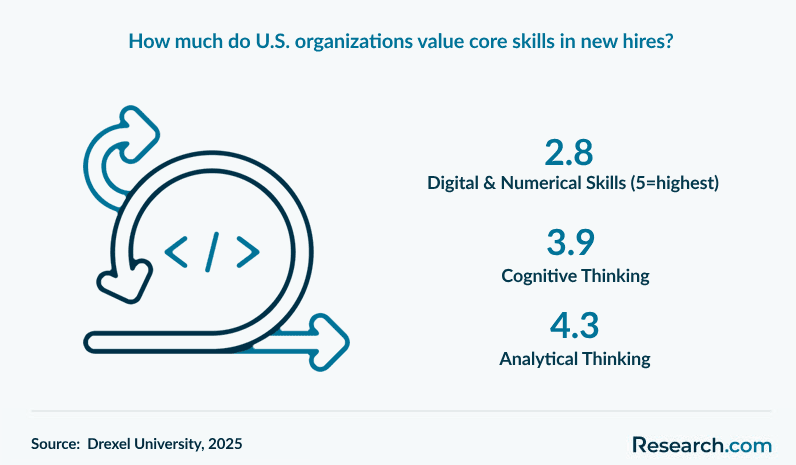
For academic advisors, this data reinforces an important point: students need help connecting academic choices to skills employers value. Advisors who understand labor market expectations can guide students toward coursework, projects, internships, and campus experiences that strengthen analytical thinking, communication, leadership, and digital confidence.
What is the certification and licensing process for academic advisors?
Academic advising in the United States generally does not require a state license or mandatory national certification. Unlike licensed counseling, teaching, nursing, law, or clinical social work roles, academic advising is typically governed by employer requirements, institutional policies, and professional standards rather than state licensure boards.
- No standard legal license: Academic advisors usually do not need a state-issued license to work in college or university advising.
- Voluntary professional credentials: Professional development through organizations such as NACADA can help advisors build expertise and demonstrate commitment to the field.
- Employer-specific training: Colleges often train new advisors on local degree requirements, student systems, catalog rules, transfer policies, confidentiality expectations, and referral protocols.
- Specialized credentials may help in hybrid roles: Advisors involved in career counseling, teaching, disability services, or mental health-adjacent work may pursue credentials related to those areas, depending on job duties.
- Continuing education is expected: Even without mandatory licensure, advisors must keep up with changing curricula, technology, equity practices, and student success strategies.
| Credential Type | Required? | Best Use |
| Bachelor’s degree | Often required | Minimum qualification for many entry-level advising and student support roles. |
| Master’s degree | Often preferred or required | Competitive preparation for university advising, counseling-adjacent roles, and advancement. |
| State license | Usually not required | Relevant only if the position includes licensed counseling, teaching, or other regulated duties. |
| Professional development | Not always required, but valuable | Helps advisors stay current with advising models, ethics, technology, and student success practices. |
| Specialized certification | Depends on role | Useful for career advising, coaching, teaching, or other specialized responsibilities. |
The absence of required licensure does not make the role informal. Advisors handle sensitive records, influence academic decisions, and must follow institutional and federal requirements related to student information.
What ethical and legal guidelines should you observe as an academic advisor?
Academic advisors work with sensitive academic records and personal information. Ethical advising means giving accurate guidance, respecting student autonomy, maintaining appropriate boundaries, and protecting information according to institutional policy and applicable law.
- Protect confidentiality: Advisors must safeguard student records and disclosures, while understanding exceptions related to safety, legal obligations, and institutional policy.
- Follow FERPA requirements: The Family Educational Rights and Privacy Act governs access to and disclosure of student education records.
- Give accurate information: Students should receive current and correct guidance about requirements, deadlines, policies, and available options.
- Avoid overstepping your role: Advisors should not provide legal, clinical, financial, or immigration advice unless they are qualified and authorized to do so.
- Respect student decision-making: Advisors can explain consequences and options, but students should remain active participants in academic choices.
- Document consistently: Advising notes should be factual, relevant, professional, and aligned with institutional standards.
- Serve students equitably: Advising should be accessible and respectful regardless of race, ethnicity, disability, age, gender identity, income level, veteran status, transfer status, or first-generation status.
- Disclose conflicts of interest: Advisors should avoid situations where personal interests could compromise professional judgment.
- Use technology responsibly: Email, advising platforms, notes, and analytics tools must be used in ways that protect student privacy.
- Know referral protocols: Advisors should understand when and how to refer students to counseling, disability services, Title IX offices, financial aid, or emergency support.
Ethical advising is one reason the job requires judgment as well as empathy. Students may be making decisions that affect time to degree, financial aid, academic standing, or eligibility for competitive programs, so accuracy and transparency are essential.
How much can you earn as an academic advisor?
Academic advisor pay depends on institution type, region, role level, experience, education, and whether the position includes leadership or specialized responsibilities. Entry-level advising and support roles tend to pay less than director, executive, or chief academic officer positions.
- Entry-level advising roles: Starting salaries for candidates with a bachelor’s degree may fall in the low to mid $30,000s annually.
- Mid-career advising roles: Advisors with several years of experience and possibly a master’s degree may earn from the mid-$40,000s to the low $60,000s.
- Senior and director roles: Experienced advisors in leadership or specialized roles may earn from $60,000 to over $80,000 or more, depending on the institution and duties.
- Education level: A master’s or doctoral degree can improve access to higher-level roles, but it does not guarantee a specific salary.
- Institution and location: Public, private, nonprofit, online, community college, and research university settings may have different salary structures.
- Specialization: Athletic advising, pre-professional advising, transfer advising, and advising administration can involve different pay ranges.
The average salary for an Academic Advisor in the United States is $54,291. Examples in the available data show some variation: Academic Advisors at Georgia State University earn $54,905, Academic Advisors in Oklahoma earn $50,288, and Athletic Academic Advisors average $47,454.
Higher-responsibility roles show larger salary differences. Academic Advising Directors average $88,222, Academic Support Coordinators average $61,031, and Associate Chief Academic Officers average $158,458. Executive-level roles are substantially higher: Chief Academic Officers average $215,951, while Chief Academic Officers in the healthcare sector average $432,294.
| Role | Average Salary Stated | What the Role Usually Indicates |
| Academic Advisor | $54,291 | Core advising role focused on student academic planning and progress. |
| Academic Advisor at Georgia State University | $54,905 | Institution-specific salary example. |
| Academic Advisor in Oklahoma | $50,288 | Location-based salary example. |
| Athletic Academic Advisor | $47,454 | Specialized advising for student-athletes. |
| Academic Support Coordinator | $61,031 | Student support role that may include advising, coordination, and academic interventions. |
| Academic Advising Director | $88,222 | Leadership role overseeing advising operations, staff, or programs. |
| Associate Chief Academic Officer | $158,458 | Senior academic administration role. |
| Chief Academic Officer | $215,951 | Executive academic leadership position. |
| Chief Academic Officer in healthcare | $432,294 | Executive role in a specialized healthcare context. |
The graph below shows the pay gap between advising, academic support, director, and senior executive roles. The main takeaway is that advising can be a stable career path, but the highest compensation generally comes from moving into administration, leadership, or specialized executive roles.
Before accepting a position, compare salary with workload, caseload size, contract length, benefits, remote or hybrid flexibility, tuition benefits, professional development funding, and opportunities for advancement.
What are the emerging trends in academic advising?
Academic advising is becoming more proactive, data-informed, and connected to whole-student support. Advisors are increasingly expected to use technology while still providing human judgment that software cannot replace.
- Proactive advising: Instead of waiting for students to ask for help, many institutions use alerts, campaigns, and required check-ins to identify risks earlier.
- Degree audit and planning tools: Students and advisors increasingly rely on digital systems to track requirements, but advisors still need to verify exceptions, substitutions, and catalog rules.
- Analytics-informed outreach: Institutions may use performance, registration, credit completion, and engagement data to prioritize student contact.
- Holistic student support: Advising often overlaps with financial stress, mental health referrals, career planning, belonging, and basic needs support.
- Online and hybrid advising: Video appointments, chat, email campaigns, and virtual advising centers are now common in many institutions.
- Career-connected advising: Students increasingly want academic choices tied to employment, graduate school, and return on investment.
- Leadership preparation: Advisors moving into strategy, assessment, or administration may explore advanced education such as online EdD programs.
Technology can improve scale and consistency, but it also creates risks. Advisors must know when a system output is incomplete, when a student needs a more nuanced conversation, and when privacy or equity concerns require extra care.
What is the job market like for an academic advisor?
The job market for academic advisors is generally stable because colleges and universities continue to focus on retention, completion, transfer pathways, and student support. Demand is shaped by enrollment patterns, institutional budgets, advising models, and the complexity of academic programs.
- Student success priorities: Institutions invest in advising because student retention and completion affect outcomes, funding, reputation, and accreditation-related expectations.
- Complex academic pathways: Transfer credits, online programs, certificates, dual enrollment, major changes, and professional prerequisites create a need for skilled guidance.
- Diverse student populations: Adult learners, first-generation students, transfer students, online learners, international students, and working students may need different advising approaches.
- Technology changes the role, not the need: Degree audits and analytics tools can support advising, but students still need interpretation, context, and human support.
- Retirements and internal mobility: Openings may occur as advisors move into leadership, enrollment management, student affairs, or academic administration.
In 2023, school and career counselors and advisors earned a median annual salary of $61,710, or $29.67 per hour, according to the U.S. Bureau of Labor Statistics. Entry into this occupational category typically requires a master’s degree, with no prior related work experience or on-the-job training required. There were approximately 360,800 jobs in this occupation in 2023, and employment is projected to grow by 4% from 2023 to 2033, about as fast as the average for all occupations. This projected growth represents an employment change of 16,200 jobs over the decade.
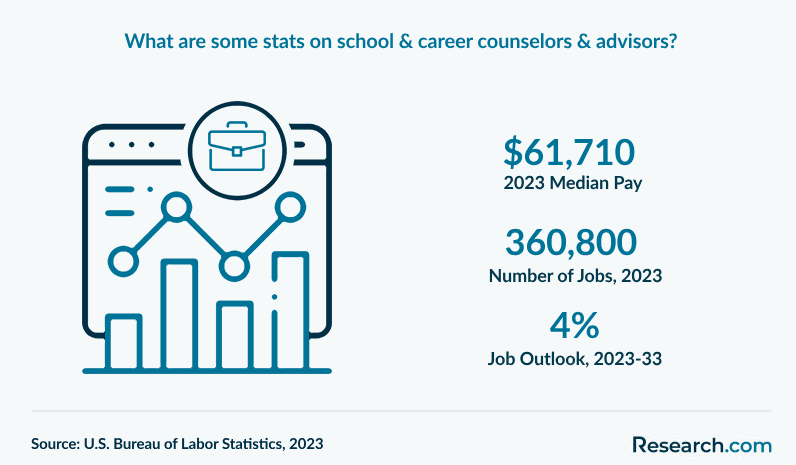
Because BLS categories include school and career counselors as well as advisors, candidates should interpret the data carefully. It is still useful as a broad labor market indicator, but academic advisor hiring will vary by higher education sector, location, and institutional finances.
What subspecialties and career paths are available for academic advisors?
Academic advising offers several specialization and advancement paths. Some professionals deepen expertise with a student population or academic area, while others move into management, assessment, policy, or academic administration.
- College or department advising: Advisors may support students in business, engineering, nursing, education, arts and sciences, or other academic units.
- Pre-professional advising: These advisors guide students preparing for medicine, law, dentistry, pharmacy, veterinary medicine, or other competitive pathways.
- First-year advising: This specialty focuses on transition, belonging, academic habits, registration, and early major exploration.
- Transfer advising: Advisors help students understand credit evaluation, articulation, degree applicability, and transition requirements.
- International student advising: These roles may involve cultural adjustment and referrals related to immigration rules, while staying within institutional boundaries.
- Athletic advising: Advisors support student-athletes balancing eligibility requirements, practice schedules, travel, and degree progress.
- Honors advising: Advisors guide high-achieving students through research, enrichment, advanced coursework, and graduate or professional preparation.
- Graduate student advising: These advisors support master’s and doctoral students with program milestones, policies, and academic progress.
- Academic coaching: Some advisors focus more intensively on study strategies, accountability, motivation, and academic recovery.
- Advising administration: Experienced professionals may become assistant directors, directors, deans, or academic affairs leaders.
Some advisors broaden their expertise through related fields. For example, those interested in supporting students with disabilities, intervention planning, or specialized learning needs may compare affordable online master’s in special education programs as part of a longer-term career strategy.
A report cited by Yahoo Finance projects that the global education consulting market will increase by USD 771.98 million between 2024 and 2028. The report describes a compound annual growth rate of 5.78% during the forecast period, as shown in the graphic below.
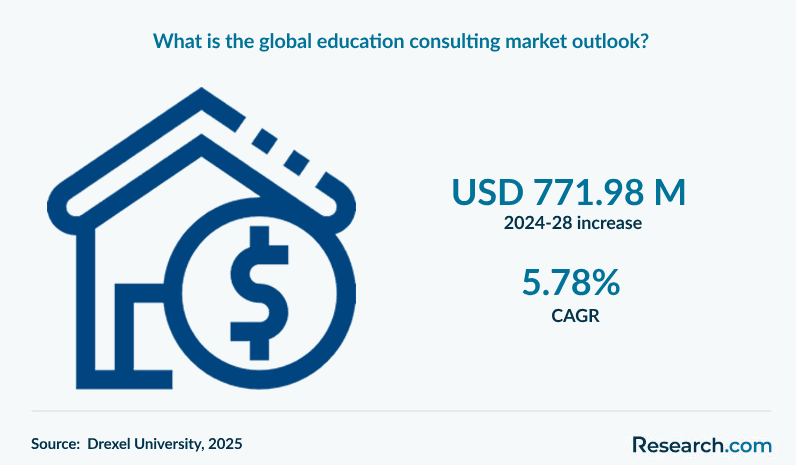
The report includes market segments by education level type, including K-12 and higher education; platform, including online and offline; and geography, including North America, Europe, APAC, South America, and the Middle East and Africa. It identifies rising demand for tailored learning solutions as a key market driver. For academic advisors, this reinforces the value of personalized, student-specific guidance rather than one-size-fits-all planning.
What challenges should you consider as an academic advisor?
Academic advising can be rewarding, but candidates should understand the pressures before entering the field. The role often involves high student volume, emotional conversations, changing rules, and institutional constraints.
- Large caseloads: Advisors may be responsible for many students, limiting time for individualized support.
- Complex student needs: Academic issues often intersect with work schedules, caregiving, finances, housing, health, disability, and family expectations.
- Policy complexity: Catalog years, substitutions, appeals, transfer rules, prerequisites, and accreditation requirements can be difficult to track.
- Emotional strain: Advisors may support students facing dismissal, failure, personal crises, or uncertainty. Professionals seeking deeper preparation for student support may review affordable online master’s in mental health counseling programs, while remembering that academic advising is not the same as licensed therapy.
- Limited resources: Advisors may know what a student needs but have limited appointments, funding, course availability, or campus services to offer.
- Administrative workload: Documentation, reports, campaigns, email, meetings, and system updates can take substantial time.
- Balancing advocacy and rules: Advisors support students but must also follow institutional requirements and academic standards.
- Measuring impact: Advising quality is not always easy to capture through simple metrics, especially when success depends on many offices and factors.
Common Mistakes to Avoid When Preparing for This Career
| Mistake | Why It Can Hurt You | Better Approach |
| Assuming every advising job has the same requirements | Community colleges, universities, online programs, and professional schools may hire for different skill sets. | Study job postings by institution type before choosing a degree or certificate. |
| Focusing only on degrees | Education helps, but hiring committees also value direct student services experience. | Build experience through campus jobs, internships, advising-adjacent roles, or volunteer mentoring. |
| Ignoring technology skills | Many advising offices rely on student records systems, degree audits, and appointment platforms. | Highlight data systems, documentation, reporting, and digital communication experience. |
| Confusing advising with therapy | Academic advisors are not automatically licensed counselors. | Learn referral boundaries and know when to connect students to qualified professionals. |
| Accepting a job without asking about caseload | Workload affects advising quality, stress, and long-term fit. | Ask about average caseload, appointment length, peak periods, and support staff. |
| Considering salary without benefits | Higher education compensation often includes benefits that affect total value. | Compare tuition benefits, retirement, healthcare, remote work, time off, and professional development funding. |
Can a well-rounded undergraduate education enhance academic advising success?
Yes. Academic advising relies on broad thinking, strong writing, careful reading, and the ability to understand students across disciplines. A liberal arts background can help future advisors interpret policies, communicate clearly, and support students who are still exploring their academic identity. For example, an affordable online bachelor’s degree in English can strengthen writing, analysis, and communication skills that are directly useful in advising conversations and documentation.
Can additional certifications boost my academic advising career?
Additional certifications can help if they match your advising goals, but they should be chosen carefully. A credential is most valuable when it builds a skill your target role actually uses, such as teaching, coaching, career development, communication, assessment, or student support.
For advisors who work closely with education majors or instructional programs, learning how to earn a teaching credential can provide useful context about certification requirements, classroom preparation, and educator career pathways. However, candidates should not assume that a teaching credential is required for standard academic advising unless the job posting specifically says so.
How can interdisciplinary studies, such as political science, enhance academic advising strategies?
Interdisciplinary study can make academic advisors more effective because students do not make decisions in isolation. Policy, civic institutions, public funding, equity, and governance all shape higher education. Political science can be especially useful for advisors interested in public universities, policy advising, civic engagement, pre-law pathways, or student advocacy. Candidates who want that foundation can explore an affordable online bachelor’s degree in political science as one route into higher education work.
How can pursuing an advanced degree broaden my academic advising expertise?
An advanced degree can help academic advisors move beyond transactional course planning into leadership, assessment, supervision, policy, and program design. Graduate study may also deepen knowledge of student development, learning theory, equity, institutional research, and higher education administration.
For professionals who want graduate preparation with a teaching or education focus, options such as affordable one-year online master’s in education programs may be worth comparing. The right choice depends on whether your goal is academic advising, teaching, student affairs leadership, counseling-adjacent work, or administration.
Can expertise in library science boost academic advising effectiveness?
Library science can strengthen an advisor’s ability to help students navigate information, evaluate sources, use academic databases, and build research confidence. These skills are especially useful for advisors who support first-year students, graduate students, online learners, or students in research-heavy programs. Professionals interested in this direction can compare options for a low-cost online MLIS degree as part of a broader higher education career plan.
How can accelerated teaching programs enhance my academic advising career?
Accelerated teaching programs may help advisors who want stronger instructional skills, especially if their role includes first-year seminars, academic success courses, workshops, or training responsibilities. Teaching preparation can improve lesson planning, student engagement, assessment, and communication. If speed and flexibility matter, reviewing pathways for earning a teaching degree online quickly can help you understand available formats and timelines.
Can specialized communication training enhance academic advising outcomes?
Specialized communication training can improve advising, particularly when advisors work with students who have communication differences, language barriers, anxiety, disability accommodations, or difficulty explaining academic concerns. Training in speech, language, and evidence-based communication strategies can make advising more inclusive and effective. Advisors interested in deeper expertise may explore programs such as an online master’s in speech pathology, while noting that speech-language pathology has its own professional requirements beyond academic advising.
Questions to Ask Before Choosing Academic Advising as a Career
- Do I enjoy helping people make decisions without making the decision for them? Advising requires guidance, not control.
- Am I comfortable explaining detailed rules repeatedly and clearly? Much of the job involves translating policies into practical choices.
- Can I handle emotionally difficult conversations? Students may come to you during failure, uncertainty, or crisis.
- Do I want to work in higher education long term? Advising career growth often depends on understanding institutional systems.
- Am I willing to keep learning? Policies, technology, programs, and student needs change often.
- What student population do I want to serve? First-year, transfer, graduate, adult, online, international, and professional-track students may need different approaches.
- What salary and advancement path do I need? Core advising roles can be fulfilling, but higher compensation often comes through leadership or administration.
Key Insights
- A bachelor’s degree may open the door, but a master’s degree often improves competitiveness: Many four-year institutions prefer graduate preparation in counseling, higher education, student affairs, education, or a related field.
- Academic advising is not just registration help: Advisors interpret policies, guide degree planning, monitor progress, refer students to resources, and support retention and completion.
- Licensure is usually not required: Academic advisors generally do not need a state license, though voluntary professional development and specialized credentials can strengthen career prospects.
- Salary increases with responsibility: The average Academic Advisor salary is $54,291, while Academic Advising Directors average $88,222 and Chief Academic Officers average $215,951.
- Broader counseling and advising demand is stable: School and career counselors and advisors had a 2023 median annual salary of $61,710, with employment projected to grow by 4% from 2023 to 2033.
- Student support shortages remain a concern: The 2023–2024 national student-to-school-counselor ratio was 376:1, above the ASCA recommendation of 250:1.
- Strong advisors combine empathy with accuracy: The role requires listening, judgment, documentation, technology skills, and careful policy interpretation.
- Technology is now central to advising: Degree audits, early alerts, analytics, and virtual advising tools can improve support, but students still need human interpretation.
- Career fit matters: Academic advising is best for people who are patient, ethical, organized, student-centered, and comfortable working inside complex institutional systems.
References:
- Anandarajan, M. (2025). College hiring outlook 2025 report. LeBow College of Business, Drexel University. Drexel University.
- American School Counselor Association. (2024). Student-to-school-counselor ratios 2023–2024. American School Counselor Association.
- U.S. Bureau of Labor Statistics. (2024, February 21). School and career counselors and advisors. Occupational Outlook Handbook. U.S. Bureau of Labor Statistics.
- U.S. Bureau of Labor Statistics. (2023, September 6). School and career counselors and advisors. Occupational Outlook Handbook. U.S. Bureau of Labor Statistics.
- Yahoo Finance. (2024, June 22). Education consulting market size is set to grow by USD 771.98 million from 2024 to 2028, accelerating at a CAGR of 5.37%. Yahoo Finance.
Other Things You Should Know About Becoming an Academic Advisor
To become an academic advisor in 2027, a master's degree in education, counseling, or a related field is highly beneficial. These programs often include coursework in student services, educational psychology, and career counseling, preparing individuals for the advisory role in higher education environments.
No counseling license is required for most college academic advisor jobs. Employers usually ask for a bachelor’s degree, and some prefer a master’s in counseling, education, or student affairs. Licensing is required only for licensed counselor or therapist roles, not standard academic advising positions.


