2027 Online Ed.D. in Leadership and Learning in Organizations: How to Evaluate Support for Students Without Recent Academic Research
Audited and Verified:
Our Editorial and Data Verification Process
Research.com uses government datasets, official education statistics and primary institutional information to support its career and degree guides. Our review process checks factual accuracy, occupational definitions, source dates and the requirements associated with the credentials discussed.
How This Article Was Fact-Checked
Our editorial team verifies salary estimates, employment projections, education requirements and program information against original data providers and official organizations. Salary figures are checked against the relevant occupational definitions and reporting periods. Information about licensure, accreditation and required in-person training is reviewed separately.
Fact-checked and verified on:

Co-Founder and Chief Data Scientist
Returning to academic research while working full time can make an online Ed.D. feel risky. A program may welcome experienced leaders yet offer too little help with scholarly writing, research methods, or an applied doctoral project.
This guide is for professionals considering an Ed.D. in Leadership and Learning in Organizations after years away from academic research. It explains how to test a program's support claims, distinguish structured instruction from help you must arrange yourself, and decide whether the degree offers a workable path from your current skills to doctoral completion.
Key Things You Should Know
- A research gap is not necessarily an admissions barrier; evaluate whether the program teaches methods before requiring independent project work.
- Ask for the course sequence, writing and methods resources, advisor-assignment process, and rules for getting help when a project stalls.
- Judge cost against documented support and your career goal, not an expected salary: the BLS median for training and development managers was $133,000 in May 2025, not a projected Ed.D. graduate salary.
What is an online Ed.D. in Leadership and Learning in Organizations?
An online Doctor of Education (Ed.D.) in leadership and learning prepares professionals to examine how organizations develop people, make decisions, and implement change. Depending on the school, students may study adult learning, organizational culture, leadership, evaluation, and applied research while continuing their jobs. The exact degree name and required final project vary by institution.
For someone without recent academic research experience, the important distinction is between using evidence in professional practice and conducting a doctoral inquiry. Experience assessing a training program or leading a change initiative is relevant, but doctoral work may also require a defensible question, appropriate methods, ethical oversight, and a written account of limitations. An Ed.D. generally emphasizes problems of practice; a research-focused PhD may be a better fit if the primary goal is to develop an academic research agenda.
How can you evaluate student support without recent academic research experience?
Look for a sequence of support, not a list of services. The strongest evidence is that methods teaching, opportunities to practice, feedback, and project supervision occur before and during the work they are meant to support. A writing center is useful, for example, but it cannot replace instruction in selecting a research design.
Request the documents below and ask a program representative to walk through the path a student with your background would actually follow. Written policies matter more than a general assurance that faculty are available.
- Map the methods sequence: Obtain course descriptions and a sample plan of study. Identify when students learn to frame a question, evaluate literature, analyze evidence, and address research ethics - and whether any preparation is assumed before the first course.
- Test the feedback process: Ask who comments on early research proposals and drafts, how advisors are assigned, whether methods consultation is available, and what happens if a proposed design proves infeasible.
- Check access in your schedule: Confirm library and database access, research-writing support, software training, live consultation hours, and whether working students can use them outside standard business hours.
- Examine progression rules: Request the project handbook, milestone rubrics, revision procedures, and policies for changing advisors, pausing enrollment, or changing project sites. Ask for completion information by entering cohort, including how the school defines completion and handles students still enrolled.
Then describe your own starting point honestly: perhaps you have written workplace evaluations but have not taken a recent statistics course or searched scholarly databases. Ask which first-term assignment would reveal a skills gap and what help is available before that gap delays progression. If you previously reached doctoral candidacy elsewhere, planning an online Ed.D. return after ABD status involves a separate review of prior work and the new institution's completion rules; earlier candidacy does not automatically carry over.
A warning sign is support described only as "individualized" without a named service, eligibility rule, or point in the curriculum when students can use it. Also distinguish help with writing and methods from permission to use workplace data: an advisor cannot grant employer access or make an ethics determination on the organization's behalf.
Is an online Ed.D. in organizational leadership accredited?
Accreditation belongs first to the institution awarding the degree; an online delivery format does not confer or remove it. Verify the institution and its recognized accreditor through the school's official disclosures and the U.S. Department of Education or Council for Higher Education Accreditation directories. Confirm that the named Ed.D. is actually offered by that institution rather than assuming similarly titled programs are equivalent.
Institutional accreditation is not proof that a particular leadership program has specialized accreditation or prepares graduates for educator licensure. If you need a principal, superintendent, or other regulated credential, obtain the program's written licensure disclosure and check with the relevant state authority before applying. For the reader returning to research, accreditation is a necessary check - not evidence that methods instruction or advising will meet your needs.
Requirements vary by program and entry term. Schools may evaluate prior degrees and transcripts, professional leadership experience, recommendations, a statement of purpose, and a writing sample or interview. A publication record, recent thesis, GRE score, or education master's degree should not be presumed necessary unless the specific program says so.
Separate eligibility from readiness. An applicant may meet formal degree requirements but still benefit from refreshing scholarly reading, research writing, or introductory methods. Conversely, substantial experience diagnosing workplace problems can demonstrate relevant reasoning without being a substitute for a required credential. Ask admissions staff which requirements are mandatory, whether preparation can be completed before enrollment, and who decides any exception.
Prior graduate credits may support admission without transferring into doctoral requirements. If you hold an education specialist degree, compare the school's written credit policy with guidance on education specialist coursework and doctoral progression; only the awarding institution can determine what applies to its Ed.D.
Relevant study commonly connects leadership and adult learning with organizational diagnosis, change, and evaluation. Research preparation may include reading scholarly literature, formulating questions, qualitative and quantitative approaches, interpreting evidence, and communicating findings to decision-makers. Course titles alone do not show how deeply those skills are taught.
For a returning researcher, sequence matters more than the breadth of a catalog. Compare what students must learn before proposing a capstone, dissertation in practice, or other required final project with the skills that project demands. Ask whether students practice methods on manageable assignments before working with organizational data. A workplace evaluation, a course project, and a doctoral study can have different approval and reporting requirements; confirm the program's actual deliverable and review process.
Completion time depends on required credits, course availability, cohort sequencing, enrollment pace, and the final project. An advertised schedule may assume uninterrupted progression. Someone rebuilding research skills should ask what happens to the timetable if a proposal needs revision, a methods course must be repeated, or an employer can no longer support the project.
Compare schools using a written estimate of tuition and mandatory fees for the full curriculum, plus required travel, materials, and any charges incurred while finishing the final project. Check whether tuition is charged by credit or term and whether employer reimbursement depends on grades, continued employment, or prior approval. The Ed.D. tuition comparison guide can help frame the comparison, but request an estimate for your entry term directly from each school.
A lower advertised price may be less attractive if limited course availability extends enrollment or if essential research consultation costs extra. Equally, a higher price does not establish better advising; compare documented services and policies before assigning them value.
Location is the clearest difference, but neither format guarantees a particular level of research support. This comparison highlights features to verify at each school rather than assuming all online or campus programs operate alike.
| Feature | Online Ed.D. | Campus-based doctoral program |
| Faculty contact | May combine live meetings, appointments, and written feedback | May offer in-person meetings alongside scheduled advising |
| Methods support | May use virtual workshops, library services, and remote consultation | May use on-campus workshops and research centers |
| Scheduling constraint | Live classes, team meetings, or campus convenings may still be required | Travel to campus and fixed meeting times may be required |
| Applied project | May draw on a workplace or approved partner site | Site and project rules depend on the program, not the format |
For a working professional, online study may make attendance geographically possible. Confirm, however, when methods workshops and advisor meetings occur, whether sessions are recorded, and whether a required campus visit conflicts with work. Compare sample feedback timelines and project handbooks across formats; these reveal more about support than the word "online" or "campus."
Graduates may apply the degree in learning and development, organizational development, workforce initiatives, consulting, or leadership roles in education, government, healthcare, business, and nonprofits. The likely next step depends heavily on existing responsibilities. A training specialist seeking to lead evaluation and strategy faces a different transition from an executive seeking stronger organizational inquiry skills.
For higher education professionals, organizational leadership Ed.D. study for higher education leaders is one possible pathway, but hiring rules and experience requirements remain role-specific. An Ed.D. does not itself confer a faculty appointment, executive promotion, or school-administrator license.
If your immediate goal is to improve a specific training program rather than assume broader leadership or research responsibility, a targeted evaluation course, employer development program, or supervised workplace project may be more direct and less costly. Choose the doctorate when its sustained research and leadership work serves a goal that shorter training cannot reasonably meet.
There is no reliable single salary for this degree. Pay follows the occupation, employer, location, scope of responsibility, and prior experience - not the credential alone. According to U.S. Bureau of Labor Statistics May 2025 occupational figures, the median annual salary for training and development managers was $133,000. That figure describes workers in the occupation, including people without an Ed.D.; it is not an estimate of what a new graduate will earn.
Assess organizational leadership doctorate cost and program value against a specific opportunity: a position you could plausibly pursue, its stated qualifications, your current compensation, and costs you would personally bear. If the role rewards demonstrated program results and management experience more than a doctorate, the financial case for enrolling may be weak.
What job outlook and certifications apply to Ed.D. graduates?
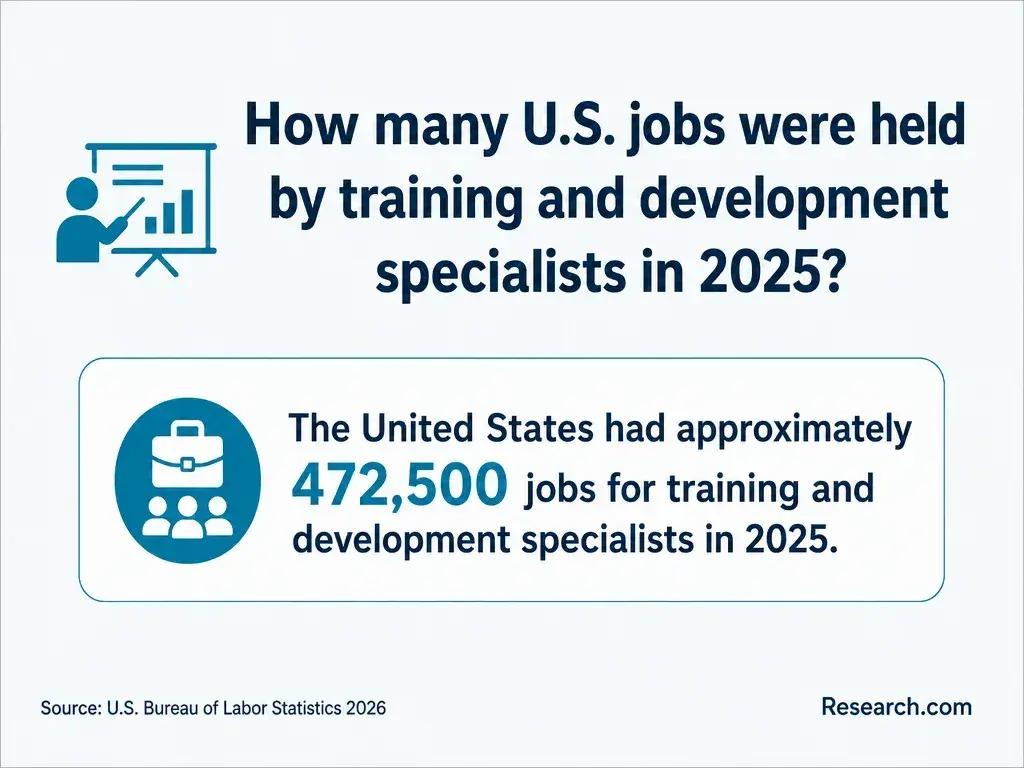
BLS projections for 2025-2035 show 10.8% employment growth for training and development specialists. That outlook concerns an occupation, not demand specifically for Ed.D. graduates. Use it to assess the field, then check postings for your target level: specialist, manager, consultant, and administrator roles can require different experience and credentials.
Professional certifications in learning, human resources, coaching, or project management may complement an Ed.D. when employers value a particular skill set, but the degree does not automatically award them. Likewise, educator and school-administrator licenses have separate state rules. Verify certification requirements with the issuing organization and licensure requirements with the relevant state authority before choosing coursework on that basis.
Other Things You Should Know About EdD Leadership
Wait until you know which tools the program uses and whether access or training is included. Software purchases will not resolve a gap in research design or interpretation.
Possibly. Ask admissions whether it accepts professional writing, what the sample must demonstrate, and whether confidential workplace information must be removed.
Check the institution's academic-integrity and project policies first. Outside help must not replace your own analysis, writing, or required faculty supervision.
Try a graduate-level research methods course, scholarly-writing course, or supervised evaluation project. Use the experience to identify remaining gaps, then ask prospective Ed.D. programs how their curriculum addresses them.
- Measuring Student Success In IPEDS: Graduation Rates (GR), Graduation Rates 200% (GR200), And Outcome Measures (OM) https://nces.ed.gov/ipeds/use-the-data/measuring-student-success-in-ipeds
- Institute of Education Sciences (IES) | ed.gov https://ies.ed.gov/
- Principles and Best Practices for Protecting Participant Privacy | Grants & Funding https://grants.nih.gov/policy-and-compliance/policy-topics/sharing-policies/dms/privacy/best-practices
- Approaching literature review for academic purposes - PMC https://pmc.ncbi.nlm.nih.gov/articles/PMC6862708/
- What Is a Problem of Practice? | spalding.edu https://online.spalding.edu/blog/what-is-problem-practice
- Research on Mentorship | Graduate Student Mentorship Network https://gradmentors.ucr.edu/ResearchonMentorship
- What is a Capstone Project in College? | snhu.edu https://www.snhu.edu/about-us/newsroom/education/what-is-a-capstone-project
- Strategies to Finding Sources - Literature Review https://guides.library.ucsb.edu/litreview/findsources
- School of Education launches online Ed.D. for aspiring leaders across sectors and fields - UNC School of Education https://ed.unc.edu/2024/03/20/school-of-education-launches-online-ed-d-for-aspiring-leaders-across-sectors-fields/