2027 Online Ed.D. in Leadership and Learning in Organizations Admissions: Explaining Why You Want a Practice-Focused Doctorate
Audited and Verified:
Our Editorial and Data Verification Process
Research.com uses government datasets, official education statistics and primary institutional information to support its career and degree guides. Our review process checks factual accuracy, occupational definitions, source dates and the requirements associated with the credentials discussed.
How This Article Was Fact-Checked
Our editorial team verifies salary estimates, employment projections, education requirements and program information against original data providers and official organizations. Salary figures are checked against the relevant occupational definitions and reporting periods. Information about licensure, accreditation and required in-person training is reviewed separately.
Fact-checked and verified on:

Co-Founder and Chief Data Scientist
An Ed.D. application needs more than a claim that you want to become a better leader. Admissions readers need to understand the organizational problem you hope to address, what your experience has taught you, and why doctoral-level applied study is the right next step. This guide is for working leaders and learning professionals considering an online Ed.D. in Leadership and Learning in Organizations. It shows you how to make a credible practice-focused case, assess whether the degree fits your goals, and check the program details that could change your decision.
Key Things You Should Know
- Make your admissions case around a specific leadership or learning problem, your documented responsibilities, and what you still need to learn - not the doctorate's prestige.
- Explain why applied inquiry fits your goal better than a research-focused PhD or shorter professional development; do not claim access to organizational data or approvals you do not have.
- Check each program's actual requirements and costs before applying. The $133,000 median annual pay for training and development managers is an occupation-wide figure, not an expected Ed.D. graduate salary.
What is an online Ed.D. in Leadership and Learning in Organizations?
It is a professional doctorate focused on using leadership, adult learning, organizational change, and applied inquiry to address problems in workplaces and institutions. Depending on the program, students may investigate how an organization develops people, implements change, evaluates training, or improves its decisions. "Online" describes where much of the instruction occurs; it does not necessarily mean self-paced study or no campus visits.
Program names and required projects vary. One school may require a dissertation in practice; another may use a different applied doctoral project. A broadly focused organizational Ed.D. also differs from a school-administration doctorate designed around state licensure. If you are still deciding which academic direction matches your work, compare education doctorate program types and leadership directions before treating similarly named degrees as interchangeable.
Why pursue a practice-focused doctorate in leadership and learning?
A persuasive reason starts with work you are already positioned to do. For example, a learning and development manager might have implemented training but lack the research preparation to determine whether employees can apply it on the job. A nonprofit director might need to examine how staff development, limited resources, and program delivery interact. In either case, the Ed.D. makes sense when sustained, evidence-informed organizational improvement is the goal - not simply when the applicant wants a senior title.
Practice-focused does not mean academically easy or free of research. It means using rigorous inquiry to inform decisions in a real setting. A research-focused PhD may fit better if your primary goal is to produce generalizable scholarship and pursue research-intensive academic work. A DBA may fit a business-specific research agenda, while a targeted certificate, employer leadership program, or supervised improvement project may meet a narrower skill need with less commitment.
The strongest reason for an Ed.D. connects three things: a problem you understand firsthand, a gap in your ability to investigate or lead change, and a plausible way to apply what you learn. If you cannot yet identify that connection, gaining responsibility for a cross-functional project may be a better first step than applying immediately.
What are the admission requirements for an online Ed.D. program?
Requirements are set by the individual institution and entry term. Programs may assess prior degrees and transcripts, professional experience, recommendations, a statement of purpose, and readiness for doctoral writing or research. Some use interviews or entrance tests; others do not. An education master's degree, senior job title, publication record, or fixed number of leadership years is not a universal requirement.
The distinctions below help you separate eligibility from the evidence that strengthens a practice-focused application.
| Admissions consideration | What to verify | Useful applicant evidence |
| Prior education | Accepted degrees, graduate-credit rules, grades, and transcript requirements | Official records and a brief explanation of relevant academic preparation |
| Professional experience | How the program defines qualifying work or leadership | Decisions made, people or processes influenced, and scope of responsibility |
| Doctoral readiness | Writing sample, test, interview, or methods expectations, if any | Analytical writing, evaluation work, or careful use of evidence |
| Recommendations | Number, eligible recommenders, and submission deadline | Referees who have observed your judgment and work firsthand |
Prior graduate credits used to establish eligibility are not necessarily transferable into the Ed.D. If your academic record or experience is unusual, ask admissions for a written interpretation rather than assuming an exception. Check the application page for the intended term before relying on a deadline or test policy.
Answer four connected questions: What problem have you encountered? What have you been responsible for? What can you not yet investigate or change effectively? Why does this program's practice-focused approach fit your next responsibilities? The statement should show sound judgment, not promise that a doctoral project will solve a problem whose causes you have not established.
Use this sequence to turn professional experience into an admissions argument without overstating your authority or results:
- Establish the setting and problem. Describe a concrete learning or leadership challenge and distinguish what you observed from what you suspect caused it.
- Show your role. Specify decisions you made, stakeholders you worked with, and evidence you used; do not substitute your job title for examples.
- Name the learning gap. Explain why you need deeper preparation in areas such as organizational diagnosis, adult learning, change implementation, or evaluation.
- Connect goal to program. Refer only to verified curriculum, faculty guidance, delivery expectations, and project requirements that support your intended work.
- Set a realistic outcome. Describe the responsibilities you hope to take on, without predicting admission, promotion, access to restricted data, or a particular project finding.
For example, "I want to study why our training fails" asserts a cause before investigation. A more credible framing is: "After coordinating staff training, I want to learn how to assess whether employees can use the new process and what organizational conditions affect its adoption." Add only details your own experience supports. If a future project would involve employees or learners, acknowledge that site permission, privacy protections, and any required academic review would come later.
Relevant study may bring together leadership and organizational theory, adult learning, change processes, research methods, and program evaluation. The admissions connection is important: your statement should identify which capabilities you need for your proposed work, rather than repeat a course catalog. Someone leading workforce training may need learning-transfer and evaluation skills; someone coordinating change across departments may need organizational diagnosis and stakeholder-engagement skills.
Check the actual course sequence and required doctoral project. A course mentioning analytics does not establish advanced data-science training, and an elective is not a guaranteed concentration. Ask whether methods instruction and faculty support will help you investigate a feasible problem with data you could be authorized to use.
There is no reliable single timeline or price for this degree. Required credits, cohort sequencing, enrollment pace, project approval, and time available outside work all affect completion. To assess affordability, request the institution's published tuition schedule and required-credit total, then account for fees, books, technology, any campus travel, and the cost of continuing enrollment if a project takes longer than planned.
Employer reimbursement can materially change your cost, but confirm its annual limit, eligible expenses, grade conditions, payment timing, and any obligation to remain employed. Compare the full commitment against your intended professional use of the degree, not an assumed salary increase. For a broader framework, see cost-conscious education doctoral degree planning; obtain a program-specific estimate before applying.
The meaningful distinction is not academic seriousness but how each format lets you participate. An online cohort can allow an employed applicant to remain in their organization and bring live practice problems to class. It may still require scheduled sessions, group meetings, and campus convenings. A campus-based program may offer easier in-person collaboration but require commuting, relocation, or a different work arrangement.
Before describing online flexibility in your application, check attendance rules, meeting times, project-team expectations, and travel requirements. If your goal is specifically college or university leadership, online organizational leadership Ed.D. choices for college leaders can help frame a more relevant comparison. Choose the format in which you can reliably do the work, not the one with the most convenient label.
Possible paths include learning and development management, organizational development, workforce-development leadership, consulting, and administration in education or nonprofit settings. The appropriate target depends heavily on what you have already led. An experienced training manager might use doctoral study to strengthen evaluation and cross-functional change work; someone without training experience is unlikely to move directly into the same role because of the degree alone.
In an application, name the responsibilities you seek - such as diagnosing performance needs, leading a learning strategy, or evaluating an initiative - rather than listing senior titles. Check job postings in your target sector for experience and technical requirements. A general organizational leadership Ed.D. does not, by itself, confer teacher or school-administrator licensure.
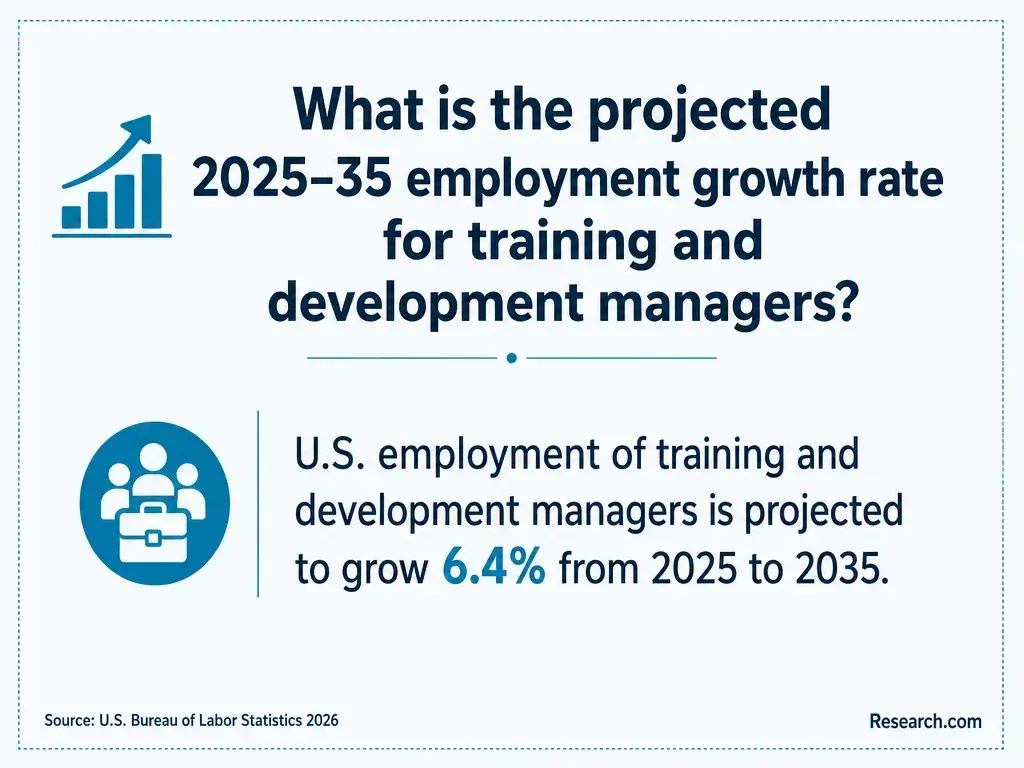
There is no single Ed.D. graduate salary. For one relevant occupation, the U.S. Bureau of Labor Statistics reports a May 2025 median annual salary of $133,000 for training and development managers, with projected employment growth of 6.4% from 2025 to 2035. These figures describe the occupation, not what new graduates earn or the value an employer assigns to an Ed.D. Experience, sector, location, and the actual job matter.
Use compensation as one input to a degree decision, especially if you expect to remain in a public-service or nonprofit role rather than change jobs. If financial support is essential, investigate employer terms and institutional options before committing; evaluating aid eligibility for higher education leadership doctorates offers a related starting point for applicants considering that sector.
How can you choose an accredited and reputable online Ed.D. program?
First confirm the institution's accreditation with its recognized accreditor and verify the exact degree being awarded. Then look beyond the label: compare the required curriculum, project model, faculty guidance, student support, schedule, total cost, and any published completion information. Institutional accreditation does not establish that a general leadership degree meets a state's licensure requirements.
Ask admissions to clarify what an applicant like you would actually experience: whether your professional background qualifies, how applied projects are approved, what happens if your employer changes, and which activities require live attendance or travel. Request written answers where a policy affects your eligibility or budget. If price is a deciding factor, use choosing a lower-cost online Ed.D. as a starting point, then compare current charges and requirements directly with each institution.
The best fit is a program whose requirements let you build on real leadership responsibility and investigate a meaningful problem ethically. If its project, schedule, or cost does not support that goal, a different program - or a smaller professional-development step - may be the stronger choice.
Other Things You Should Know About EdD Leadership
Check the program's application-integrity policy first. Editing for clarity may be permitted, but the experiences, judgments, and reasons for applying must remain yours. Do not submit invented examples or confidential workplace information.
Follow the application's instructions and your employer's confidentiality rules. You can often describe an organizational challenge at a useful level of detail without disclosing protected records, colleagues' identities, or internal findings.
Yes, if the program invites prospective-student contact. Ask a focused question about a faculty member's area of work or the fit of your interests; do not assume a positive reply constitutes admission or a commitment to supervise a project.
Refining a question is normal in doctoral study. A major change may affect project feasibility or program fit, so ask the program how students develop and revise their applied inquiry topics.
- Partnering with Students to Develop a Capstone for a... - PMC https://pmc.ncbi.nlm.nih.gov/articles/PMC11732519/
- Types of Financial Aid: Grants, Work-Study, and Loans | studentaid.gov https://studentaid.gov/understand-aid/types
- Cost of Attendance (Budget) | 2025-2026 Federal Student Aid Handbook https://fsapartners.ed.gov/knowledge-center/fsa-handbook/2025-2026/vol3/ch2-cost-attendance-budget
- 2026 UNC Online EdD in Organizational Learning & Leadership https://online.unc.edu/online-doctoral-programs/online-edd-organizational-learning-and-leadership/
- What's the Difference Between a PhD and a Professional Doctoral Degree? | Walden University https://www.waldenu.edu/online-doctoral-programs/resource/what-is-the-difference-between-a-phd-and-a-professional-doctoral-degree
- Online Doctorate in Education and Leadership (Ed.D.) | Rockhurst University https://onlinedegrees.rockhurst.edu/online-edd-programs
- Online EdD Admission | UD-EDU https://educationonline.udayton.edu/edd/admission/
- How to Write a Statement of Professional Goals | du.edu https://morgridge.du.edu/admission-aid/help-how-guides/how-write-statement-professional-goals
- What Is a Problem of Practice? Definition, Examples, and Writing Tips - JHU School of Education https://education.jhu.edu/news/what-is-a-problem-of-practice-definition-examples-and-writing-tips/
- Types of Doctorate Degrees | University of the People https://www.uopeople.edu/blog/list-of-doctorate-degrees/