2027 Online Ed.D. in Leadership and Learning in Organizations: Evaluating Research Preparation for Building a Literature Review Around a Workplace Challenge
Audited and Verified:
Our Editorial and Data Verification Process
Research.com uses government datasets, official education statistics and primary institutional information to support its career and degree guides. Our review process checks factual accuracy, occupational definitions, source dates and the requirements associated with the credentials discussed.
How This Article Was Fact-Checked
Our editorial team verifies salary estimates, employment projections, education requirements and program information against original data providers and official organizations. Salary figures are checked against the relevant occupational definitions and reporting periods. Information about licensure, accreditation and required in-person training is reviewed separately.
Fact-checked and verified on:

Co-Founder and Chief Data Scientist
A workplace challenge can make a compelling doctoral project, but a credible literature review takes more than collecting articles about its symptoms. For learning and development professionals and organizational leaders considering an online Ed.D., the important distinction is whether a program teaches them to find, evaluate, and synthesize research that can inform a real decision.
This guide shows what that preparation should include, how to inspect a program's curriculum and support, and when a shorter research or evaluation course may be enough.
Key Things You Should Know
- A strong research sequence should teach a documented search strategy, critical appraisal, thematic synthesis, and a clear connection between published evidence and the workplace problem - not just require a final bibliography.
- Ask for a research-course sequence, a literature-review rubric, library access details, and examples of permitted final-project formats before treating "applied research" as evidence of adequate preparation.
- The review must distinguish studies of comparable organizations from evidence about your own setting; published findings cannot establish the cause of a local problem without local investigation.
What is an online Ed.D. in Leadership and Learning in Organizations?
An Ed.D. in Leadership and Learning in Organizations is a practice-oriented education doctorate focused on how people learn, lead, and implement change at work. Depending on the institution, students may study adult learning, organizational development, leadership, and applied inquiry through online courses and a dissertation in practice, capstone, or another approved final project. The exact degree name and requirements vary.
Its value for a literature review lies in bringing research into a professional decision: What does existing evidence suggest about a challenge, where is that evidence weak, and what still needs to be learned locally? A research-focused PhD may be a better fit for someone primarily seeking to produce disciplinary scholarship. A targeted methods course may be enough for a leader who needs to improve one review rather than complete a doctorate.
Degree labels alone do not establish affordability or research depth. Readers comparing cross-sector options can use an online organizational leadership doctoral affordability guide as a cost starting point, then check each program's actual research requirements.
How does an online Ed.D. prepare students to research workplace challenges?
Good preparation moves from a broad concern to a bounded question and then to a defensible synthesis. Suppose an L&D leader is concerned that employees do not use skills after onboarding. "Training effectiveness" is too broad for a useful review. A more focused question might examine what published research says about supervisor support and the transfer of onboarding skills in settings comparable to the leader's organization. That question does not presume supervisor support is the local cause.
A student should have opportunities to practice the following sequence, with faculty feedback before a final project is due:
- Define the workplace decision, the people and setting involved, key concepts, and plausible explanations other than a training gap.
- Search relevant scholarly databases using recorded terms, synonyms, date limits, and inclusion criteria; retain a search log so the process can be checked or updated.
- Appraise studies for design, measurement, setting, limitations, and relevance rather than treating every published result as equally persuasive.
- Organize an evidence matrix and synthesize findings by theme, disagreement, and gap instead of summarizing one article per paragraph.
- Explain what the literature supports, what remains uncertain locally, and which appropriately approved workplace evidence could inform the next decision.
A literature review uses existing sources; interviewing employees or analyzing restricted records is a separate activity that may require employer permission, privacy safeguards, and institutional review. Ask how faculty teach that distinction and how the required final project uses the review. For help comparing deliverables, see online Ed.D. final project format comparisons, then confirm the format with the program itself.
What courses are included in an Ed.D. in Leadership and Learning program?
Course titles differ, but the most relevant preparation is a sequence, not a single "research methods" course. Look for instruction in organizational problem framing, literature searching, qualitative and quantitative reasoning, program evaluation, research ethics, and scholarly writing. Adult learning and organizational change courses should help students interpret why findings from one workplace may not transfer neatly to another.
Inspect syllabi or sample assignments for evidence of practice: Does a student construct and revise a search strategy? Compare conflicting studies? Explain why an outcome measure is or is not credible? Receive feedback on a draft synthesis before proposing local data collection? A course that merely introduces research terminology may not provide enough support for a rigorous review.
Also ask which courses are required, which are electives offered regularly, and when the review must be completed relative to project approval. Prior experience reading research can help, but it is not the same as learning to build a transparent, critical synthesis.
Requirements are institution-specific. Programs may request a graduate degree or graduate coursework, transcripts, professional experience, recommendations, a statement of purpose, and an interview. An education master's, a publication, or a particular statistics course should not be assumed to be universally required.
For this topic, assess readiness as well as eligibility. An applicant can describe a workplace challenge, the decisions they influence, and the limits of their access to organizational information without claiming to have diagnosed the problem. Ask admissions staff whether prior methods preparation is expected and whether a proposed workplace setting is necessary at entry. Graduate credits considered for admission do not necessarily transfer into the doctorate.
Applicants returning to doctoral study after completing coursework elsewhere face a different policy question. Resources for ABD education students comparing online doctoral pathways can help frame it, but only the receiving institution can determine whether earlier work applies.
Neither format automatically produces a better literature review. Compare the access and feedback available while the review is being built, not simply where classes meet.
| Research-preparation feature | Online program | Campus-based program |
| Library and research help | May offer remote databases, librarians, and consultations; verify doctoral-student access. | May offer in-person services; verify access for students who work off campus. |
| Draft feedback | May occur through live meetings, written comments, or peer review; timing matters. | May occur in seminars or office hours; availability still depends on course design. |
| Scheduling | Location-flexible, but live sessions, group work, or campus convenings may be required. | Travel to class may be routine, though face-to-face meetings can be easier to arrange. |
Ask how often an advisor reviews drafts, whether a librarian can help refine a search, and whether the program provides access to the databases your topic needs. Online study can reduce routine travel without removing workload or convening costs. If price is part of the format decision, compare affordable distance learning Ed.D. degrees against each program's full attendance requirements.
Completion time and total cost depend on required credits, course pacing, project milestones, tuition policy, and whether a literature review or project proposal must be revised. A published course sequence is not a promise of completion by a particular date. Request the program's current degree plan and ask when students typically begin the review, receive an advisor, and reach final-project approval.
For a usable cost comparison, obtain written figures for tuition and mandatory fees, then add any required travel, materials, and extra terms if the project extends beyond the planned schedule. Check employer reimbursement conditions before subtracting that assistance from your expected expense. Tuition-focused education doctorate program choices can help identify candidates, but the institution's current charges and your likely enrollment pattern determine the budget.
If the immediate goal is a well-built literature review for a workplace decision, compare that full commitment with the cost and time of a focused evidence-synthesis or evaluation course.
Confirm the university's institutional accreditation with the accreditor and the institution, then verify the exact Ed.D. award and program requirements. Accreditation does not, by itself, show that a program teaches systematic searching or provides strong research supervision. Nor does institution-level accreditation establish eligibility for a regulated education role.
For research preparation, the more revealing documents are the catalog, methods-course descriptions, project handbook, assessment rubric, and library-access information for your proposed entry term.
Ask who approves a review question, what standard is used to assess the synthesis, and what ethical review applies if the project later involves organizational data. Professional standards can inform program design, but a claim of alignment is not a substitute for seeing what students must actually produce.
Experienced L&D professionals may use applied research skills in training leadership, talent development, organizational development, or consulting. The relevant work includes diagnosing learning needs, weighing evidence for an intervention, evaluating implementation, and explaining limits to decision-makers. A well-executed review can demonstrate judgment, especially when paired with authorized examples of subsequent evaluation or change work.
The degree does not replace experience managing people, budgets, stakeholders, or sector-specific operations. Someone moving from instructional design into organizational development, for example, should seek cross-functional project responsibility and mentorship alongside academic study. If the target job mainly requires better evidence synthesis rather than doctoral-level leadership work, targeted training and a supervised workplace project may be a more direct route.
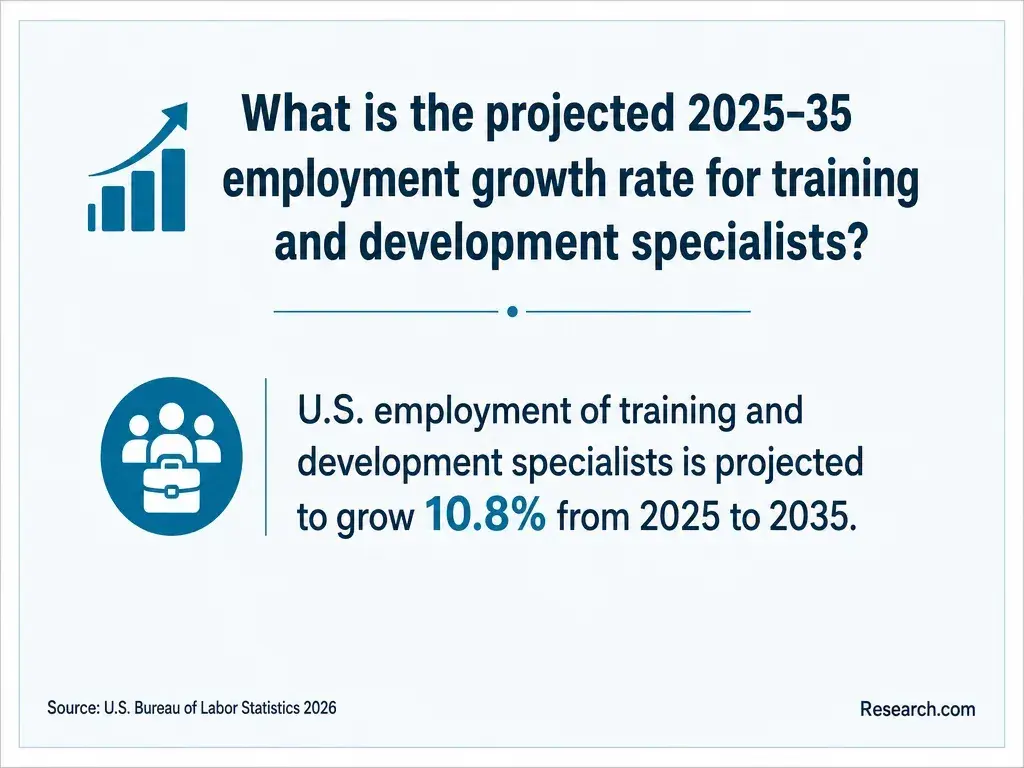
US occupational figures describe jobs, not Ed.D. graduate outcomes. These Bureau of Labor Statistics medians and projections illustrate two roles in which organizational learning and evidence use may matter; neither role universally requires this doctorate.
| Occupation | Median annual salary, May 2025 | Projected employment change, 2025-2035 |
| Training and development managers | $133,000 | +6.4% |
| Training and development specialists | $69,280 | +10.8% |
The gap between these occupations underscores the importance of role and responsibility when estimating potential earnings. A doctorate alone does not move a specialist into a manager position. Compare your current experience with actual job postings and your employer's advancement rules before using an occupational median in a degree-cost decision.
Does an Ed.D. in Leadership and Learning require a professional license?
Organizational learning and leadership roles generally are not licensed simply because a professional holds an Ed.D. The degree also does not automatically qualify someone for teacher, principal, superintendent, counseling, or other regulated practice.
If your intended job has a licensing requirement, ask the program whether its specific curriculum is approved for that credential and confirm eligibility with the relevant state authority. That check is separate from evaluating how well the program teaches literature reviews.
Other Things You Should Know About EdD Leadership
Yes, if the assignment permits them. Label them as practice or contextual evidence, assess their methods and possible interests, and do not treat them as substitutes for peer-reviewed research when scholarly support is required.
There is no universal cutoff. Use current studies for changing workplace practices while retaining older foundational work when it remains relevant. Follow the program's rubric and explain the date limits used in your search.
Follow institutional rules. AI-generated summaries can misstate or invent sources; verify every citation and substantive claim against the original work, and do not enter confidential workplace information into an unapproved tool.
Tell the advisor early. A revised question may require a new search, different evidence, or renewed project approval. Confirm whether the program allows a change of organizational setting before relying on one employer for the final project.
- Student Education and Outcomes - NCBI - NIH https://www.ncbi.nlm.nih.gov/books/NBK43478/
- Measuring Student Success In IPEDS: Graduation Rates (GR), Graduation Rates 200% (GR200), And Outcome Measures (OM) https://nces.ed.gov/ipeds/use-the-data/measuring-student-success-in-ipeds
- CDC Program Evaluation Framework, 2024 | MMWR https://www.cdc.gov/mmwr/volumes/73/rr/rr7306a1.htm
- Research Design Guidance | lehigh.edu https://research.lehigh.edu/policies-guidance-forms/research-design-guidance
- Leadership and Learning in Organizations Online Ed.D. | Peabody College of Education and Human Development https://peabody.vanderbilt.edu/academics/edd-programs/online-leadership-learning-organizations/
- What Is a Problem of Practice? Definition, Examples, and Writing Tips - JHU School of Education https://education.jhu.edu/news/what-is-a-problem-of-practice-definition-examples-and-writing-tips/
- Working with Your Own Students | Guides & Resources | Columbia University https://www.tc.columbia.edu/institutional-review-board/guides--resources/working-with-your-own-students/
- Student Resources - Penn LPS Online https://lpsonline.sas.upenn.edu/student-resources
- A Guide to Writing the Dissertation Literature Review | umass.edu https://openpublishing.library.umass.edu/pare/article/1516/galley/1467/view/
- What Is a Problem of Practice? | spalding.edu https://online.spalding.edu/blog/what-is-problem-practice