2027 Online Ed.D. in Leadership and Learning in Organizations: Comparing Coursework in Leadership Assessment
Audited and Verified:
Our Editorial and Data Verification Process
Research.com uses government datasets, official education statistics and primary institutional information to support its career and degree guides. Our review process checks factual accuracy, occupational definitions, source dates and the requirements associated with the credentials discussed.
How This Article Was Fact-Checked
Our editorial team verifies salary estimates, employment projections, education requirements and program information against original data providers and official organizations. Salary figures are checked against the relevant occupational definitions and reporting periods. Information about licensure, accreditation and required in-person training is reviewed separately.
Fact-checked and verified on:

Co-Founder and Chief Data Scientist
Two online Ed.D. programs can both promise leadership development while teaching very different ways to assess it. One may emphasize personal feedback and coaching; another may ask students to diagnose organizational problems and evaluate whether an intervention worked. For learning and development professionals and emerging organizational leaders, that difference matters more than a course title. This guide shows how to compare assessment coursework, its research demands, and its practical fit - so you can choose a program that builds the evidence-use skills your work actually requires.
Key Things You Should Know
- Compare what students assess: individual leaders, teams and organizational systems, or the results of a leadership-development program. Similar course names do not imply equal depth.
- Look for a sequence connecting measurement, qualitative or quantitative methods, interpretation, and an applied project - not just exposure to a feedback instrument.
- The U.S. Bureau of Labor Statistics reports a $133,000 median annual salary for training and development managers in 2025; that occupational figure is not an expected salary for Ed.D. graduates.
What is an online Ed.D. in Leadership and Learning in Organizations?
An Ed.D. in leadership and learning in organizations is a practice-oriented doctorate concerned with how people learn, lead, and improve performance within institutions. Depending on the school, its curriculum may combine adult learning, organizational change, leadership, and applied research. The exact degree name and requirements vary: a similarly titled program may put much more weight on education administration, organizational development, or research methods.
Leadership assessment is the systematic collection and interpretation of evidence about leadership behavior, capability, or its organizational effects. That might involve feedback from colleagues, interviews about team decision-making, or evaluation of a development initiative. It is not simply giving a leader a personality test. For an L&D professional, the useful question is whether the doctorate teaches you to select appropriate evidence, interpret it responsibly, and act within your authority.
How does leadership assessment coursework differ across online Ed.D. programs?
The sharpest distinction is the unit of assessment: a person, an organizational system, or a development program. The table compares common curricular approaches, not verified offerings at particular universities. Check the required syllabus and assignments before treating any approach as a program feature.
| Coursework emphasis | Typical evidence and output | Best fit and main limitation |
| Individual leadership development | Self-reflection, multisource feedback, interviews, and a coached development plan | Useful for coaching or talent development; feedback may be subjective and sensitive |
| Team or organizational diagnosis | Stakeholder interviews, workflow evidence, climate measures, and a diagnosis of possible barriers | Useful for change or organizational development; access and competing explanations matter |
| Program evaluation | Participation, learning, behavior, and performance measures tied to a leadership initiative | Useful for L&D accountability; observed improvement alone rarely establishes causation |
| Research-intensive assessment | Instrument selection, measurement critique, sampling, analysis, and interpretation | Useful for designing defensible studies; may demand more methods preparation than a coaching-focused course |
A strong comparison goes beyond whether a catalog mentions "assessment." Ask what students must produce, which methods courses precede the assignment, whether they critique an instrument's validity for its intended use, and how faculty assess conclusions. A 360-degree feedback exercise can teach reflection without preparing someone to evaluate a company-wide leadership program.
Also distinguish a classroom exercise from authorized workplace inquiry. Using identifiable employee feedback or restricted records can require employer permission, confidentiality safeguards, and institutional review under the school's rules. If you need a formally named focus rather than particular electives, consult guidance on comparing academic focuses within Ed.D. programs, then confirm what the university actually awards.
What courses are included in an Ed.D. in Leadership and Learning in Organizations?
Course titles differ, but a curriculum suited to leadership assessment usually links leadership theory to adult learning, organizational diagnosis, research methods, and evaluation. The sequence matters: students need to define a problem and choose credible measures before interpreting results or recommending change.
Look for required work that asks students to distinguish a leader's behavior from team outcomes, examine whose perspectives are missing from feedback, and consider alternative explanations for apparent improvement. Qualitative methods can support interviews and observation; quantitative methods can support survey interpretation and comparisons. Program evaluation connects those approaches to decisions about whether a development initiative should continue or change.
An elective called "leadership assessment" is less valuable to your goal if it is rarely offered or cannot be taken before the applied project. Request a degree map and recent syllabus, then check whether the final project permits the kind of assessment you want to conduct. Coursework alone does not establish competence to administer every proprietary instrument or make high-stakes personnel decisions.
Delivery mode changes how assessment work is conducted, not necessarily what students are expected to learn. An online student may conduct interviews remotely and collaborate through scheduled meetings; a campus-based student may have more in-person contact but still need independent access to an organization.
For working professionals, compare actual attendance requirements rather than assuming online means self-paced. Ask about live class times, group-assignment scheduling, required campus convenings, and whether an assessment project can use an external organization. A program that fits your workday during coursework may become harder to manage when interviews, partner approvals, and project revisions converge.
Schools set their own admission rules. Applications commonly ask for prior academic records, recommendations, a statement of purpose, and evidence of relevant professional work, but a particular master's field, test, experience threshold, or research prerequisite should never be assumed. For this curriculum, useful preparation includes explaining a real leadership or learning problem and showing that you can reason from evidence without claiming results you have not measured.
If you already hold an education specialist degree, advanced study options after an Ed.S. may help you identify possible pathways. Ask each Ed.D. program separately whether prior study satisfies admission requirements and whether any credits apply to the doctorate; those are different decisions. Request the answer in writing before planning a shorter course of study.
Completion time depends on the school's required credits, cohort sequence, enrollment pace, and final-project rules. A published schedule is a plan, not a guarantee that a workplace assessment will be approved, completed, and revised on that timetable.
When comparing fast-track online education doctorate programs, ask when methods courses occur and how soon students must secure an assessment site or data access. Compressing coursework may be manageable; compressing partner approval, ethical review when required, data collection, and faculty feedback can be less predictable. Check leave and reentry policies if your employment or access to the organization could change.
Without a named school and entry term, there is no reliable single price. Compare the full degree cost, not only the advertised tuition rate: required credits, mandatory fees, travel for any convenings, materials, and additional enrollment if the applied project takes longer. Employer reimbursement may lower your personal cost, but eligibility, annual limits, grade conditions, and repayment obligations need written confirmation.
A low-cost option is not necessarily good value if assessment methods are optional or the project you want cannot receive adequate supervision. Conversely, an employer-funded leadership program or targeted evaluation course may be the more direct choice if you need one skill rather than a doctorate. Readers considering education-sector roles can use a higher education leadership doctoral education funding guide to identify funding questions, while verifying every award and condition with the school and employer.
Leadership assessment coursework can support work in learning and development, talent development, organizational development, program evaluation, and consulting. The roles differ: an L&D manager may evaluate leadership training; an organizational development practitioner may diagnose a team-level problem; a consultant may need to justify recommendations to an external client.
For an established practitioner, the strongest career evidence is often a defensible project: the decision it addressed, why its measures were appropriate, what its limitations were, and what action it informed. Share only material your organization permits you to disclose. A doctorate does not replace supervisory experience, sector knowledge, or an employer's hiring requirements. If your goal is school administration, confirm state licensure requirements separately; a general organizational leadership Ed.D. does not automatically meet them.
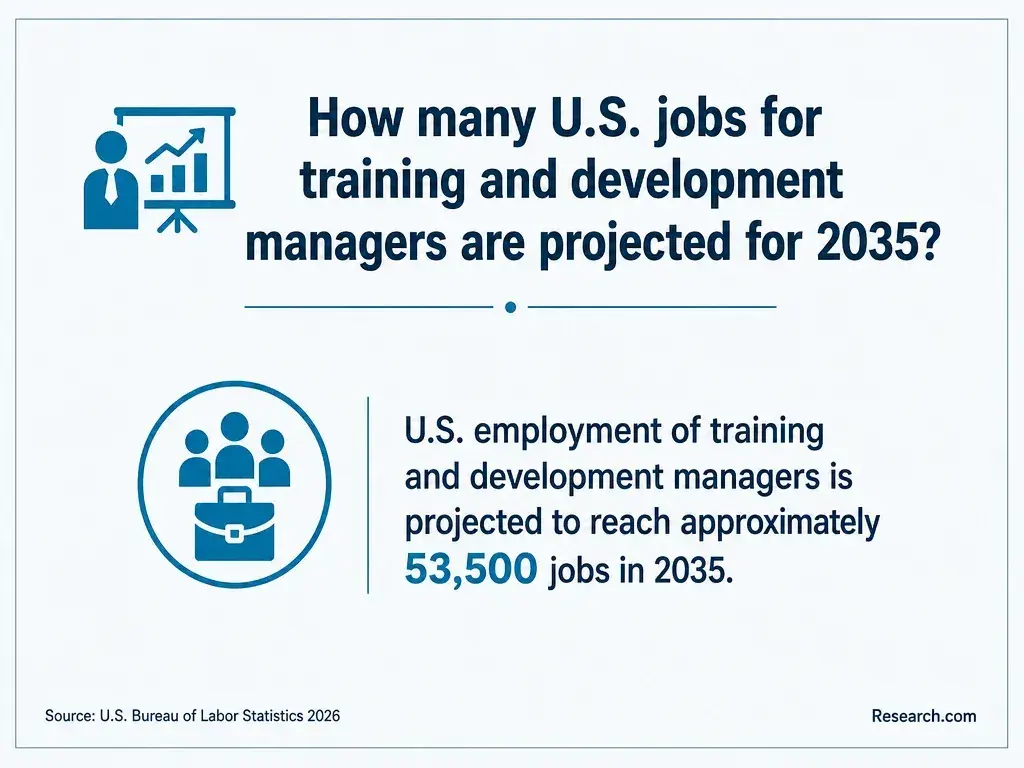
There is no single Ed.D. leadership salary. Pay depends on occupation, experience, employer, location, and responsibility. The U.S. Bureau of Labor Statistics reports a 2025 median annual salary of $133,000 for training and development managers and projects 6.4% employment growth from 2025 to 2035. Those figures describe an occupation, not people who completed this degree.
Use the occupation closest to your target job when assessing the investment, then examine actual postings for required management experience and assessment skills. An L&D specialist moving toward management should not treat a manager's median pay as an expected post-graduation offer. Internal promotion rules and demonstrated leadership responsibility may matter more than the credential alone.
How can you choose an accredited online Ed.D. program?
First, verify the university's institutional accreditation with the accreditor and confirm that the advertised award is an Ed.D. Accreditation establishes an important institutional baseline; it does not prove that leadership assessment is taught deeply, that a project will be approved, or that the degree leads to licensure.
Then compare programs against your intended work. Request the current degree map, leadership-assessment syllabi, assignment descriptions, methods sequence, project handbook, and live-attendance requirements. Ask a program representative whether students can assess individual development, organizational conditions, or program outcomes; what data permissions are needed; and who supervises the work. Give more weight to required, assessable work than to broad marketing language.
Finally, compare the written total-cost estimate with the curricular evidence. A shortlist of budget-friendly online education doctorates is a starting point, not a substitute for checking each school's current charges and whether its coursework matches your assessment goal.
Other Things You Should Know About EdD Leadership
It depends on the instrument and intended use. Check the publisher's licensing, training, and administration rules; completing an Ed.D. course does not override them.
Be cautious: colleagues may be identifiable from their roles or answers even without names. Follow organizational privacy rules and the university's project-review process before collecting responses.
No single perspective establishes effectiveness. Self-assessment can guide reflection, but claims about behavior or organizational effects need other appropriate evidence and careful interpretation.
Do not assume so. High-stakes employment decisions require appropriate, job-related measures and compliance with employer policy and applicable law; a classroom exercise is not automatically suitable for that purpose.
- Evaluation Resources | U.S. Department of Education http://www.ed.gov/grants-and-programs/grants-through-grade-12/effective-educator-dev/seed/evaluation-resources
- Maximizing the Impact and ROI of Leadership Development | nih.gov https://pmc.ncbi.nlm.nih.gov/articles/PMC11505461/
- Designing an Assessment Strategy | U.S. Office of Personnel Management https://www.opm.gov/policy-data-oversight/assessment-and-selection/assessment-strategy/
- Online Ed.D. in Leadership and Learning in Organizations | VU-EDU https://peabodyonline.vanderbilt.edu/edd-in-organizational-learning/
- 360 Degree Assessment Overview | umn.edu https://hr.umn.edu/Professional-Development/Supervisory-and-Leadership-Development/Leadership-Competencies-and-Assessments/Assessment-Options/360-Degree-Assessments/360-Degree-Assessment-Overview
- Measurement, Evaluation, & Statistics | Human Development | Columbia University https://www.tc.columbia.edu/human-development/measurement-evaluation-and-statistics/
- What is a Master of Education in Measurement, Evaluation, Statistics, and Assessment? | UIC Online MESA https://mesaonline.ec.uic.edu/news-stories/what-is-a-master-of-education-in-measurement-evaluation-statistics-and-assessment/
- Credit hours is not enough: Explaining undergraduate perceptions of course workload using LMS records - ScienceDirect https://www.sciencedirect.com/science/article/pii/S1096751622000380
- Online Ed.D. in Higher Education | Rockhurst University https://onlinedegrees.rockhurst.edu/programs/online-edd-education-leadership/higher-ed
- Overview of the Four Assessment Tools | University Human Resources https://hr.uiowa.edu/development/leading-and-supervising/coaching/360-multi-rater/overview-four-assessment-tools