2027 Is Demand for Business Development Degree Graduates Growing or Declining?

Co-Founder and Chief Data Scientist
Choosing a business development degree is really a question about employability: will the program help you qualify for roles that companies still need as markets, technology, and customer behavior change? Business development sits at the intersection of sales, strategy, market research, partnerships, and revenue growth, so demand depends on how well graduates can turn business goals into measurable opportunities.
Recent data from the U. S. Bureau of Labor Statistics shows that employment in business development-related fields is projected to grow by 9% from 2022 to 2032, faster than the average for all occupations. That outlook is encouraging, but it does not guarantee equal outcomes for every graduate. Industry choice, location, degree level, technical skills, communication ability, and comfort with AI-supported tools all influence job prospects.
This guide explains where demand is strongest, which occupations are growing, how employers evaluate candidates, and whether a business development degree can be a worthwhile investment for students planning a career in growth-focused business roles.
Key Things to Know About the Demand for Business Development Degree Graduates
- Employment for business development degree graduates is steady, with roles expanding in tech and healthcare sectors driven by increasing mergers and strategic partnerships.
- The U.S. Bureau of Labor Statistics projects a 9% growth in business development-related jobs from 2022 to 2032, faster than the average for all occupations.
- Specializations in digital marketing or international business significantly improve long-term opportunities as companies prioritize innovation and global market expansion.
What Factors Are Driving Demand for Business Development Degree Professionals?
Demand for business development professionals is driven by one basic business need: organizations must keep finding customers, partnerships, markets, and revenue streams. A degree can help students build the analytical and relationship-based skills behind that work, but the strongest opportunities usually go to graduates who can connect strategy with execution.
- Industry growth: Expanding sectors such as technology, healthcare, and renewable energy need professionals who can assess market potential, support partnerships, and help companies enter new segments. Business development graduates who understand sector-specific buyers and regulations are better positioned than those with only general business knowledge.
- Technological advancement: Digital transformation has made data literacy more important. Employers increasingly expect candidates to work with customer relationship management systems, analytics dashboards, sales intelligence tools, and AI-supported research. Graduates who can interpret data and translate it into action have a stronger hiring case.
- Regulatory changes: Trade rules, privacy expectations, healthcare requirements, and compliance standards can affect expansion plans. Business development professionals do not replace legal or compliance teams, but they need enough awareness to avoid unrealistic proposals and identify viable opportunities.
- Demographic shifts: Aging populations, changing household patterns, and a more diverse workforce affect buying behavior. Companies need people who can spot changes in customer needs and help adapt products, services, messaging, and partnerships accordingly.
- Evolving skill requirements: Employers value communication, negotiation, relationship management, research, and cross-functional collaboration. Technical fluency matters, but business development is still a people-centered field where trust, follow-through, and judgment affect results.
Prospective students should also evaluate program quality carefully. Accreditation for business development degrees can affect credit transfer, graduate school eligibility, and employer confidence. Students comparing graduate business options may find Research.com’s guide to the most affordable online MBA programs useful when weighing cost, flexibility, and career goals.
Which Business Development Occupations Are Seeing the Highest Growth Rates?
The strongest business development career paths are not always labeled “business development.” Many related roles sit in market research, sales leadership, consulting, finance, partnerships, and growth strategy. The U.S. Bureau of Labor Statistics projects overall employment to grow 5% over the next decade, so occupations above that benchmark may offer relatively stronger opportunity.
- Market Research Analysts and Marketing Specialists: Projected to grow by 18% from 2022 to 2032, these roles benefit from greater use of data analytics, customer segmentation, and digital marketing strategy. A bachelor's degree in business, marketing, or a related field is typically required. This path may fit students who enjoy research, trend analysis, survey data, competitive intelligence, and campaign performance.
- Sales Managers: Expected to grow at 7%, sales management remains closely tied to business development because managers set targets, guide teams, evaluate territories, and support revenue strategy. Candidates usually hold a bachelor's degree and have experience in sales or marketing. This route is often best for graduates who can combine people management with measurable sales performance.
- Management Analysts: With a 14% projected growth rate, management analysts help organizations improve efficiency, evaluate opportunities, and solve operational or strategic problems. A bachelor's degree in business or a related discipline is standard, though many professionals pursue advanced degrees. This can be a strong option for students interested in consulting, process improvement, and organizational strategy.
- Financial Analysts: Anticipated to grow near 11%, financial analyst roles reflect the complexity of investment, budgeting, forecasting, and global finance decisions. Education requirements typically include a bachelor's degree in finance, economics, or business. This path may suit students who want a more quantitative business development-adjacent role focused on financial feasibility and growth planning.
Students should look beyond growth rates alone. A fast-growing role may still be competitive if it attracts many applicants, while a slower-growing role may offer strong pay or advancement in the right industry. The best fit depends on whether the student’s strengths lean toward analytics, relationship-building, leadership, or financial decision-making.
Which Industries Hire the Most Business Development Degree Graduates?
Business development graduates can work across many sectors because nearly every organization needs customers, revenue, partnerships, and market intelligence. The best industries for a graduate often depend on the type of problems they want to solve and the level of specialization they are willing to build.
- Technology: Technology companies hire business development professionals to identify market opportunities, build channel partnerships, support product launches, and manage enterprise relationships. This sector can offer strong growth potential, but it often expects comfort with software, technical products, subscription models, and fast sales cycles.
- Finance: Banks, investment firms, insurance companies, and financial service providers use business development talent to expand client relationships, support new offerings, and build referral networks. Graduates who understand financial products, risk, and client trust may have an advantage.
- Healthcare: Healthcare organizations rely on business development professionals for partnerships, service-line growth, payer or provider relationships, and market expansion. This sector rewards patience, regulatory awareness, and the ability to work with clinical, administrative, and community stakeholders.
- Manufacturing: In manufacturing, business development roles may involve distributor relationships, supply chain collaboration, product expansion, and entry into domestic or international markets. Graduates who can understand operations, pricing, procurement, and logistics may stand out.
- Professional Services: Consulting, marketing, accounting, and legal firms use business development teams to generate leads, strengthen client relationships, prepare proposals, and position firm expertise. This environment often values writing, presentation skills, credibility, and long-term relationship management.
A practical way to choose an industry is to ask three questions: Which customers do you understand? Which products or services can you explain convincingly? Which sector’s pace and culture fit your work style? Business development success often depends less on a generic degree title and more on how well graduates can apply their skills to a specific market.
Breakdown of Public Fully Online Title IV Institutions

How Do Business Development Job Opportunities Vary by State or Region?
Location affects business development hiring because opportunities tend to cluster around employers, customers, investors, and industry networks. Graduates may find more openings in large metropolitan areas, but they should compare job volume, competition, cost of living, and remote-work options before relocating.
- High-demand states: California, New York, and Texas stand out because their large metropolitan areas and diverse economies include strong technology, finance, energy, healthcare, and professional services sectors. These states may offer more openings, but they can also attract a larger applicant pool.
- Industry clusters: Regional economies shape hiring. For example, the Southeast sees growth in healthcare and manufacturing, which can create specialized openings for graduates who understand those sectors. A candidate with targeted industry knowledge may be more competitive than one applying broadly.
- Urban vs. rural markets: Cities often provide a larger volume of business development jobs, more networking events, and easier access to headquarters or regional offices. Rural areas may have fewer roles, but graduates may face less competition and find broader responsibilities in smaller organizations.
- Cost of living impact: A higher salary in a major metro area does not automatically mean greater financial benefit. Housing, transportation, taxes, and commuting time can reduce the value of higher pay. Graduates should compare total compensation against realistic living costs.
- Remote work options: Remote and hybrid roles can give graduates access to employers in high-demand markets without requiring immediate relocation. However, remote business development jobs may require stronger self-management, digital communication, and comfort building relationships without frequent in-person meetings.
Data from the U.S. Bureau of Labor Statistics indicates nearly twice the density of business development positions in metropolitan areas compared with rural ones. That does not mean every graduate must move to a major city, but it does mean location should be part of the job-search strategy from the beginning.
How Does Degree Level Affect Employability in Business Development Fields?
Degree level can influence which business development jobs a candidate can access, but experience and results also matter. Employers often want evidence that a graduate can research a market, communicate with prospects, support revenue goals, and collaborate across teams. Higher degrees may improve advancement potential, especially for strategic, managerial, or specialized roles.
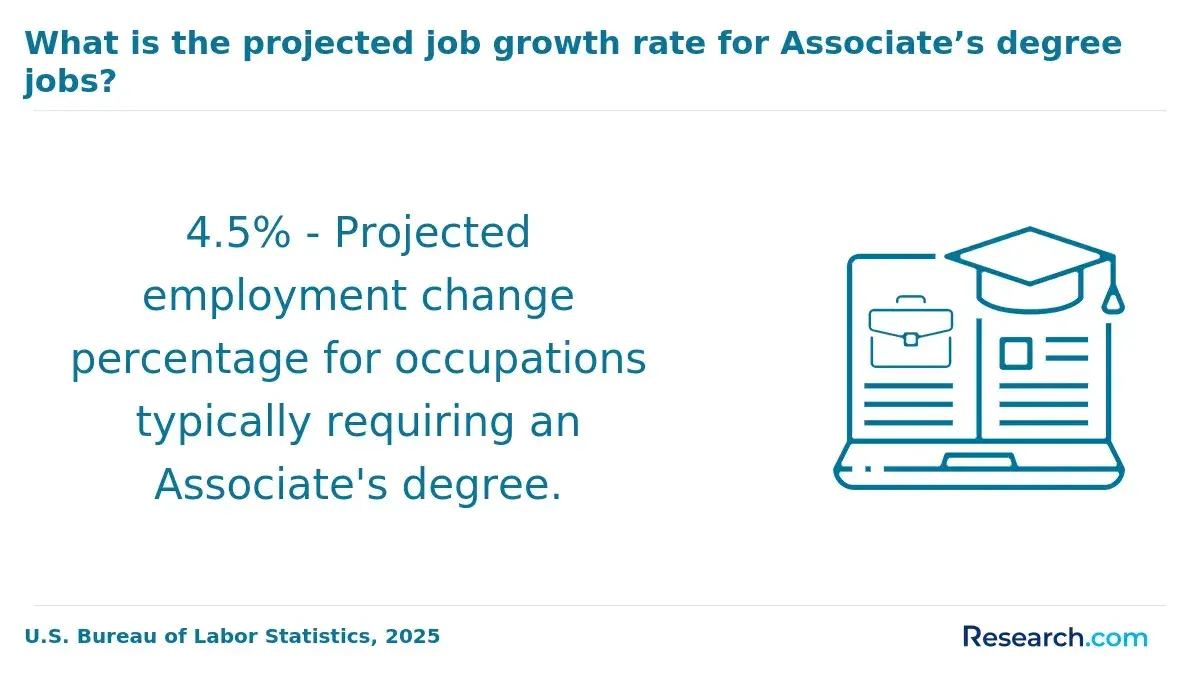
- Associate Degree: An associate degree may support entry-level roles such as sales support, business assistant, account coordinator, or administrative support in a growth-focused department. It can be a cost-conscious starting point, but candidates may need additional experience or a bachelor’s degree to move into analyst, manager, or strategist roles.
- Bachelor's Degree: A bachelor's degree is often the most common credential for business development coordinator, analyst, sales operations, marketing, and account-related roles. It can give graduates broader access to employers and internships. Students comparing business pathways may also consider whether a business management degree online better matches their need for flexibility and broad management training.
- Master's Degree: A master's degree can support movement into mid- to senior-level roles such as business development manager, strategy manager, partnerships lead, or consultant. It is most valuable when paired with work experience, a clear industry focus, and leadership ability. Students exploring adjacent fields can also review options such as a master’s in psychology online if their goals involve consumer behavior, organizational development, or people-centered business roles.
- Doctorate Degree: A doctorate is less common for traditional business development roles. It may be relevant for research, executive consulting, academic work, innovation strategy, or highly specialized leadership positions. For most business development careers, a doctorate is not required, so students should weigh the time and cost against their intended role.
The key question is not simply “Which degree is highest?” but “Which credential matches the job level I want next?” A bachelor’s degree may be enough for many entry-level roles, while a master’s degree may help candidates compete for strategy, leadership, or industry-specialized positions.
What Skills Are Employers Seeking in Business Development Graduates?
Employers look for business development graduates who can create opportunities, not just describe business concepts. The most competitive candidates show a mix of communication, analysis, sales awareness, and follow-through. These skills are especially important because business development work often involves uncertainty, long sales cycles, and coordination with multiple departments.
- Effective Communication: Graduates need to explain ideas clearly, ask strong questions, write concise outreach messages, and present proposals to different audiences. Communication affects prospecting, partnership discussions, internal buy-in, and client trust.
- Strategic Analysis: Employers value candidates who can interpret market data, compare competitors, identify customer pain points, and recognize trends. Analytical ability helps business development teams avoid chasing every lead and focus on opportunities with realistic potential.
- Sales Expertise: Business development is not always the same as closing sales, but it is closely related. Graduates should understand customer needs, value propositions, qualification, pricing conversations, objections, and pipeline movement.
- Project Coordination: Growth initiatives often involve sales, marketing, product, finance, legal, and operations teams. Graduates who can track tasks, meet deadlines, and keep stakeholders aligned are more useful than those who only generate ideas.
- Network Building: Relationship-building remains central to the field. Strong candidates know how to maintain professional contacts, follow up appropriately, and build credibility over time rather than treating networking as a one-time transaction.
- Flexibility: Markets change, prospects go quiet, budgets shift, and strategies fail. Employers look for graduates who can adjust without losing momentum or professionalism.
When asked what skills employers prioritize, one graduate from a business development degree program described early job experiences in fast-moving environments where priorities shifted daily. He recalled, “Early on, I often had to rethink my approach because the market conditions or client expectations changed unexpectedly.” He emphasized that technical knowledge mattered, but adaptability mattered just as much. “It's not just about having the right skills on paper,” he explained, “but about showing resilience and willingness to adapt in real-world situations that really caught employers' attention.”
How Does Job Demand Affect Business Development Graduate Salaries?
Job demand can influence business development salaries, but it is only one part of compensation. Pay also depends on industry, location, company size, role level, performance expectations, commissions or bonuses, and the candidate’s ability to show measurable value. For example, employment in business and financial occupations, including business development roles, is projected to grow 8% from 2022 to 2032, reflecting steady demand that may support salary growth over time.
- Competitive salaries: When employers need growth talent and the supply of qualified candidates is limited, they may offer stronger starting pay, better benefits, or incentive compensation to attract capable professionals.
- Stagnant or declining wages: If many graduates compete for the same entry-level openings, employers may have less pressure to raise wages. This is why internships, industry knowledge, CRM experience, and evidence of results can help candidates stand out.
- Economic growth boosts: During expansion periods, companies may invest more in market entry, product launches, partnerships, and sales teams. That can create more opportunities for raises, promotions, bonuses, and performance-based compensation.
- Market slowdowns: During recessions or downturns, businesses may reduce hiring, delay expansion, or tighten sales budgets. Business development roles may still exist, but employers may expect stronger proof of return on investment before adding headcount.
Students should be cautious about assuming that degree completion alone will lead to high pay. The strongest salary outcomes usually come from combining education with practical experience, industry specialization, measurable achievements, and the ability to contribute to revenue or strategic growth.
How Is AI Changing Demand for Business Development Professionals?
AI is changing business development by automating routine work and raising expectations for analysis, speed, and personalization. Advances in artificial intelligence (AI) are significantly transforming workforce demands within business development, with studies suggesting that up to half of current tasks could be automated. That does not eliminate the need for business development professionals, but it changes what makes them valuable.
- Automation of routine tasks: AI can support data entry, lead scoring, contact research, email drafting, meeting summaries, and pipeline updates. This can free professionals to spend more time on strategy, relationship-building, negotiation, and complex account planning.
- Emergence of specialized roles: Newer responsibilities may involve AI-supported market intelligence, sales enablement analytics, customer segmentation, and AI strategy consulting. These roles require business judgment as well as comfort with digital tools.
- Changing skill requirements: Employers increasingly favor candidates who can use AI tools responsibly, verify AI-generated insights, protect customer data, and combine automation with human judgment. Blind reliance on AI can damage credibility if the output is inaccurate or poorly tailored.
- Evolving hiring trends: Companies may prioritize candidates with experience in technology-driven environments, virtual customer engagement, digital marketing, and analytics. Graduates who can show practical tool fluency may have an advantage in competitive searches.
I spoke with a recent graduate of a business development degree program about her perspective on these changes. She said early career work felt challenging as traditional methods gave way to AI-powered systems. “Initially, learning to interpret AI-generated insights was overwhelming,” she recalled, “but it also opened up new ways to engage clients more effectively.” Her experience points to an important lesson: AI fluency is becoming part of career readiness, but curiosity, ethical judgment, and adaptability still matter.
Is Business Development Considered a Stable Long-Term Career?
Business development can be a stable long-term career for professionals who keep adapting. The function is tied to revenue, partnerships, and market expansion, which makes it important in many organizations. However, stability is not automatic. Roles can be affected by economic cycles, industry disruption, sales performance, and changes in technology.
- Consistent demand: Organizations across varied sectors depend on business development professionals to identify growth opportunities and build client relationships. That supports job security and growth trends in business development careers, especially for candidates who can show results.
- Industry reliance: Technology, healthcare, finance, and manufacturing all use business development to expand market presence and revenue. Because the function appears across sectors, professionals may be able to transfer skills if one industry slows.
- Adaptability to change: Long-term employability depends on keeping up with digital tools, data analytics, AI-supported workflows, and changing buyer expectations. Professionals who resist new tools may become less competitive.
- Career advancement and reskilling: Business development can lead to roles in sales leadership, marketing strategy, partnerships, product strategy, consulting, or general management. Reskilling helps professionals move into stronger opportunities as markets change.
Advanced education may help some professionals move into leadership, consulting, or organizational strategy roles, though it should match the person’s goals and expected return. Those considering education-focused leadership paths can review affordable EDD programs as one possible route for further professional development.
Is a Business Development Degree Worth It Given the Current Job Demand?
A business development degree can be worth it if it helps a student build practical, employer-valued skills and enter a field aligned with their strengths. Demand in the United States remains moderately strong, and employment prospects in related roles are expected to grow at a rate similar to the average for all occupations over the next decade. Businesses continue to need professionals who can identify market opportunities, build partnerships, and support revenue growth, especially in sectors such as technology, healthcare, and financial services.
The degree is less likely to pay off if students treat it as a guaranteed job credential without building experience. Outcomes depend heavily on internships, networking, industry selection, communication ability, data skills, and location. Urban centers usually offer the highest concentration of openings, but they also bring more competition. Remote and hybrid work can broaden access, but candidates must be prepared to prove they can build relationships and manage work independently.
For many students, the strongest approach is to pair the degree with targeted skill-building. Useful additions may include CRM experience, market research projects, sales internships, data analysis coursework, presentation practice, and industry-specific knowledge. Students who already hold a bachelor’s degree and want a faster advanced credential may also compare options such as one year masters programs online when evaluating cost, time, and career readiness.
In short, a business development degree is most worthwhile for students who want growth-focused business roles and are willing to develop both analytical and relationship-based skills. The job demand is real, but graduates still need to show employers that they can contribute to measurable business outcomes.
What Graduates Say About the Demand for Their Business Development Degree
- : "Choosing to pursue a business development degree was one of the best decisions I've made. The practical skills and strategic mindset I gained gave me tangible returns, not just in salary growth but also in my confidence to lead projects. This degree truly transformed my career trajectory and opened doors I hadn't imagined possible. — Iker"
- : "Reflecting on my journey, earning a business development degree was a calculated risk that paid off. The knowledge I gained helped me navigate complex market challenges and secure pivotal partnerships at work. It's been rewarding to see the long-term value this education adds to both my professional growth and the companies I collaborate with. — Pattie"
- : "The career impact of completing a business development degree has been profound. From day one, the concepts learned were immediately applicable, enhancing my negotiation skills and strategic approach. The return on investment has far exceeded my expectations, firmly establishing my role as a key driver of growth in my organization. — Georgie"
Other Things You Should Know About Business Development Degrees
In 2027, industries such as technology, healthcare, and renewable energy are hiring the most business development graduates. These sectors are expanding rapidly, requiring strategic professionals to drive growth and innovation, making them top employers for graduates with business development skills.
In 2027, business development degree graduates can expect entry-level salaries ranging from $50,000 to $70,000 annually, depending on location and specific industry. Graduates entering tech sectors may see higher offers, reflecting the demand for innovation and strategic growth skills.
References
- Business Development Job Description with Example and Key Skills https://talenthub.glints.com/en-sg/blog/business-development-job-descriptions
- Is business development a good career? | The BD School https://www.thebdschool.com/blog/is-business-development-a-good-career
- The Role of AI in Business Strategies for 2025 and Beyond https://www.thestrategyinstitute.org/insights/the-role-of-ai-in-business-strategies-for-2025-and-beyond
- Global Salary Report: What International Business Development Managers Earn Worldwide - EMLV Business School Paris https://www.emlv.fr/en/global-salary-report-international-business-development-managers/
- Skills gap analysis: What soft skills do employers want from business school graduates? | QS https://www.qs.com/insights/skills-gap-analysis-what-soft-skills-do-employers-want-from-business-school-graduates
- Top Industries Hiring Business Career Program Graduates https://www.csinow.edu/blog/top-industries-hiring-business-career-program-graduates/
- Top International Business Development Skills for Master’s Students https://www.ue-amsterdam.com/blog/top-international-business-development-skills-you-can-gain-with-a-business-management-masters
- What does a Business Development Manager do? Role, Skills and Salary (2025) https://hyperisland.com/en/blog/hyper-insights/what-does-a-business-development-manager-do-role-skills-salary
- Key trends in business research, D.B.A. students should know https://ema.education/en/blog/key-trends-in-business-research-dba-students-should-know/
- Why Getting a Business Development Job is the Right Move | TAP https://www.tapcareers.io/resources-and-events/blog/why-getting-a-business-development-job-is-the-right-move