2027 Can You Get an AI Bachelor's Degree Online? Full Guide

Co-Founder and Chief Data Scientist
Many working professionals with unrelated undergraduate degrees face significant challenges when seeking a flexible and accredited route into the artificial intelligence industry. Traditional bachelor's programs often require full-time campus attendance and prior technical backgrounds, limiting opportunities for career pivots. Additionally, the rapid evolution of AI demands up-to-date education aligned with industry standards. This article explores the availability of online bachelor's degrees in artificial intelligence for 2026, focusing on accredited programs that accommodate non-technical students. It aims to help readers identify practical pathways to enter the AI field with flexible study options and reputable credentials.
Key Things You Should Know
- Many accredited U.S. universities now offer fully online AI bachelor's degrees, reflecting growing industry demand with job growth projected at 37% through 2030 per the Bureau of Labor Statistics.
- Curricula typically blend computer science fundamentals, machine learning, and ethics, preparing students for diverse roles in technology, healthcare, and finance sectors.
- Costs vary widely; scholarships and financial aid are increasingly available, with average tuition for online AI programs ranging from $15,000 to $40,000 annually.
Question: Can you earn a bachelor's degree in artificial intelligence entirely online from an accredited U.S. university?
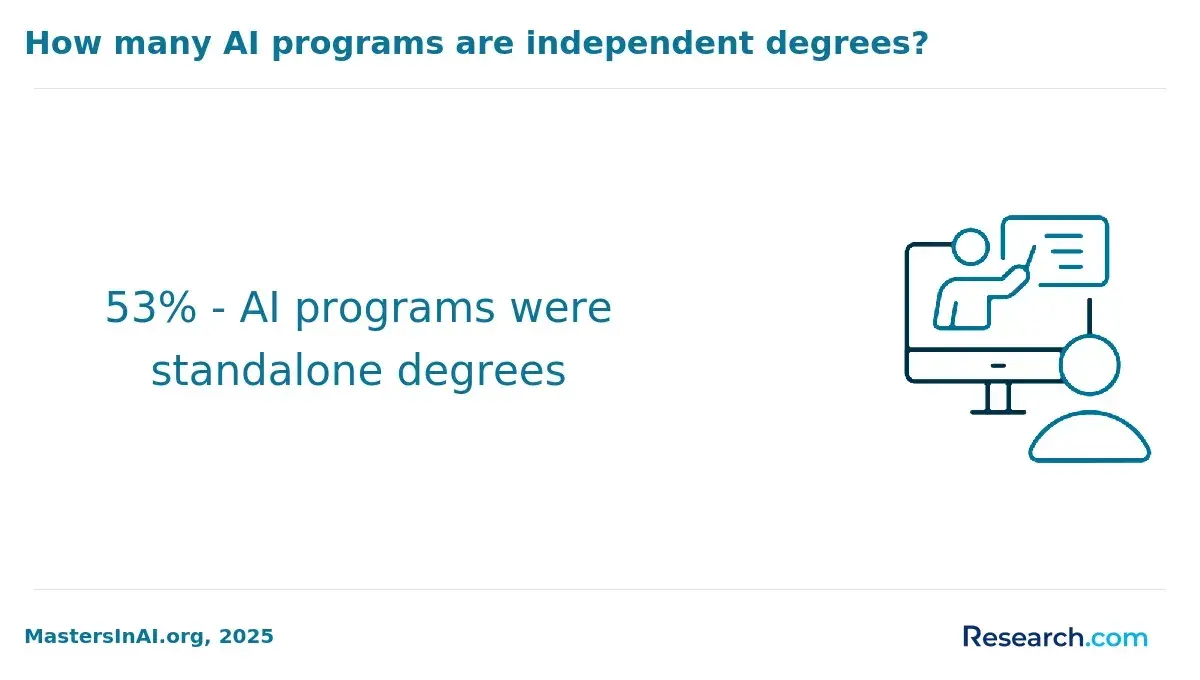
Fully accredited online artificial intelligence bachelor's degree programs in the U.S. remain limited, with around 15 to 20 options available nationwide. Most universities offer AI as a concentration within computer science or data science degrees rather than standalone AI bachelor's programs.
Degrees explicitly labeled in artificial intelligence focus intensely on AI theories, algorithms, and applications, while AI tracks within broader programs cover foundational computing alongside AI topics.
Students looking to earn a bachelor's degree in artificial intelligence from a U.S. university online should prioritize programs accredited by bodies such as ABET or regional organizations. Such programs often emphasize areas like machine learning, neural networks, natural language processing, and robotics, ensuring industry-relevant curricula.
Universities like Arizona State University and the University of Texas at Austin offer robust online computer science degrees with AI specializations, providing flexibility for learners who want a blend of core computing skills and AI fundamentals.
Verification of accreditation status through official databases, including those maintained by ABET or the U.S. Department of Education, is crucial to avoid non-accredited offerings. Prospective students should also assess whether pursuing a dedicated AI bachelor's or an AI concentration within computer science better aligns with their career goals.
Roles such as AI researcher, data scientist, or AI software developer may require different educational emphases, making thoughtful program selection important. Those interested may explore options through a trusted online computer science degree resource to find accelerated programs suited to AI careers.
Question: What are the typical admission requirements for an online AI bachelor's degree program?
Typical admission requirements for an online artificial intelligence bachelor's degree include a high school diploma or equivalent, a minimum GPA, and standardized test scores. A common eligibility criterion for earning an online AI bachelor's degree is maintaining at least a 3.0 GPA, which about 73% of programs require.
Many institutions, roughly 68%, also request SAT or ACT scores, although research universities tend to emphasize these more than community colleges or vocational schools.
Applicants will usually need to submit official transcripts showing their academic history. Some programs ask for letters of recommendation, especially when admission is competitive or involves holistic review. While personal statements are less common, they can strengthen an application by explaining interest in AI and career objectives.
International students may need to provide English proficiency test scores like TOEFL or IELTS. Prerequisite coursework in computer science, math, or programming might also be required depending on prior education.
Students transferring college credits should review each program's transfer policy and submit transcripts accordingly. It's important to check specific deadlines and requirements, as these vary between public, private, and for-profit institutions.
Prospective students seeking affordability and quality options can explore alternatives like the cheapest online master's mechanical engineering programs for inspiration on cost-effective degree paths.
Question: How long does it take to complete an online bachelor's degree in artificial intelligence?
The average time for online artificial intelligence bachelor's program completion varies significantly based on enrollment status and program design. Full-time students typically finish in about 4.8 years, slightly longer than the 4.1 years common in traditional on-campus STEM programs. Part-time students, balancing other commitments, may take closer to 6.2 years.
This reflects data from the U.S. Department of Education's National Center for Education Statistics. Program flexibility and transfer credits can also impact duration, with some accelerated or competency-based models allowing completion in as few as three years.
Curriculum structure plays a key role in how long to complete an online bachelor's degree in artificial intelligence. Institutions emphasizing foundational computer science courses before advanced AI topics may extend study time. Requirements such as internships or capstone projects further influence timelines. Transfer policies are crucial, as accepting previous college credits can shorten the path to graduation.
Given these factors, prospective students should carefully evaluate program intensity and support services to manage expectations and ensure a smooth educational experience. For those exploring related fields, there are options like online colleges for game design that may offer alternative pathways into technology careers.
Question: What core coursework and technical skills are taught in an AI bachelor's degree curriculum?
An AI bachelor's degree program dedicates a significant portion of coursework to machine learning and neural networks, reflecting the growing demand for these skills in industry. Core subjects include algorithms, data structures, statistics, and programming languages like Python, R, and Java, which are essential technical skills taught in artificial intelligence curriculum.
Students gain hands-on experience with AI frameworks such as TensorFlow and PyTorch, and work with large datasets in cloud environments to build practical expertise.
Mathematics courses focusing on linear algebra, calculus, and probability provide the necessary foundation to understand, troubleshoot, and innovate AI models. Additionally, courses cover computer vision, natural language processing, robotics, ethics, and software engineering principles to prepare students for scalable AI system development.
Programs strike a balance between theoretical concepts and applied projects, with electives offering specialization in areas like reinforcement learning or AI hardware acceleration. This tailored approach equips graduates for diverse career paths aligned with labor market needs.
Prospective students interested in related fields might also consider options like a cyber security degree to complement their AI knowledge. The core coursework in an AI bachelor's degree program ensures a comprehensive understanding necessary for careers in AI development and research.
Question: Which accreditation bodies verify the quality of online AI degree programs?
Accreditation for online AI bachelor's degree programs in the U.S. is overseen by regional accreditors like the Higher Learning Commission and the Middle States Commission on Higher Education. These agencies assess overall academic quality and institutional integrity, which is crucial for qualifying for federal financial aid and transferring credits. Ensuring a program holds regional accreditation helps safeguard educational standards.
ABET is the primary specialized accreditor for computing and engineering programs. It has accredited hundreds of online computer science and engineering programs, though only a minority explicitly emphasize AI specializations in their accreditation documents. ABET accreditation validates that curricula, faculty expertise, and outcomes meet rigorous industry standards. This specialized validation is especially important for students seeking technical credibility in AI-focused education.
Prospective students should confirm that AI curricula include core competencies like machine learning, data science, and ethical considerations. Verifying accreditation by ABET or bodies such as the Computing Accreditation Commission offers additional assurance of program quality. Some programs may also have endorsements from professional AI organizations, which complement but do not replace formal accreditation.
Choosing an accredited program affects employability and graduate school opportunities. Students can use Research.com to explore detailed program and accreditation information to make informed decisions about online AI degrees.
Question: What is the average cost of an online AI bachelor's degree, and what financial aid options are available?
The cost of earning an online bachelor's degree in artificial intelligence or computer science varies widely. Public universities typically charge between $32,400 and $48,600 for both in-state and out-of-state students combined. Private institutions are generally more expensive, with tuition ranging from $58,000 to $84,000 in total. These costs account for tuition and mandatory fees but exclude expenses such as textbooks, technology, and living costs.
Financial aid plays a vital role for many students pursuing an online AI degree. About 64% of online STEM students rely on federal aid, including Pell Grants-which don't require repayment-and federal student loans featuring low-interest rates and flexible repayment options.
State grants and scholarships specifically targeting STEM fields, women, underrepresented minorities, or veterans can further ease the financial burden. Employer tuition assistance is also an option for working professionals.
Applying annually for the Free Application for Federal Student Aid (FAFSA) is necessary to access most federal and state aid programs. Merit-based scholarships often require separate applications submitted directly to the institution. In-state residency can cut tuition costs by up to 50% at public universities, so checking for residency-based pricing in online programs is essential.
Accredited institutions ensure eligibility for federal aid, while unaccredited programs usually do not.
Question: What career paths and job titles are available to graduates with an online AI bachelor's degree?
Graduates with an online AI bachelor's degree can pursue careers in diverse fields such as technology, healthcare, finance, automotive, and robotics. Common roles include AI specialist, machine learning engineer, data scientist, AI researcher, robotics engineer, and natural language processing engineer. These positions demand strong programming skills, proficiency in machine learning frameworks, and expertise in data analysis and algorithm development.
Job demand is rapidly increasing; the LinkedIn Jobs Report 2024 notes a 74% year-over-year rise in postings for AI specialists, machine learning engineers, and AI researchers. Notably, 89% of these roles require a bachelor's degree or higher, highlighting the value of an accredited AI bachelor's degree for competitive employment.
AI specialists focus on designing tailored AI models for business challenges, while machine learning engineers create scalable algorithms and optimize their performance. Data scientists interpret complex data using AI techniques to support decision-making, and AI researchers develop new models alongside academic or corporate R&D teams.
Additional career paths include AI product management, AI ethics compliance, AI consulting, computer vision engineering, and reinforcement learning specialist roles.
Building practical experience through internships, projects, and certifications in relevant AI tools and libraries significantly enhances employability. For prospective students, online degrees offer flexible pathways to acquire the skills needed to enter these dynamic and rapidly evolving fields.
Question: What is the job outlook and salary potential for AI bachelor's degree holders in 2027?
The job outlook for bachelor's degree holders in artificial intelligence is exceptionally strong, with a projected employment growth of 36% through 2033 according to the U.S. Bureau of Labor Statistics. This growth far surpasses the average across all occupations, driven by demand in technology, healthcare, finance, and automotive industries.
Salary potential reflects this demand, with the median annual wage for AI and machine learning engineers at $136,000. Entry-level roles like data scientist or software developer start lower but often increase rapidly with experience and specialization. Professionals skilled in areas like natural language processing and computer vision command higher salaries due to their expertise scarcity.
Location and industry also affect earnings. Tech hubs such as San Francisco, Seattle, and Boston typically offer better pay but higher living costs. Remote work opportunities have expanded, enabling competitive salaries in more affordable areas. Careers in AI ethics, product management, and research provide diverse alternatives beyond traditional engineering paths.
A bachelor's degree in artificial intelligence offers strong job security and substantial earning potential. While advanced degrees can accelerate career growth into senior or specialized roles, certifications and experience also open well-paying opportunities without graduate studies.
Question: How do online AI bachelor's degrees compare to computer science or data science degree programs?
Online AI bachelor's degree programs offer specialized training in machine learning, neural networks, natural language processing, and robotics, going beyond the broader approach of typical computer science or data science degrees. Whereas computer science focuses on algorithms, software development, and systems engineering, AI programs emphasize building and deploying intelligent systems.
Data science degrees prioritize statistical analysis, data mining, and visualization, preparing students more for data engineering roles than AI model creation.
Salary outcomes support this specialization. Based on hiring data from Glassdoor Economic Research, graduates with AI bachelor's degrees earn starting salaries about 18% higher than computer science graduates and 22% higher than those in data science from comparable institutions. This reflects strong employer demand for candidates skilled in AI fields such as autonomous vehicles, healthcare diagnostics, and financial algorithms.
AI programs typically require robust foundations in mathematics, statistics, and programming, while including added coursework in ethics, model interpretability, and advanced algorithms. In contrast, data science students gain more training in database management and big data frameworks.
Students aiming for careers specifically in AI research, robotics, or intelligent system design benefit most from AI degrees, while those targeting broader software engineering or data analytics roles may find computer science or data science more suitable.
Question: What should you look for when choosing a reputable online AI bachelor's degree program?
Accreditation plays a crucial role when selecting an online AI bachelor's degree program. Programs accredited by ABET are highly valued, as a survey by the Society for Human Resource Management found that 76% of employers prefer graduates from ABET-accredited programs, who also tend to earn 12% higher starting salaries. This accreditation ensures the program meets rigorous standards and equips students with relevant skills.
Strong industry partnerships enhance the learning experience by providing internships, networking, and real-world projects. Programs connected with Silicon Valley companies or AI research labs often incorporate leading industry tools and methodologies into their courses.
Curriculum quality and hands-on experience are essential. Look for programs covering core AI topics like machine learning, natural language processing, computer vision, and AI ethics. Practical labs, coding projects, and capstone experiences help solidify these skills. Some offer specializations in areas such as robotics or data science, broadening career options.
Faculty expertise and access to research opportunities add value through mentorship and up-to-date instruction. Flexible scheduling and asynchronous learning options are important for balancing study with work or personal commitments, maintaining accessibility without compromising educational rigor or relevance.
Other Things You Should Know About Artificial Intelligence
Yes, an online AI bachelor's degree from an accredited institution is generally recognized by employers, especially if the program is well-established and offers rigorous coursework. Many companies value the skills and knowledge demonstrated by graduates, regardless of whether the degree was earned online or on-campus. However, reputation and accreditation of the institution remain important factors in employer recognition.
Many online AI bachelor's degree programs offer options to specialize in areas such as machine learning, robotics, natural language processing, or computer vision. Specializations depend on the curriculum design and electives available through the program. Students should review course catalogs or contact advisors to confirm specialization opportunities within online formats.
To pursue an AI bachelor's degree online in 2027, you'll need a computer with a reliable internet connection, updated hardware to run computational software, and access to specialized platforms like Jupyter Notebook. Ensure you have the necessary software licenses and capabilities to engage with AI and machine learning tools effectively.
While not always mandatory, internships or related work experience are strongly recommended for online AI bachelor's students. They provide valuable exposure to industry practices and enhance employability after graduation. Many programs assist students in finding internships or include cooperative education components to integrate practical work experience with academic learning.
References
- Cost to Study Artificial Intelligence in 2026 https://checkmateittech.com/cost-to-study-artificial-intelligence-usa/
- Online Bachelor of Science (BSc) in Artificial Intelligence - Swiss School of Business and Management Geneva https://www.ssbm.ch/online-bachelor-of-science-bsc-in-artificial-intelligence/
- Who Accredits Artificial Intelligence (AI) Degree Programs? - AI Degrees Online https://aidegreesonline.com/accreditation/who-accredits-ai-degree-programs/
- Accreditations | Maestro https://maestro.org/accreditations
- Artificial Intelligence vs. Computer Science | University of Bridgeport https://www.bridgeport.edu/news/artificial-intelligence-ai-vs-computer-science-degree-whats-the-difference/
- What do you learn in a bachelor's in artificial intelligence? | edX https://www.edx.org/resources/what-do-you-learn-in-a-bachelors-in-artificial-intelligence
- How long does AI online training in the USA usually take to ... https://forums.h2kinfosys.com/community/main-category-artificial-intelligence/how-long-does-ai-online-training-in-the-usa-usually-take-to-complete/
- Undergraduate https://ai.seas.upenn.edu/academics/undergraduate/
- How to Choose the Best Online Courses for AI - IABAC https://iabac.org/blog/how-to-choose-the-best-online-courses-for-ai
- Accreditation - ABET https://www.abet.org/accreditation/