2027 Are Online AI Master's Degrees Respected by Employers?

Co-Founder and Chief Data Scientist
Imagine a professional with a bachelor's degree in an unrelated field aiming to enter the artificial intelligence industry but unsure if an online AI master's degree will gain employer recognition. With the rising popularity of remote education, questions about the credibility and market value of these programs have become critical. As job markets evolve rapidly, candidates must understand if investing time and money into an online AI degree will actually improve their career prospects. This article explores employer attitudes toward online AI master's degrees in 2027 and offers guidance on choosing reputable programs that enhance employability.
Key Things You Should Know
- Online AI master's degrees have gained credibility, with 68% of U.S. employers increasingly valuing them equally to traditional degrees as of 2025.
- Accreditation and university reputation remain critical; degrees from recognized institutions significantly improve employment prospects in AI fields.
- Practical experience and portfolio quality often weigh heavier than degree format, influencing hiring decisions amid rapid AI industry growth.
Do employers value online AI master's degrees the same as degrees from traditional universities?
Employers generally view online AI master's degrees as equal in value to those from traditional universities, especially when candidates demonstrate strong skills and competencies. The 2024 Coursera Global Skills Report highlights that 74% of employers prioritize skills over the learning format, reflecting a shift in the value placed on online education. Practical experience and project-based learning frequently outweigh how the instruction is delivered.
In tech companies like Google and Microsoft, hiring managers openly support graduates from accredited online programs that use current AI tools and real-world applications. The value of online AI degrees compared to traditional universities increasingly depends on the reputation of the institution, with degrees from well-ranked schools still holding strong credibility. Accredited programs with active faculty and industry partnerships tend to be favored over lesser-known providers.
Working professionals benefit from online master's degrees by showing continuous learning and adaptability, particularly through capstone projects that showcase problem-solving and collaboration. To enhance employer trust, students should supplement their studies with internships or practical AI work and highlight these competencies in interviews. Using platforms recognized by recruiters can further validate skills in the evolving job market.
For more insights on career outcomes, explore this artificial intelligence degree resource.
What accreditation standards should you verify before enrolling in an online AI master's program?
Before enrolling, verify accreditation requirements for online AI master's programs carefully. Accreditation confirms that an institution meets established quality standards in curriculum, faculty, and student outcomes. Regional accreditation standards for AI master's degrees, such as those from the Middle States Commission or the Western Association of Schools and Colleges, are essential in the United States and are widely recognized by employers and academic institutions.
For technology-focused degrees, ABET accreditation is particularly valuable. ABET ensures programs meet rigorous criteria related to computing and engineering fields, including AI and machine learning curricula. A 2024 analysis by the National Center for Education Statistics found that programs accredited by ABET or regional bodies have a 23% higher employment rate within six months of graduation than non-accredited ones. This highlights the impact of accreditation on job prospects and credit transferability, as well as eligibility for federal financial aid.
Students should also evaluate whether coursework aligns with industry competencies and if the institution maintains partnerships with employers or offers career services. Accreditation alone isn't enough; prospective students should ensure programs demonstrate engagement with AI developments and labor market demands to optimize their return on investment. For more detailed insights, see the data science master degree ranking.
Which top-tier universities offer online AI master's degrees that are recognized in the job market?
Several top-tier universities provide online AI master's degrees recognized by employers across the U.S. job market.
- Carnegie Mellon University, notable for its leadership in AI research, offers an online Master of Science in Machine Learning. Graduates from this program report an average starting salary of $165,000, making it one of the highest-ROI online AI degrees available. Such programs attract students aiming for strong career prospects in AI fields.
- Massachusetts Institute of Technology (MIT) delivers online AI and machine learning courses through its Professional Education platform. While not a full master's degree, these certificates carry significant industry respect and are an excellent complement to advanced degrees.
- Stanford University provides online graduate certificates and courses in AI that benefit from the institution's outstanding faculty and reputation, appealing to professionals seeking quality credentials.
- Georgia Institute of Technology's online Master of Science in Computer Science with a specialization in AI and machine learning has competitive tuition and strong ties to industry enhance appeal for career-focused students.
- Johns Hopkins University and the University of Texas at Austin also offer online master's programs related to AI, supported by research excellence and vast alumni networks.
Choosing from the best online AI master's programs accepted in the job market involves verifying accreditation, faculty quality, and proven employment outcomes. Employers prioritize practical skills and recognized credentials, so degrees from well-regarded research universities accompanied by measurable salary gains typically hold the most value. For additional insight into affordable options, prospective students can explore online AI degree offerings compiled by expert sources.
What is the typical curriculum and core coursework in an online AI master's degree?
Online AI master's degrees offer a comprehensive curriculum that covers core coursework in online artificial intelligence degrees. Students engage deeply with machine learning, data structures and algorithms, neural networks, computer vision, natural language processing, and AI ethics. Programs also focus on practical skills through programming languages like Python and frameworks such as TensorFlow or PyTorch. Some schools provide specializations that include robotics or reinforcement learning.
By 2024, 89% of leading programs integrated generative AI and large language model training, a sharp rise from 34% in 2022, according to the Association for Computing Machinery's AI Education Index. This update reflects industry demands and evolving technology trends. Coursework frequently includes transformer architectures, prompt engineering, and deployment methods tailored to generative models.
Many programs emphasize project-based learning, equipping students with hands-on experience in data preprocessing, model evaluation, and addressing scalability challenges. This practical approach prepares graduates for real-world problem solving. Electives often explore AI applications in healthcare, finance, or autonomous systems, allowing learners to customize their studies according to career aims.
AI policy, security, and bias mitigation are increasingly included due to growing ethical concerns. Students should carefully evaluate programs to find a balance between solid theory, current curriculum elements - especially on generative AI - and opportunities for experiential projects essential for career readiness and employer recognition. For those interested in similar technology fields, consider exploring the best data science master's programs.
How long does it take to complete an online AI master's degree, and what are the typical costs?
Online master's degrees in artificial intelligence generally require 18 to 24 months to complete, closely matching the timeline of on-campus programs. This duration typically covers 30 to 36 credits and supports students balancing studies with work or other commitments. Part-time enrollment allows greater flexibility but may extend the total time, while accelerated tracks can shorten completion to under 18 months by increasing course loads per term.
The total tuition cost often ranges between $30,000 and $60,000, about 40% less than equivalent on-campus programs, according to the 2024 Peterson's Graduate Programs guide. Savings arise from reduced campus fees, commuting, and housing expenses. Costs differ based on university prestige, program design, and residency status.
Additional expenses may include technology fees, software licenses, and textbooks. Some programs charge flat tuition regardless of credits, while others bill per credit hour. Financial aid, discounts for veterans, or employer tuition reimbursement plans can help offset costs for some students.
When choosing an online master's in artificial intelligence, consider factors beyond duration and price. Program quality, faculty expertise, and career support services are critical to long-term value. Schools with strong industry ties may offer networking advantages that justify higher costs or longer enrollment periods. Evaluating these elements carefully helps ensure a wise educational investment.
What are the admission requirements for online AI master's programs, and how competitive are they?
Admission for online AI master's programs is highly competitive, with candidates usually required to hold a bachelor's degree in computer science, engineering, mathematics, or a similarly related field. Essential coursework often includes algorithms, linear algebra, and statistics. Many top institutions, such as UT Austin and UC San Diego, expect GRE scores, with admitted students averaging 165 out of 170 on the quantitative section. These standards reflect the demanding academic expectations programs uphold.
Acceptance rates hover around 28%, highlighting the competitive nature of these programs. Successful applicants present strong academic records, relevant research or project experience, and persuasive recommendation letters. Professional experience in AI or software development can provide an advantage, especially for those without a directly related undergraduate degree, who may need to complete prerequisite classes or demonstrate proficiency through prior projects.
International applicants should prepare English proficiency test scores like TOEFL or IELTS, along with evaluations of academic credentials. Some programs also require personal statements that align career goals with AI technologies, which can influence decisions. Publication of research or contributions to AI open-source projects further strengthen applications.
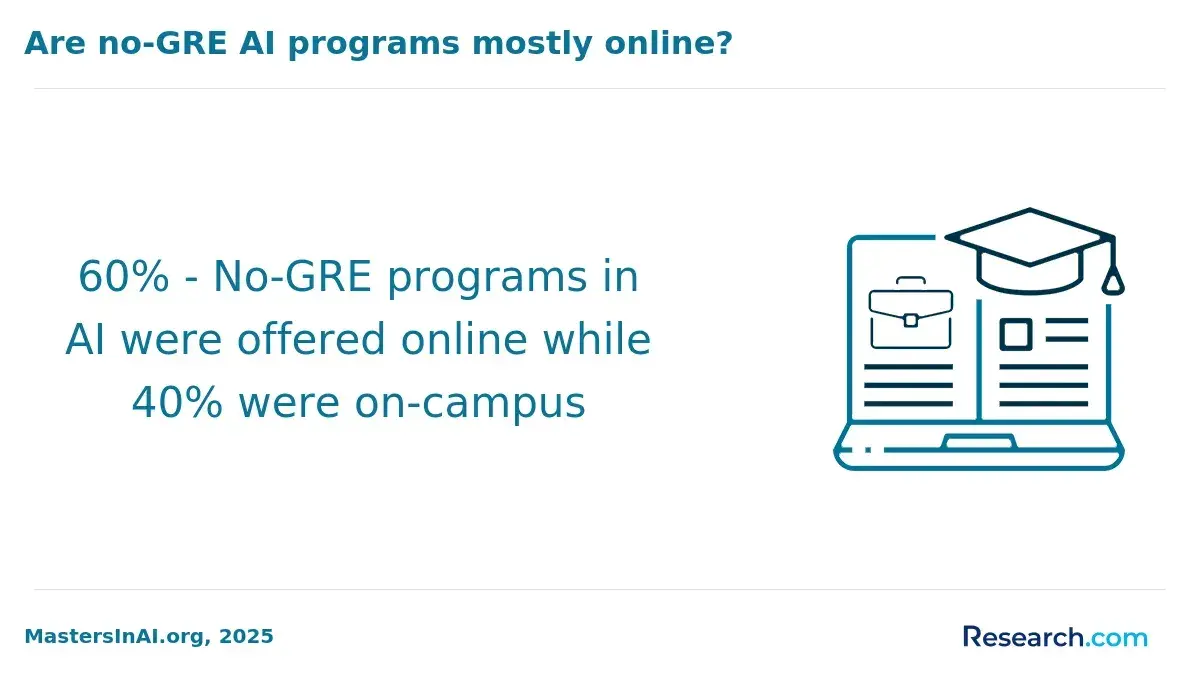
While some programs waive the GRE based on professional experience or previous graduate study, leading universities tend to maintain strict testing requirements. Prospective students should focus on building quantitative skills and assembling comprehensive applications to improve their chances.
What job titles and career roles are available to graduates with online AI master's degrees?
Graduates with online AI master's degrees frequently secure positions such as AI/ML Engineer, Machine Learning Operations Engineer, and AI Research Scientist, which together account for 58% of graduate placements, according to the LinkedIn Jobs Report 2024. These roles reflect the growing industry demand for professionals who design, develop, and optimize machine learning systems across sectors like finance, healthcare, and technology.
AI/ML Engineers build and deploy models tailored to specific business challenges, collaborating closely with data scientists and software engineers to create scalable AI solutions. Machine Learning Operations Engineers focus on automating and maintaining the infrastructure that supports continuous deployment and monitoring of AI models, ensuring systems run efficiently and reliably.
AI Research Scientists contribute by advancing new algorithms and developing theoretical underpinnings for future AI applications, requiring expertise in deep learning frameworks, programming, and data science fundamentals. Other career paths include Data Scientist, AI Product Manager, and AI Ethics Specialist, which highlight the diverse roles and ethical considerations within the field.
Graduates should emphasize practical experience with machine learning pipelines, proficiency in Python programming, and knowledge of cloud AI platforms. Emerging roles in AI strategy and governance suit those combining technical skills with policy or management expertise, aligning career goals with evolving industry needs.
What is the average salary for professionals with an online AI master's degree?
AI professionals with an online master's degree earn an average annual salary of $156,000, reflecting a 67% premium over those holding just a bachelor's degree in the same field. This data, reported by the U.S. Bureau of Labor Statistics and Glassdoor, highlights the financial benefits of pursuing advanced AI education online.
Salary differences within the AI field depend on specialization, location, and employer type. For instance, machine learning engineers and data scientists with a master's often earn salaries at or above this average, especially in tech hubs like Silicon Valley, Seattle, or Boston. Meanwhile, professionals in smaller markets or less technical roles may earn less but still benefit from the degree's credential.
Employers highly regard the expertise and dedication signaled by an online master's degree. Hiring managers often seek skills in neural networks, natural language processing, and AI ethics-areas emphasized in graduate AI curricula. Candidates proficient in these fields tend to secure roles in research, product development, or AI strategy with enhanced compensation.
For current and aspiring AI professionals, these salary insights underscore the value of investing in well-recognized online master's programs known for rigorous coursework and industry relevance. This approach increases marketability and earning potential in a competitive U.S. job market.
What is the job outlook and industry demand for AI professionals in the next five years?
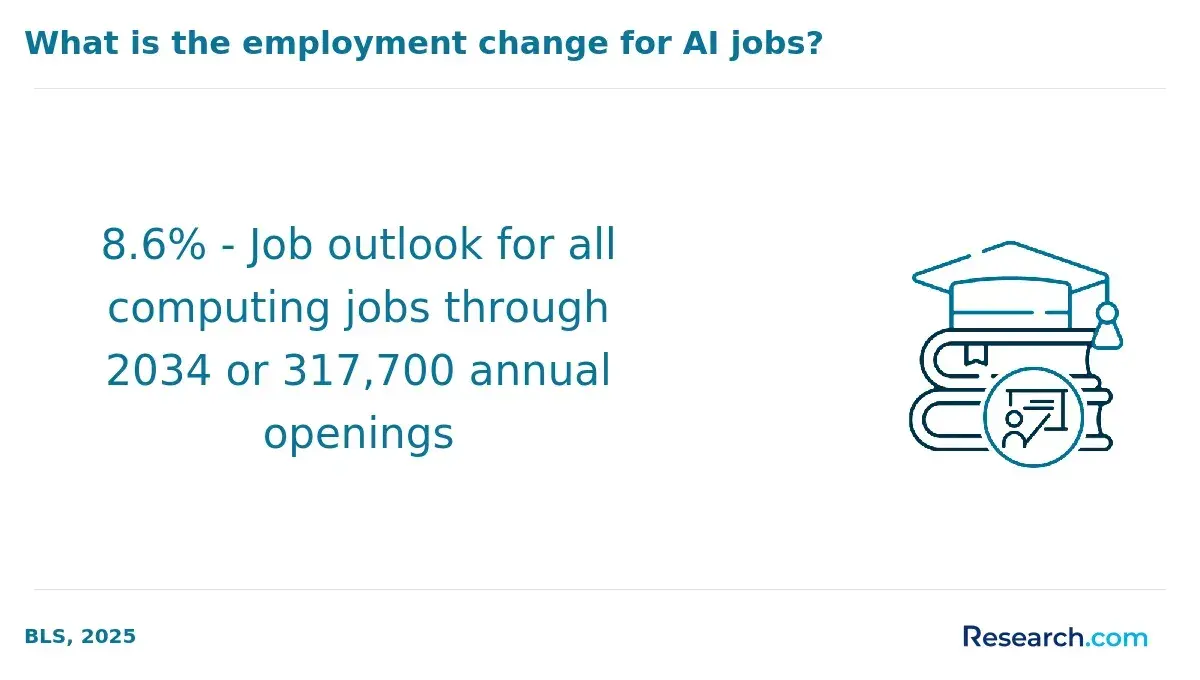
Positions for AI and machine learning engineers are projected to grow by 35%, far outpacing the average 5% growth expected for all occupations, according to the U.S. Bureau of Labor Statistics' 2023-2033 Occupational Outlook Handbook. This growth reflects widespread adoption of AI technologies in sectors like healthcare, finance, automotive, and cybersecurity.
Graduates with master's degrees in AI, including those earned online, have access to a variety of roles such as data scientist, AI developer, and machine learning engineer. Employers increasingly emphasize skills in neural networks, natural language processing, and computer vision, which advanced AI programs prioritize. Practical experience through robust projects and internships can further enhance employability.
As industries adopt AI-driven solutions, professionals who blend technical AI expertise with domain knowledge-such as in finance or robotics-are particularly valuable. For instance, healthcare providers rely on AI for diagnostics and patient care automation, while autonomous vehicle companies develop algorithms requiring expert AI engineers. Remaining updated with emerging AI trends and industry demands helps position graduates strongly in this competitive field.
Prospective students and working professionals seeking career advancement should consider programs that offer comprehensive training and connections to internships that build practical experience, ensuring readiness for the expanding AI job market.
Are there professional certifications or credentials that complement an online AI master's degree?
Professional certifications add significant value to an online AI master's degree in today's competitive job market. Employers frequently seek credentials that prove practical expertise alongside academic knowledge. According to the 2024 Dice Tech Salary Survey, 92% of employers prefer AWS Certified Machine Learning Specialty or Google Cloud Professional Machine Learning Engineer certifications as complementary credentials. These certifications confirm skills in deploying machine learning models on leading cloud platforms, which is essential for many AI positions.
Certifications should align with career goals. AWS Certified Machine Learning Specialty focuses on Amazon Web Services, including data engineering, model training, and deployment. Google Cloud Professional Machine Learning Engineer highlights AutoML and pipeline automation within Google Cloud. Both validate hands-on experience in implementing scalable AI solutions, supplementing the theory from a master's program.
Additional valuable certifications include Microsoft's Azure AI Fundamentals for those targeting the Microsoft cloud ecosystem, and Certified Artificial Intelligence Practitioner (CAIP), which provides broader AI knowledge applicable across platforms. Data science certificates from IBM or Coursera also support foundational skills that complement AI degree studies.
Combining an online AI master's degree with relevant certifications improves employability by showing readiness for real-world AI challenges and cloud infrastructure management. Candidates should study industry trends and job requirements carefully to select certifications that best fit their intended roles and platforms for optimal career advancement.
Other Things You Should Know About Artificial Intelligence
Students in online AI master's programs gain advanced technical skills such as machine learning, natural language processing, robotics, and computer vision. They also develop strong analytical abilities in data science and programming languages like Python. Additionally, critical thinking and problem-solving skills are emphasized to apply AI methods to real-world challenges.
Most online AI master's programs incorporate hands-on projects, labs, and sometimes internships to provide practical experience. These programs often use virtual labs, simulation tools, and collaborative platforms to replicate real-world AI development environments. Capstone projects are common, allowing students to apply theoretical knowledge to solve complex problems.
Many online AI master's programs welcome career changers, but some require foundational knowledge in programming, mathematics, or statistics. Preparatory or bridge courses may be available to help non-technical students catch up. Prospective students should check prerequisites carefully and consider supplementing their education with coding or math fundamentals before starting.
Online AI master's programs often include virtual networking sessions, group projects, and industry webinars that facilitate connections. These programs often collaborate with industry leaders, providing opportunities similar to traditional degrees. If your interest is in AI's financial applications, explore a master’s in AI and finance for specialized networking prospects.
References
- Top 10 AI certifications and courses for 2025 https://www.techtarget.com/whatis/feature/10-top-artificial-intelligence-certifications-and-courses
- Best Online AI Courses and Certifications in 2025 https://www.upskillist.com/blog/online-ai-courses-certifications/
- Artificial Intelligence Certificate Programs - MastersInAI.org https://www.mastersinai.org/degrees/ai-certificate-programs/
- 11 Best AI Certifications in 2025 to Deepen Your Technical Knowledge | DigitalOcean https://www.digitalocean.com/resources/articles/ai-certifications
- Remote AI Jobs Salary Report 2024 - Top AI's Jobs https://topaisjobs.com/remote-ai-jobs-salary-report-2024/
- Is the Traditional College Degree Still Relevant in an AI-Driven Job Market? - ReviewNPrep https://reviewnprep.com/blog/is-the-traditional-college-degree-still-relevant-in-an-ai-driven-job-market/
- AI’s Impact on Job Growth | J.P. Morgan Global Research https://www.jpmorgan.com/insights/global-research/artificial-intelligence/ai-impact-job-growth
- Superagency in the workplace: Empowering people to unlock AI’s full potential https://www.mckinsey.com/capabilities/tech-and-ai/our-insights/superagency-in-the-workplace-empowering-people-to-unlock-ais-full-potential-at-work
- Start of the accreditation process for the ALI master’s program https://blog.studiumdigitale.uni-frankfurt.de/ali-en/cool_timeline/start-of-the-accreditation-process-for-the-ali-masters-program/
- 6 High-Paying Jobs With a Master’s in AI | University of Bridgeport https://www.bridgeport.edu/news/high-paying-jobs-with-a-masters-in-ai/