
2027 Fastest Way To Become a Counselor in Texas

Co-Founder and Chief Data Scientist
Becoming a counselor in Texas is a practical career goal, but the fastest route depends on one key distinction: whether you want an entry-level helping role now or full independent licensure as a professional counselor. Texas has clear licensure steps for Licensed Professional Counselors, but students can lose time by choosing the wrong degree, overlooking accreditation, delaying exams, or waiting too long to secure supervised clinical placements.
This guide explains how to move through the Texas counseling pathway efficiently without cutting corners. You will learn the fastest route to licensure, what you can do with only a bachelor’s degree, how online and accelerated programs compare, what salaries look like, where demand is strongest, and how to decide whether a fast-track counseling path is worth it for your situation.
Quick Answer: Fastest Path to Becoming a Counselor in Texas
The fastest route to becoming a licensed professional counselor in Texas is to complete a qualifying master’s degree in counseling or a closely related field, pass the required exams, apply for LPC-Associate status through the Texas Behavioral Health Executive Council, complete 3,000 post-master’s supervised hours including 1,500 direct client hours over at least 18 months, and then apply for full LPC licensure. Most candidates should expect the post-master’s licensure stage to take about two and a half to three years after earning the graduate degree.
- Best fit: Students who want clinical counseling roles in mental health agencies, private practice settings, schools, hospitals, or community organizations.
- Fastest practical strategy: Choose a licensure-aligned master’s program, prepare early for the NCE or NCMHCE, submit paperwork promptly, and secure a board-approved supervisor before graduation if possible.
- Important limitation: A bachelor’s degree can qualify you for support roles, but it generally does not qualify you for independent clinical counseling licensure in Texas.
- Salary context: Counseling pay varies by specialty, employer, region, and license level. The article cites Texas counselor averages around $58,000 in one overview and about $68,000 for LPC-focused estimates.
- Fastest way to become a licensed counselor in Texas
- Counseling-related jobs in Texas with a bachelor’s degree
- Accelerated counseling degree programs in Texas
- Online vs. traditional counseling programs
- Challenges fast-track counseling students should expect
- How Texas employers view fast-track counseling graduates
- Cost and affordability of fast-track and online programs
- Substance abuse counseling specialization in Texas
- Transitioning into school counseling in Texas
- Demand for counselors in Texas
- Best degree choice for a counseling career in Texas
- Counselor pay in Texas
- Whether the fast route is worth it
- Continuing education requirements for Texas counselors
What is the fastest way to become a licensed counselor in Texas?
The fastest licensure path is not simply the shortest degree program. It is the path that meets Texas LPC requirements the first time, avoids paperwork delays, and positions you to complete supervised hours steadily after graduation. Once you hold a qualifying master’s degree in counseling or a related field, your timeline depends heavily on exam readiness, application timing, supervisor availability, and access to enough client contact hours.
| Step | What to do | How to avoid delays |
| Graduate education | Complete a master’s degree in counseling or a related field that aligns with Texas licensure expectations. | Confirm licensure alignment before enrolling, especially if the program is online or based outside Texas. |
| Licensing exams | Prepare for the National Counselor Examination (NCE) or the National Clinical Mental Health Counseling Examination (NCMHCE), along with the Texas Jurisprudence Exam. | Use National Board for Certified Counselors (NBCC) study materials, practice tests, and a written study calendar. |
| LPC-Associate application | Submit the LPC application and supporting documents through the Texas Behavioral Health Executive Council (TBHEC) online portal. | Request transcripts, forms, and supervisor documentation early instead of waiting until graduation is fully complete. |
| Background check | Complete the fingerprint-based criminal background check required for licensure processing. | Schedule fingerprinting soon after applying because background checks can become a bottleneck. |
| Supervised practice | Complete 3,000 post-master’s supervised hours, including 1,500 direct client hours, over at least 18 months. | Choose a board-approved supervisor and a placement with reliable client volume so your hours accumulate consistently. |
A realistic fast-track plan starts before graduation. Use your university career center, faculty network, practicum site, and local professional associations to identify supervisors and employers that regularly hire LPC Associates. A strong placement can make the difference between steady progress and long gaps between client hours.
Students comparing counseling options should also look beyond the LPC title. The broader field includes clinical mental health counseling, school counseling, addiction counseling, family-focused counseling, community mental health roles, and related human services work. If you are still weighing career outcomes, Research.com’s guide to what you can do with a counseling degree can help you compare possible paths before committing to one licensure route.
Fastest Texas LPC timeline after the master’s degree
| Phase | Fast-track priority | Decision point |
| Before graduation | Confirm degree eligibility, prepare for exams, and identify potential supervisors. | Does the program clearly support Texas LPC requirements? |
| Immediately after graduation | Submit application materials, complete the background check, and take required exams. | Are all transcripts, forms, and exam plans ready? |
| LPC-Associate period | Build supervised counseling hours with consistent client contact. | Will the placement provide enough direct client hours to stay on track? |
| Final licensure stage | Document completed hours and apply for full LPC licensure. | Are supervision records complete and accurate? |
What counseling careers can you pursue in Texas with only a bachelor’s degree?
A bachelor’s degree can help you enter the behavioral health field in Texas, but it is usually not enough for independent clinical counseling practice. The best bachelor’s-level roles are supervised support positions where you assist licensed professionals, coordinate care, document client progress, or provide crisis and recovery support within structured programs.
These roles can be valuable if you want paid experience before graduate school. They can also help you confirm whether counseling is the right long-term career before investing in a master’s degree.
| Bachelor’s-level role | Typical work | Why it can help future counselors |
| Behavioral Health Technician | Support treatment plans, monitor client progress, assist clinical teams, and work in mental health clinics, rehabilitation facilities, or hospitals. | Provides direct exposure to mental health care, documentation, client support, and treatment-team operations. |
| Substance Abuse Counselor Assistant | Help with recovery programming, client support, group activities, and administrative tasks in addiction treatment settings. | Builds familiarity with recovery models, relapse prevention support, and community-based services. |
| Case Manager | Coordinate services, connect clients with resources, advocate for needs, and track care plans in social service agencies. | Develops practical skills in systems navigation, client communication, and interagency collaboration. |
| Crisis Hotline Counselor | Provide immediate emotional support, crisis screening, and referrals while working under protocols and supervision. | Strengthens active listening, risk assessment awareness, and calm communication under pressure. |
Applicants can strengthen their profile by adding relevant training, volunteer work, supervised experience, or credentials such as Registered Behavior Technician (RBT), when appropriate for the role. These experiences do not replace graduate licensure requirements, but they can make you a stronger applicant for counseling programs and entry-level behavioral health jobs.
If your long-term goal is professional counseling, it is useful to understand how early support roles connect to licensure, private practice, specialization, and income growth. Research.com’s overview of the career outlook for LPC professionals explains how the licensed professional counselor path compares with other counseling careers.
The chart below uses 2024 workforce supply data and shows mental health counselors as the largest group, followed by addiction counselors and marriage and family therapists. The figures show the size of these professional groups, while also pointing to the continued need for trained mental health providers in many communities.
Are there accelerated counseling degree programs in Texas?
Yes. Texas students can find accelerated and flexible counseling programs, including online and evening formats, that may shorten the time needed to finish coursework. However, “accelerated” should never mean “less rigorous.” For licensure-bound students, the program still needs the right curriculum, practicum or internship structure, faculty support, and state-aligned preparation.
| Program | Format and pace | Career or licensure relevance | Cost note |
| Lamar University | Online M.Ed. in Counseling and Development with an accelerated five-week course format. | Includes Marriage, Couple & Family Counseling and School Counseling concentrations and is designed around Texas professional or school counselor preparation. | Tuition is around $17,100 for Texas residents. |
| Texas Woman’s University | MS in Counseling & Development with evening and online classes. | Supports preparation for clinical mental health counseling and professional school counseling roles in Texas. | Not specifically labeled accelerated, but flexible scheduling can help motivated students move faster than traditional part-time pacing. |
| Texas A&M University-Kingsville | Fully online Master of Science in Counseling & Guidance. | Requires 48 semester hours for school counseling certification. | The online format may help students who can manage heavier course loads progress more quickly. |
Before choosing a shorter program, verify that it fits the license or credential you actually want. A program that is fast but misaligned can cost more time than it saves. Review curriculum maps, fieldwork requirements, faculty advising, exam support, and graduate outcomes. Students planning to work outside Texas should also compare state rules because counseling licensure is state-regulated. Research.com’s guide to the counseling certification process by state can help you identify requirements before enrolling.
Questions to ask before enrolling in an accelerated counseling program
- Does the curriculum meet the Texas licensure path I plan to pursue?
- How are practicum and internship placements arranged?
- Can online students complete fieldwork near home?
- What happens if I need to slow down for work, family, or health reasons?
- Does the program provide preparation for the NCE, NCMHCE, and Texas Jurisprudence Exam?
- Are faculty advisors familiar with Texas LPC-Associate requirements?
Are online counseling programs in Texas faster than traditional ones?
Online counseling programs can be faster, but not automatically. Their main advantage is flexibility. Students may be able to take year-round courses, avoid commuting, complete assignments around work schedules, and arrange field experiences closer to home. Those advantages can help a disciplined student maintain momentum, especially when balancing employment or family responsibilities.
| Factor | Online counseling program | Traditional campus program | Best choice when... |
| Scheduling | Often offers asynchronous or evening-friendly coursework. | May require set class times and campus attendance. | Online is stronger if you work full-time or have caregiving obligations. |
| Pace | May include year-round terms, summer courses, or shorter sessions. | Often follows fall and spring semester pacing. | Online may be faster if you can handle a heavier academic load. |
| Fieldwork | May allow local practicum and internship placements. | Often relies on established regional site partnerships. | Campus may be stronger if the school has excellent local clinical partnerships. |
| Networking | Requires intentional effort to build faculty, peer, and supervisor relationships. | Can provide more informal face-to-face networking. | Campus may help students who value in-person professional community. |
| Commute and relocation | Can reduce travel, parking, and housing disruption. | May require regular travel or living near campus. | Online is often more practical for students far from major universities. |
Online learning works best for students who are organized, proactive, and comfortable asking for help before problems become serious. It may be less ideal for students who need highly structured classroom routines or who learn best through frequent in-person discussion.
One Texas counselor described online classes as the only format that made graduate school possible while working and managing family responsibilities. She completed coursework late at night and on weekends, and the lack of commute gave her several additional hours each week for assignments and practicum planning. That kind of flexibility can matter, but it only helps if the program is properly aligned with licensure and the student can sustain the workload.
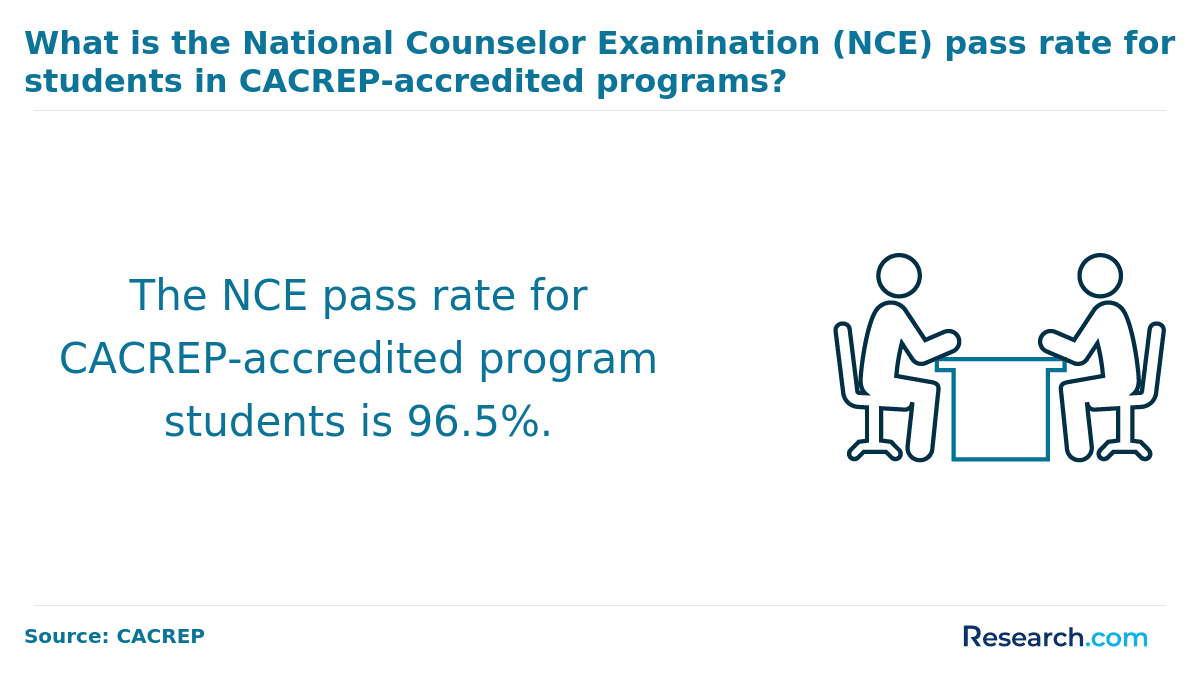
The image below presents the NCE pass rate for students in CACREP-accredited counseling programs, which can help readers think about exam preparation and program quality when comparing options.
What challenges do fast-track counseling students face?
Accelerated counseling programs can reduce time in school, but they concentrate the workload. Students should enter with a realistic plan for study time, fieldwork, self-care, finances, and exam preparation. Moving quickly is helpful only if you still meet academic, ethical, clinical, and licensure standards.
- Compressed coursework: Shorter terms can mean frequent readings, assignments, exams, skills demonstrations, and group projects with little downtime between courses.
- Clinical scheduling pressure: Texas supervised experience requirements do not disappear because a program is faster. Students still need practicum, internship, and post-master’s supervised hours.
- Burnout risk: Counseling training requires emotional presence, not just academic output. Students balancing work, family, and fieldwork can become overwhelmed if they overload every term.
- Exam readiness concerns: Passing the NCE or NCMHCE is essential. Rushing content without review time may increase the chance of retesting, which can add cost and delay.
- Limited flexibility: Some accelerated schedules leave little room for illness, job changes, caregiving emergencies, or placement problems.
- Hidden expenses: Faster completion may reduce some costs, but fees, background checks, exam costs, books, travel to field sites, and potential retakes still need to be budgeted.
Common mistakes that slow down fast-track counseling students
| Mistake | Why it causes problems | Better approach |
| Choosing the shortest program without checking licensure fit | A fast degree that does not meet Texas requirements can delay licensure. | Ask the program to explain how its curriculum maps to Texas LPC or school counseling requirements. |
| Waiting until graduation to look for supervision | Supervisor shortages or weak placement options can delay post-master’s hours. | Start networking during practicum and internship. |
| Assuming online means self-paced | Many online programs still have deadlines, live sessions, and fixed fieldwork rules. | Review the academic calendar and course delivery format before enrolling. |
| Budgeting only for tuition | Licensure, exams, books, travel, and technology can raise total costs. | Build a full cost estimate before accepting admission. |
| Ignoring personal capacity | An overloaded schedule can reduce learning quality and increase burnout. | Choose the fastest pace you can sustain, not the fastest pace advertised. |
How do employers in Texas view fast-track counselors?
Texas employers generally care less about whether a program is labeled “fast-track” and more about whether the candidate is eligible for the role, clinically prepared, ethical, supervised appropriately, and ready to serve clients. A graduate from an accelerated program can be competitive if the program is credible and the candidate has strong field experience.
- Licensure compliance comes first: Employers want candidates whose education, associate status, supervision, and documentation meet Texas rules.
- Clinical readiness matters: Hiring managers may ask detailed questions about practicum, internship, crisis experience, documentation skills, and client populations served.
- Motivation can be an asset: Completing a demanding program quickly may signal discipline, adaptability, and commitment when supported by strong references.
- Prior experience helps: Backgrounds in education, healthcare, social services, case management, or behavioral health support can strengthen a fast-track graduate’s profile.
- Placement partnerships build confidence: Employers may feel more comfortable with programs that have established relationships with clinics, schools, community agencies, or hospitals.
- Competence outweighs speed: A fast path does not compensate for weak counseling skills, poor documentation, limited supervision, or lack of professional maturity.
How to present a fast-track background to employers
- Lead with your license status, exam completion, supervised experience, and client populations served.
- Explain your practicum and internship experience in concrete terms rather than emphasizing program speed.
- Ask supervisors for references that speak to clinical judgment, ethics, documentation, and reliability.
- Show commitment to continuing education, especially in areas such as trauma care, crisis response, addiction, school-based services, or family systems.
Are fast-track and online counseling programs in Texas more affordable?
Fast-track and online counseling programs can be more affordable, but the total price depends on tuition, fees, course load, fieldwork expenses, exam costs, technology, and whether you can keep working while enrolled. A lower tuition number does not always mean a lower total cost if the program creates placement delays or requires extra terms.
- Tuition and time in school: Online counseling programs in Texas often range from $16,000 to $25,000. Accelerated formats may reduce the number of semesters, which can lower total tuition and fee exposure.
- Ability to keep earning income: Flexible online coursework can make it easier for working adults, career changers, and parents to remain employed during graduate school.
- Reduced commuting or relocation costs: Studying from home can reduce spending on gas, parking, housing changes, or long-distance travel to campus.
- In-state rates and aid options: Texas residents may qualify for in-state tuition at some schools, and eligible students can pursue federal aid, state scholarships, and assistantships.
| Cost factor | Why it matters | Question to ask the school |
| Tuition | This is the largest visible cost, but not the only one. | What is the total tuition for the full degree, not just per credit or per course? |
| Fees | Online, technology, graduation, clinical, and student service fees can add up. | Which mandatory fees apply each term? |
| Fieldwork | Practicum and internship may require travel, schedule changes, or reduced work hours. | Can I complete fieldwork near where I live? |
| Exams and licensure | Exam preparation, testing, background checks, and applications carry extra costs. | Does the program provide exam preparation or licensure advising? |
| Lost income | Full-time study can reduce earnings, while part-time study can extend the timeline. | Can the program be completed while working full-time? |
A former teacher who moved into counseling through a fast-paced online program said the format made the career change financially possible. She could continue teaching while attending online classes, and avoiding a long commute reduced stress and saved time. Her experience highlights a key point: affordability is not only about tuition. It is also about whether the schedule lets you keep your income and complete fieldwork without major disruption.
The 2023 degree-award data below shows Walden University granting 773 mental health counseling degrees, followed by Capella University with 657 and Grand Canyon University with 593. These figures reflect the scale of counseling education at major institutions and the role graduate programs play in expanding the mental health workforce.
How can I specialize in substance abuse counseling in Texas?
Substance abuse counseling is one of the most practical specializations for students who want to work in treatment centers, community agencies, hospitals, recovery programs, or integrated behavioral health settings. In Texas, this path usually requires addiction-focused coursework, supervised experience with substance use populations, ethics training, and a clear understanding of state credentialing rules.
Students interested in this specialization should look for programs or electives covering assessment, co-occurring disorders, relapse prevention, group counseling, motivational interviewing, family impact, crisis response, and referral coordination. Field placements in addiction treatment settings can be especially valuable because employers want evidence that candidates understand recovery environments and client safety needs. For a focused step-by-step explanation, review Research.com’s guide on how to become a substance abuse counselor in Texas.
How can I transition to a school counseling career in Texas?
School counseling is a distinct path because the work combines student mental health support, academic planning, career readiness, family communication, crisis response, and collaboration with teachers and administrators. Candidates moving from clinical counseling, teaching, social services, or youth work should confirm the exact Texas credential requirements before enrolling in a program.
The strongest preparation includes school-based field experience, mentorship inside a local district, familiarity with K–12 systems, and evidence that you can support both counseling and educational outcomes. When comparing programs, ask how internships are placed, whether faculty understand Texas school counseling expectations, and how graduates move into district roles. For a more detailed pathway, see Research.com’s guide on how to become a school counselor in Texas.
Is there a demand for counselors in Texas?
Yes. Texas continues to need mental health professionals across clinical, school, addiction, family, and community settings. Demand is shaped by population growth, greater awareness of mental health needs, shortages in underserved areas, and rising use of behavioral health services. The need can vary by location and specialty, so students should research the region and setting where they plan to work.
- Broad occupational growth: Counseling roles, including clinical and counseling psychologists, are projected to grow by about 20% from 2022 to 2032, which is much faster than the national average.
- School-based need: Enrollment growth and student mental health concerns support continued demand for school counselors across Texas districts.
- Addiction treatment demand: Substance use challenges, including the opioid crisis, continue to create openings for addiction-focused counselors.
- Family and relationship services: More individuals and families seeking help with relationship, parenting, and personal challenges contribute to demand for marriage and family therapy services.
- Rural shortages: Rural and remote communities often have fewer mental health providers, which can create opportunities for counselors willing to serve underserved areas.
- Licensure advantage: Fully licensed professionals generally have stronger mobility, more role options, and better long-term career flexibility than candidates without graduate credentials.
Students hoping to enter the field quickly should remember that demand does not eliminate credential requirements. You still need the correct degree, exams, supervised experience, and license for the role you want. If graduate school is your next step, Research.com’s guide to whether getting a master’s in counseling is easy can help you understand the workload and expectations before applying.
What degree should I pursue for a successful counseling career in Texas?
For most students who want to become licensed professional counselors in Texas, the most direct academic choice is a master’s degree in counseling or a closely related field designed for licensure preparation. The right degree should include counseling theory, assessment, ethics, human development, multicultural counseling, group counseling, diagnosis, practicum, internship, and preparation for required exams.
| Goal | Degree or preparation to consider | Best fit |
| Licensed Professional Counselor | Master’s degree in counseling or a related field aligned with Texas LPC requirements. | Students who want clinical mental health counseling, agency work, or eventual private practice options. |
| School Counselor | Counseling program or certification pathway aligned with Texas school counseling requirements. | Educators or counseling students who want to work in K–12 settings. |
| Substance Abuse Counseling | Counseling education plus addiction-specific coursework, training, and supervised experience. | Students drawn to recovery, treatment programs, and community behavioral health. |
| Social Work or broader human services | Social work degree pathway may be appropriate depending on desired role and license. | Students interested in case management, clinical social work, policy, advocacy, or integrated services. |
If you are deciding between counseling and social work, compare the actual job duties, licensure requirements, field placements, and populations served. The two fields overlap in mental health settings, but they are not interchangeable. Students considering a broader route can review Research.com’s guide to Texas social worker educational requirements before choosing a program.
How much do counselors get paid in Texas?
Counselor pay in Texas depends on license level, specialty, location, employer type, experience, and whether the counselor works in private practice, schools, nonprofits, hospitals, community agencies, or government-funded programs. One general overview places the average salary for counselors in Texas around $58,000, while LPC-focused estimates put the average for a Licensed Professional Counselor at about $68,000 a year.
Most LPCs in the cited range earn between $54,500 and $74,500 annually. More experienced counselors or those in high-demand settings may approach $94,000, and some may exceed six figures in rare cases. Texas ranks 50th among states in terms of counselor salary in Texas, so students should evaluate local cost of living, employer type, and advancement options rather than relying on salary averages alone.
| Pay factor | How it affects earnings |
| Specialization | School counselors, substance abuse counselors, and mental health counselors often fall within the $52,000 to $75,000 range, though individual roles vary. |
| Work setting | Substance abuse and mental health roles may be lower in some nonprofit or community settings, while school roles, urban employers, and private practice can pay more. |
| Experience level | Entry-level professionals and nonprofit workers may start closer to $32,000–$54,000, while experienced LPCs can earn more, especially in private practice. |
| Location | Urban centers may offer higher wages, but cost of living and competition can also be higher. |
| Credentials | Advanced training, licensure status, supervision quality, and specialized certifications can improve employability and earning potential. |
Students evaluating return on investment should compare total program cost with realistic entry-level earnings, not just long-term income potential. Also ask programs where graduates work, how many become LPC Associates, and what support is available for field placement and exam preparation.
Is taking the fast route to become a counselor in Texas worth it?
The fast route can be worth it if the program is licensure-aligned, affordable, clinically strong, and realistic for your schedule. It is not worth it if speed causes you to choose a weak program, miss licensure requirements, underprepare for exams, or burn out before completing supervised hours.
| Fast-track counseling is a good idea if... | Consider a slower route if... |
| You already know you want a counseling career and are ready for graduate-level clinical training. | You are still unsure whether counseling, social work, psychology, education, or another helping profession fits best. |
| You can manage intensive coursework while maintaining your health, work, and family responsibilities. | You need more schedule flexibility or cannot commit consistent weekly hours to study and fieldwork. |
| The program clearly prepares students for Texas licensure and supervised practice. | The school cannot clearly explain how graduates meet Texas requirements. |
| You have a plan for practicum, internship, supervision, and post-master’s employment. | You would need to find all fieldwork and supervision support on your own with limited guidance. |
| The total cost is manageable and the timeline helps you begin paid supervised work sooner. | The program’s pace would force you to stop working or take on debt you cannot justify. |
One benefit of moving efficiently is that after earning your master’s degree and meeting application requirements, LPC-Associate status allows you to begin supervised paid counseling work. This gives you real client experience, professional references, and a clearer path toward specialization while completing the 3,000 post-master’s hours required for full licensure.
Fast progress can also help you enter high-need areas earlier, such as trauma-informed care, school counseling, substance abuse treatment, rural mental health, or community behavioral health. Still, the strongest counselors are not simply the ones who finish first. They are the ones who complete rigorous training, seek good supervision, build ethical judgment, and continue learning after licensure.
What are the continuing education requirements for counselors in Texas?
Continuing education helps Texas counselors maintain competence, follow ethical standards, and stay current with changes in clinical practice, law, documentation, telehealth, supervision, crisis care, and specialty treatment. Requirements can vary by license type and may be updated by state regulators, so counselors should always verify the current rules directly before each renewal period.
For current LPC-focused details, review Research.com’s guide to LPC license requirements in Texas. When choosing continuing education, prioritize approved providers, topics relevant to your client population, and training that strengthens your actual practice rather than selecting courses only because they are quick or inexpensive.
What Counselors in Texas Say About Their Careers
- Taking an accelerated path into counseling in Texas gave me the stability I wanted and the chance to start helping clients sooner. Demand has been steady across several specialties, and the salary potential made the decision feel practical as well as meaningful. – Margie
- Moving quickly into counseling was challenging because Texas communities are so different from one another. Working across urban and rural needs forced me to grow, but it also made the career more rewarding than I expected. – Joe
- Continuing education has been a major advantage in my Texas counseling career. Workshops, conferences, and specialized training have helped me keep my skills current while moving through a demanding professional path. – Sheryl
Key Insights
- The fastest legitimate LPC path in Texas still requires a qualifying master’s degree, exams, LPC-Associate approval, and 3,000 post-master’s supervised hours, including 1,500 direct client hours over at least 18 months.
- A bachelor’s degree can open doors to behavioral health support roles, but it usually will not qualify you for independent counseling practice.
- Online and accelerated programs can save time, especially for working adults, but only if they meet Texas licensure requirements and provide strong field placement support.
- Program speed should never outweigh accreditation, curriculum fit, supervision access, exam preparation, and total cost.
- Counseling demand in Texas is strong across mental health, school, substance abuse, family, and rural service settings, but job quality and salary vary by specialization and employer.
- Salary estimates differ by source and role, with cited Texas counseling averages around $58,000 and LPC-focused averages about $68,000; students should compare local employer data before estimating ROI.
- The best fast-track candidates are organized, clinically mature, financially prepared, and proactive about supervision, exams, and licensure documentation.
Related Articles for Nearby States
- 2027 Fastest Way To Become a Counselor in Louisiana
- 2027 Fastest Way To Become a Counselor in Oklahoma
- 2027 Fastest Way To Become a Counselor in Arkansas
- 2027 Fastest Way To Become a Counselor in New Mexico
- 2027 Fastest Way To Become a Counselor in Kansas
- 2027 Fastest Way To Become a Counselor in Missouri
- 2027 Fastest Way To Become a Counselor in Colorado
- 2027 Fastest Way To Become a Counselor in Mississippi
- 2027 Fastest Way To Become a Counselor in Tennessee
- 2027 Fastest Way To Become a Counselor in Arizona
References:
- Concordia University Texas. (n.d.). How to become a therapist in Texas. https://www.concordia.edu/blog/how-to-become-a-therapist-in-texas.html
- My Texas Future. (n.d.). Mental health counselors career overview. https://www.mytexasfuture.org/career-explorer/mental-health-counselors/
- O*NET OnLine. (n.d.). Texas employment trends: 21-1014.00 - Mental health counselors. https://www.onetonline.org/link/localtrends/21-1014.00
- St. Edward’s University. (n.d.). Four in-demand counseling careers. https://www.stedwards.edu/news/demand-counseling-careers-austin
- Texas Career Check. (n.d.). Mental health counselors - occupation summary. https://texascareercheck.com/OccupationInfo/OccupationSummary/21-1014.00
- The Texas Tribune. (2023, February 21). Texas’ shortage of mental health care professionals is getting worse. https://www.texastribune.org/2023/02/21/texas-mental-health-workforce-shortage/
- West Coast University. (n.d.). How to get a mental health counselor license in Texas. https://westcoastuniversity.edu/blog/how-to-obtain-your-clinical-mental-health-counselor-license-in-texas
Other Things to Know About Becoming a Counselor in Texas
Texas requires a fingerprint-based criminal background check through IdentoGO before the Texas Behavioral Health Executive Council can issue a counseling license. Applicants must submit fingerprints for state and FBI review, and any disciplinary or criminal history may affect approval.
In 2027, to become a licensed counselor in Texas, you'll typically need a master's degree in counseling or a related field. Ensure the program is accredited and meets Texas State Board of Examiners requirements. Accredited programs usually include supervised practicum/internship experiences essential for licensure.


