
2027 Tennessee Psychology Licensure Requirements – How to Become a Psychologist in Tennessee

Co-Founder and Chief Data Scientist
Becoming a psychologist in Tennessee is a regulated professional pathway, not just an academic goal. If you want to provide psychological services, use the psychologist title, or move into clinical, counseling, school, forensic, organizational, or assessment-focused work, you need to understand how Tennessee licensure works before choosing a degree program or career specialty.
As of May 2024, Tennessee had approximately 720 people working in clinical and counseling psychology, about 830 psychologists specializing in school psychology, and 760 psychologists across other psychology specialties. Those numbers show that the profession is active in the state, but entry is controlled by education, supervised experience, examinations, renewal rules, and Tennessee Board of Examiners in Psychology requirements.
Psychology is classified as one of the healing arts in Tennessee. Only people licensed or certified by the Tennessee Board of Examiners in Psychology may legally practice psychology in the state. Practicing without the proper certification or psychology license in Tennessee can violate Tennessee Code Annotated §§ 63-1-123 and 63-11-206. This guide explains the licensure path, renewal process, degree requirements, program selection factors, career outlook, and related psychology career options, including traditional and online graduate psychology programs.
Quick Answer: How Do You Become a Licensed Psychologist in Tennessee?
To become a licensed psychologist in Tennessee, you generally need to earn a bachelor’s degree, complete a doctoral degree in psychology from an APA-approved or National Register-designated program, complete supervised professional experience under a licensed psychologist, pass the Examination for Professional Practice in Psychology (EPPP), pass the Tennessee Jurisprudence Exam, submit official documentation to the Tennessee Board of Examiners in Psychology, and renew the license every two years with required continuing education.
The process is most suitable for students and professionals who want independent psychological practice, clinical assessment authority, advanced research roles, or doctoral-level psychology careers. If your goal is counseling, school services, applied behavior analysis, social work, or marriage and family therapy, Tennessee may require a different license or certification path.
Tennessee Psychology Licensure Requirements Table of Contents
- Tennessee psychology profession overview
- Education needed for Tennessee psychologist licensure
- How to apply for and renew a Tennessee psychology license
- Why location matters when comparing Tennessee psychology programs
- Top psychology programs in Tennessee for 2027
- Substance abuse counseling as a related career option
- Educational psychology for Tennessee professionals
- BCBA certification in Tennessee
- Psychometrics and assessment-focused psychology careers
- Moving from psychology into counseling roles
- Using social work principles in psychology practice
- Continuing education and professional development
- Criminal psychology pathways in Tennessee
- Telepsychology and remote care delivery
- How LPC requirements affect counseling practice
- Psychologist salary and job outlook in Tennessee
- Business psychology and organizational practice
- Other Tennessee licenses and certifications to consider
Overview of the Psychology Industry in Tennessee
Tennessee’s psychology workforce includes licensed psychologists in hospitals, private practices, schools, universities, community agencies, correctional settings, assessment centers, and business environments. The right career route depends heavily on whether you want to diagnose and treat mental health conditions, work with students, conduct research, consult with organizations, or specialize in testing and evaluation.
According to Projections Central, Tennessee psychology employment is expected to grow by 2.8% during the ten-year period ending in 2030, with an average of 75 openings per year through 2030. For readers asking about jobs you can pursue with a psychology degree, it is important to separate degree-level opportunities from licensed practice. A bachelor’s or master’s degree may support roles in research, human services, human resources, case management, or program coordination, but independent psychology practice in Tennessee requires meeting Board requirements.
Salary outcomes vary by specialty, employer, region, experience, and licensure status. The reported average annual salary for psychologists in Tennessee is $106,900 based on a survey of 92 professionals. That figure sits within a reported range from $79,500 to $157,500 and is described as corresponding to the national average.
| National psychologist labor market measure | Reported figure |
| Employment Growth from 2024 to 2034 | 6% |
| Average Annual Job Openings | 12,900 |
| Minimum Annual Wage | $54,860 |
| Average Annual Wage | $117,580 |
| Maximum Annual Wage | $157,330 |
Educational Requirements for Psychologists in Tennessee
The Tennessee psychologist licensure path is doctoral-level. Students interested in clinical psychology, counseling psychology, school psychology, research psychology, neuropsychology, forensic work, or applied organizational practice should plan their education carefully because not every psychology degree leads to the same license or career authority.
Students comparing psychology with business-focused fields, such as an industrial-organizational psychology degree, should also consider whether they want clinical licensure, applied workplace consulting, research, or human resources work. These goals can require different credentials.
Step 1: Earn a Bachelor’s Degree
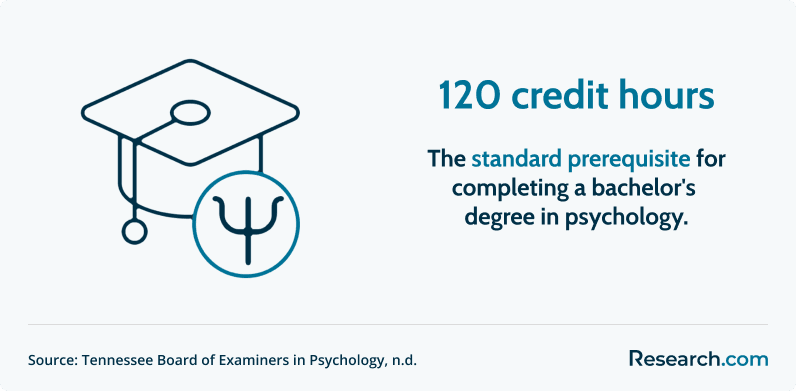
A bachelor’s degree is the foundation for graduate study in psychology. Full-time students typically complete about four years of study and 120 credit hours. A psychology major can be useful because it introduces research methods, statistics, human development, abnormal psychology, and behavioral science, but Tennessee does not require every future psychologist to major in psychology as an undergraduate.
If your interest is workplace behavior, leadership, or employee assessment rather than clinical practice, you may also compare graduate options such as online master’s programs in organizational psychology. A master’s degree can support applied roles, but it does not replace the doctoral requirement for psychologist licensure in Tennessee.
Step 2: Complete a Doctoral Degree in Psychology
Tennessee psychologist licensure requires a doctoral degree in psychology. The doctoral program must be approved by the American Psychological Association (APA) or come from a National Register-designated school. This point matters when choosing a program: accreditation and designation can affect eligibility, internship options, transferability, and future licensure mobility.
Step 3: Complete Supervised Professional Experience
After doctoral training, candidates must complete supervised professional experience that satisfies Tennessee Board of Examiners in Psychology requirements. The experience must be supervised by a licensed psychologist and documented according to Board expectations. Before accepting a placement, candidates should confirm that the supervisor, setting, duties, and documentation process will count toward licensure.
| Stage | What you complete | Why it matters for Tennessee licensure |
| Bachelor’s degree | About four years and 120 credit hours | Builds the academic base for graduate psychology study |
| Doctoral degree | APA-approved or National Register-designated psychology program | Meets the core educational expectation for psychologist licensure |
| Supervised experience | Board-compliant supervised professional practice | Demonstrates readiness for ethical and competent practice |
| Examinations | EPPP and Tennessee Jurisprudence Exam | Confirms national psychology knowledge and Tennessee legal knowledge |
| Renewal | Continuing education and renewal every two years | Keeps the license active and supports ongoing professional competence |
Tennessee Licensure Application and Renewal Process
The Tennessee Department of Health provides an online application system for health professionals, including psychology applicants. Candidates can use the system to apply for an initial license, complete required profile information, upload many documents, and pay the initial application fee by credit card, debit card, or e-check.
Even with online filing, applicants should treat the process as a documentation-heavy professional review. Missing transcripts, unclear supervision records, unpaid fees, or incomplete exam results can delay approval.
Application Process
- File the Tennessee application. Applicants seeking licensure as a psychologist in Tennessee must submit an application to the Board of Examiners of Psychology. Tennessee allows application submission online or by mail.
- Request official transcripts. The Board requires an official transcript from the school that awarded the qualifying degree. The transcript must come directly from the educational institution and be sent to the Board office at 665 Mainstream Drive, Nashville, TN 37243.
- Document supervised professional experience. Candidates must verify supervised professional experience in a form that satisfies Board requirements. Keep detailed records early; reconstructing hours later can be difficult.
- Pass required examinations. Tennessee applicants must pass the Examination for Professional Practice in Psychology (EPPP) and the Tennessee Jurisprudence Exam. The EPPP includes areas such as assessment, intervention, ethics, legal standards, and professional practice knowledge.
- Submit required payments. Applicants must pay all required fees connected to the psychology license application.
Renewal Process
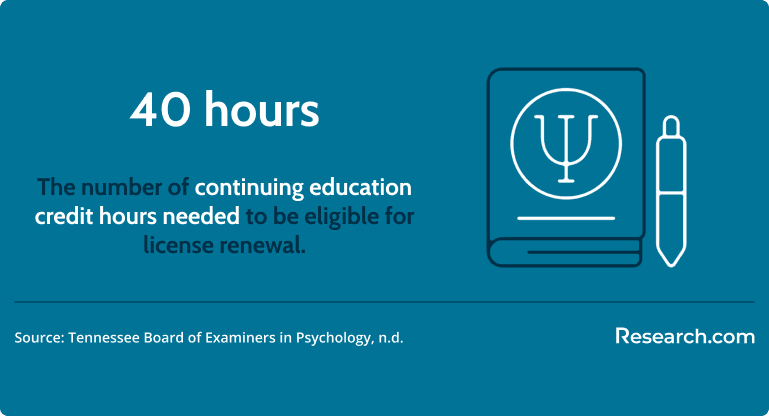
- Complete continuing education. Tennessee psychologists must complete 40 hours of continuing education credits for renewal. These credits must be earned between January 1 and December 31 in the two calendar years before the renewal year.
- Use the online renewal system. Psychologists can renew through the Licensure and Regulatory System site. Users who have not accessed the newer system since March 23, 2018 need to create an account.
- Pay the renewal fee. Tennessee psychologist licenses renew every two years, and the renewal fee is $225.
- Resolve tax clearance issues. If the Department of Revenue has notified the Board that a professional privilege tax is unpaid, the Board cannot renew the license until it receives a tax clearance letter.
Importance of Location When Choosing Psychology Programs in Tennessee
Location can shape your psychology training more than many applicants expect. Tennessee programs may offer different access to hospitals, school districts, rural behavioral health sites, research labs, correctional settings, veterans’ services, and private practice networks. Those practical experiences can influence your internship readiness and long-term career direction.
Nashville, Memphis, and Knoxville can provide access to larger medical systems, research centers, and diverse client populations. Programs in or near rural regions may be especially valuable for students interested in integrated care, community psychology, school psychology, or underserved populations. Neither option is automatically better; the right choice depends on your specialty and the populations you want to serve.
Cost of living also matters. A lower tuition rate may not save money if housing, transportation, parking, internship travel, or unpaid practicum requirements make attendance expensive. Before enrolling, compare total cost, not just published tuition.
Students comparing campus options can use Research.com’s guide to the best colleges for psychology in Tennessee to review program features and regional advantages.
Questions to Ask Before Choosing a Tennessee Psychology Program
- Is the doctoral program APA-approved or National Register-designated for Tennessee licensure purposes?
- Does the program place students in the type of practicum or internship settings I need?
- How does the program support EPPP preparation?
- Are assistantships, tuition waivers, or funding packages available?
- What percentage of students complete the program, match with internships, and move into licensure-track roles?
- Will the program support my intended specialty, such as clinical, school, forensic, neuropsychology, or organizational psychology?
List of Top Psychology Programs in Tennessee for 2027
The following Tennessee psychology programs are useful starting points for graduate applicants. Review each school’s current catalog, funding policies, accreditation status, licensure alignment, and faculty research areas before applying.
| Institution | Program length | Tracks or concentrations | Credits | Cost per credit | Accreditation |
| Vanderbilt University | Five years | Clinical Science, Cognitive and Cognitive Neuroscience, Developmental Science, Neuroscience, Quantitative Methods | 90 | $2,088 | APA |
| University of Tennessee, Knoxville | Five years | Clinical Psychology, Experimental Psychology, School Psychology | 90 | $1,776 | APA |
| University of Memphis | Five years | Clinical Psychology, Cognitive Psychology, Developmental Psychology, Social Psychology | 90 | $1,421 | APA |
| East Tennessee State University | Five years | Clinical Psychology, Experimental Psychology | 90 | $1,233 | APA |
| Middle Tennessee State University | Two to three years | Clinical Psychology, Experimental Psychology, Quantitative Psychology, School Psychology, Industrial-Organizational Psychology | 43 to 46 | $536 (in-state); $1,483 (out-of-state) | APA |
Vanderbilt University
Vanderbilt University offers a Psychological Sciences doctoral program built through collaboration between the Department of Psychology in the College of Arts and Science and the Department of Psychology and Human Development in Peabody College. The program emphasizes psychological theory, research design, and original empirical work across several areas of specialization.
- Best for: Students seeking a research-intensive doctoral environment with multiple science-based tracks.
- Key decision factor: Applicants should match their interests closely with faculty research areas before applying.
University of Tennessee, Knoxville
The University of Tennessee, Knoxville offers graduate psychology training that combines research, assessment, counseling, and teaching preparation. Faculty approaches include psychodynamic, cognitive-behavioral, emotion-focused, and systemic perspectives.
- Best for: Students who want clinical, experimental, or school psychology options within a large public university setting.
- Key decision factor: Compare practicum opportunities and specialty fit before choosing a track.
University of Memphis
The University of Memphis Department of Psychology is recognized as a Center of Excellence in Tennessee and has more than 30 full-time faculty members. Doctoral students receive at least four years of assistantship funding, tuition waivers, health coverage, office space, and conference travel support.
The department expects early research engagement. Students are encouraged to begin research in the first year and develop individualized projects with a primary mentor and additional faculty members.
- Best for: Doctoral applicants who want strong research mentorship and structured funding support.
- Key decision factor: Faculty mentor fit is central because research involvement begins early.
East Tennessee State University
East Tennessee State University’s Clinical Psychology Ph.D. concentration focuses on clinical training for rural behavioral health needs, especially in integrated primary healthcare environments. Its Experimental Psychology Ph.D. concentration prepares students for translational research in developmental psychology, cognitive psychology, social psychology, and behavioral neuroscience.
- Best for: Students interested in rural behavioral health, integrated care, or translational psychological science.
- Key decision factor: Applicants should consider whether rural and integrated care training aligns with their career goals.
Middle Tennessee State University
Middle Tennessee State University offers Master of Arts degrees across six graduate psychology programs and an Education Specialist degree in School Psychology. Because master’s and specialist-level programs can lead to different career outcomes than doctoral psychology programs, applicants should verify whether the credential supports their intended license or role.
- Best for: Students considering master’s-level psychology training, school psychology, or applied specialties.
- Key decision factor: Confirm whether the program aligns with psychologist licensure, school psychology credentialing, or another professional path.
Is Expanding Into Substance Abuse Counseling a Valuable Option for Psychology Professionals in Tennessee?
Substance abuse counseling can be a practical adjacent specialty for psychology students and professionals who want to work with addiction, co-occurring disorders, crisis intervention, relapse prevention, and community behavioral health. It may be especially relevant for clinicians who already serve clients with anxiety, depression, trauma, family stress, or court-involved treatment needs.
This path is not the same as psychologist licensure, so professionals should check Tennessee’s specific credentialing rules before changing services or job titles. For a focused licensing and certification overview, see Research.com’s guide on how to become a substance abuse counselor in Tennessee.
How Can a Master's in Educational Psychology Enhance Your Practice and Career Prospects in Tennessee?
Educational psychology can strengthen skills in learning assessment, motivation, instructional design, student development, and intervention planning. It can be useful for professionals working with schools, higher education, testing programs, learning support, or research teams.
A master’s in educational psychology may broaden your expertise, but it should not be confused with psychologist licensure unless it is part of a pathway that meets Tennessee’s doctoral and Board requirements. Students should ask whether the program is designed for research, school-based services, instructional roles, or preparation for further doctoral study.
How Can You Become a Board Certified Behavior Analyst (BCBA) in Tennessee?
Board Certified Behavior Analyst preparation is a separate professional route centered on applied behavior analysis, behavioral assessment, intervention planning, data collection, and supervised practice. It can complement psychology training, particularly for professionals working with autism services, developmental disabilities, school-based behavior supports, or intensive behavioral intervention programs.
Because BCBA certification has its own coursework, supervision, and examination expectations, candidates should not assume that a psychology degree alone is enough. For Tennessee-specific guidance, review how to become a BCBA in Tennessee.
What Value Does Advanced Psychometric Training Add to Your Psychology Career in Tennessee?
Psychometric training can be valuable for professionals who want to specialize in psychological testing, educational measurement, employment assessment, clinical instruments, research design, or data interpretation. Strong assessment skills can support better diagnostic clarity and more defensible recommendations when used within the professional’s legal scope of practice.
Students interested in testing-heavy careers should compare licensure requirements, supervised assessment experience, and employer expectations. Research.com’s psychometrician career salary guide offers additional context on assessment-focused career pathways.
How Can I Transition to a Counseling Role in Tennessee?
Moving from psychology coursework into counseling practice may require a different licensure route. Counseling roles commonly emphasize client-centered therapy, diagnosis within scope, treatment planning, supervised counseling experience, and state-specific examinations. A psychology degree may help, but it does not automatically satisfy all counseling licensure requirements.
If your goal is to become a licensed professional counselor rather than a psychologist, review how to become an LPC in Tennessee before selecting a program or supervised placement.
How Can Integrating Social Work Principles Augment Your Psychology Career in Tennessee?
Social work principles can make psychology practice more responsive to real-world client needs. Case coordination, resource navigation, family systems awareness, advocacy, community partnerships, and attention to social determinants of health can improve care planning, especially for underserved communities.
Psychologists do not become social workers simply by using social work-informed methods. If you want to hold a social work license or move into social work practice, review the education and credentialing pathway explained in what degree you need to be a social worker in Tennessee.
How Can Ongoing Professional Development Enhance Practice in Tennessee?
Continuing education is more than a renewal requirement. It helps psychologists keep pace with ethics, telehealth practices, assessment standards, documentation expectations, cultural competence, trauma-informed care, and new treatment research. In Tennessee, renewal requires 40 hours of continuing education credits during the designated two-calendar-year period before the renewal year.
Professional development can also support specialization. For example, professionals interested in school-based assessment, student support, and educational systems can review how to become a school psychologist in Tennessee to understand how that pathway differs from general psychologist licensure.
How can I become a criminal psychologist in Tennessee?
Criminal psychology is typically connected to forensic assessment, criminal behavior, legal systems, correctional settings, competency questions, risk evaluation, and expert consultation. Students sometimes ask, is criminal psychology a major? Programs may use different names, including forensic psychology, criminal psychology, or psychology with forensic coursework, so applicants should look beyond the title and evaluate the curriculum, supervised experience, and licensure fit.
In Tennessee, aspiring criminal or forensic psychology professionals usually need advanced psychology education, supervised experience, and training that connects psychological science with legal and correctional contexts. For a more direct pathway overview, see how to become a criminal psychologist in Tennessee.
How Does Telepsychology Enhance Service Delivery in Tennessee?
Telepsychology can help Tennessee practitioners reach clients who face transportation barriers, live in underserved areas, or need flexible scheduling. It also requires careful attention to privacy, informed consent, emergency procedures, technology security, documentation, and jurisdiction rules.
Telehealth does not remove licensure obligations. Psychologists and counselors should verify whether their license permits the service, where the client is located, and which state rules apply. Professionals who want a faster route into counseling-focused work can compare options in Research.com’s guide to the shortest path to become a counselor in Tennessee.
How do Tennessee LPC license requirements impact clinical and counseling practices?
Tennessee LPC requirements affect who may provide professional counseling services, what education is required, how supervised experience is documented, and which examinations or Board rules apply. The LPC pathway is different from psychologist licensure, even though both fields may involve mental health treatment.
If you are deciding between psychology licensure and counseling licensure, compare scope of practice, degree level, supervision expectations, time to completion, and the kinds of clients you want to serve. Research.com’s guide to Tennessee LPC license requirements explains the counseling-specific route.
What are the emerging areas of specialization in psychology in Tennessee?
Specialization can help psychologists align their training with employer needs and client populations. The strongest choice depends on your doctoral training, supervised experience, licensure status, and professional goals.
- Telepsychology: Remote care can improve access, but it requires strong knowledge of confidentiality, technology, client location rules, and emergency planning.
- Forensic psychology: This area connects psychology with courts, corrections, competency evaluations, expert testimony, and criminal behavior assessment.
- Neuropsychology: Neuropsychology focuses on brain-behavior relationships and often involves assessment of cognitive impairment, brain injury, developmental disorders, or neurological conditions.
- Health psychology: Health psychologists address the behavioral and emotional dimensions of chronic illness, health behavior, stress, pain, and integrated healthcare.
- Industrial-organizational and business psychology: These applied specialties use psychological science to improve hiring, leadership, employee engagement, organizational culture, and workplace well-being.
| Specialty | When it may be a good fit | Important caution |
| Clinical or counseling psychology | You want to provide assessment, diagnosis, and therapy within psychologist scope | Requires meeting Tennessee psychologist licensure standards |
| School psychology | You want to work with students, schools, learning needs, and educational systems | Credentialing may differ from general psychology practice |
| Substance abuse counseling | You want to focus on addiction, recovery, and co-occurring behavioral health needs | May require separate certification or licensure |
| Applied behavior analysis | You want to design behavior interventions and analyze behavioral data | BCBA requirements are distinct from psychologist licensure |
| Business psychology | You want to apply psychology in workplaces, leadership, HR, or organizational consulting | Clinical authority depends on licensure, not business psychology training alone |
Salary Expectations and Career Outlook for Psychologists in Tennessee
Psychologist salary in Tennessee depends on specialization, licensure, employer type, geography, experience, and whether the professional works in private practice, healthcare, schools, research, government, or consulting. Reported salary averages should be treated as planning estimates rather than guaranteed earnings.
Salary Factors to Compare
- Specialization: Clinical, school, forensic, neuropsychology, industrial-organizational, and assessment-focused roles can have different compensation patterns.
- Experience: Early-career professionals generally have less bargaining power than licensed psychologists with advanced specialization, leadership duties, or an established practice.
- Setting: Hospitals, private practices, universities, schools, government agencies, and corporate employers may use different pay structures.
- Location: Urban areas may offer more job options, while rural areas may provide different service needs and professional opportunities.
- Credential fit: A degree that does not meet licensure expectations can limit access to independent practice roles.
Job Market Considerations
Tennessee offers roles for psychology professionals in clinical care, counseling centers, school systems, universities, research programs, assessment services, behavioral health agencies, correctional settings, and corporate environments. The best opportunities usually go to candidates whose education, supervised experience, license, and specialty match the role closely.
Professionals interested in organizational roles may compare affordable online master’s programs in organizational psychology as one way to build applied workplace expertise. However, students should confirm whether the credential supports their target job title and whether licensure is needed.
Integrating Business Psychology into Emerging Psychological Practices
Business psychology applies psychological principles to workplace behavior, leadership, hiring, employee development, organizational culture, and work-related well-being. It is a practical option for students who like psychology but do not necessarily want a traditional therapy-centered career.
Where Business Psychology Can Be Used
- Employee assessment and development: Using evidence-based tools to understand skills, performance needs, and growth opportunities.
- Leadership coaching: Helping managers improve communication, decision-making, motivation, and team effectiveness.
- Workplace mental health: Supporting burnout prevention, stress management, wellness programs, and healthier work systems.
- Organizational strategy: Applying behavioral data to workforce planning, change management, and culture improvement.
Students who want to combine psychology with organizational strategy can explore a business psychology pathway. Possible roles include human resources consultant, talent development specialist, organizational change manager, and corporate wellness program designer. These roles may not require psychologist licensure, but job requirements vary by employer.
What Other Licenses or Certifications Are Required for Psychology Professionals in Tennessee?
Not every mental health career in Tennessee uses the same license. A person trained in psychology may still need a different credential to practice as a counselor, marriage and family therapist, social worker, school psychologist, substance abuse counselor, or behavior analyst.
For example, professionals who want to work specifically with couples, families, and relationship systems may consider an MFT license in Tennessee. This credential is separate from psychologist licensure and focuses on family systems, relational dynamics, and therapy within the MFT scope of practice.
Common Mistakes to Avoid When Pursuing Psychology Licensure in Tennessee
- Choosing a program without checking licensure alignment. A psychology-related degree is not automatically enough for Tennessee psychologist licensure.
- Assuming online and campus programs have the same outcomes. Delivery format is less important than accreditation, supervised training, faculty fit, and licensure preparation.
- Looking only at tuition. Total cost includes fees, housing, transportation, books, unpaid practicum time, internship travel, and lost income.
- Waiting too long to document supervised experience. Keep supervisor names, dates, duties, hours, and setting details organized from the beginning.
- Confusing psychology, counseling, social work, MFT, and BCBA pathways. These fields overlap but have different scopes of practice and licensing rules.
- Assuming salary averages are guaranteed. Reported wages are useful for planning, but individual earnings depend on specialty, employer, location, and experience.
- Ignoring renewal rules. Tennessee psychologists must plan ahead for 40 hours of continuing education and the two-year renewal cycle.
Obtaining a Psychology License in Tennessee
The Tennessee psychology licensure process is best understood as a sequence: complete the required education, gain Board-compliant supervised experience, pass the EPPP and Tennessee Jurisprudence Exam, submit documentation and fees, and maintain the license through renewal and continuing education.
Before committing to a program, ask whether it supports your exact goal. A student pursuing independent clinical psychology practice needs a different plan from someone pursuing criminal psychology research, school psychology, counseling licensure, organizational consulting, or an applied behavior analysis credential.
The strongest path is the one that connects your degree, supervised experience, examinations, license, and intended job market. Use program rankings and school lists as starting points, but make the final decision based on accreditation, training quality, funding, licensure fit, specialty match, and practical career outcomes.
Key Insights
- Tennessee regulates psychology practice. Psychology is treated as one of the healing arts, and practicing without the correct Tennessee license or certification can violate state law.
- The psychologist pathway is doctoral-level. Tennessee applicants generally need a doctoral degree in psychology from an APA-approved or National Register-designated program, supervised professional experience, and passing exam results.
- Licensure and renewal require planning. Applicants must submit transcripts, supervision verification, exam documentation, and fees; renewal occurs every two years and requires 40 hours of continuing education.
- Program choice should follow career intent. Clinical practice, school psychology, business psychology, forensic work, counseling, social work, MFT, and BCBA roles can require different credentials.
- Salary figures are useful but not guaranteed. Tennessee psychologist earnings vary by setting, specialty, experience, geography, and license status.
- Accreditation is a decision point, not a detail. Before enrolling, verify that the program’s accreditation or designation supports your Tennessee licensure goal.
Related Articles for Nearby States
- 2027 Kentucky Psychology Licensure Requirements – How to Become a Psychologist in Kentucky
- 2027 Mississippi Psychology Licensure Requirements – How to Become a Psychologist in Mississippi
- 2027 Alabama Psychology Licensure Requirements – How to Become a Psychologist in Alabama
- 2027 Georgia Psychology Licensure Requirements – How to Become a Psychologist in Georgia
- 2027 North Carolina Psychology Licensure Requirements – How to Become a Psychologist in North Carolina
- 2027 Missouri Psychology Licensure Requirements – How to Become a Psychologist in Missouri
- 2027 Arkansas Psychology Licensure Requirements – How to Become a Psychologist in Arkansas
- 2027 Virginia Psychology Licensure Requirements – How to Become a Psychologist in Virginia
- 2027 Indiana Psychology Licensure Requirements – How to Become a Psychologist in Indiana
- 2027 South Carolina Psychology Licensure Requirements – How to Become a Psychologist in South Carolina
References:
- U.S. Bureau of Labor Statistics. (2025). Psychologists: Occupational Outlook Handbook. https://www.bls.gov/ooh/life-physical-and-social-science/psychologists.htm
- Indeed. (2025). Psychologist salary in Tennessee. https://www.indeed.com/career/psychologist/salaries/TN
- Projections Central. (2025). Long-Term occupational Projections | Projections Central. https://www.projectionscentral.org/volume/2024/state/tn
- Tennessee Board of Examiners in Psychology. (n.d.). 1180 Board of Examiners of Psychology. https://publications.tnsosfiles.com/rules/1180/1180.htm
Other Things You Should Know About The Tennessee Psychology Licensure
You need to complete supervised professional experience as per the requirements set by the Tennessee Board of Examiners in Psychology. The exact number of hours and specific criteria can be verified directly with the Board.
To become a licensed psychologist in Tennessee in 2027, you need a doctoral degree in psychology, 1,900 hours of pre-doctoral and 1,900 hours of post-doctoral supervised experience. Additionally, you must pass the EPPP and the Tennessee Jurisprudence Exam.
Psychologists in Tennessee must renew their licenses every two years. The renewal process includes completing 40 hours of continuing education credits and paying the renewal fee.
To earn a psychology license in Tennessee, candidates must complete a doctoral degree in psychology from an accredited institution. The program should align with standards set by the American Psychological Association or the National Register of Health Service Psychologists.
Yes, the Tennessee Department of Health offers an online application system where you can apply for your initial license, complete a practitioner profile, and upload required documents. The initial application fee can be paid online using a credit card, debit card, or e-check.
To obtain a psychology license in Tennessee, candidates must pass the Examination for Professional Practice in Psychology (EPPP) and the Tennessee State Jurisprudence Examination, ensuring an understanding of relevant ethical and legal standards.
To renew your psychology license in Tennessee, you must complete 40 hours of continuing education credits every two years. These credits must be obtained between January 1 and December 31 in the two calendar years before your renewal year.


