2027 How to Become a Licensed Therapist (LPC) in Tucson, AZ

Co-Founder and Chief Data Scientist
Becoming a Licensed Professional Counselor in Tucson is a structured process: you need the right graduate degree, supervised clinical experience, a state-approved exam, and approval from the Arizona Board of Behavioral Health Examiners. The path is demanding, but the local labor market makes it worth serious consideration. Counseling jobs in Arizona are projected to grow 39.1% by 2032, with more than 1,200 openings expected each year.
This guide is for future counselors, career changers, psychology graduates, and helping professionals who want to understand what it actually takes to become an LPC in Tucson. You will learn the education requirements, licensure steps, supervision rules, local school options, salary expectations, employers, related career paths, and practical mistakes to avoid before investing in a counseling degree.
Quick Answer: How do you become an LPC in Tucson?
To become an LPC in Tucson, you first complete a qualifying master’s or doctoral degree in counseling or a closely related field from a regionally accredited institution. The program must include at least 60 semester credits and meet Arizona’s required counseling curriculum and clinical training standards. After graduation, you typically begin as a Licensed Associate Counselor, complete supervised post-master’s experience, pass a board-approved exam, and then apply for full Licensed Professional Counselor status through the Arizona Board of Behavioral Health Examiners.
Key Things to Know About Becoming an LPC in Tucson
- Your graduate degree is the foundation for licensure. Arizona requires a master’s or doctoral degree in counseling or a related field with at least 60 semester credits. The program must be offered by a regionally accredited institution and must satisfy the Arizona Board of Behavioral Health Examiners’ required coursework and clinical preparation standards.
- Supervised practice is a major part of the process. After completing an eligible graduate degree, candidates must complete at least 3,200 hours of supervised post-master’s counseling experience over a minimum of 24 months. That total must include 1,600 direct client contact hours and 100 hours of clinical supervision.
- Arizona’s counseling labor market is expanding quickly. Counseling roles in Arizona are projected to grow 39.1% from 2022 to 2032, which is much faster than the national average. This growth creates more opportunities for new counselors, especially in communities with unmet behavioral health needs in southern Arizona.
- Education requirements for LPC licensure in Tucson
- How to apply for counselor licensure in Tucson
- Tucson schools and programs for future LPCs
- Internship and practicum options for counseling students
- LPC salary expectations in Tucson
- Supervision requirements before full LPC status
- Adding substance abuse counseling to an LPC practice
- Moving from LPC work into marriage and family therapy
- Using LPC experience in educational settings
- Continuing education and license renewal
- BCBA certification as an additional credential
- Whether Tucson is a strong market for LPCs
- How competitive Tucson’s LPC job market is
- Counseling associations and professional networks
- Common LPC employers in Tucson
What are the educational requirements to become an LPC in Tucson?
The Arizona Board of Behavioral Health Examiners sets the academic rules for counselor licensure across the state, including Tucson. Before you can practice independently as an LPC, your graduate education must show that you have studied core counseling theory, ethics, assessment, human development, diversity, research, and supervised clinical practice.
- You need a qualifying graduate degree. Arizona requires a master’s or doctoral degree with a major counseling emphasis from a regionally accredited institution. The degree must include at least 60 semester hours, or 90 quarter hours, of graduate-level coursework.
- Your program must cover eight core areas. Required topics include professional orientation and ethical practice, social and cultural diversity, human growth and development, career development, helping relationships, group work, assessment, and research and program evaluation.
- Your degree must include supervised clinical training. If your program is not CACREP- or CORE-accredited, Arizona requires at least 700 hours of supervised clinical practicum or internship experience as part of the degree.
- Nontraditional, international, or unaccredited programs may require extra review. Applicants from programs without recognized accreditation may need to provide syllabi, course descriptions, and other documentation. The board may also require additional graduate coursework.
- Some academic gaps can be corrected after graduation. If your transcript is missing a required content area or credit requirement, you may be able to complete approved graduate-level coursework later to address the deficiency.
| Requirement | What Tucson applicants should verify before enrolling |
| Degree level | Confirm the program awards a master’s or doctoral degree that can support counselor licensure in Arizona. |
| Credit total | Check that the curriculum includes at least 60 semester hours or 90 quarter hours of graduate coursework. |
| Institutional accreditation | Make sure the school is regionally accredited, not only nationally or programmatically recognized. |
| Clinical training | Ask whether the practicum and internship structure satisfies Arizona’s clinical training expectations. |
| Curriculum match | Compare required courses with Arizona’s eight core counseling content areas before committing. |
Educational eligibility matters because it determines whether you can move into Licensed Associate Counselor status, the supervised stage required before full LPC licensure. A program that looks convenient or affordable can still create problems if it does not meet Arizona’s rules.
How do you apply for licensure as a counselor in Tucson?
Counselor licensure in Tucson is handled at the state level by the Arizona Board of Behavioral Health Examiners. The application process is designed to confirm that applicants have the required education, clinical preparation, ethical fitness, and examination record before they begin licensed practice.
- File the correct application with the AZBBHE. Applicants submit the required licensure application through the Arizona Board of Behavioral Health Examiners and provide accurate personal, academic, and professional information.
- Send official proof of graduate education. You must provide transcripts showing completion of an eligible master’s or doctoral counseling program from a regionally accredited institution.
- Pass an approved counseling examination. Arizona applicants must pass a board-approved exam, such as the National Counselor Examination, or another qualifying test accepted by the board.
- Document clinical experience when required. Candidates applying at the Licensed Associate Counselor stage must show that their supervised clinical hours meet board expectations.
- Complete the background and fee requirements. The process includes payment of the required application fee and a criminal background check to determine professional suitability.
Once approved for LAC status, you may provide counseling services under supervision while you work toward the experience required for full LPC licensure. If your long-term goal is a broader psychology-based clinical career, it may also help to compare this route with how to become a counseling psychologist, which involves additional education and training in clinical psychology.
How the LPC path compares with related counseling careers
| Career path | Best fit for | Key difference from LPC preparation |
| Licensed Professional Counselor | Students who want to provide mental health counseling to individuals, groups, and families in clinical or community settings. | Focused on professional counseling practice and Arizona LPC licensure rules. |
| Counseling psychologist | Students interested in psychological assessment, research-informed clinical work, and doctoral-level psychology practice. | Generally requires more advanced psychology training than the LPC route. |
| School counselor | Students who want to support academic, social, and emotional development in K-12 settings. | May involve education-specific credentialing and school-based requirements. |
| Marriage and family therapist | Clinicians who want a primary focus on couples, family systems, and relational therapy. | Uses a family systems licensure pathway rather than standard LPC-only preparation. |
Growing Demand for LPCs Nationwide
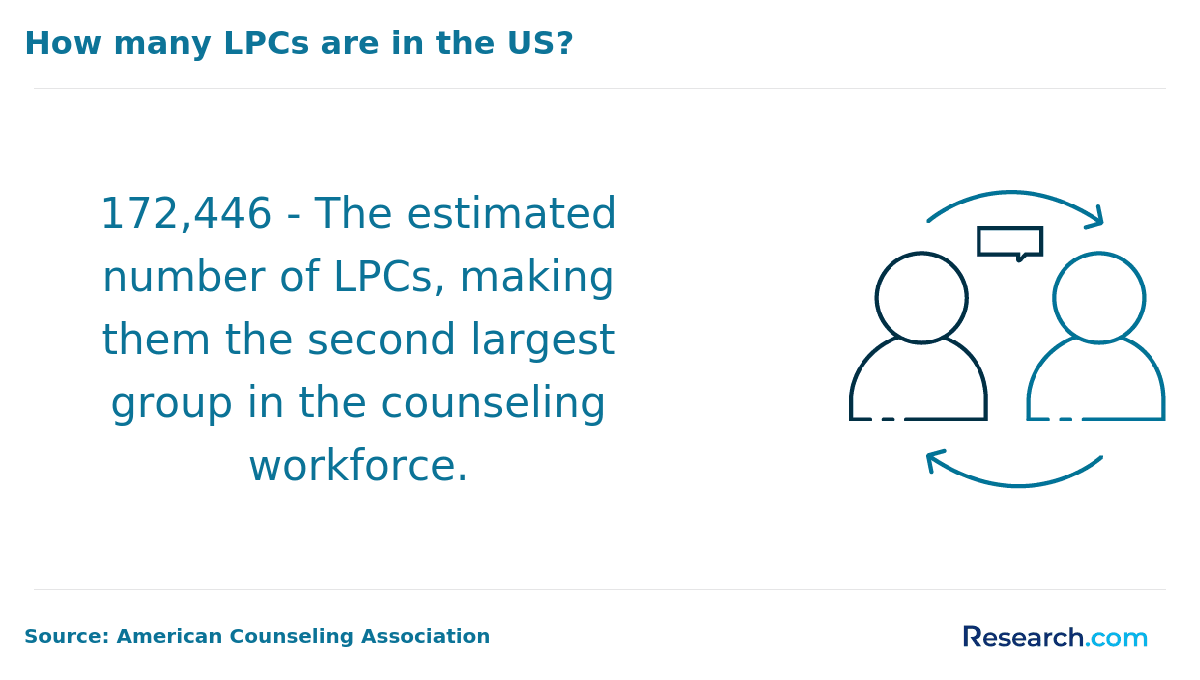
The LPC workforce is already substantial. There are an estimated 172,446 LPCs nationwide, making LPCs the second largest group in the counseling workforce. For students in Tucson, this signals two realities at once: mental health services need qualified clinicians, but new counselors should still build strong clinical skills, supervision relationships, and specialized experience to stand out.
Which schools in Tucson offer programs for aspiring LPCs?
Tucson-area students can prepare for LPC licensure through local, hybrid, and online graduate programs. The most important question is not simply whether a school offers counseling courses. You need to confirm that the degree aligns with Arizona Board of Behavioral Health Examiners requirements, includes the correct clinical training, and gives you a realistic path to supervised experience after graduation.
- University of Arizona. The University of Arizona offers a Master of Arts in Counseling Psychology with CACREP accreditation. The program emphasizes counseling skills, human development, clinical practice, and professional ethics for students preparing for Arizona counseling licensure.
- Northern Arizona University. Northern Arizona University offers a Master of Arts in Counseling with a Clinical Mental Health Counseling focus. Tucson residents may find the online and hybrid formats useful, and the CACREP-accredited structure can help students align their education with Arizona licensure expectations.
- Pima Community College. Pima Community College does not offer a master’s-level counseling degree, but it can be a practical starting point for students completing lower-cost foundational coursework in psychology, social work, or related subjects before transferring into a bachelor’s or graduate pathway.
Students who need more flexibility may also compare online options, including popular online masters in marriage and family counseling programs. However, online students should be especially careful: not every distance-based counseling program is designed to meet Arizona LPC requirements.
Questions to ask before choosing a counseling program
- Does the program meet Arizona’s LPC educational requirements, not just general counseling standards?
- Is the institution regionally accredited?
- Is the counseling program CACREP- or CORE-accredited, or will you need extra documentation?
- How many practicum and internship hours are included in the degree?
- Does the school help Tucson students secure approved local placements?
- What percentage of students complete the program on time?
- Will online or hybrid coursework create any licensure complications?
- How does the program support students preparing for a board-approved exam?
Are there internship or practicum opportunities for counseling students in Tucson?
Yes. Counseling students in Tucson can often complete practicum and internship hours in community mental health, nonprofit, school-based, hospital, private practice, and integrated healthcare settings. These placements are important because they help students turn classroom knowledge into supervised counseling skills with real clients.
- Community clinics and counseling centers. Tucson has mental health clinics and community-based providers that may partner with schools such as the University of Arizona and Northern Arizona University for supervised student placements. These settings may expose interns to mental health counseling, substance use treatment, family work, and crisis-related services.
- Schools and nonprofit organizations. Nonprofits and educational settings may offer opportunities to support children, adolescents, adults, and families. These placements can be useful for students interested in prevention, trauma-informed care, student support, or underserved populations.
- Hospitals and private practices. Some students pursue placements in healthcare systems or private counseling practices. These sites may offer closer exposure to specialized clinical work, documentation practices, care coordination, and individual therapy models.
Clinical placement is a common feature across many counseling disciplines. For example, top genetic counseling programs also rely on supervised field experiences to help students apply professional skills in real settings. For future LPCs in Tucson, strong practicum and internship choices can shape your first job options, supervision network, and clinical confidence.
| Placement setting | What students may learn | Who it may suit |
| Community mental health | Assessment, treatment planning, crisis exposure, and work with diverse client needs. | Students interested in high-need populations and broad clinical experience. |
| Schools or youth programs | Child and adolescent support, family coordination, and prevention-focused services. | Students considering school-based or youth-focused counseling roles. |
| Hospital or integrated care | Team-based care, behavioral health documentation, and coordination with medical providers. | Students interested in healthcare settings or complex client presentations. |
| Private practice | Individual therapy, client retention, scheduling, and business-side exposure. | Students who may eventually want independent or group practice work. |
How much do LPCs make in Tucson?
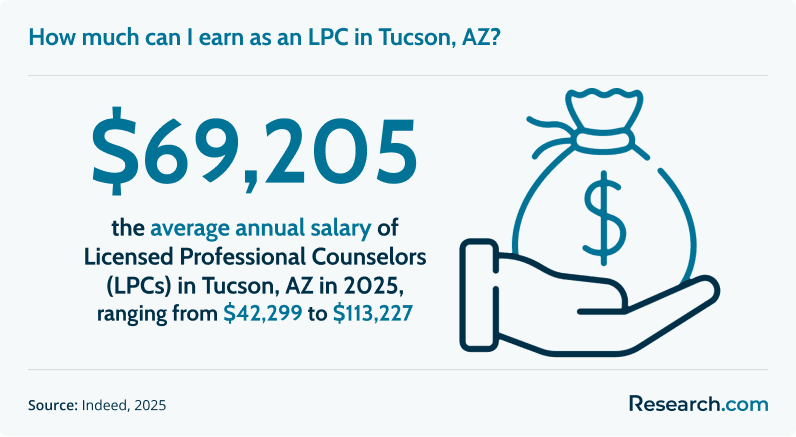
Licensed Professional Counselors in Tucson, AZ, earn an average annual salary of approximately $69,205 in 2025. Reported pay varies widely, from around $42,299 to $113,227, depending on experience, setting, specialization, caseload, and employer type. This Tucson figure is about 10% below the national average for LPCs.
Salary should be evaluated with context. Hospital systems, larger healthcare organizations, specialized clinical roles, and established private practices may pay more than some nonprofit or community-based positions. Lower-paying roles may still offer valuable benefits, supervision access, student loan support, training, or a stronger pathway into licensure.
Tucson’s lower salary level may be partly offset by its lower cost of living compared with many larger metro areas. Still, students should run the numbers before borrowing heavily for graduate school. If keeping education debt low is a priority, comparing options such as the most affordable online Master's in Counseling can help you evaluate cost before choosing a program.
| Salary factor | How it can affect LPC pay in Tucson |
| Experience level | Newer clinicians often start closer to entry-level ranges, while experienced LPCs may qualify for higher-paying clinical or supervisory roles. |
| Work setting | Hospitals, healthcare systems, and private practice roles may pay differently from nonprofit or community agency positions. |
| Specialization | Experience with substance use, trauma, children and adolescents, crisis care, or integrated behavioral health may improve competitiveness. |
| Licensure status | Fully licensed LPCs generally have more independence and job options than associate-level clinicians still under supervision. |
| Benefits and support | Salary is only one part of compensation; supervision, insurance, paid training, loan assistance, and schedule flexibility can change total value. |
What are the supervision requirements for LPCs in Tucson?
Future LPCs in Tucson must complete 24 months of post-master’s degree work experience before qualifying for full independent licensure. This experience must include at least 1,600 hours of direct client contact and 100 hours of clinical supervision. No more than 400 of the direct client contact hours may be related to psychoeducation.
Some graduate pathways, including school counseling online master's programs, include structured fieldwork and supervision during the degree. However, students should not assume that program-based supervision automatically replaces Arizona’s post-master’s LPC supervision requirements. Always confirm which hours count toward which stage of licensure.
These supervision requirements matter because Arizona’s counseling workforce serves clients with a wide range of behavioral health needs. The state has more than 8,000 professionals working in substance abuse, behavioral disorder, and mental health counseling, and careful supervision helps new clinicians build the judgment needed for safe and ethical practice.
How to make supervision work in your favor
- Choose a supervisor with experience in the population or specialty you want to serve.
- Keep detailed records of hours, client contact, supervision dates, and supervisor approvals.
- Clarify expectations for documentation, crisis protocols, mandated reporting, and ethical decision-making early.
- Ask whether your employer provides supervision at no cost or whether you must pay separately.
- Review Arizona’s supervision rules before accepting a job that promises hours toward LPC licensure.
How can LPCs expand their practice to include substance abuse counseling in Tucson?
LPCs in Tucson who want to serve clients with substance use concerns can build a more focused practice through additional training, supervised experience, and relevant credentialing. Substance abuse counseling can pair naturally with mental health counseling because many clients experience overlapping behavioral health, trauma, family, and recovery needs. To understand the specific steps, review this guide on how to become a drug counselor in Tucson.
Can LPCs transition into marriage and family therapy in Tucson?
Yes, but LPCs who want to practice as marriage and family therapists should examine whether they need additional education, supervised experience, or a separate credential. Marriage and family therapy focuses heavily on relational patterns, couples work, family systems, and conflict dynamics. LPCs who want this specialty can use how to become a marriage and family therapist in Tucson to compare the requirements with their current counseling background.
Can LPCs transition into educational roles in Tucson?
LPC training can be valuable in schools, colleges, student support programs, and behavioral health coordination roles. However, education-based jobs may require credentials beyond LPC licensure, especially for formal teaching or school-specific positions. Counselors considering a move into education can compare training options through this guide to the cheapest way to become a teacher in Tucson.
What are the continuing education and licensure renewal requirements for LPCs in Tucson?
LPCs in Tucson must maintain licensure by following Arizona’s continuing education and renewal standards. Renewal usually involves completing approved professional development, keeping documentation, and submitting renewal materials by the required deadline. Topics may include ethics, cultural competence, clinical methods, legal updates, and emerging counseling practices. For a broader step-by-step overview of mental health counseling preparation in the city, see how to become a mental health counselor in Tucson.
Is pursuing BCBA certification a viable path for LPCs in Tucson?
BCBA certification can be a useful add-on for LPCs who want to work more deeply with behavior analysis, autism services, developmental disabilities, or structured behavioral interventions. This route is separate from LPC licensure and requires additional coursework, supervised behavior analysis experience, and a certification exam. LPCs considering this direction should review BCBA certification requirements in Tucson before deciding whether the time and cost fit their goals.
Is Tucson a good place to work as an LPC?
Tucson can be a strong place to build an LPC career if you value community-based mental health work, cultural diversity, and a lower-cost lifestyle compared with many larger metropolitan areas. Counselors in the city may work with clients experiencing anxiety, depression, trauma, substance use concerns, relationship stress, and other behavioral health challenges.
The trade-off is compensation. Tucson’s average LPC salary is lower than some other Arizona cities, so the decision should include both professional fit and financial planning. For many clinicians, Tucson’s appeal comes from the combination of meaningful work, local healthcare and nonprofit networks, outdoor lifestyle, and a more manageable cost profile.
How does Tucson’s LPC salary compare to other Arizona cities?
The average annual salary for LPCs in Tucson is approximately $69,205. Other Arizona cities report higher figures: Scottsdale is around $102,680 annually, Glendale is approximately $95,168, and Sierra Vista is approximately $93,325.
That difference does not automatically mean Tucson is the wrong choice. A higher salary in another city may come with higher housing costs, longer commutes, or different clinical workloads. Compare salary, benefits, supervision, caseload expectations, cost of living, and career growth before deciding where to practice.
| Choose Tucson if you value... | Consider another market if you need... |
| Lower living costs than many larger cities | The highest possible LPC salary in Arizona |
| Community health, nonprofit, and culturally responsive counseling work | A larger concentration of high-paying private practice or hospital roles |
| A slower pace and access to outdoor lifestyle options | A bigger metropolitan job market with more employer variety |
| Opportunities to serve southern Arizona communities | A location where compensation is the primary deciding factor |
How competitive is the job market for LPCs in Tucson?
Tucson’s LPC job market benefits from strong statewide demand. Arizona employment for substance abuse, behavioral disorder, and mental health counselors is projected to grow 39.1% from 2022 to 2032, with an average of 1,290 annual job openings. Among neighboring states, Arizona has the highest projected growth rate for this occupational group.
Even in a growing market, competition still exists. Employers may prefer candidates who already have supervised clinical hours, experience with high-need populations, bilingual or culturally responsive counseling skills, crisis training, substance use knowledge, or comfort with telehealth and integrated care teams.
The chart below compares projected job growth and annual openings for substance abuse, behavioral disorder, and mental health counselors in Arizona and neighboring states. Use it as labor-market context, not as a guarantee of employment.
Current trends affecting LPCs in Tucson
- Behavioral health integration is growing. More healthcare settings are combining medical and mental health services, which can create opportunities for counselors who can collaborate with physicians, case managers, and social workers.
- Telehealth remains part of counseling practice. Many clients expect virtual options, so new LPCs should become comfortable with teletherapy ethics, privacy, documentation, and crisis planning.
- Specialized skills can improve employability. Experience with substance use, trauma, child and adolescent counseling, family systems, and crisis response may help candidates compete for stronger roles.
- Documentation and compliance matter. Employers increasingly value clinicians who can deliver strong care while meeting insurance, legal, ethical, and agency documentation standards.
Are there counseling associations in Tucson?
Yes. Tucson counselors can connect with statewide and local organizations for networking, continuing education, advocacy, supervision leads, and professional development. These groups can be especially helpful for students and associate-level counselors who are still building their clinical identity.
- Arizona Counseling Association. The Arizona Counseling Association supports counselors throughout the state with advocacy, networking, continuing education, conferences, and professional resources. Tucson-based counselors can use membership to stay connected with broader state-level issues affecting the profession.
- Tucson Counseling Associates. Tucson Counseling Associates provides outpatient psychotherapy for adults, couples, and families. It offers in-office and online appointments, evening and weekend availability, and functions as a teaching facility by providing clinical supervision and training for associate-level clinicians in a private practice environment.
- Arizona Psychological Association. The Arizona Psychological Association represents licensed psychologists and therapists across Arizona. Although its primary focus is psychology, LPCs may find value in its continuing education, conferences, interdisciplinary resources, and legislative advocacy.
Professional associations are not a substitute for licensure requirements, but they can help you stay informed, meet colleagues, find training, and understand policy changes that affect counseling practice in Tucson.
Which are the most popular employers of LPCs in Tucson?
LPCs in Tucson work in hospitals, community health centers, psychiatric facilities, outpatient clinics, private practices, and behavioral health organizations. The right employer depends on your licensure stage, specialty interests, supervision needs, schedule preferences, and tolerance for caseload intensity.
- Tucson Medical Center. Tucson Medical Center is a nonprofit hospital with behavioral health-related roles where LPCs may provide counseling and therapy services.
- Banner University Medical Center Tucson. As a major teaching hospital and University of Arizona clinical partner, Banner University Medical Center hires LPCs in outpatient psychotherapy and primary care settings serving a diverse patient population.
- El Rio Community Health Center. El Rio Community Health Center is a nonprofit provider offering comprehensive healthcare services, including behavioral health roles for LPCs working with low-income families in Tucson.
- Sonora Behavioral Health. Sonora Behavioral Health is Tucson’s largest inpatient psychiatric hospital and employs LPCs in inpatient and outpatient settings, including work with children and adolescents.
- Connections Health Solutions. Connections Health Solutions provides behavioral health services in Arizona, including Tucson, with LPC roles in outpatient and inpatient care as well as potential clinical supervision opportunities.
- Thriveworks. Thriveworks is a national counseling practice with a Tucson presence and offers LPCs opportunities for in-person and online therapy work with flexible scheduling options.
How to evaluate an LPC job offer in Tucson
| Question to ask | Why it matters |
| Will this role count toward my supervised hours? | Associate-level counselors need approved experience to progress toward full LPC licensure. |
| Who provides supervision, and is there a cost? | Supervision can affect your budget, professional growth, and licensure timeline. |
| What is the expected caseload? | High caseloads can increase burnout risk, especially for early-career counselors. |
| Are telehealth, crisis duties, or after-hours responsibilities required? | Schedule and clinical expectations can vary widely by employer. |
| What benefits are included beyond salary? | Health insurance, paid training, retirement plans, loan support, and supervision can change the real value of an offer. |
Common mistakes to avoid when pursuing LPC licensure in Tucson
- Choosing a graduate program before checking Arizona requirements. A counseling degree is not automatically license-eligible. Confirm credit hours, accreditation, curriculum, and practicum rules first.
- Looking only at tuition. Total cost includes fees, books, commuting, lost work time, exam costs, supervision costs, and possible extra coursework.
- Assuming online programs always qualify. Some online counseling degrees may be excellent, but students must verify that the program meets Arizona licensure standards.
- Waiting too long to plan supervision. Your post-master’s supervision arrangement can determine how quickly you move from associate status to full LPC licensure.
- Ignoring documentation. Poor hour tracking can delay licensure even when you have completed the actual work.
- Assuming salary outcomes are guaranteed. Reported salary ranges are useful, but individual pay depends on employer, experience, location, specialty, and licensure level.
What LPCs in Tucson Say About Their Careers
- After more than 15 years as an LPC in Tucson, I have valued the steady growth opportunities available through local hospitals and schools. Working in pediatric counseling helped me deepen my specialty skills, and the professional community has made mentorship and continuing education easier to access. Tucson has allowed me to build a stable counseling career while maintaining a pace of life that feels sustainable. Karl
- When I moved to Tucson and began working at a behavioral health clinic downtown, I noticed how well the city balanced career development with day-to-day quality of life. The lower cost of living compared with larger metro areas has helped me stay comfortable while continuing to invest in training and certifications. Access to nature and local community events also supports the kind of work-life balance counselors need. Harvey
- Practicing as an LPC in Tucson has given me the chance to work closely with a diverse community shaped by cultural depth and resilience. My University of Arizona training, combined with local professional resources, has helped me adapt therapy to clients’ backgrounds and needs. Seeing individuals and families make meaningful progress here has been one of the most rewarding parts of my career. Tiffany
Related Articles for Nearby Cities
- 2027 How to Become a Licensed Therapist (LPC) in Chandler, AZ
- 2027 How to Become a Licensed Therapist (LPC) in Gilbert, AZ
- 2027 How to Become a Licensed Therapist (LPC) in Mesa, AZ
- 2027 How to Become a Licensed Therapist (LPC) in Scottsdale, AZ
- 2027 How to Become a Licensed Therapist (LPC) in Phoenix, AZ
- 2027 How to Become a Licensed Therapist (LPC) in Glendale, CA
- 2027 How to Become a Licensed Therapist (LPC) in El Paso, TX
- 2027 How to Become a Licensed Therapist (LPC) in Albuquerque, NM
- 2027 How to Become a Licensed Therapist (LPC) in Henderson, NV
- 2027 How to Become a Licensed Therapist (LPC) in Chula Vista, CA
Key Insights
- Becoming an LPC in Tucson requires a qualifying graduate degree, supervised clinical practice, a board-approved exam, and approval from the Arizona Board of Behavioral Health Examiners.
- The required education is specific: at least 60 semester credits or 90 quarter hours, regional accreditation, core counseling coursework, and required clinical training.
- Post-master’s supervision is substantial. Candidates need at least 24 months of experience, including 1,600 direct client contact hours and 100 hours of clinical supervision.
- Tucson’s average LPC salary is approximately $69,205 in 2025, with reported pay ranging from around $42,299 to $113,227.
- Arizona’s projected counseling job growth of 39.1% from 2022 to 2032 makes Tucson a promising market, but specialized skills and strong supervision records still matter.
- Before enrolling in any counseling program, verify accreditation, Arizona licensure alignment, practicum structure, internship placement support, and total cost.
- Tucson can be a strong fit for counselors who value community impact, cultural diversity, and a lower-cost lifestyle, while other Arizona cities may offer higher average salaries.
References:
- Arizona Board of Behavioral Health Examiners. (2025). Applying for licensure. Retrieved May 14, 2025, from BBHE.
- Arizona Board of Behavioral Health Examiners. (2025). Counseling. Retrieved May 14, 2025, from BBHE.
- Arizona State Legislature. (n.d.). 32-3301. Licensed professional counselor; licensure; requirements. Retrieved May 14, 2025, from Arizona State Legislature.
- Bureau of Labor Statistics. (2024). May 2023 State occupational employment and wage estimates: Arizona. Retrieved May 14, 2025, from BLS.
- Indeed. (2025). Licensed professional counselor salary in Tucson, AZ. Retrieved May 14, 2025, from Indeed.
- Tucson Counseling Associates. (2025). About us. Retrieved May 14, 2025, from TCA.
Other Things You Should Know About How to Become a Licensed Therapist (LPC) in Tucson
The Arizona Board of Behavioral Health Examiners (BBHE) regulates LPC licensure statewide, including Tucson. It reviews applications, approves supervisors, and enforces renewal rules. Applicants must meet BBHE education, examination, and supervised practice standards before receiving the Licensed Professional Counselor credential.
Licensed Professional Counselors in Tucson, AZ must complete 30 hours of continuing education every two years for license renewal. Of these, at least 3 hours must be in ethics. The Arizona Board of Behavioral Health Examiners outlines approved courses and providers for these requirements.