2027 Highest Paying Jobs with a Construction Management Degree

Co-Founder and Chief Data Scientist
A construction management degree can lead to several well-paid roles, but the best choice depends on the type of projects you want to manage, how much field responsibility you want, and whether you prefer scheduling, budgeting, compliance, technology, sustainability, or executive leadership. The highest-paying paths usually combine construction knowledge with specialized expertise in cost control, contracts, infrastructure, facilities operations, claims, or digital construction tools.
This guide explains what construction management professionals do, which jobs pay the most, what affects earnings, how certifications and advanced education can improve career options, and how to compare salaried, public-sector, private-sector, and freelance paths. It is written for students, recent graduates, working construction professionals, and career changers deciding how to turn a construction management degree into a stronger long-term career.
Quick answer: What are the best jobs with a construction management degree?
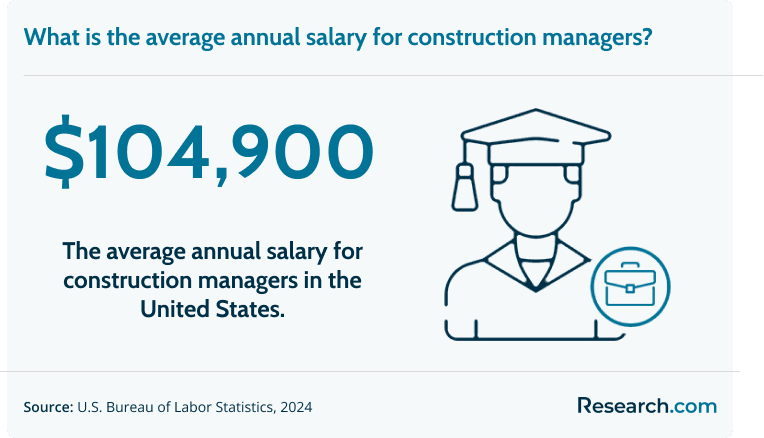
Some of the highest-paying jobs for construction management degree holders include construction claims manager, facilities manager, construction project manager, construction superintendent, civil engineer, sustainability consultant, and cost estimator. Reported salaries in this guide range from $74,740 for cost estimators to $116,627 for facilities managers, while construction managers have an average annual salary of $104,900, or about $50.43 per hour.
The strongest earning potential usually comes from managing complex projects, working in high-paying industries such as heavy and civil engineering construction, earning respected credentials, and building expertise in contracts, budgeting, safety, Building Information Modeling, and leadership.
Key things to know about jobs with a construction management degree
- A construction management degree can support careers in residential, commercial, infrastructure, facilities, specialty trade, and renewable energy-related construction projects.
- The average annual salary for construction managers is $104,900, or about $50.43 per hour.
- Demand remains favorable because construction projects are becoming more complex and employers need professionals who can manage budgets, schedules, compliance, safety, and teams.
- The best-paying roles are not always entry-level. Many require several years of experience, strong field judgment, and specialized knowledge.
- Certifications such as PMP, CCM, OSHA training, CPC, and LEED credentials can help demonstrate job-ready expertise, but they do not guarantee a salary increase by themselves.
- What is construction management, and what does a construction manager do?
- Highest-paying jobs for construction management degree holders for 2027
- What factors affect how much you can earn with a construction management degree?
- What career options are available with a construction management degree?
- What industries pay the highest salaries for construction management professionals?
- What certifications or skills can increase earning potential?
- What are the best-paying states for construction management jobs?
- Can an accelerated degree boost your construction management career?
- How are emerging technologies changing construction management careers?
- How can further education support career advancement?
- Are specialized construction management roles more lucrative?
- What career advancement strategies work best for construction managers?
- How do legal and regulatory issues shape construction management careers?
- Can an advanced degree significantly improve a construction management career?
- How do public and private sector construction management careers differ?
- Are alternative education tracks useful for construction management careers?
- What is the job outlook for construction managers in the U.S.?
- What soft skills matter most in construction management?
- What are the benefits and risks of freelance construction management jobs?
- How can continuous professional development improve your career?
- What should you ask before choosing a construction management career path?
What is construction management, and what does a construction manager do?
Construction management is the professional coordination of a building or infrastructure project from planning through closeout. It combines field knowledge, project management, budgeting, scheduling, safety oversight, contract administration, and communication. A construction manager’s job is to help the owner, contractor, design team, and trades complete the project safely, correctly, on schedule, and within the agreed budget.
Unlike a single trade role, construction management requires a broad view of the entire project. Managers need to understand drawings, sequencing, labor needs, procurement, change orders, inspections, risk, and stakeholder expectations. The role is practical and fast-moving: one day may involve reviewing a schedule delay, and the next may involve negotiating with subcontractors or explaining budget changes to a client.
Typical responsibilities of a construction manager
- Project planning: Build schedules, review scopes of work, estimate resource needs, and help define milestones before construction begins.
- Budget oversight: Track labor, materials, equipment, change orders, and contingency costs to keep spending under control.
- Team coordination: Communicate with owners, architects, engineers, contractors, subcontractors, inspectors, and suppliers.
- Site supervision: Monitor daily field progress, resolve conflicts, and make sure work follows plans and specifications.
- Safety and compliance: Help enforce OSHA requirements, building codes, environmental standards, permit conditions, and jobsite procedures.
- Problem solving: Respond to weather delays, material shortages, design conflicts, labor issues, inspection findings, and contract disputes.
- Documentation: Maintain reports, meeting notes, requests for information, submittals, cost records, and closeout materials.
Who is a construction management degree best for?
This degree is a strong fit for people who want to lead construction projects rather than work only in a single trade or design function. It is especially useful if you enjoy field operations, logistics, problem solving, teamwork, and decision-making under pressure.
It may be a weaker fit if you want a desk-only job with predictable daily routines. Many construction management roles involve early mornings, travel to job sites, urgent schedule changes, and accountability for decisions that affect safety, cost, and deadlines.
Highest-paying jobs for construction management degree holders for 2027
The highest-paying construction management jobs usually involve one or more of the following: large budgets, high-risk sites, contract disputes, technical infrastructure, sustainability requirements, or responsibility for several teams at once. The roles below are among the most financially attractive options connected to a construction management background.
| Role | Average salary | Best fit for | Why it can pay well |
| Facilities Manager | $116,627 | Professionals who want to manage building operations after construction | Combines construction knowledge with long-term maintenance, compliance, renovations, and asset management |
| Construction Claims Manager | $106,432 | Professionals with strong contract, documentation, negotiation, and dispute-resolution skills | Claims work affects project losses, settlements, delays, and legal exposure |
| Construction Project Manager | $104,900 | Leaders who can manage budgets, schedules, subcontractors, owners, and risk | Project managers carry high responsibility for cost, schedule, quality, and client satisfaction |
| Civil Engineer | $95,890 | Professionals interested in infrastructure, design coordination, and technical project delivery | Infrastructure work requires specialized technical judgment and coordination with engineers and regulators |
| Construction Superintendent | $94,140 | Field-focused leaders who prefer daily site operations and crew coordination | Superintendents directly influence productivity, safety, sequencing, and schedule control |
| Sustainability Consultant | $81,825 | Professionals interested in energy efficiency, sustainable materials, and green building practices | Sustainable construction expertise is increasingly useful on projects with environmental goals |
| Cost Estimator | $74,740 | Detail-oriented professionals who enjoy numbers, bids, quantities, and risk assumptions | Accurate estimates help companies win profitable work and avoid underpriced projects |
Construction Project Manager
Construction project managers oversee the full project lifecycle, including planning, procurement, scheduling, budget tracking, stakeholder communication, and closeout. They are often the main point of contact between owners, design teams, contractors, and subcontractors. A master’s degree connected to project management may be useful for professionals who want to compete for larger leadership roles or move beyond field supervision into strategic project delivery.
Average Salary: $104,900
Cost Estimator
Cost estimators review drawings, specifications, labor needs, materials, equipment, timelines, and risk factors to calculate what a project is likely to cost. Their work supports bidding, budgeting, procurement, and financial planning. This role rewards accuracy, industry knowledge, and the ability to identify hidden cost drivers before construction begins.
Average Salary: $74,740
Construction Superintendent
Construction superintendents are the on-site leaders responsible for daily production. They coordinate crews and subcontractors, monitor safety and quality, track progress, organize inspections, and respond quickly when work does not go as planned. This role is well suited to professionals who want to stay close to field operations rather than move fully into office-based management.
Average Salary: $94,140
Civil Engineer
Civil engineers plan, design, and supervise infrastructure projects such as roads, bridges, water systems, and public works. A construction management background can be especially valuable when paired with engineering expertise because infrastructure projects require careful coordination between design intent, field conditions, budgets, and public regulations. Students who need a flexible engineering path can compare online engineering programs before choosing a school.
Average Salary: $95,890
Construction Claims Manager
Construction claims managers handle disputes involving delays, change orders, contract terms, defective work, damages, or schedule impacts. They review project records, analyze contract language, document evidence, support negotiations, and help resolve conflicts. This is a specialized path for professionals who are comfortable with detailed documentation, legal concepts, and high-stakes communication.
Average Salary: $106,432
Facilities Manager
Facilities managers oversee the operation, repair, maintenance, renovation, and compliance of buildings and physical assets. Construction management knowledge is valuable because facilities leaders often manage capital improvements, vendor contracts, building systems, code requirements, and long-term asset planning. High-paying opportunities may appear in commercial real estate, healthcare, education, and large corporate environments.
Average Salary: $116,627
Sustainability Consultant
Sustainability consultants help construction teams improve energy performance, reduce environmental impact, select more sustainable materials, and align projects with green building goals. Professionals interested in this path may benefit from understanding how environmental science, policy, building systems, and construction delivery intersect. For broader context, Research.com’s guide on careers connected to an environmental science degree can help clarify related options.
Average Salary: $81,825
Business training can also strengthen a construction management career, particularly for professionals who want to move into operations, estimating leadership, development, or executive roles. If cost is a major concern, comparing the cheapest online business administration degree options may help you find a program that supports leadership, accounting, and organizational decision-making without unnecessary expense.
What factors affect how much you can earn with a construction management degree?
Your degree can open the door, but salary depends on the responsibility you take on, the market you work in, and the value you bring to employers. Two graduates with the same credential can earn very different salaries if one manages small residential projects and the other manages complex infrastructure work in a high-cost region.
| Factor | How it affects pay | What to do about it |
| Experience level | Entry-level roles usually pay less than positions that require independent judgment, client management, and field leadership. | Build a record of completed projects, measurable cost control, safe jobsite performance, and reliable schedule management. |
| Location | States and metro areas with strong construction demand and higher costs of living often offer higher wages. | Compare salaries against housing, commuting, licensing, taxes, and quality-of-life costs before relocating. |
| Project type | Large commercial, heavy civil, infrastructure, and complex specialty projects often pay more than smaller residential work. | Seek internships or early roles with contractors, public agencies, or developers that handle larger scopes. |
| Certifications | Credentials can signal knowledge in project management, safety, sustainability, estimating, or construction leadership. | Choose certifications that match your target role instead of collecting credentials without a plan. |
| Company size and scope | Larger firms and organizations managing complex or government-funded projects may offer stronger compensation structures. | Evaluate training, promotion paths, project portfolio, benefits, and workload expectations, not salary alone. |
| Business and financial skills | Managers who understand budgets, contracts, cash flow, and profitability can be more competitive for senior roles. | Consider targeted business coursework or compare affordable online business administration programs if management is your goal. |
What career options are available with a construction management degree?
A construction management degree does not lock you into one job title. It can support field supervision, estimating, scheduling, contracts, technology, inspections, equipment coordination, and owner-side project oversight. The right path depends on whether you prefer people leadership, technical analysis, site operations, documentation, or long-term facility operations.
- Construction Scheduler: Builds and updates project timelines, identifies schedule risks, coordinates sequencing, and helps teams understand how delays affect the overall completion date.
- Building Inspector: Reviews projects for compliance with building codes, permits, safety standards, and local regulations. This role is a strong fit for detail-oriented professionals who value compliance and quality assurance.
- Construction Contract Administrator: Manages contracts, change orders, submittals, payment documentation, compliance records, and communication between project parties. Professionals who want stronger leadership and organizational training may consider affordable online BS in organizational leadership degrees when it fits their career plan.
- BIM Manager: Uses Building Information Modeling tools to coordinate digital models, identify design conflicts, improve visualization, and support project planning before field work begins.
- Construction Equipment Manager: Oversees equipment availability, maintenance schedules, utilization, transportation, and jobsite logistics so crews have the machinery they need when they need it.
- Project Coordinator: Supports project managers and superintendents by tracking documents, coordinating meetings, updating schedules, following up on tasks, and maintaining communication across teams.
- Owner’s Representative: Acts on behalf of the project owner to monitor budgets, schedules, quality, and contractor performance.
- Preconstruction Manager: Works before construction begins on estimating, constructability reviews, procurement planning, value engineering, and bid strategy.
How to choose the right construction management path
| If you enjoy... | Consider... | Why this path may fit |
| Leading people in the field | Superintendent or project manager | These roles require daily decision-making, coordination, and direct accountability for jobsite progress. |
| Numbers and risk analysis | Cost estimator or preconstruction manager | These jobs depend on accurate quantities, pricing, assumptions, and bid strategy. |
| Contracts and documentation | Claims manager or contract administrator | These paths reward precision, recordkeeping, negotiation, and knowledge of legal obligations. |
| Technology and visualization | BIM manager or digital construction specialist | These roles use modeling and coordination tools to reduce conflicts and improve planning. |
| Long-term building operations | Facilities manager | This path combines construction, maintenance, vendor management, compliance, and capital planning. |
What industries pay the highest salaries for construction management professionals?
Industry choice can have a major effect on pay because project complexity, risk, budgets, and staffing needs vary widely. Heavy and civil engineering construction is among the highest-paying sectors for construction managers, with a median annual wage of approximately $110,940. Nonresidential building construction follows at around $107,660, while specialty trade contractors report $101,390 and residential building construction reports $92,980.
| Industry | Reported median annual wage | Why compensation may be higher or lower |
| Heavy and civil engineering construction | Approximately $110,940 | Projects often involve public infrastructure, large crews, technical complexity, and extensive regulatory coordination. |
| Nonresidential building construction | Around $107,660 | Commercial, institutional, and industrial projects can involve larger budgets and more complex delivery teams. |
| Specialty trade contractors | $101,390 | Specialized scopes can pay well when technical expertise, sequencing, or safety risk is high. |
| Residential building construction | $92,980 | Pay can be competitive, but smaller project size and market cycles may affect compensation. |
Across construction manager roles, the lowest 10% earn around $64,480, while the highest 10% earn more than $172,040. The average salary for construction managers is around $104,900 as of 2023. Professionals who want to grow beyond site-level responsibilities can study a broader project management career path to understand how leadership skills apply across industries and larger project portfolios.
What certifications or skills can increase earning potential?
Certifications and specialized skills can make a construction management graduate more competitive, especially when they match the job’s responsibilities. A credential is most useful when it proves a capability employers already value, such as safety oversight, project controls, estimating, contract administration, sustainability, or leadership.
For example, a professional who manages budgets may benefit from stronger accounting knowledge. Research.com’s overview of an accounting certification course can help readers understand when finance-focused training may complement construction management work.
Certifications that can strengthen a construction management resume
- Certified Construction Manager (CCM): Offered by the Construction Management Association of America, this credential validates professional knowledge in construction management, leadership, cost, schedule, quality, and risk.
- Project Management Professional (PMP): The Project Management Professional (PMP) credential from PMI is widely recognized and can be valuable for professionals managing complex projects. Readers exploring the broader field can review Research.com’s guide on how to become a project manager.
- Certified Professional Constructor (CPC): Offered by the American Institute of Constructors, this certification can demonstrate professional competence and commitment to industry standards.
- OSHA Safety Certifications: OSHA 30-Hour or 10-Hour training can support jobsite safety knowledge, especially for field leadership and supervisory roles.
- LEED Accreditation: Leadership in Energy and Environmental Design (LEED) certification can help professionals show knowledge of green building, sustainable design, and environmentally responsible construction practices.
Skills that employers often value
- Cost estimation and budgeting: Employers value managers who can control costs, interpret estimates, track change orders, and understand financial risk.
- Scheduling and time management: Familiarity with tools such as Primavera P6 or Microsoft Project can help professionals manage sequencing, dependencies, and delays.
- Building Information Modeling: BIM knowledge, including software such as Autodesk Revit or Navisworks, can improve coordination and reduce design conflicts.
- Contract management: Understanding contract terms, claims, procurement, scope changes, and dispute resolution can lead to specialized roles.
- Leadership and communication: Construction managers need to explain decisions clearly, manage conflict, negotiate with stakeholders, and keep teams aligned.
- Visual communication: In some roles, the ability to create clear reports, diagrams, and presentations can help. If presentation design is a weakness, short creative training such as easy graphic design courses may be useful for client-facing professionals.
What are the best-paying states for construction management jobs?
State-level pay can reflect cost of living, project volume, public infrastructure investment, commercial development, labor supply, and regional demand for experienced managers. The states below are among the top-paying locations cited for construction management jobs.
| State | Reported median annual wage | What to consider before relocating |
| New Jersey | Approximately $145,400 | High pay should be weighed against housing, commuting, taxes, and competition for senior roles. |
| Rhode Island | $132,750 | Opportunities may be tied to urban development, coastal infrastructure, and local market size. |
| New York | Around $131,950 | Large metropolitan projects can pay well, but cost of living and workload expectations can be high. |
| Delaware | About $124,000 | Growing real estate and infrastructure activity may create opportunities for experienced managers. |
| California | $117,770 | Major residential and commercial markets can offer strong pay, especially in cities like Los Angeles and San Francisco. |
Do not choose a state based only on salary. Compare total compensation, benefits, licensing or certification expectations, union environment, travel demands, commute times, and the stability of the project pipeline.
Can an accelerated degree boost your construction management career?
An accelerated degree can help if your main obstacle is time. It may allow you to finish required coursework faster, enter the labor market sooner, or qualify for promotion without spending as long in school. This path can be especially useful for working adults who already have construction experience but need the academic credential for management roles.
However, speed should not be the only factor. Before enrolling, confirm the school’s accreditation, course quality, transfer credit policy, faculty experience, internship or field requirements, and whether employers in your region respect the credential. Students comparing faster options can review Research.com’s guide to a 2-year construction management degree online to understand what accelerated formats may involve.
How are emerging technologies changing construction management careers?
Construction management is becoming more data-driven and technology-supported. Building Information Modeling, drone surveying, digital takeoff tools, scheduling platforms, field reporting apps, document control systems, and real-time project management software are changing how teams coordinate work and identify risks.
Technology does not remove the need for construction judgment. It raises expectations. Employers increasingly need managers who can read drawings, understand field constraints, interpret digital models, communicate with trades, and use software to make better decisions. A formal construction management degree can help students build a foundation in modern construction methods, while hands-on software training can make that education more practical.
How can further education support career advancement?
Further education can help construction professionals move from task execution into management, from site coordination into project leadership, or from one specialty into another. The right option depends on your current experience and target role. Some professionals need a bachelor’s degree, while others may only need focused coursework in estimating, scheduling, safety, contracts, or finance.
An online associate degree can be a lower-commitment way to build a foundation in construction principles, budgeting, safety compliance, and project coordination. It may also help students test the field before investing in a longer degree path.
Are specialized construction management roles more lucrative?
Yes. Specialized construction management roles often pay more because they require deeper expertise, greater accountability, or higher-risk decisions. The best-paid specialists usually solve expensive problems: inaccurate estimates, schedule delays, contract disputes, coordination failures, safety issues, or infrastructure complexity.
- Construction Project Director: Oversees multiple large-scale projects, budgets, teams, and schedules across sites. Project directors can earn well over $150,000 annually, especially in major cities with significant development activity.
- Senior Cost Estimator: Builds advanced estimates for materials, labor, equipment, timelines, and risk. Professionals working on large commercial or infrastructure projects can command salaries exceeding $120,000 per year.
- BIM Manager: Leads digital modeling and virtual construction planning using tools such as Autodesk Revit and Navisworks. Salaries can reach $110,000 or more when BIM expertise improves coordination and project efficiency.
- Construction Claims Consultant: Handles disputes involving delays, contract breaches, damages, and unforeseen conditions. Depending on experience and case complexity, these professionals can earn $130,000 or more.
- Civil Engineering Construction Manager: Manages infrastructure projects such as highways, bridges, and public utilities. Because these projects involve engineers, regulators, contractors, and public stakeholders, compensation can exceed $120,000 annually.
How to move into a higher-paying specialty
- Choose one specialization instead of trying to pursue every credential at once.
- Build project experience that proves your skill in that area.
- Document results, such as avoided delays, improved estimates, reduced conflicts, or safer jobsite performance.
- Find a mentor already working in the role you want.
- Use certifications strategically when they match the specialty and employer expectations.
What career advancement strategies work best for construction managers?
The most effective advancement strategies are targeted. Construction managers grow fastest when they combine project results, trusted relationships, technical skill, and leadership visibility. Promotions usually go to professionals who can be relied on when costs rise, schedules slip, inspections fail, or stakeholders disagree.
- Build a measurable project record: Track completed scopes, budget performance, schedule outcomes, safety contributions, and client feedback.
- Seek mentors and sponsors: Experienced superintendents, project executives, estimators, and owners can help you understand promotion paths and avoid common mistakes.
- Join professional associations: Industry groups can expose you to regulations, technology, bidding trends, and hiring contacts.
- Learn the business side: Senior leaders must understand profitability, cash flow, contracts, staffing, procurement, and risk.
- Use education selectively: If application costs are a barrier, compare options such as online colleges with no application fee, but still check accreditation, curriculum quality, and career relevance.
How do legal and regulatory issues shape construction management careers?
Construction managers operate in a heavily regulated environment. Safety rules, building codes, environmental laws, zoning requirements, labor rules, procurement policies, permits, insurance requirements, and contract terms can all affect a project’s timeline and budget. Managers who understand compliance are better prepared to reduce risk and avoid costly delays.
Legal and regulatory knowledge can also create career opportunities. Contract administrators, claims managers, public-sector project managers, safety leaders, and owner’s representatives often need stronger command of documentation and compliance than entry-level field roles require. Professionals who need a faster educational route can compare options such as the fastest degree to get online, but they should verify that the coursework actually supports construction, compliance, or management goals.
Can an advanced degree significantly improve a construction management career?
An advanced degree can help if it aligns with your career target. It may be useful for professionals who want to move into executive leadership, development, public administration, engineering management, facilities leadership, consulting, or large-scale program management. It is less useful if you already lack field experience, because senior construction roles usually require proven judgment on real projects.
Before pursuing graduate study, compare tuition, time away from work, employer tuition assistance, promotion requirements, and expected role changes. Research.com’s guide to the highest paying graduate degrees can help readers evaluate broader advanced-degree options, but construction professionals should focus on programs that strengthen management, finance, risk, or technical expertise relevant to their goals.
How do public and private sector construction management careers differ?
Public and private sector construction management careers can both be rewarding, but they operate differently. Public-sector roles often involve government-funded infrastructure, formal procurement rules, transparency requirements, strict budgets, and detailed compliance processes. Private-sector roles may involve faster decisions, competitive bidding, client-driven changes, performance incentives, and more variable workloads.
| Career setting | Common advantages | Common trade-offs |
| Public sector | Work may involve infrastructure, community impact, stable processes, and clearly defined compliance requirements. | Procurement rules, budget limits, documentation demands, and approval timelines can slow decision-making. |
| Private sector | Projects may move faster, compensation may be more performance-based, and roles can offer exposure to commercial development. | Workload, deadlines, market cycles, and client expectations may be more volatile. |
Professionals moving between sectors may need to update their skills quickly. Shorter credentials or fast associate degree programs online may help some learners fill gaps, but the best choice depends on previous experience and the role being targeted.
Are alternative education tracks useful for construction management careers?
Alternative education tracks can help when they add a specific capability instead of duplicating what you already know. Short programs, certificates, bootcamps, employer training, union training, safety courses, software credentials, and business classes can all strengthen a construction management profile when matched to a clear career goal.
For example, a superintendent may benefit from OSHA and scheduling training, while a future claims manager may need contract and documentation coursework. A preconstruction professional may benefit from estimating and cost-control training. Some students compare flexible programs listed among the easiest degrees to get, but ease should never outweigh accreditation, employer reputation, learning outcomes, and career relevance.
What is the job outlook for construction managers in the U.S.?
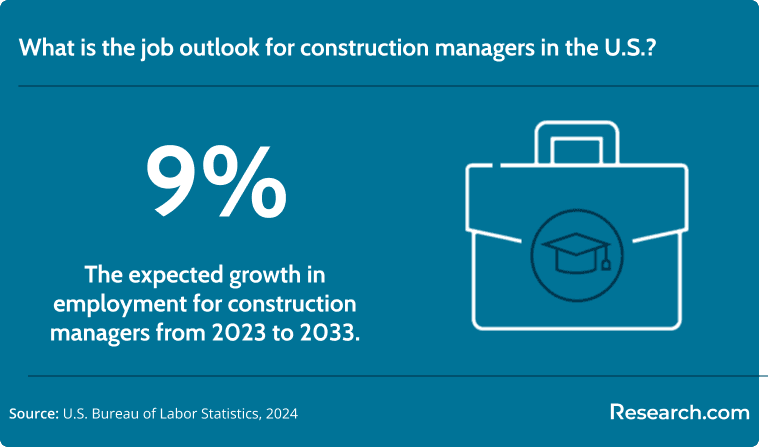
The job outlook for construction managers in the U.S. is strong. Employment is projected to grow 9% from 2023 to 2033, which is much faster than the average for all occupations. Demand is supported by residential, commercial, and infrastructure projects, along with the need for energy-efficient building retrofits.
Approximately 45,800 job openings for construction managers are expected each year, largely because of retirements and workers moving into other careers. As projects become more complex, employers are likely to value managers who can coordinate teams, control budgets, manage risk, understand technology, and keep work compliant with safety and building requirements.
What soft skills matter most in construction management?
Technical knowledge is not enough in construction management. Managers have to communicate clearly with people who may have conflicting priorities: owners want value, contractors need productivity, designers protect design intent, inspectors enforce code, and trades need practical sequencing. The best managers can translate between these groups without losing control of scope, cost, safety, or schedule.
- Communication: Explain decisions, expectations, risks, and changes in clear language.
- Leadership: Set direction, hold teams accountable, and maintain jobsite momentum.
- Conflict resolution: Address disputes before they turn into costly delays or claims.
- Decision-making under pressure: Make practical calls when weather, inspections, procurement, or labor issues disrupt the plan.
- Negotiation: Work through pricing, change orders, schedules, and expectations without damaging relationships.
- Attention to detail: Catch documentation gaps, drawing conflicts, safety concerns, and cost risks early.
Professionals who want to strengthen leadership and communication alongside advanced technical or management skills can compare one year online master programs, especially if they already have field experience and a clear promotion target.
What are the benefits and risks of freelance construction management jobs?
Freelance construction management can be attractive for experienced professionals who want more control over their projects, schedule, and earning structure. It is usually not the best first step for new graduates because independent work requires strong networks, contract knowledge, insurance awareness, pricing discipline, and the ability to manage client expectations without employer support.
| Freelance factor | Potential benefit | Main risk |
| Earning structure | Freelancers may negotiate rates based on expertise, project complexity, and scope. | Income can be inconsistent when contracts end or the market slows. |
| Schedule control | Independent managers may choose projects that match their interests or availability. | Urgent client demands can still create long hours and unpredictable workloads. |
| Project variety | Freelancers can gain experience across different owners, sectors, and project types. | Constantly changing teams and processes can make quality control harder. |
| Business ownership | Independent work can build a personal brand and consulting practice. | Freelancers must handle marketing, contracts, taxes, insurance, invoicing, and legal compliance. |
| Benefits | Professionals can design their own benefit and retirement strategy. | No employer-provided health insurance, paid leave, or retirement plan is guaranteed. |
When freelance construction management may make sense
- You have a strong professional network that can generate repeat work.
- You understand contracts, insurance, scope control, and payment terms.
- You have enough savings to handle gaps between projects.
- You can price your work accurately and say no to poor-fit clients.
- You have a clear specialty, such as owner representation, scheduling, claims, estimating, or project controls.
How can continuous professional development improve your career?
Continuous professional development matters because construction changes constantly. Building codes evolve, software tools improve, safety expectations shift, sustainability requirements grow, and owners demand tighter cost and schedule control. Professionals who stop learning may struggle to compete for senior roles, especially on complex projects.
Useful professional development can include certifications, software training, safety courses, estimating workshops, contract seminars, leadership programs, graduate education, mentoring, and industry conferences. Advanced academic options, including 2 years doctoral programs, may be relevant for professionals pursuing research, executive, consulting, or academic paths, but most construction managers should prioritize education that directly supports their target role.
Common mistakes to avoid when planning a construction management career
- Choosing a program without checking accreditation: Accreditation can affect transfer credits, employer recognition, and future education options.
- Focusing only on salary: High pay may come with long hours, travel, high stress, or expensive living costs.
- Ignoring field experience: Degrees and certifications are stronger when paired with real project exposure.
- Collecting unrelated credentials: Certifications are most useful when they match the job you want.
- Assuming online programs are automatically equal: Compare curriculum, faculty, student support, internship expectations, and employer reputation.
- Overlooking transfer credit policies: Poor transfer policies can increase time and cost.
- Relying only on rankings: Rankings can be a starting point, but they should not replace program-level research.
- Expecting salary guarantees: Reported salaries are useful benchmarks, not promises. Actual pay depends on market, experience, employer, and performance.
Questions to ask before choosing a construction management path
- Do I want to work mostly in the field, in an office, or in a hybrid role?
- Am I more interested in people leadership, estimating, scheduling, technology, contracts, sustainability, or facilities?
- Which industries are hiring construction managers in my region?
- Does my target role require a bachelor’s degree, certification, field experience, or specialized software skills?
- Will the program I choose help me build a portfolio, internship experience, or employer connections?
- How much debt am I willing to take on, and what salary range is realistic for my location and experience?
- Do I want the stability of salaried work or the flexibility and risk of freelance consulting?
- What skills do senior professionals in my target role have that I still need to build?
Key Insights
- Construction management can lead to high-paying careers, but the best path depends on your preferred work style: field leadership, budgeting, contracts, digital coordination, facilities, sustainability, or executive oversight.
- The average salary for construction managers is about $104,900 per year, or $50.43 per hour, while specialized roles such as facilities manager and construction claims manager report higher figures in this guide.
- A bachelor’s degree, which usually takes about 4 years, is a common route into construction management, but experience, certifications, and project results strongly influence advancement.
- Employment for construction managers is projected to grow 9% from 2023 to 2033, with approximately 45,800 job openings expected each year.
- Industry and location matter. Heavy and civil engineering construction reports approximately $110,940, and New Jersey reports approximately $145,400 for construction managers.
- Certifications such as CCM, PMP, CPC, OSHA training, and LEED credentials can improve credibility when they match your target role.
- Freelance construction management can offer flexibility, but it is best suited to experienced professionals who can manage contracts, clients, taxes, insurance, and inconsistent income.
- The smartest career strategy is to choose a specialty, build measurable project experience, keep learning, and evaluate education options based on accreditation, cost, relevance, and return on investment.
Resources:
- Glassdoor. (2025). Salary: Construction Claims Manager in the United States 2024. https://www.glassdoor.com/Salaries/construction-claims-manager-salary-SRCH_KO0,27.htm
- Fieldwire. (n.d.). The best states for construction management jobs. https://www.fieldwire.com/blog/best-states-for-construction-management-jobs
- Indeed.com. (2025). Construction superintendent salary in the United States. https://www.indeed.com/career/construction-superintendent/salaries
- Salary.com. (2025). Facilities Manager Salary in the United States. https://www.salary.com/research/salary/benchmark/facilities-manager-salary
- U.S. Bureau of Labor Statistics. (2024). Occupational Outlook Handbook: Construction Managers. https://www.bls.gov/ooh/management/construction-managers.htm
Other things you should know about high-paying jobs with a construction management degree
Most Construction Manager jobs do not require one mandatory national certification, but employers often prefer the Certified Construction Manager (CCM) from CMAA or the Project Management Professional (PMP) from PMI. Many state-licensed specialty roles also require contractor or trade licenses issued by state boards.
The job outlook for construction management graduates in 2027 is strong, with employment in this field projected to grow by 8%, according to the U.S. Bureau of Labor Statistics. This growth is driven by the need for new construction projects and the maintenance of existing structures.
Certifications like the Certified Construction Manager (CCM) and Project Management Professional (PMP) can significantly enhance earning potential. They demonstrate advanced skills and expertise, often leading to higher-level positions and increased salaries in the construction management field.