2027 BCBA Certification Pathway Explained Step by Step

Co-Founder and Chief Data Scientist
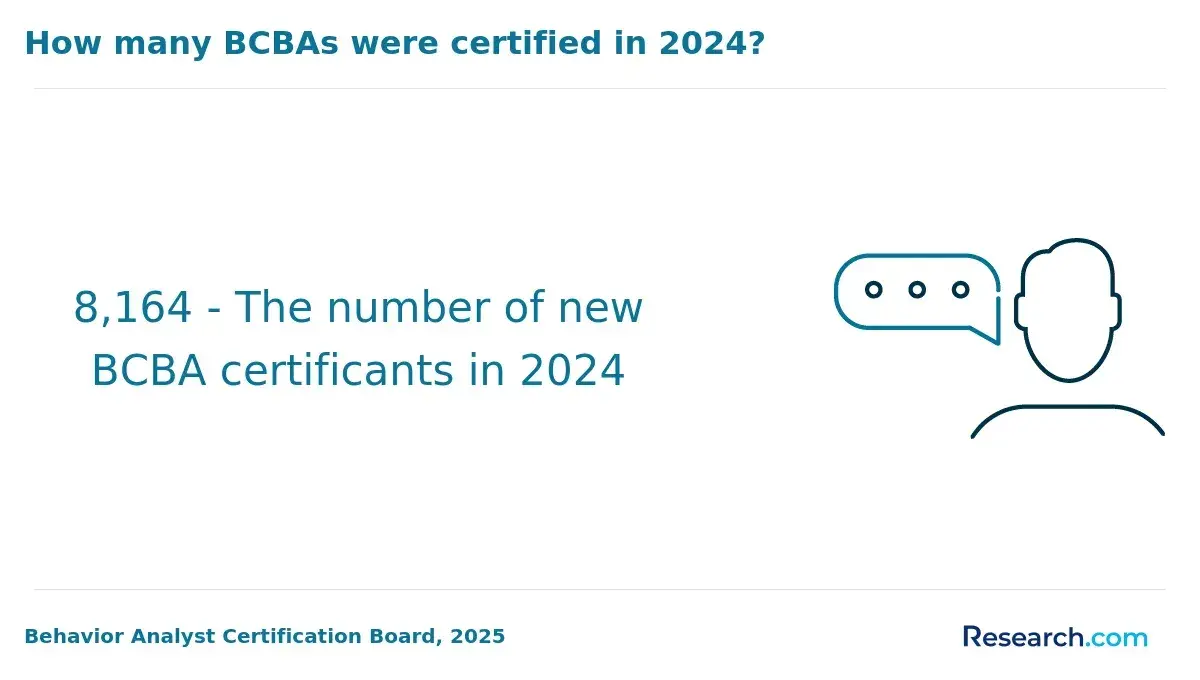
BCBA certification is the credential many behavior analysis roles use to determine whether a professional is prepared to assess behavior, design intervention plans, supervise services, and practice with professional accountability. The path is demanding: in 2024, 9,911 first-time candidates sat for the BCBA exam, and 54% passed. Demand is also strong, with tens of thousands of service roles requiring or preferring BCBA credentials and job postings growing by 58% in 2024.
This guide explains the 2027 BCBA certification process from start to finish. You will learn why the credential matters, how it differs from BCaBA certification, what education and fieldwork requirements apply, how to submit an exam application, what can cause delays or rejection, what the exam covers, and how renewal works after certification. Use it to plan your timeline, avoid common documentation mistakes, and decide whether the BCBA pathway matches your career goals.
What are the benefits of taking the BCBA certifcation?
- Entry-level BCBA salaries can start as low as approximately $54,818 per year, with senior roles in some locations reaching above $120,000.
- Educational settings (schools) are increasingly hiring BCBAs to support students with behavioral needs, making the education sector a rising employment setting for BCBAs.
- Because the BCBA pathway includes supervised fieldwork, exam preparation, and continuing education requirements, completion often leads to higher job satisfaction.
Why is BCBA certification important for professionals in applied behavior analysis?
BCBA certification matters because it signals that a behavior analyst has met a national standard for graduate education, supervised experience, examination, ethics, and professional practice. In applied behavior analysis, that standard is important because BCBAs often make decisions that affect client safety, treatment quality, staff training, and long-term outcomes.
A BCBA can independently design, implement, evaluate, and supervise behavior-analytic interventions, subject to BACB rules and any state licensure requirements that apply. This level of responsibility is one reason schools, clinics, healthcare organizations, autism service providers, and community programs often require or strongly prefer the credential for clinical leadership roles.
The credential is also rigorous. According to the Behavior Analyst Certification Board (BACB), 54% of first-time candidates pass the BCBA exam. That pass rate reflects the breadth of the knowledge base candidates must master, including behavioral principles, assessment, data analysis, ethics, intervention design, and supervision.
Students who complete programs through reputable BCBA certification schools typically receive structured preparation in required coursework and supervised fieldwork planning. However, completing a degree alone is not enough. Candidates must document that their coursework, fieldwork, supervision, and application materials meet BACB requirements.
For working professionals, BCBA certification can improve career mobility and qualify them for roles that involve assessment, program oversight, staff supervision, and clinical decision-making. It can also support advancement into leadership, training, consultation, or program development positions. The credential should be viewed less as a final destination and more as entry into a regulated professional practice that requires ongoing ethics, continuing education, and accountability.
What is the difference between BCBA and BCaBA certification?
The main difference between BCBA and BCaBA certification is the level of education, independence, and responsibility. A BCBA is prepared for independent behavior-analytic practice, while a BCaBA works under the supervision of a BCBA and has a more limited scope of practice.
| Category | BCBA | BCaBA |
| Minimum degree level | Master’s degree or higher | Bachelor’s degree |
| Coursework level | Roughly 315 hours of graduate-level behavior-analytic coursework | Around 225 hours of behavior-analytic coursework |
| Fieldwork | 1,500 to 2,000 hours of supervised fieldwork | Supervised fieldwork under a BCBA |
| Practice authority | Can design, oversee, and supervise behavior-analytic programs independently, subject to applicable rules | Must practice under BCBA supervision |
| Typical role | Clinical supervisor, behavior analyst, program lead, consultant, or supervisor | Assistant behavior analyst, implementation support, data collection, and supervised intervention assistance |
A BCaBA can be a strong option for professionals who want to enter the field sooner, build experience, or support ABA services while working toward a graduate degree. However, BCaBAs do not have the same authority to independently create treatment plans, supervise programs, or make final clinical decisions.
The BCBA route is usually the better fit for candidates who want long-term independence, supervisory responsibilities, and broader career mobility. Because it requires a graduate degree, candidates should compare programs carefully for BACB-aligned coursework, fieldwork support, faculty expertise, and exam outcomes.
For students who need flexibility, BCBA courses online can make the graduate pathway more manageable. Online options may be useful for working adults, but candidates should confirm that the coursework meets BACB requirements and that fieldwork supervision can be arranged correctly before enrolling.
What are the current BCBA certification requirements under the BACB?
BCBA certification requires more than finishing a graduate program. Candidates must satisfy BACB eligibility rules for education, coursework, supervised fieldwork, examination, and ongoing maintenance. Missing one requirement can delay or prevent exam approval.
- Education requirement: Earn a master’s degree or higher in behavior analysis or a related field from an accredited institution. Many candidates choose a behavior analysis master's online program because it can make graduate study more accessible while they work or complete fieldwork.
- Coursework requirement: Complete 315 hours of graduate-level behavior-analytic coursework. The coursework should cover areas such as ethics, behavioral principles, assessment, intervention, measurement, research design, and supervision.
- Fieldwork hours: Complete either 1,500 hours of concentrated fieldwork or 2,000 hours of standard supervised fieldwork. Candidates should track hours carefully throughout the process rather than trying to reconstruct records later.
- Supervision requirement: Fieldwork must be supervised by a BCBA or other approved supervisor who meets BACB criteria. Supervision should begin only after prerequisites are met, including a signed supervision contract and coursework initiation.
- Exam application and passing: After meeting eligibility requirements, submit the BCBA exam application, receive approval, and pass the exam based on the BCBA Test Content Outline (6th edition).
- Continuing education: After certification, maintain the credential through continuing education, renewal, ethics compliance, and any applicable state-specific licensure requirements.
The best way to avoid problems is to plan backward from exam eligibility. Before starting a program or fieldwork site, confirm that the degree, coursework sequence, supervisor qualifications, supervision contract, hour categories, and documentation process all align with BACB rules.
Applying for the BCBA exam is a documentation-heavy process. Candidates who prepare their records early are less likely to face delays, denials, or requests for clarification. The application should be treated as a formal audit of your eligibility, not as a simple registration form.
- Review eligibility before applying: Confirm that your graduate degree, coursework, fieldwork hours, supervision, and documentation meet BACB requirements. Do this before paying fees or submitting forms.
- Create or update your BACB account: Log in to your BACB Gateway account or create one if you are new. Your name and personal information should match your official documents exactly.
- Complete the BCBA certification application: Submit the application through the BACB portal and pay the required application fee. The initial application fee is $245.
- Upload supporting documentation: Provide required materials such as official transcripts, coursework attestations if required, fieldwork verification forms, supervision records, contracts, and any other requested documentation.
- Check forms for accuracy: Before submission, verify dates, signatures, supervisor information, fieldwork totals, and form versions. Small inconsistencies can lead to delays.
- Wait for application review: The BACB reviews applications in the order received. Once all documentation is in, it may take up to 45 days for a determination.
- Receive Authorization to Test: If approved, you will receive an Authorization to Test (ATT) by email. This allows you to schedule the exam through Pearson VUE.
- Schedule the exam: Use your Pearson VUE account to choose a test center and date, then pay the exam appointment fee. Choose a date that gives you enough time for final review.
- Prepare identification for test day: Bring two valid IDs that match the name in your BACB account. Name mismatches can create test-day problems.
- Take the exam and check results: After completing the exam, results are typically available shortly, with confirmation through your online account or email.
- Receive certification after passing: Once you pass and all requirements are verified, the BACB issues your BCBA credential.
- Plan for maintenance immediately: Track renewal dates, continuing education requirements, fees, ethics obligations, and any state licensure rules that apply where you practice.
A common mistake is waiting until the end of fieldwork to organize records. Instead, keep a running file with supervision contracts, monthly and final verification forms, hour logs, transcripts, and supervisor credentials. This makes the application process faster and reduces the risk of a preventable denial.
BCBA exam applications are often rejected or delayed because the documentation does not prove eligibility clearly enough. Even candidates who completed the required education and fieldwork can run into problems if forms are outdated, inconsistent, unsigned, or tied to an ineligible supervisor.
- Incorrect or mismatched personal information: The name in the BACB account, transcript, identification, and verification forms should match exactly. If your name changed, prepare appropriate documentation before applying.
- Wrong eligibility pathway selected: Choosing the wrong pathway, such as Pathway 2 instead of Pathway 1, can result in denial and may require a new application.
- Supervisor not qualified or verified: Fieldwork hours may be rejected if the supervisor does not meet BACB supervisor requirements or if the supervisor relationship was not properly documented.
- Incomplete or outdated forms: Missing signatures, incorrect dates, blank fields, or older versions of required forms can cause rejection.
- Missing or incorrect fieldwork documentation: Applications may be denied when hour totals, supervision frequency, direct and indirect hour categories, or verification forms do not meet BACB standards.
- Coursework does not meet requirements: A graduate degree alone does not guarantee eligibility. Coursework must satisfy the required behavior-analytic content and hour expectations.
- Transcript problems: Unofficial transcripts, missing degree conferral dates, or documents sent incorrectly can delay review.
- Failure to disclose required information: Applicants may be denied for failing to report required legal, ethical, or health-related declarations in the application affidavit.
- Late record review: Candidates who wait until application time to review fieldwork logs may discover errors that are difficult or impossible to correct.
Before applying, perform a final audit with your supervisor or program advisor. Compare your documents against BACB requirements, confirm that the newest forms were used, and keep copies of everything you submit.
The BCBA exam in 2027 is based on the Behavior Analyst Certification Board 6th Edition Test Content Outline. The exam is designed to assess whether candidates can apply behavior-analytic knowledge in professional situations, not simply recall definitions. Strong preparation should combine content review, fluency with terminology, data interpretation practice, ethics scenarios, and applied decision-making.
Candidates who attend accredited schools that offer BCBA certification may receive structured exposure to these domains, but exam success still requires independent study and repeated practice with applied questions.
- Behaviorism and philosophical foundations: Covers the science of behavior analysis, assumptions of the field, and concepts such as determinism and selectionism.
- Concepts and principles: Tests knowledge of reinforcement, punishment, stimulus control, generalization, motivating operations, and other core behavioral processes.
- Measurement, data display, and interpretation: Requires candidates to select measurement systems, interpret graphs, evaluate data quality, and use data to guide decisions.
- Experimental design: Includes single-subject designs, validity threats, functional relations, and interpretation of experimental data in applied contexts.
- Ethical and professional issues: Focuses on the ethics code, professional boundaries, client rights, consent, documentation, supervision, and legal or regulatory responsibilities.
- Behavior assessment: Covers functional behavior assessment, functional analysis, direct and indirect assessment tools, preference assessment, and interpretation of assessment results.
- Behavior-change procedures: Includes intervention design, reinforcement schedules, extinction, differential reinforcement, punishment procedures, prompting, shaping, chaining, and monitoring outcomes.
- Selecting and implementing interventions: Tests how to choose interventions based on assessment data, client needs, environmental context, feasibility, treatment integrity, and effectiveness.
- Personnel supervision and management: Covers staff training, performance monitoring, feedback, supervision systems, service delivery oversight, and ethical management of behavior-analytic services.
A practical study plan should map each content area to specific tasks: define the concept, recognize it in a scenario, apply it to a client case, interpret data related to it, and identify ethical issues that may arise. This approach is more effective than memorizing terms without application.
The BCBA exam contains 175 scored multiple-choice questions and an additional 10 unscored pilot questions. Candidates have four hours to complete the exam. Because pilot questions are mixed into the test and are not identified, candidates should answer every question carefully.
The exam uses scaled scoring rather than a simple raw percentage. This means the number of correct answers needed to pass can vary depending on the difficulty of the test form. Although getting approximately 76% of items correct has been cited as the necessary threshold for passing, the exact number of correct responses varies by exam form.
For preparation, the scoring method has one important implication: do not rely only on a target percentage from practice tests. Practice exams can help identify weak areas, but candidates should focus on consistent competence across domains, especially ethics, data interpretation, assessment, and intervention selection. A balanced score profile is safer than being very strong in a few areas and underprepared in others.
Candidates typically receive BCBA exam results within 7–10 business days after the exam date. After that, once all application materials and fees have been verified and approved, the official BCBA certification is usually issued within 2–4 weeks.
Most candidates can expect confirmation and a digital certificate within a month of passing, although timing may vary during backlog periods or if documentation still needs review. Passing the exam is a major milestone, but certification is not fully complete until the BACB issues the credential.
After certification is issued, you may identify yourself as a BCBA and practice within the limits of BACB requirements and any state licensure rules that apply. If your state requires a separate license for behavior analysis, confirm those requirements before offering services independently or supervising others.
The BCBA exam is challenging. In 2024, about 54% of first-time candidates passed. Retake candidates had a much lower pass rate near 25%, which shows why the first attempt should be taken seriously. The exam covers nine major domains and tests applied judgment, not just memorized terminology.
Pass rates can also vary by university program. For instance, Purdue University reported an 82% pass rate for its candidates, significantly above the national average. Program-level outcomes are not a guarantee of individual success, but they can help applicants compare training quality, curriculum alignment, advising, and exam preparation support.
Ways to improve your odds of passing
- Choose a strong program: Review published program pass rates when available, but also consider supervision support, faculty experience, coursework sequence, and student advising.
- Study from the test content outline: Build your plan around the BCBA Test Content Outline rather than studying randomly from multiple sources.
- Start early: Begin reviewing while completing coursework and fieldwork. Waiting until exam approval can leave too little time for weak areas.
- Practice applied questions: Use scenario-based practice to strengthen decision-making, especially for assessment, intervention, ethics, and supervision questions.
- Use data to guide studying: Track practice results by domain and spend more time on areas where your scores are inconsistent.
- Review ethics repeatedly: Ethics questions often require judgment in realistic situations, so repeated exposure to examples is important.
- Simulate exam conditions: Practice pacing for a four-hour testing window so fatigue and time pressure do not undermine performance.
- Do not ignore fieldwork learning: Real supervision cases, graph interpretation, treatment planning, and staff training experiences can reinforce exam content when linked back to behavioral principles.
If you do not pass, review the score report carefully, identify weak domains, and rebuild your study plan before retesting. Retaking too quickly without changing your preparation strategy can repeat the same result.
How long is a BCBA certification valid before renewal is required?
A BCBA certification is valid for two years from the date it is issued. To keep the credential active, certificants must complete renewal requirements before the end of each certification cycle.
During renewal, BCBAs must complete 32 hours of continuing education, including at least 4 hours in ethics. These requirements help ensure that professionals stay current with ethics expectations, supervision standards, evidence-based practices, and developments in applied behavior analysis.
Continuing education can come from approved training, conferences, workshops, and relevant professional learning opportunities. High-quality ABA therapy programs may also support ongoing skill development, although certificants should verify whether specific activities qualify for required continuing education credit.
To avoid renewal problems, track CEUs as you earn them, save certificates, monitor renewal deadlines, and review any state licensure requirements separately from BACB certification. A lapsed certification can affect your ability to practice as a BCBA, supervise others, or meet employer and payer requirements.
Other Things You Should Know About BCBA Certification Pathway
The supervision contract is a written agreement between the trainee and supervisor that sets out fieldwork duties, supervision frequency, and documentation rules. It should be signed before supervision starts, because the BACB requires an active contract to count fieldwork hours toward BCBA eligibility.
BCBA certification in 2027 requires adherence to the BACB's Professional and Ethical Compliance Code. Applicants must complete a course on ethical conduct and pass an exam section dedicated to ethics, reflecting the BACB's emphasis on maintaining professional standards.
In 2027, BCBA certification requires 2,000 hours of supervised fieldwork. This must include both concentrated and supervised independent fieldwork under a qualified BCBA supervisor. These experiences are essential for gaining practical skills necessary for the certification process.
- AppliedBehaviorAnalysisEdu.org. (2025). BCBA® certification & requirements: A step-by-step guide. https://www.appliedbehavioranalysisedu.org/bcba-certification/
- Behavior Analyst Certification Board. (2024). Examination information. https://www.bacb.com/examination-information/
- Graber, J., & Graber, A. (2025). Applied behavior analysis at a crossroads: Reform, branding, and the future of behavior analysis. Perspectives on Behavior Science, 48(3), 577–588. https://doi.org/10.1007/s40614-025-00462-4
- Indeed Career Guide. (2025, April). How to become a Board Certified Behavior Analyst (BCBA). https://www.indeed.com/career-advice/career-development/how-to-become-bcba
- Psychology.org. (2025). Board Certified Behavior Analyst (BCBA) career overview. https://www.psychology.org/resources/bcba-meaning-career-overview/
- Purdue University College of Education. (2025, June). The College of Ed’s ABA pass rate is the highest in Indiana. https://education.purdue.edu/2025/06/college-of-eds-aba-pass-rate-is-highest-in-indiana/
- Turner, C., & et al. (2022). Recommended practices for individual supervision: Considerations for behaviour analytic trainees and supervisors. Behaviour Analysis in Practice, 15(2), 424–434. https://doi.org/10.1007/s40617-022-00691-9
- University of Cincinnati. (2025, February). US employment demand for behavior analysts: 2010‑2024 [Report]. Behavior Analyst Certification Board. https://www.bacb.com/wp-content/uploads/2025/02/Lightcast2025_250204-a.pdf
- University of Cincinnati Online. (2025). How to become a BCBA: Certification requirements & career guide. https://online.uc.edu/how-to-become-a-bcba/