2027 BCBA School Application Checklist for First-Time Applicants

Co-Founder and Chief Data Scientist
Applying to a BCBA program is not just a school admissions task. It is the first step in a credentialing path that includes graduate coursework, supervised fieldwork, documentation, and the BCBA examination. Missing one requirement can delay admission, fieldwork approval, or exam eligibility.
This guide is for first-time applicants who want a clear path into applied behavior analysis, including career changers, recent graduates, educators, psychology majors, and professionals comparing online and in-person options. It explains what BCBA certification means, what education and fieldwork are required, how to evaluate programs, what documents to prepare, and how to connect program choice with career outcomes.
Use this as a practical checklist before you apply. Requirements can vary by school and credentialing pathway, so applicants should always confirm details with the Behavior Analyst Certification Board, the program admissions office, and any state licensing board that may apply to their intended practice location.
Key Things You Should Know
- The BCBA school application process for 2026 requires verified coursework aligned with the BACB's 2025 Task List, emphasizing updated content on ethics and assessment methods.
- Applicants must document 1,500 hours of supervised fieldwork, with over 70% of programs now offering hybrid or online practicum options for flexible learning.
- Competitive applicants increasingly benefit from submitting detailed supervision contracts and strong letters of recommendation, reflecting the 12% annual rise in BCBA credentialing competition.
What is a BCBA certification and who needs it?
A Board Certified Behavior Analyst (BCBA) certification is a professional credential issued through standards set by the Behavior Analyst Certification Board (BACB). It indicates that a candidate has completed qualifying graduate education, supervised experience, and the BCBA exam process required for certification.
BCBAs use applied behavior analysis to assess behavior, design intervention plans, monitor progress, train caregivers or staff, and make data-based decisions. They commonly work in schools, autism service organizations, clinics, hospitals, residential programs, community agencies, and private practices.
This credential is usually important for professionals who want to design or oversee behavior analytic services rather than only assist with implementation. In many U.S. settings, employers, school districts, and autism service providers require BCBA certification for positions involving behavior plan development, clinical supervision, or program oversight. Funding and compliance rules may also make the credential necessary for certain roles.
People who commonly need BCBA certification include:
- Graduate students preparing for careers in applied behavior analysis.
- Teachers, school psychologists, or special education professionals who want to lead behavior support services.
- Autism services professionals moving into clinical supervision or program design.
- Psychology, education, or human services graduates seeking an ABA-focused credential.
- Practitioners who plan to supervise Registered Behavior Technicians or other direct-care staff.
For those wondering who needs a bcba certification in the united states, the answer depends on the role, employer, funding source, and state rules. Certification is especially relevant for professionals responsible for assessment, intervention design, supervision, and ethical decision-making in behavior analytic services.
BCBA certification requirements for first-time applicants include graduate-level coursework, supervised practical experience, and a passing score on the BCBA exam. Recent data shows that first-time pass rates declined from 54% to 51%, which makes program quality, fieldwork supervision, and exam preparation important parts of the decision.
Applicants comparing affordable education routes can review BCBA certification programs to understand online options, cost differences, and curriculum structures before choosing a school.
What education is required to become a BCBA?
To become a BCBA, candidates generally need graduate-level education that satisfies BACB coursework standards. The degree is commonly a master's or higher in behavior analysis, education, psychology, or a related field, paired with coursework in applied behavior analysis.
The required curriculum typically includes behavior assessment, behavior-change procedures, ethics, measurement, experimental design, intervention planning, supervision, and data analysis. The key question is not only whether a school offers an ABA degree, but whether the coursework aligns with BACB requirements for the certification pathway the student intends to use.
Common education pathways include:
- Master's in applied behavior analysis: Often the most direct option because the curriculum is built around ABA competencies.
- Master's in psychology or education with ABA coursework: Can work well if the program includes the required behavior analysis sequence.
- Graduate certificate in ABA: May be suitable for students who already hold a qualifying graduate degree but need the required ABA coursework.
- Special education or related graduate programs: Useful for school-based careers when the program clearly documents BACB-aligned coursework.
Students evaluating ABA masters programs should confirm the program's coursework, delivery format, faculty qualifications, exam preparation support, and fieldwork guidance before applying.
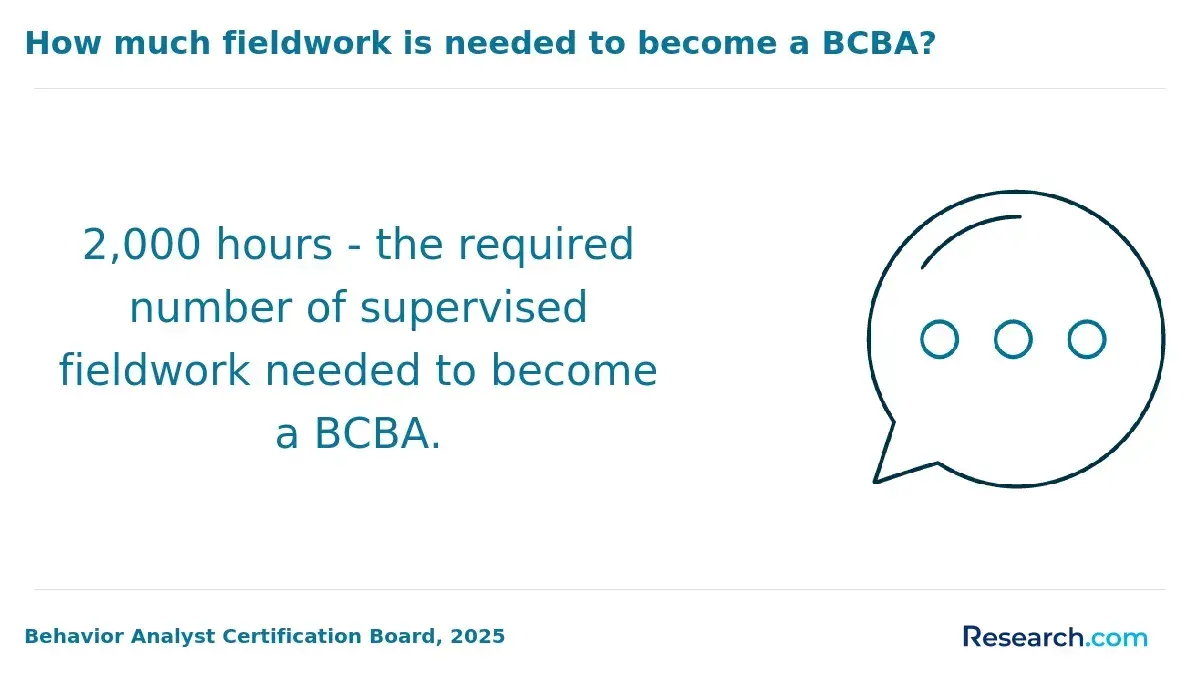
In addition to coursework, candidates must complete supervised fieldwork totaling approximately 1,500 to 2,000 hours under qualified supervision. This fieldwork is not a formality; it is where candidates learn to apply assessment, data collection, treatment planning, caregiver training, and ethical decision-making in real service settings.
BCBA education requirements for first-time applicants are increasingly competitive. The BACB reports a 10% annual growth rate, with certificants projected to rise from 74,125 to 81,566. That growth creates opportunity, but it also raises the stakes for choosing a program that prepares students for both certification and practice.
Before enrolling, applicants should ask each program for written confirmation of how its coursework and fieldwork support line up with current BACB expectations. This is especially important for online students, career changers, and applicants who plan to complete supervised hours outside the university's own clinic or partner sites.
How do I find BACB-accredited BCBA programs?
The safest way to find BCBA programs accredited by BACB in the United States is to start with official BACB resources and then verify details directly with each school. Program status, curriculum alignment, and fieldwork support can change, so applicants should not rely only on old rankings, advertisements, or informal recommendations.
If you are searching for BACB-approved BCBA accredited programs near me, use a two-step process: first confirm the program's official recognition or approval status, then evaluate whether the format, cost, supervision model, and outcomes match your needs.
Program pass rates can be a useful signal, but they should not be the only factor. For instance, Northern Kentucky University's online Concentration in Autism/ABA reported an 88% first-time BCBA pass rate, notably higher than the national average of 50-55%. A strong pass rate may suggest effective instruction and exam preparation, but applicants should also look at cohort size, admissions selectivity, fieldwork quality, and student support.
When comparing programs, focus on these questions:
- Is the program's status current with the BACB or other relevant approval source?
- Does the curriculum cover BACB task list competencies without requiring extra unplanned coursework?
- Are courses offered online, in person, hybrid, synchronous, or asynchronous?
- Does the school help students secure supervised fieldwork, or must students find supervision independently?
- What is the first-time BCBA exam pass rate, and how many students are included in that rate?
- How responsive are faculty and advisors when students have eligibility or documentation questions?
Applicants should also be cautious with speed-focused marketing. A short program may be attractive, but it must still provide enough academic depth, documentation support, and fieldwork planning. If time to completion is a major priority, compare fastest BCBA program options carefully against pass rates, supervision quality, and total cost.
BCBA program admission requirements vary by institution, but most schools review academic readiness, professional fit, and the applicant's ability to complete graduate-level ABA coursework. For certification, applicants must also keep BACB requirements in mind, because admission to a program and eligibility for certification are related but not identical.
Admission to BCBA programs in 2026 commonly centers on graduate study in behavior analysis, education, psychology, or a related field from an accredited institution. Programs may require or prefer previous coursework in psychology, education, statistics, research methods, child development, special education, or behavioral science.
Typical application requirements include:
- Official transcripts from prior colleges or universities.
- A minimum GPA set by the school.
- Letters of recommendation from faculty, supervisors, or professionals who can speak to academic ability and professional judgment.
- A resume or curriculum vitae showing relevant work, volunteer, teaching, research, or human services experience.
- A personal statement explaining career goals and interest in applied behavior analysis.
- Standardized test scores if the school still requires them.
- English proficiency scores for some international applicants.
Programs may also ask applicants to describe how they plan to complete supervised fieldwork, especially if the program is online. First-time applicant requirements for BCBA programs include completing supervised fieldwork typically ranging from 1,500 to 2,000 hours. This fieldwork must be completed under qualified supervision and documented according to BACB standards.
Applicants should not assume that admission automatically provides a fieldwork placement. Some programs include practicum options, some maintain employer partnerships, and others expect students to arrange supervision separately. This difference can affect cost, timeline, and certification readiness.
Demand for BCBAs continues to grow, with certificant numbers rising 50% from 54,223 in 2021 to 81,566 in 2025, supported by over 21,000 annual exam takers. That growth can make the credential attractive, but it also means applicants should choose programs that are organized, transparent, and serious about documentation.
Students comparing options can review a reputable ABA program list, then contact admissions offices directly to confirm prerequisites, GPA expectations, fieldwork support, transfer policies, and exam preparation resources.
A typical BCBA curriculum is designed to teach the science and practice of applied behavior analysis. It should prepare students to assess behavior, select interventions, collect and interpret data, make ethical decisions, and supervise behavior analytic services responsibly.
Core coursework usually covers:
- Foundations of behavior analysis: Concepts, principles, terminology, history, and philosophical assumptions.
- Measurement and data collection: Direct observation, frequency, duration, latency, interobserver agreement, graphing, and data interpretation.
- Assessment: Functional behavior assessment, preference assessment, skills assessment, and functional analysis.
- Behavior-change procedures: Reinforcement, punishment, extinction, stimulus control, motivating operations, prompting, fading, shaping, chaining, and generalization.
- Skill acquisition: Teaching communication, social, academic, adaptive, and daily living skills through systematic instruction.
- Behavior reduction: Designing safe, ethical, function-based interventions for challenging behavior.
- Experimental design: Single-case research designs and evaluation of intervention effects.
- Ethics and professionalism: Client dignity, consent, scope of competence, documentation, supervision, and responsible service delivery.
- Supervision and staff training: Training technicians, caregivers, educators, and team members to implement behavior plans consistently.
Strong programs do more than cover terms for an exam. They require students to apply concepts to case examples, interpret real or simulated data, write behavior plans, practice ethical decision-making, and connect coursework to supervised fieldwork.
Many programs blend coursework with applied fieldwork to prepare candidates for work with children with autism, people with developmental disabilities, students in school systems, and clients in community or clinical settings. Applicants must ensure their curriculum meets BACB competency standards and includes at least 270 hours of supervised experience.
With over 23,151 first-time BCBA candidates taking exams in 2025, students should treat curriculum quality as a major selection factor. A convenient schedule or low price may help, but weak coursework can make the exam harder and leave graduates less prepared for ethical practice.
BCBA programs generally take 1 to 3 years to complete, depending on degree type, enrollment status, course load, transfer credits, and supervised fieldwork progress. Full-time students may finish coursework in 12 to 18 months, while part-time students often need 2 or 3 years because they are balancing school with employment, family responsibilities, or fieldwork hours.
The total timeline is not limited to classes. Applicants should plan for coursework, supervised fieldwork, application processing, exam preparation, and the BCBA exam itself. Students who find qualified supervision early and keep accurate records usually move through the process more smoothly than those who wait until late in the program.
Tuition costs differ significantly by institution type, residency status, online or campus format, and whether the program is a full master's degree or a graduate certificate. Typical tuition falls between $15,000 and $30,000 for the full program. Students should also budget for books, technology fees, background checks, supervision-related costs, application fees, and exam-related expenses.
Cost should be compared against outcomes. Pass rates vary and highlight the importance of selecting programs with strong academic support and prerequisites. For example, Arcadia University's online applied behavior analysis program reports a 46% certification pass rate, while top-tier programs exceed 80%, according to 2024 BACB data via appliedbehavioranalysisedu.org.
Before enrolling, ask each program for a full cost estimate and a realistic completion plan. Important questions include:
- Is tuition charged per credit, per semester, or as a flat program rate?
- Are supervision costs included, optional, or paid separately?
- Can students complete fieldwork through their current employer?
- Are online students charged additional technology or distance learning fees?
- What academic support is available for students who struggle in statistics, research design, or exam preparation?
- Does the school publish pass rates and explain what student group is included?
The least expensive program is not always the best value if it delays eligibility, offers limited advising, or leaves students underprepared for the exam. The best financial choice is usually the program that balances affordability, eligibility clarity, strong instruction, and dependable fieldwork support.
The best online BCBA programs combine flexible delivery with rigorous training. They should provide BACB-aligned coursework, qualified faculty, strong advising, clear fieldwork guidance, and exam preparation that reflects the level of difficulty first-time candidates face.
Online format matters, but it should not be the only deciding factor. A fully asynchronous program may be convenient for working adults, while live online classes may offer more structure and interaction. The right choice depends on your schedule, learning style, fieldwork access, and need for faculty support.
With the national first-time BCBA exam pass rate dropping to 51% in 2025, applicants should look for evidence that a program does more than deliver recorded lectures. Strong online programs usually provide:
- Course sequences clearly aligned with BACB coursework expectations.
- Faculty or advisors who understand certification documentation.
- Guidance for letters of recommendation from qualified supervisors familiar with BACB standards.
- One-on-one supervision by trained board-certified behavior analysts during fieldwork, when included by the program.
- Practice with case analysis, data interpretation, ethics scenarios, and exam-style questions.
- Clear syllabi aligned with BACB coursework to avoid curriculum gaps.
- Strong alumni networks or advising focused on exam readiness and career support.
Applicants should verify whether the online program includes fieldwork or only coursework. Some online BCBA programs are excellent academically but require students to secure local supervision independently. That can work well for students already employed in ABA settings, but it may be difficult for applicants without a current placement.
Established universities with BCBA accreditation typically maintain higher pass rates due to standardized training quality compared to emerging programs. However, name recognition alone is not enough. Students should compare pass rates, faculty access, student reviews, supervision policies, and total cost.
Cost, credit flexibility, and asynchronous course options matter, but they should come after confirming that the program can prepare students for certification requirements and responsible practice. Trusted online BCBA programs help reduce the risk of curriculum gaps, documentation problems, and weak exam readiness.
BCBA applicants should prepare documents for two related processes: admission to a BCBA-focused school program and the eventual certification or exam application process. Schools may request admissions materials, while the BACB process requires documentation that verifies education, coursework, and supervised fieldwork.
For school admission, applicants commonly need official transcripts, a resume, letters of recommendation, a personal statement, and any test scores or English proficiency results required by the institution. For certification eligibility, documentation must show that the applicant completed qualifying coursework and fieldwork according to applicable standards.
Key application materials include:
- Official graduate transcripts showing relevant coursework.
- Supervision verification forms detailing fieldwork hours.
- Personal statement highlighting relevant experience and career goals.
- Professional or academic reference letters.
- Completed ethics coursework evidence, if required.
- BCBA exam application and fee payment.
Official graduate transcripts should clearly verify the completed degree and relevant coursework. If the transcript does not make course content obvious, applicants may need syllabi, course descriptions, or program verification materials. This is especially important for students who completed ABA coursework inside a broader psychology, education, or special education degree.
Supervision documentation is one of the most important parts of the BCBA process. Fieldwork forms should be accurate, signed as required, and consistent with BACB expectations. Applicants should keep copies of monthly records, final verification forms, supervisor contact information, and any documentation requested by the program or credentialing body.
Reference letters should come from people who can comment on the applicant's judgment, reliability, communication skills, ethical conduct, and readiness for graduate-level behavior analytic training. Strong letters usually come from supervisors, faculty members, clinical leaders, or professionals familiar with the applicant's work in education, psychology, human services, or ABA settings.
A personal statement should be specific rather than generic. It should explain why the applicant wants to become a BCBA, what populations or settings interest them, what experience they bring, and how the chosen program fits their goals. The BACB reports exam pass rates only for programs with at least six first-time candidates annually, so applicants may also want to discuss why a structured, proven training environment matters to them.
The most common documentation mistakes are submitting unofficial transcripts when official ones are required, missing signatures on supervision forms, using recommenders who do not know the applicant well, and waiting until the deadline to request records. Applicants should start collecting documents early and keep a personal checklist for each program.
BCBA graduates can work in a range of education, healthcare, community, and private service settings. The credential is most often associated with autism and developmental disability services, but BCBAs may also work in schools, behavioral health organizations, hospitals, residential programs, early intervention, staff training, organizational behavior management, and research-supported service programs.
Common job titles include behavior analyst, clinical supervisor, autism specialist, program coordinator, behavior consultant, school-based behavior specialist, and ABA program manager. Some BCBAs provide direct assessment and intervention, while others supervise teams, train caregivers, manage service programs, or oversee quality assurance.
Salaries typically range from $50,000 to $90,000 annually, influenced by location, experience, employer type, caseload, supervisory responsibility, and funding environment. Entry-level BCBAs in public schools often earn between $50,000 and $60,000, while experienced professionals in private healthcare or management may earn $85,000 to $90,000.
Career outcomes can also depend on program preparation. For example, Nova Southeastern University's M.S. in ABA program (program 51064) shows a 62% pass rate on certification exams, compared to 33% for its ABA Concentration. This difference shows why applicants should compare specific program tracks rather than assuming all ABA-related options at the same university lead to the same level of readiness.
BCBA careers often progress through increasing responsibility. A new certificant may begin with assessment, intervention planning, and case oversight. With experience, many move into clinical supervision, regional management, staff training, program development, consulting, or leadership roles. Those who supervise Registered Behavior Technicians or multidisciplinary teams may have broader responsibilities and higher earning potential.
Applicants should evaluate salary expectations realistically. Pay can vary widely by state, urban or rural market, school versus clinic setting, billable-hour requirements, and whether the role is salaried or contract-based. Before choosing a program, students should review job postings in their intended location to see which employers hire BCBAs, what experience they prefer, and whether state licensure is also required.
What is the job outlook for BCBAs?
The job outlook for Board Certified Behavior Analysts remains strong because demand for behavior analytic services continues across schools, clinics, healthcare organizations, and community programs. Growth is especially visible in services for individuals with autism spectrum disorder and developmental disabilities, but the need for behavior assessment, staff training, and data-based intervention extends beyond one population.
Over the past four years, the number of certified BCBAs has surged by 50%, outpacing first-time exam pass rates that hover between 51% and 54%. This creates a mixed picture: the profession is expanding, but certification remains challenging enough that applicants should prepare carefully.
Strong opportunities are common in school districts, autism service providers, early intervention programs, behavioral health clinics, residential programs, and private practices. Policy changes and expanded insurance coverage continue to support job openings in many markets. Telehealth and hybrid service models may also expand access, although job duties and supervision expectations vary by employer and location.
Prospective students should weigh the outlook against the full cost and effort of the credential. Important factors include:
- Program pass rates and the quality of exam preparation.
- Availability of supervised fieldwork in the student's area.
- Tuition, financial aid, and any added supervision expenses.
- Employer demand in the student's preferred state or region.
- State licensure rules, if applicable, in addition to BCBA certification.
- Opportunities to gain experience with different clients, settings, and supervision models.
Graduates of strong Applied behavior analysis programs with higher pass rates may benefit from better exam readiness and a clearer return on investment. The best strategy is to choose a program that aligns with certification requirements, provides dependable support, and connects directly to the type of BCBA role the student wants after graduation.
Other Things You Should Know About Applied Behavior Analysis
First-time applicants should submit supervised fieldwork logs, monthly verification forms, and final Fieldwork Verification Forms signed by a qualified supervisor. The BACB requires documented hours, supervision dates, and task completion records that match the university program’s approved sequence before the application can move to exam authorization.
For 2027 BCBA school applications, applicants should first verify eligibility by confirming a relevant degree and coursework. Then, prepare required documents, including transcripts and a resume. Submit an online application, ensure supervisory experiences are logged, and schedule the BCBA exam. Double-check deadlines and fees.
Treatment effectiveness in applied behavior analysis is measured using data-driven methods. Behavior analysts collect and analyze quantitative data on targeted behaviors before, during, and after interventions. Progress is tracked through ongoing assessment, enabling practitioners to modify treatment plans based on measurable outcomes.
Yes, maintaining BCBA certification requires earning continuing education units (CEUs) every two years. Certified behavior analysts must complete at least 32 CEUs, including specific training in ethics. This ensures practitioners stay current with advances in the field and uphold professional standards throughout their careers.
- How to Become a BCBA | Complete Career Guide 2026 https://special-learning.com/guides/become-a-bcba/
- The Complete BCBA Application Process (2026 Guide): Step-by-Step Breakdown from Eligibility to Exam Authorization https://flashgenius.net/blog-article/the-complete-bcba-application-process-2026-guide-step-by-step-breakdown-from-eligibility-to-exam-authorization
- BCBA and ABA Salaries by State https://www.appliedbehavioranalysisedu.org/salaries/
- Applied Behavior Analysis Master’s—100 % Online https://www.baypath.edu/academics/graduate-programs/applied-behavior-analysis-ms/
- Considering a Career as a Board Certified Behavior Analyst (BCBA) https://aba-llc.com/considering-bcba/
- What Is A Board Certified Behavioral Analyst (BCBA)? https://www.psychology.org/resources/bcba-meaning-career-overview/
- 25+ Affordable ABA/BCBA Online Programs (Masters & Certs) https://abamastersprograms.org/affordable-online-aba-masters-programs/
- BCBA Job Outlook in 2026 Explained | Divine Steps ABA https://www.divinestepstherapy.com/blog/bcba-job-outlook
- BCBA Programs & Schools | Intellistars - ABA Therapy https://www.intellistarsaba.com/blog/bcba-programs-schools