2027 How to Search for Affordable BCBA Programs by State

Co-Founder and Chief Data Scientist
Choosing a BCBA pathway is really two decisions at once: how to meet certification and licensure requirements, and how to do it without overpaying for graduate education. The right program must align with Behavior Analyst Certification Board expectations, fit your state’s rules, provide a realistic fieldwork plan, and make financial sense for your situation.
This guide explains how to compare affordable BCBA programs by state, including accreditation, online versus campus formats, admission requirements, program length, curriculum, career outcomes, and salary considerations. It is designed for prospective graduate students, career changers with unrelated bachelor’s degrees, educators, autism service professionals, and working adults who need a practical route into applied behavior analysis.
Key Things You Should Know
- State-specific tuition varies widely, with average BCBA program costs ranging from $12,000 to over $30,000, making location a critical factor in affordability for 2026 applicants.
- Several states offer scholarships and financial aid targeted at BCBA students, with up to 40% of programs in 2025 providing in-state discounts or grants to reduce costs.
- Online BCBA programs accredited by the Behavior Analyst Certification Board surged by 25% in 2024, offering flexible, cost-effective alternatives across states.
What is a BCBA certification and why pursue it?
BCBA certification, or the Board Certified Behavior Analyst credential, is a professional certification for practitioners trained to apply behavior analysis principles in clinical, educational, organizational, and community settings. It signals that a professional has completed graduate-level preparation, supervised practical experience, and a comprehensive certification exam focused on assessment, intervention, ethics, research methods, and behavior-change procedures.
BCBAs often design treatment plans, analyze behavior data, supervise intervention teams, consult with families and schools, and support individuals with autism spectrum disorder, developmental disabilities, behavioral health needs, or skill-acquisition goals. The credential is especially relevant for careers in autism therapy, special education, developmental disability services, mental health programs, and applied behavior analysis research.
Demand for BCBA-certified professionals continues to grow, with a 14% increase in certification numbers from 2022 to 2023. Growth is supported by healthcare systems, school districts, private clinics, and community programs that rely on evidence-based behavioral intervention.
Why students pursue BCBA certification
- To qualify for specialized behavior analyst roles in clinical, school, and community settings.
- To lead ABA treatment teams and supervise behavior technicians or other direct-service staff.
- To work with children with autism spectrum disorder and adults with developmental disabilities.
- To gain a recognized credential tied to national standards for ethical and evidence-based practice.
- To improve long-term career mobility in applied behavior analysis and related fields.
Prospective students who need a cost-conscious route can compare BCBA certification online programs, especially if they cannot relocate or need to continue working while completing graduate coursework and fieldwork.
What are BCBA education and licensure requirements?
BCBA education and licensure requirements in 2026 are shaped by two separate but connected systems: certification requirements set by the Behavior Analyst Certification Board and state licensure rules set by individual states. Students should plan for both before enrolling, because completing a program that meets certification coursework expectations does not automatically guarantee state licensure in every location.
Core BCBA certification requirements
Most candidates complete a master’s degree in applied behavior analysis or a closely related field. Graduate-level coursework must align with BACB standards and typically covers behavior assessment, intervention design, ethics, measurement, research methods, supervision, and data-based decision-making. Candidates must also complete 1,500 to 2,000 hours of supervised practical experience under credentialed BCBA professionals before they can sit for the BCBA exam.
These requirements are intended to ensure that future BCBAs can move beyond theory and demonstrate practical competence in real-world settings. Fieldwork is especially important because it connects coursework to assessment, treatment planning, documentation, supervision, and ethical decision-making.
State licensure considerations
Licensure requirements vary by state. Many states require BCBA certification as part of the licensure process, but they may also require background checks, fees, continuing education for renewal, jurisprudence exams, documentation of supervised experience, or other state-specific steps. Before committing to a program, students should check the licensing board in the state where they intend to practice.
Cost should be reviewed alongside compliance. Affordable BCBA education programs in the US can meet BACB standards without requiring excessive tuition. For example, the University of North Texas offers one of the lowest ABA master’s program tuitions at approximately $2,591 per year. A low price is valuable only if the program also supports certification eligibility, fieldwork planning, and the state licensure pathway you need.
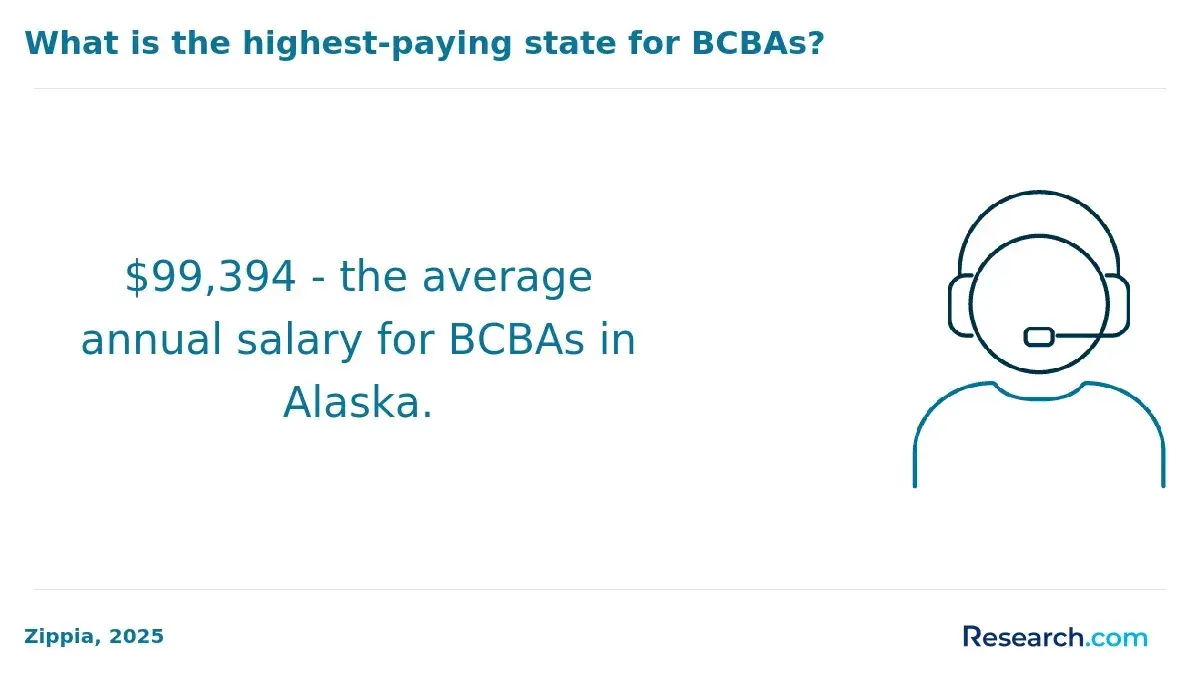
Students comparing outcomes, compensation, and career planning can review BCBA salary resources while evaluating programs.
How do I find accredited BCBA programs by state?
To find accredited BCBA programs by state, start with certification alignment, then verify institutional accreditation, state licensure compatibility, total cost, and fieldwork support. The lowest advertised tuition is not always the best value if the program lacks the coursework, supervision structure, or licensure fit required for your career plan.
Step-by-step search process
- Use the BACB verified course sequence directory. The Behavior Analyst Certification Board’s directory helps identify programs with coursework aligned to certification standards.
- Check institutional accreditation. Regional accreditation recognized by the U.S. Department of Education matters for financial aid eligibility, credit transfer, employer recognition, and admission to future doctoral study.
- Contact the state licensing board. Some states, including California and New York, may enforce additional practicum, documentation, or coursework standards beyond BACB approval.
- Compare online, hybrid, and campus options. If your state has limited local programs, an online program may provide access to approved coursework while you complete supervised fieldwork locally.
- Ask how fieldwork is arranged. A program should explain whether it helps students find supervisors, whether fieldwork is embedded, and what additional supervision costs may apply.
- Review total cost, not tuition alone. Include fees, textbooks, exam costs, technology fees, travel, supervision expenses, and any residency-related tuition differences.
Job market conditions can also influence your decision. States with stronger demand may have more program options and better employer networks, but they may also have higher tuition and living costs. For example, behavior analysts in California earn a median $102,690 annually in school districts, well above the national average.
Professional associations, state ABA conferences, university information sessions, and local provider networks can help uncover scholarships, assistantships, practicum sites, and lesser-known public university options. Students who need flexibility can also compare an online masters in ABA with state-based licensure requirements before applying.
The cheapest BCBA programs are commonly found at public universities, state university systems, and online programs that offer competitive tuition for graduate coursework. Low-cost options often appeal to students who already have a bachelor’s degree and need a certification-aligned master’s degree, certificate, or coursework sequence without relocating.
Public universities like the University of North Dakota, Ball State University in Indiana, and Arizona State University provide programs costing between $6,000 and $12,000 for the full certification coursework. These options can be especially cost-effective when the curriculum is recognized by the Behavior Analyst Certification Board and the student has a realistic plan for supervised fieldwork.
Online and hybrid programs may reduce indirect expenses such as relocation, commuting, parking, and housing. Schools such as the University of Cincinnati and Florida Institute of Technology offer fully online BCBA courses priced under $10,000. In-state tuition can reduce the cost further for students who qualify for residency rates.
Costs to compare before choosing a low-cost program
- Graduate tuition: Compare per-credit and full-program cost, not only annual tuition.
- Mandatory fees: Technology, distance learning, university service, and program fees can change the real price.
- Textbooks and materials: ABA courses may require specialized assessment, ethics, and research texts.
- Supervision fees: Fieldwork supervision may be included, arranged through an employer, or paid separately.
- Exam and certification expenses: Budget for application and testing costs after coursework and fieldwork are complete.
- Licensure costs: State applications, background checks, and renewal fees vary by location.
Affordability should never come at the expense of eligibility. Before enrolling, confirm that the curriculum meets BACB requirements for your intended certification pathway and that it supports the state where you plan to practice.
The investment can be significant, but salary potential is one reason many students pursue the credential. Entry-level certified BCBAs earn around $74,000 annually, while experienced practitioners can make upwards of $132,500. Students comparing accredited options can review top applied behavior analysis graduate programs as part of their search.
States with the most affordable BCBA programs usually have public universities with lower in-state graduate tuition, strong state university systems, or online programs that charge competitive rates regardless of residency. For many students, the most affordable state is the one where they qualify for in-state tuition and can complete supervised fieldwork without moving.
Minnesota is one example. St. Cloud State University charges in-state graduate tuition of $7,607—less than half the $15,921 out-of-state undergraduate tuition, according to intelligent.com. That difference shows why residency status can be one of the biggest cost drivers in BCBA preparation.
Midwestern and Southern states often provide cost-effective options as well. Missouri, Ohio, and Texas, for instance, have public universities with graduate tuition for residents generally ranging from $8,000 to $10,000 annually.
How to identify the most affordable state for you
- Compare in-state and out-of-state rates. Nonresident tuition can sometimes double or triple the cost.
- Review residency rules early. States differ in how students qualify for in-state tuition, and moving shortly before enrollment may not be enough.
- Look for online programs with flat tuition. Some schools charge the same graduate tuition regardless of residency.
- Consider fieldwork logistics. A cheap online program may still be difficult if you cannot secure qualified supervision locally.
- Add fees and books. Published tuition may not include the full cost of attendance.
- Check licensure fit. A program in one state may not fully prepare you for licensure requirements in another state unless you plan carefully.
For the best value, start with public universities in your own state, then compare nearby states with reciprocity or competitive online tuition. The goal is not simply to find the lowest sticker price, but to find the lowest-cost program that keeps you eligible for certification, licensure, and employment.
Online and on-campus BCBA programs can both prepare students for certification when they meet required standards, but they differ in flexibility, interaction, fieldwork arrangements, cost, and learning style. The better format depends on your schedule, location, budget, need for structure, and access to supervised practice sites.
| Factor | Online BCBA programs | On-campus BCBA programs |
| Schedule | Often more flexible, with asynchronous coursework that fits working adults. | More structured, with set class times and regular campus attendance. |
| Interaction | Uses discussion boards, video meetings, and virtual collaboration tools. | Offers face-to-face contact with faculty, classmates, and campus resources. |
| Fieldwork | Often completed locally, but students may need to secure approved supervision. | May offer stronger connections to local clinics, schools, or university-affiliated practicum sites. |
| Cost | May reduce commuting, housing, and relocation expenses. | May be affordable for in-state students but expensive for nonresidents. |
| Best for | Working professionals, rural students, parents, and students far from ABA programs. | Students who want in-person mentoring, campus structure, and local networking. |
Online programs require strong time management. Students must keep up with deadlines, arrange fieldwork, and seek support proactively. On-campus programs may offer more immediate feedback, easier faculty access, and peer relationships, but they can be harder to manage for students with full-time jobs or family responsibilities.
On-campus learning may also include hands-on labs, practicum coordination, or local partnerships that are harder to replicate online. However, online programs increasingly support supervised fieldwork in students’ local communities while remaining aligned with BACB standards. Before enrolling in either format, ask exactly how the program helps students secure supervision and document fieldwork hours.
Cost should be evaluated beyond tuition. Online programs may save on commuting and housing, while campus programs may offer assistantships, local placement pipelines, or in-state tuition advantages. The national median salary for behavior analysts is $59,190 according to BLS data, with BCBAs typically earning between $75,000 and $100,000 or more, so program quality and career support matter as much as price.
Consider these points when choosing a program:
- Choose online if flexibility and location independence are your highest priorities.
- Choose on-campus if you learn best with face-to-face structure and local faculty access.
- Confirm the program’s BACB alignment and state licensure compatibility.
- Ask whether fieldwork supervision is built in, optional, employer-based, or arranged independently.
- Compare total cost, including fees, travel, supervision, and time away from work.
BCBA programs usually take one to two years to complete, depending on whether the student enrolls full time or part time, whether the program is a full master’s degree or a certification-focused coursework sequence, and how quickly supervised fieldwork hours are completed. Accelerated options may shorten coursework time, but fieldwork still requires careful planning and consistent supervision.
The curriculum is designed to match Behavior Analyst Certification Board standards and prepare students to assess behavior, design interventions, use data ethically, and supervise behavior-change programs. Students should expect both academic coursework and practical training expectations.
Common BCBA curriculum areas
- Principles of behavior analysis and behavior-change procedures.
- Behavior assessment and measurement techniques.
- Experimental design and data analysis.
- Functional behavior assessment and interpretation of behavioral data.
- Development of behavior intervention plans.
- Ethics and professional conduct in applied behavior analysis.
- Supervision, consultation, and collaboration with families, schools, and care teams.
- Supervised practical experience or fieldwork.
Supervised fieldwork is not a minor add-on. It is one of the most important parts of BCBA preparation because it allows students to practice assessment, intervention planning, documentation, caregiver training, and ethical decision-making under qualified supervision.
Program length and cost can vary significantly by state and institution. For example, residents of Indiana, Kentucky, and Ohio may pay under $16,000 for ABA programs at some universities, while others in these states charge nearly $23,000. These differences make it important to compare full tuition, required fees, fieldwork costs, and completion timeline before applying.
Admission requirements for BCBA programs generally include a bachelor’s degree from an accredited institution, official transcripts, and evidence that the applicant is prepared for graduate-level study. Programs may admit students from psychology, education, special education, social work, healthcare, or unrelated undergraduate backgrounds, but prerequisite expectations vary.
Common application materials
- Official transcripts from all colleges attended.
- A bachelor’s degree from an accredited institution.
- Letters of recommendation from faculty, supervisors, or professionals who can assess readiness for graduate study.
- A statement of purpose explaining career goals and interest in applied behavior analysis.
- Resume or curriculum vitae showing relevant work, volunteer, teaching, clinical, or human services experience.
- GRE scores, if required by the university.
- An interview, for programs that assess professional fit before admission.
Some programs expect prerequisite coursework aligned with Behavior Analyst Certification Board standards or foundational knowledge in ethics, measurement, behavior assessment, and intervention strategies. Others allow students to complete introductory coursework after admission.
Relevant experience can strengthen an application, especially work with individuals who have developmental, behavioral, educational, or mental health needs. However, not every program requires direct ABA experience before admission, making the field accessible to career changers who can demonstrate strong motivation and readiness.
Ball State University offers an online BCBA program with a graduate tuition of $9,328 regardless of residency and an admission rate of 87%, reflecting moderate selectivity based on clear standards.
Applicants should also check whether their target state has licensure-related education requirements beyond certification coursework. Preparing transcripts, recommendations, prerequisite records, and a focused statement of purpose early can reduce delays and improve admission chances.
BCBA certification can lead to roles in schools, autism centers, hospitals, behavioral health organizations, private clinics, residential programs, early intervention agencies, and community service providers. Common job titles include clinical behavior analyst, autism specialist, behavioral consultant, behavior program supervisor, ABA director, and school-based behavior analyst.
Salaries vary by state, employer type, experience, caseload, supervisory responsibility, and local funding. States with insurance mandates for applied behavior analysis services tend to offer higher salaries, often 20-30% above those in states without such mandates. This difference reflects stronger reimbursement systems, greater service demand, and larger employer networks.
Entry-level BCBAs in non-mandate states usually earn between $50,000 and $60,000 annually, while experienced professionals in mandate states can earn from $80,000 up to $95,000 or more. In states like California and Massachusetts, known for their autism insurance laws, median salaries frequently approach six figures.
Common BCBA career paths
- Clinical behavior analyst: Designs and monitors ABA treatment programs in clinics, homes, or community settings.
- School behavior analyst: Supports behavior intervention plans, staff training, and student behavior data systems.
- Autism specialist: Works with children and families on communication, social, adaptive, and behavioral goals.
- Program supervisor: Oversees behavior technicians, case quality, compliance, and treatment implementation.
- Behavioral consultant: Advises schools, agencies, or organizations on behavior support strategies.
- Organizational behavior management professional: Applies behavior analysis to workplace training, performance, safety, and systems improvement.
Career growth often depends on supervision experience, leadership skills, specialty training, and the ability to document outcomes. BCBAs who can manage teams, train staff, support complex cases, or move into organizational behavior management may have stronger advancement potential.
Prospective students should research state insurance laws, Medicaid reimbursement, school district hiring patterns, and local ABA provider networks before choosing where to study or practice.
What is the job outlook for BCBAs?
The job outlook for BCBAs is strong because behavior analytic services are used across autism treatment, special education, developmental disability services, behavioral health, early intervention, and organizational performance settings. Increased autism spectrum disorder diagnoses and broader use of evidence-based behavioral interventions continue to support demand.
Employment growth in this field is projected to exceed the average for all occupations, with job openings increasing by over 20% in many states. Demand is not evenly distributed, however. It depends on state policy, insurance coverage, Medicaid reimbursement, school funding, provider networks, and access to qualified supervisors.
States like California, Texas, and Florida offer robust BCBA job opportunities, supported by Medicaid reimbursements and insurance mandates for behavior analysis services. Rural areas may have fewer employers, but telehealth and expanding service models are improving access and creating additional employment possibilities.
Cost of entry also affects the workforce pipeline. Tuition for in-state verified course sequence (VCS) endorsed programs can be affordable, with recent reports from Reddit communities citing semester costs as low as $1,800 to $2,300. Lower-cost pathways can make the profession more accessible and help address workforce shortages.
Skills that can improve employability
- Pediatric intervention experience.
- Autism assessment and treatment planning.
- School consultation and individualized behavior support.
- Supervision and staff training.
- Organizational behavior management.
- Telehealth service delivery.
- Data analysis and outcome documentation.
- Ethical decision-making in complex service settings.
Graduates should also plan for credential maintenance, continuing education, and state license renewal where applicable. The strongest job prospects generally belong to BCBAs who combine certification with supervised experience, licensure readiness, communication skills, and the flexibility to serve different populations and settings.
Other Things You Should Know About Applied Behavior Analysis
To find the most affordable BCBA programs by state in 2027, start by researching each state's average tuition rates. Compare these costs alongside potential financial aid availability. Consider online resources, such as tuition comparison tools, and reach out to program advisors for detailed fee structures.
Yes, applied behavior analysis extends beyond autism treatment and can be used in areas such as education, organizational behavior management, mental health, and developmental disabilities. It is a versatile science that focuses on understanding and modifying behavior in various settings and populations.
Affordable BCBA programs should include supervised fieldwork that meets BACB rules: 1,500 concentrated hours or 2,000 standard hours, with at least 5% of hours supervised in each month. The program should also align coursework with BACB-approved content requirements for exam eligibility.
Many institutions offer financial aid, scholarships, or grants for students enrolled in BCBA programs. Prospective students should explore federal student aid, university-specific scholarships, and professional organization funding opportunities to help offset educational costs.
- 14 Affordable ABA Programs: Expert-Verified Options Under $15,000 - Online ABA Programs https://onlineabaprograms.org/masters/affordable-aba-programs/
- Is Pursuing BCBA Certification a Smart Investment? https://blossomabatherapy.com/blog/is-bcba-certification-worth-it
- How To Become A Board Certified Behavior Analyst (BCBA) https://www.crossrivertherapy.com/behavioral-analysts/certification
- What is a BCBA? Your Guide to the BCBA Certification and Exam https://www.thechicagoschool.edu/insight/career-development/bcba-guide-bcba-certification-exam/
- BCBA Programs and Schools: How to Choose https://www.apexaba.com/blog/bcba-programs-and-schools
- Applied Behavior Analysis (ABA)—Board Certified Behavior Analyst (BCBA) Certification - University of Mount Saint Vincent https://mountsaintvincent.edu/graduate-adult/graduate-programs/applied-behavior-analysis-aba-board-certified-behavior-analyst-bcba-certification/
- What Is A Board Certified Behavioral Analyst (BCBA)? https://www.psychology.org/resources/bcba-meaning-career-overview/
- Top 20 Most Affordable Online ABA Graduate Certificate Programs 2022 https://www.abadegreeprograms.net/rankings/online-graduate-certificate/
- Guide to Becoming a BCBA https://www.aprilaba.com/resources/guide-to-becoming-a-bcba
- Top Online Bachelor's in Behavior Analysis https://www.appliedbehavioranalysisedu.org/bachelors-in-behavior-analysis-online/