2027 What to Know Before Leaving Teaching for an ABA Career

Co-Founder and Chief Data Scientist
Moving from teaching into applied behavior analysis is a serious career decision, not just a change of workplace. Teachers often bring strong skills in instruction, classroom management, data tracking, family communication, and individualized support, but ABA roles use those skills in a more clinical, behavior-focused, and credential-driven way.
This guide is for educators considering ABA as a next step, whether they want to test the field through an entry-level role, pursue BCBA certification, or compare online and campus-based graduate programs. It explains how ABA differs from teaching, what education and certification may be required, how to evaluate accredited programs, what the curriculum usually includes, and what jobs and salary ranges are commonly associated with the field.
Key Things You Should Know
- Transitioning from teaching to an ABA career typically requires obtaining Board Certified Behavior Analyst (BCBA) certification, often demanding a master's degree and supervised fieldwork.
- Employment growth for ABA professionals is projected at 20% through 2031, much faster than average, driven by increased autism spectrum disorder diagnoses and services.
- Average starting salaries for BCBAs in 2025 range from $55,000 to $70,000, with potential for growth linked to geographic location, experience, and specialization.
What is an ABA career and how does it differ from teaching?
An ABA career centers on Applied Behavior Analysis, a scientific field that studies how behavior works and how it can be changed through evidence-based interventions. ABA professionals often support individuals with autism and developmental disabilities, though the field can also apply to schools, clinics, community programs, early intervention, and organizational settings.
The biggest difference from teaching is the focus. Teachers usually plan lessons for groups of students, cover academic standards, manage classroom routines, and assess broad learning outcomes. ABA professionals focus more narrowly on observable behavior, skill acquisition, communication, social interaction, daily living skills, and behavior reduction goals. Treatment plans are individualized, measured frequently, and adjusted based on data.
| Area | Teaching | Applied behavior analysis |
| Primary goal | Academic learning, classroom progress, and developmental support | Measurable behavior change and skill development |
| Typical setting | Classrooms, schools, and education programs | Clinics, homes, schools, community settings, and telehealth services |
| Service model | Often group-based instruction | Often one-on-one or small-group intervention |
| Decision-making | Guided by curriculum, standards, assessment data, and student needs | Guided by behavioral assessment, treatment goals, intervention data, and ethical standards |
| Credentialing | Usually state teaching licensure and an education degree | Often RBT, BCaBA, or BCBA certification depending on role |
For example, a teacher may deliver a language arts lesson to a class and differentiate instruction for several reading levels. An ABA professional may work with one child to increase functional language, using reinforcement, prompting, and data collection to track whether the intervention is working.
Educators often find the transition appealing because many teaching skills transfer. Lesson planning becomes intervention planning. Classroom management experience supports behavior assessment. Progress monitoring becomes more intensive data collection. Parent communication remains important, but the work is usually tied to treatment goals rather than classroom performance alone.
The credentialing path is also different. ABA careers often require certification such as the Board Certified Behavior Analyst (BCBA), which involves graduate study, supervised fieldwork, and a certification exam. Job postings for BCBA or related credentials have grown 58% recently, which reflects expanding demand for ABA roles.
Teachers considering this path should be ready for a shift from broad classroom responsibility to individualized clinical or behavior-support work. Those who want a faster graduate pathway can compare options such as an accelerated BCBA program online, especially if they need to keep working while completing coursework.
What education is required to transition from teaching to ABA?
The education required for an ABA transition depends on the role you want. Teachers can enter the field at different levels, from direct service roles to graduate-level behavior analyst positions. The key is to match your education plan to the credential and job duties you are targeting.
Many educators start as Registered Behavior Technicians (RBTs). This route requires 40 hours of training and a certification exam, and it allows career changers to gain direct experience while working under supervision. RBT work can be a practical first step for teachers who want to confirm that ABA is a good fit before investing in a graduate program.
To become Board Certified Behavior Analysts (BCBAs), candidates need a master's degree in ABA or a related field, about 270 hours of approved coursework, 1,500 supervised clinical hours, and a passing score on the BCBA certification exam. Teachers may already meet some background expectations through prior education or classroom experience, but they usually still need behavior-analysis-specific coursework and supervised fieldwork.
| Path | Typical education requirement | Best for |
| RBT | 40 hours of training and certification exam | Teachers who want entry-level ABA experience before committing to graduate study |
| BCaBA | Bachelor's-level pathway with approved behavior analysis preparation | Professionals seeking assistant-level behavior analyst work |
| BCBA | Master's degree, approved coursework, supervised clinical hours, and certification exam | Educators who want to design, supervise, and evaluate ABA programs |
Career progression data from the Behavior Analyst Certification Board shows that approximately 22% of RBTs pursue BCBA certification, usually completing this transition within 3-5 years while working. That timeline can be realistic for teachers who need to maintain income while completing graduate coursework and supervision.
Before enrolling, request a transcript review and ask whether any prior coursework in education, psychology, special education, assessment, or child development can support admission or reduce prerequisites. You should also confirm that the program’s coursework aligns with current BACB requirements and that supervision can be completed in your state or local area.
Educators comparing routes can review BCBA accredited programs to understand how different schools structure coursework, fieldwork, and certification preparation. Early planning matters because missing coursework or supervision requirements can delay exam eligibility.
Do I need BCBA certification to work in ABA?
You do not need BCBA certification for every ABA job, but you usually need it for independent, supervisory, and program-design roles. Entry-level positions such as Registered Behavior Technician or ABA therapist typically involve implementing treatment plans under supervision rather than creating or independently changing those plans.
For teachers, this distinction is important. In education, experienced teachers often make many instructional decisions independently. In ABA, your authority depends heavily on credential level, employer policy, state regulation, and supervision requirements.
| Role type | BCBA required? | Typical responsibilities |
| Registered Behavior Technician | No | Delivers direct ABA services under supervision and collects data |
| ABA therapist or behavior technician | Usually no | Implements behavior plans and supports clients during sessions |
| Program supervisor or clinical supervisor | Often yes | Oversees staff, reviews data, and supports treatment quality |
| Board Certified Behavior Analyst | Yes | Conducts assessments, designs intervention plans, supervises services, and evaluates outcomes |
For those asking whether the BCBA credential is necessary for an ABA career, the practical answer is: not for entry, but often yes for advancement. Without BCBA certification, you may be limited to direct support roles. With the credential, you can qualify for positions that involve assessment, treatment planning, supervision, and leadership.
Common transition strategies include:
- Starting as an RBT to learn ABA practice before enrolling in a graduate program.
- Using a teaching background to meet admission expectations for a BCBA-aligned master’s program.
- Pursuing BCBA coursework and supervised fieldwork while continuing to work in education or behavior support.
- Moving directly toward BCBA eligibility if you already hold a relevant graduate degree and can complete remaining requirements.
State licensing rules may further affect what you can do, what titles you can use, and whether certain services can be billed. Before committing to a program or job, check your state’s behavior analyst licensure requirements and ask employers how supervision is structured.
Certification can also affect earning potential. BCBA annual salaries range from $70,000 to $90,000 compared to $50,000 to $65,000 for special education teachers, per Healing Haven ABA. Actual compensation depends on location, employer type, experience, caseload, and whether the role is school-based, clinic-based, or supervisory.
If BCBA certification is your goal, an MS in ABA online may offer a flexible way to complete graduate study while continuing to work. Just confirm that the program supports the coursework and fieldwork requirements tied to certification eligibility.
The best degree program for an aspiring BCBA is not simply the most recognizable school name. It is the program that aligns with certification requirements, provides credible faculty support, fits your schedule, and helps you complete supervised fieldwork without unnecessary delays.
Most aspiring BCBAs pursue a graduate degree in applied behavior analysis, psychology, education, or special education with a BCBA coursework sequence. Candidates should prioritize programs verified by the Behavior Analyst Certification Board because approved coursework is essential for BCBA exam eligibility.
Strong programs usually include:
- Graduate-level coursework in behavior assessment, intervention, ethics, measurement, and research design.
- A clear BCBA-aligned course sequence.
- Support for supervised fieldwork in clinical, educational, or community settings.
- Faculty with behavior analysis expertise, research experience, or applied clinical experience.
- Exam preparation resources and transparent student outcome information when available.
A master’s degree in applied behavior analysis is often the most direct route. However, a master’s in psychology or special education with the required behavior analysis sequence may also work for candidates who want to keep career options open in education, counseling-adjacent support, or school-based services.
Post-master’s BCBA coursework certificates may be useful for educators who already hold a graduate degree and do not want to complete a second full master’s program. These certificates can be more focused, but students still need to confirm fieldwork, exam eligibility, and any state licensure requirements.
| Program type | Best fit | Key caution |
| MS or MA in applied behavior analysis | Students who want a direct BCBA-focused graduate pathway | Fieldwork support varies by school |
| Psychology or education master’s with BCBA sequence | Educators who want ABA preparation within a broader academic field | Not every related degree includes the required coursework |
| Post-master’s certificate | Professionals who already have a graduate degree | May not include all supports offered in a full degree program |
| Online or hybrid ABA program | Working teachers and career changers needing flexibility | Students may need to arrange local supervision |
For teachers researching flexible options, an applied behavior analysis master's degree online can be a practical alternative to a campus program if it meets certification expectations and offers adequate advising.
Long-term earning potential can be one reason educators consider this path. Top degree programs for aspiring BCBAs can lead to careers paying significantly above national averages. For example, New Jersey reports an average BCBA salary of $95,532 annually compared to a national average of $87,535, highlighting financial advantages over many teaching positions. These figures should be treated as planning benchmarks rather than guaranteed outcomes.
Online and campus-based ABA programs can both prepare students for ABA careers if they meet the same academic and certification standards. The better choice depends on your schedule, learning style, supervision access, budget, and need for in-person support.
Online ABA programs are often attractive to teachers because they allow coursework to fit around school schedules, family responsibilities, and employment. Many use asynchronous lectures and assignments, which can be helpful for working professionals. Campus-based programs offer more built-in structure, face-to-face discussion, and easier access to faculty, peers, and local university resources.
| Factor | Online ABA program | Campus-based ABA program |
| Schedule | Usually more flexible, especially with asynchronous coursework | More structured class times and in-person expectations |
| Learning environment | Requires self-management and consistent study habits | Offers live discussion and immediate classroom interaction |
| Fieldwork | May require students to find qualified local supervisors | May offer stronger local placement relationships |
| Cost considerations | May reduce commuting or housing costs, though tuition may be similar | May involve commuting, relocation, or campus fees |
| Best fit | Working adults, rural students, and teachers who need flexibility | Students who want structure, in-person support, and local networking |
The most important issue is fieldwork. BCBA eligibility depends not only on coursework but also on supervised experience. Campus programs may have established relationships with local clinics or schools. Online students may need to secure a qualified supervisor independently, which can delay progress if they wait too long.
Before choosing an online program, ask direct questions:
- Does the program meet BACB coursework expectations?
- How does the school help students locate supervision?
- Are there restrictions by state for online enrollment or fieldwork?
- Can working teachers complete fieldwork outside traditional school hours?
- What technology, live attendance, or residency requirements apply?
Entry into the ABA field can also begin before graduate school. Registered Behavior Technician certification requires only 40 hours of training and a certification exam as noted by Kids Club ABA. For some teachers, RBT work can help clarify whether to choose an online or campus-based ABA degree later.
An ABA curriculum teaches students how to assess behavior, design interventions, measure outcomes, and make ethical decisions using behavior-analytic principles. The coursework is more technical and data-driven than many education courses, though teachers may recognize overlapping themes such as assessment, progress monitoring, and individualized support.
Most programs begin with foundational concepts: antecedents, behaviors, consequences, reinforcement, punishment, extinction, stimulus control, and measurement. Students then learn how to use these concepts to conduct assessments, teach new skills, reduce harmful or interfering behaviors, and evaluate whether an intervention is working.
- Behavioral principles such as reinforcement, punishment, extinction, and stimulus control.
- Functional behavior assessments (FBA) to identify possible causes or functions of behavior.
- Data collection, graphing, measurement, and progress monitoring.
- Single-subject research designs and experimental analysis of behavior.
- Skill acquisition strategies for communication, social, academic, and daily living skills.
- Behavior reduction procedures and intervention planning.
- Ethical guidelines and professional conduct in ABA practice.
- Collaboration with families, educators, clinicians, and other service providers.
- Supervised clinical or educational experience.
Many programs also include content focused on autism spectrum disorder and developmental disabilities. However, strong ABA training should not be limited to one population. Students should learn how to define behavior clearly, collect reliable data, select interventions based on assessment, and adjust plans based on measurable outcomes.
For teachers, the most significant adjustment is usually the level of precision. ABA students are expected to define target behaviors in observable terms, collect frequent data, and justify intervention changes with evidence. This can feel more clinical than classroom teaching, but it can also appeal to educators who value measurable progress.
Job opportunities in ABA have grown over 5,800% between 2010 and 2021, highlighting strong demand for trained professionals. Certification such as BCBA requires comprehensive academic study and supervised fieldwork, so students should treat the curriculum as professional preparation rather than a general education credential.
ABA admission requirements and costs vary by credential level, institution, format, and whether the program includes only training, a certificate, or a full degree. Teachers should compare total cost, not just tuition, because supervision, exams, technology fees, and travel can add to the final amount.
Registered Behavior Technician training typically requires a high school diploma or GED. Higher credentials have higher education expectations. Board Certified Assistant Behavior Analyst pathways generally require a bachelor’s degree, while Board Certified Behavior Analyst pathways require a master’s degree. Programs may also expect prior coursework or experience in behavior analysis, psychology, education, special education, or related human services fields.
| Credential or program level | Common admission expectation | Common cost range or requirement stated |
| RBT training | High school diploma or GED | $1,000 to $2,500 |
| BCaBA pathway | Bachelor's degree | Often part of the $5,000 to $10,000 range for higher-level programs |
| BCBA pathway | Master's degree | Often between $5,000 and $10,000 depending on institution and format |
| Certification preparation | Approved coursework and supervised fieldwork | 150 to 300 hours of approved coursework and 1,000 to 2,000 hours of supervised fieldwork |
Common requirements include approved coursework, supervised fieldwork, and passing the certification exam from the Behavior Analyst Certification Board. Candidates with teaching experience may have relevant professional background, but they should not assume classroom experience automatically satisfies ABA fieldwork expectations. Programs and certifying bodies may treat education work differently depending on supervision, duties, and documentation.
Cost planning should include:
- Application fees and enrollment deposits.
- Tuition and mandatory university fees.
- Books, software, and technology requirements.
- Supervision fees if not included through employment or the program.
- Certification exam and assessment fees.
- Travel or residency costs for hybrid or campus-based programs.
Former educators note that RBT roles are "very manageable and much less stressful" than classroom teaching, according to Healing Haven ABA. That may make the initial investment appealing, but prospective students should still compare pay, benefits, supervision quality, and advancement options before leaving a teaching position.
An ABA degree can lead to roles in behavioral health, autism services, schools, early intervention, residential programs, community agencies, and private clinics. The jobs available depend heavily on your credential level. A degree alone may not qualify you for independent practice if the employer or state requires BCBA certification or licensure.
Common roles include Board Certified Behavior Analyst, behavior technician, ABA therapist, program coordinator, behavioral consultant, clinical supervisor, and research assistant. Some educators combine ABA training with teaching credentials to work in special education, behavior intervention, transition support, or school consultation.
| Role | Typical responsibilities | Salary information stated |
| Behavior technician | Implements therapy plans and collects data under supervision | $30,000 to $45,000 |
| ABA therapist | Provides direct intervention services, often one-on-one | Varies by employer, location, and credential |
| BCBA | Assesses behavior, designs treatment plans, supervises staff, and evaluates outcomes | Approximately $87,535 annually |
| Clinical supervisor | Manages treatment quality, supervises teams, and supports program implementation | Seasoned clinical supervisors can make over $90,000 |
| Mental health counselor | Related comparison role outside ABA | $53,710 |
| Psychologist | Related comparison role requiring separate education and credentialing | $92,740 |
BCBAs typically have broader opportunities because they can oversee treatment plans and supervise direct care staff. Behavior technicians and ABA therapists are important roles, but they usually have less autonomy and lower salary ceilings.
Pay varies by location, experience, employer type, funding source, and caseload. Private clinics may pay more than schools or nonprofits, but benefits, schedules, workload, and job stability can differ. Teachers should compare the full compensation package, not only the posted salary.
Before entering the field, review BCBA certification requirements carefully. The credential requires specific graduate courses and supervised fieldwork, and it can expand opportunities beyond education into healthcare, residential treatment, early intervention, and behavioral consultation.
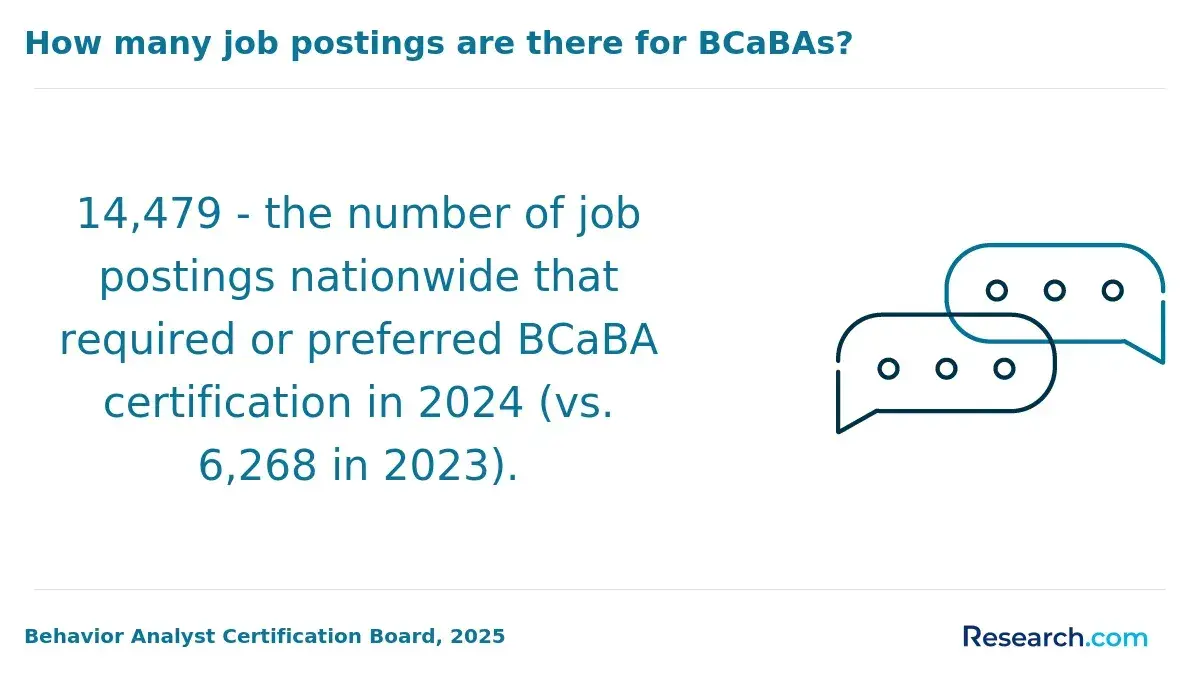
The job outlook for ABA professionals is strong, especially for candidates with BCBA credentials. Demand for ABA services has expanded across healthcare, education, early intervention, community programs, and telehealth. According to UC Online, job openings requiring BCBA credentials increased 58% from 2023 to 2024.
Several trends are shaping the market:
- High demand in healthcare for behavior interventions supporting individuals with autism and developmental disabilities.
- Increased use of ABA methods in public schools to support individualized education plans and behavior intervention needs.
- Expansion of telehealth services, which can broaden geographic access to ABA treatment and remote consultation roles.
- Growth in mental health, early intervention, residential services, and organizational behavior management.
The strongest prospects are generally for professionals who can meet certification and licensure expectations. Entry-level roles such as Registered Behavior Technician can provide useful experience, but they may offer fewer long-term advancement options without additional education.
Regional variation matters. State licensure rules, Medicaid reimbursement policies, insurance coverage, school district funding, and local provider networks can all affect job availability. Areas with more comprehensive coverage and established ABA providers may offer more positions, while rural areas may have fewer employers but greater need.
Career changers should use job postings as research tools before enrolling in a program. Look for the credentials employers request, whether supervision is provided, what populations they serve, and whether roles are school-based, clinic-based, home-based, or remote. This helps align your degree plan with actual hiring requirements rather than broad career descriptions.
How to choose an accredited ABA program?
To choose an accredited ABA program, start by verifying whether the coursework supports the credential you want. For BCBA preparation, students should check approval from the Behavior Analyst Certification Board or accreditation and recognition through the Association for Behavior Analysis International. Do not rely only on a school’s general accreditation or marketing language.
A strong program should clearly explain how its coursework, fieldwork guidance, faculty support, and student advising connect to certification eligibility. Online, campus-based, and hybrid formats can all be viable, but the program must fit your state, schedule, and supervision needs.
| What to check | Why it matters |
| BACB-aligned or ABAI-recognized coursework | Helps ensure the academic sequence supports BCBA exam preparation |
| Institutional accreditation | Affects academic credibility, transferability, and financial aid eligibility |
| Supervised fieldwork support | Fieldwork is essential for certification and can delay progress if not planned early |
| Faculty expertise | Instructors with research or clinical experience can provide stronger mentorship |
| State licensure fit | Some states have additional requirements beyond national certification |
| Total cost | Tuition, supervision, fees, books, and travel can change affordability |
| Program outcomes | Exam pass information, completion data, and job placement details can indicate quality |
Teachers should also ask how prior teaching or paraprofessional experience may apply. Some experience may strengthen an application or help with fieldwork placement, but it may not automatically reduce certification requirements. For paraprofessionals in special education roles, union protections and pension plans similar to teachers may also affect the timing and financial wisdom of a career transition.
Before enrolling, speak with an admissions adviser, a faculty member, and at least one current student or graduate if possible. Ask direct questions about supervision availability, workload, exam preparation, faculty responsiveness, and whether working students finish on time.
The best ABA program is the one that is properly recognized, affordable for your situation, realistic for your weekly schedule, and transparent about certification requirements. A program that looks convenient but leaves you without supervision or exam eligibility support can cost more in delays than it saves in flexibility.
Other Things You Should Know About Applied Behavior Analysis
Most ABA employers require a criminal background check and fingerprint screening before hiring, especially for roles serving children or vulnerable adults. Some agencies also ask for reference checks, TB clearance, and proof of immunizations before orientation. State licensing boards may add their own screening rules.
Supervision is critical in ABA careers, especially for those pursuing certification such as the BCBA. Supervised fieldwork ensures that trainees develop practical skills under the guidance of experienced professionals. It also helps maintain ethical standards and effective treatment practices.
Transitioning from teaching to an ABA career in 2027 may present challenges such as acquiring specialized certification or credentials, adapting to the scientific and data-driven nature of ABA, and understanding differing employer expectations. Teachers might also need to adjust to a more individualized and behavior-focused approach compared to classroom teaching.
- What Jobs Can a BCBA Do - What are the Roles? https://www.biermanautism.com/resources/blog/what-jobs-can-a-bcba-do/
- ABA Careers: Find Applied Behavior Analysis Jobs - LEARN Behavioral https://learnbehavioral.com/careers
- The Rate of Job Growth for BCBAs | Grateful Care ABA https://www.gratefulcareaba.com/blog/the-rate-of-job-growth-for-bcbas
- ABA Program Curriculum: What You Will Study - ABA Masters Programs https://abamastersprograms.org/curriculum/
- 11 Best BCBA Programs & Schools (In-Person & Online) https://www.crossrivertherapy.com/behavioral-analysts/best-bcba-programs
- BCBA Job Outlook 2025 Shows Strong Growth and Demand https://blossomabatherapy.com/blog/bcba-job-outlook
- Applied Behavior Analysis (ABA) | Autism Speaks https://www.autismspeaks.org/applied-behavior-analysis
- Master of Science in Applied Behavior Analysis (ABA) https://tsengcollege.csun.edu/programs/ABA/admission-requirements
- Quitting Teaching? 5 Things to Consider Before You Go — Woods Life Coaching | Michelle Woods https://woodslifecoaching.com/blog/leaving-teaching-5-things-to-consider-before-you-go
- Scottsdale Children's Institute | Why an ABA Curriculum is Effective https://www.scottsdaleci.com/7-reasons-why-an-aba-curriculum-is-effective-in-the-classroom/