2027 How to Afford a BCBA Master's Without Taking on Too Much Debt

Co-Founder and Chief Data Scientist
The main question for many future behavior analysts is not whether a BCBA master's can lead to meaningful work, but how to pay for it without taking on debt that limits career choices later. Tuition, supervision costs, exam fees, and reduced work hours can add up quickly, especially for students balancing graduate school with employment or family responsibilities.
This guide explains how to evaluate the cost of a BCBA master's degree, compare online and in-person options, identify financial aid and scholarships, and judge whether the expected salary and career path justify the investment. It is written for prospective graduate students, registered behavior technicians, educators, career changers, and working professionals who want a practical plan for becoming eligible for BCBA certification while keeping borrowing as low as possible.
Key Things You Should Know
- Graduate tuition for BCBA master's programs averages $20,000-$35,000, with scholarships and employer tuition assistance reducing debt for 40% of students in 2024.
- Part-time, online, and hybrid programs allow students to work while studying, balancing income and expenses to minimize borrowing.
- Approximately 30% of BCBA candidates leverage federal loans with income-driven repayment plans, reducing financial pressure post-graduation.
What is a BCBA and why pursue a master's degree?
A Board Certified Behavior Analyst, or BCBA, is a graduate-level professional who applies behavior analysis to assess behavior, design intervention plans, monitor progress, and support clients, families, schools, and organizations. BCBAs commonly work with individuals with autism spectrum disorder, developmental disabilities, behavioral health needs, and learning or skill-acquisition challenges.
A master's degree matters because it is part of the standard pathway to BCBA certification. The right graduate program helps students build competence in behavioral assessment, intervention design, ethics, research methods, data analysis, and supervision. It can also help students connect coursework with supervised fieldwork, which is essential for applying behavior analysis safely and effectively.
The degree can be worth pursuing if it aligns with your career goals and if the program cost is reasonable compared with your likely earnings. Cost deserves close attention. Graduates from private nonprofit institutions often face an average debt of $95,381, with $79,329 attributed to graduate studies alone. That level of borrowing can affect housing, savings, and career flexibility after graduation.
To reduce risk, compare programs by total tuition, fees, fieldwork support, accreditation or certification alignment, online flexibility, employer reimbursement eligibility, and student outcomes. Students who need flexible or lower-cost options can review BCBA certification online cost resources as part of a broader affordability search.
Who is a BCBA master's best for?
- Registered behavior technicians or ABA staff who want to move into assessment, supervision, or program-design roles.
- Educators and school professionals who want to use behavior analysis in special education or student support services.
- Psychology, counseling, or human services graduates seeking a more specialized applied credential.
- Working adults who need an online or hybrid route that allows them to keep earning while completing coursework and fieldwork.
What are BCBA certification and education requirements?
BCBA certification generally requires a master's degree, approved graduate-level behavior-analytic coursework, supervised fieldwork, and a passing score on the BCBA exam. Because certification rules can change, students should verify the current requirements directly with the certifying body and with any program they are considering before enrolling.
The graduate degree is typically in behavior analysis, education, psychology, or a closely related field from an accredited institution. Coursework usually covers ethics, measurement, assessment, behavior-change procedures, experimental design, supervision, and professional practice. When comparing BCBA programs, confirm that the curriculum is designed to meet current BCBA eligibility standards rather than assuming that any ABA-related master's will qualify.
Candidates also need supervised fieldwork. The required experience is often described as 1,500 to 2,000 hours of supervised fieldwork under a qualified BCBA supervisor, depending on the fieldwork pathway. These hours are not a formality; they are where students learn to translate coursework into assessment, treatment planning, data-based decision-making, caregiver training, and ethical practice.
The final step is passing the BCBA exam, which tests knowledge across core behavior-analytic domains. Many students complete the overall process in two to three years, although the timeline depends on course load, fieldwork access, employment schedule, and exam preparation.
Core requirement checklist
| Requirement | What to verify before enrolling |
| Graduate degree | The institution is properly accredited and the degree field fits the current eligibility pathway. |
| Coursework | The program clearly states how its courses align with BCBA education requirements. |
| Supervised fieldwork | You know whether the program helps arrange placements or expects students to secure their own sites. |
| Exam preparation | The program provides advising, practice exams, or structured review support. |
| Cost plan | You understand tuition, fees, supervision costs, expected borrowing, and repayment options. |
Financial planning should start early. EducationData.org reports that Master of Education graduates, many of whom pursue Applied behavior analysis certification, average $67,553 in total student debt, with $42,680 linked directly to graduate school expenses. Students can lower the amount borrowed by choosing lower-cost accredited options, using employer tuition benefits, applying for scholarships, and enrolling part time when it helps them keep working.
How much do BCBA master's programs cost?
BCBA master's programs commonly cost from $15,000 to over $40,000 in tuition, depending on the institution, residency status, delivery format, and credit requirements. Public universities are often less expensive, especially for in-state students, with tuition frequently between $15,000 and $25,000. Private schools commonly charge between $30,000 and $45,000. Online programs can reduce relocation and commuting costs, but they rarely fall below $20,000.
Tuition is only one part of the total cost. Students should budget for textbooks, technology fees, application fees, supervision fees if not covered by an employer or placement site, exam-related expenses, background checks, and travel connected to practicum or fieldwork. These charges can add several thousand dollars to the final price.
Debt risk also depends on the field and the student's earnings after graduation. Financing BCBA degrees can be challenging because social work and counseling master's programs, which include many BCBA tracks, have some of the highest debt-to-earnings ratios. Analysis of 2024-2025 College Scorecard data shows that half of graduates in these fields carry debt exceeding their early-career salaries, raising affordability concerns.
How to estimate your real program cost
- Use total program tuition, not per-credit tuition alone. Multiply the cost per credit by the required credits, then add mandatory fees.
- Ask about supervision. Some students receive supervised fieldwork through paid employment; others may pay separately or spend unpaid hours in placements.
- Compare time to completion. A cheaper program may cost more overall if it requires unpaid time away from work or delays certification.
- Check whether online tuition differs by state. Some public universities charge the same online rate to all students, while others use residency-based pricing.
- Calculate expected monthly loan payments before enrolling. A program is not affordable just because loans are available.
Prospective students should compare accredited programs with transparent pricing and strong certification support. Part-time enrollment, employer tuition assistance, scholarships, grants, and federal loans may help manage cost. Students comparing flexible routes can also review ABA online masters programs to understand how online formats affect time, cost, and work schedules.
BCBA master's students may be able to use several types of financial aid, but eligibility depends on the school, program format, enrollment status, and the student's personal circumstances. Start with the FAFSA if the institution participates in federal student aid, then compare federal loans, institutional scholarships, assistantships, employer benefits, and external awards before considering private loans.
Federal aid for graduate students commonly includes Federal Direct Loans, and some students may qualify for programs tied to service commitments, such as TEACH Grants for those committing to teaching in underserved areas. Do not assume every form of federal aid applies to graduate study; for example, Pell Grants are generally associated with undergraduate aid, so students should confirm eligibility directly through FAFSA and the school's financial aid office.
Institutional aid can be especially valuable. Graduate assistantships may provide tuition waivers, stipends, or hourly pay in exchange for teaching, research, clinical, or administrative work. For example, Western Connecticut State University's online ABA master's program has the lowest average total debt among top programs at $23,203, demonstrating the benefits of lower-cost program structures and funding opportunities (DegreeChoices.com).
Common funding sources for BCBA master's students
| Funding source | Best for | What to ask |
| Federal student aid | Students attending eligible institutions who need structured borrowing options. | What loan types are available, what are the borrowing limits, and what repayment plans apply? |
| Graduate assistantships | Students who can work for the department while studying. | Does the award include tuition remission, a stipend, or both? |
| Institutional scholarships | Applicants with academic merit, financial need, or program-specific qualifications. | Are awards automatic, competitive, renewable, or tied to full-time enrollment? |
| Employer tuition reimbursement | ABA staff, educators, healthcare workers, and school employees. | Is reimbursement paid upfront or after grades are posted, and is continued employment required? |
| Military and veteran benefits | Eligible service members, veterans, and dependents. | Can GI Bill benefits or Yellow Ribbon support apply to the program? |
| Private scholarships | Students connected to autism services, disability advocacy, education, or behavioral health. | What essays, recommendations, or service commitments are required? |
State grants and tuition waivers may also be available, especially for in-state residents or public-sector employees. Veterans and military personnel may use GI Bill benefits and Yellow Ribbon programs to help cover educational expenses. Employer tuition reimbursement is often one of the strongest options for working ABA professionals because clinics, school districts, and behavioral health organizations may help pay for employees pursuing BCBA credentials.
Private scholarships from organizations such as the Behavior Analyst Certification Board Foundation and local autism advocacy groups can provide targeted support. Students comparing flexible paths may also research online BCABA programs to understand how lower-level behavior analysis credentials and online study options fit into a longer-term certification plan.
Yes. Affordable online BCBA master's programs are available, especially through public universities and institutions with transparent graduate tuition. Online study can be a strong option for working adults because it may allow students to keep earning income while completing coursework. However, online does not automatically mean inexpensive, and students still need to verify certification alignment, fieldwork support, and total cost.
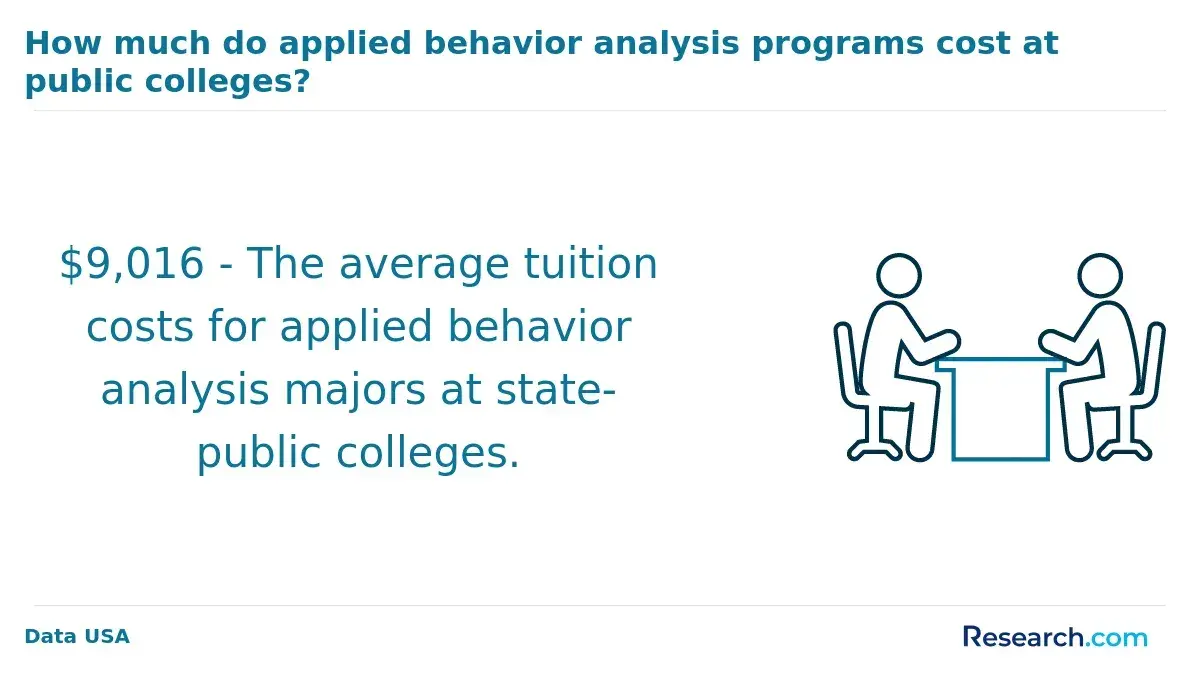
Public institutions often have a cost advantage. According to EducationData.org (2025), master's degree borrowers from public institutions graduate with an average debt of $69,624, compared to $95,381 from private nonprofits. This difference is one reason many cost-conscious students begin their search with public universities, in-state options, and online programs that charge flat or reduced tuition rates.
When comparing online BCBA master's programs, look beyond the advertised tuition. Ask whether the program has residency requirements, synchronous class meetings, campus visits, fieldwork seminars, technology fees, and separate supervision expenses. A program with low tuition but weak fieldwork support may create delays that increase the real cost of certification.
Signs an online program may be affordable in practice
- The school publishes total program tuition and mandatory fees clearly.
- The coursework is designed to meet current BCBA eligibility requirements.
- Students can complete coursework while working full time or part time.
- The program helps students understand supervised fieldwork requirements.
- In-state, military, employer-partner, or online tuition discounts are available.
- Financial aid, scholarships, or payment plans are available to eligible students.
Review each program's total cost, graduation rates, fieldwork structure, student support, and average debt when available. The best affordable program is not simply the cheapest one; it is the one that helps you reach certification eligibility efficiently without unnecessary borrowing.
BCBA master's programs usually take between 1.5 and 3 years to complete. Full-time students often finish coursework in about two years, while part-time students may need longer because they are balancing employment, fieldwork, and personal responsibilities. Accelerated options can shorten the timeline, but they require careful planning and may not be realistic for students working full time.
Program length depends on credit requirements, course sequencing, start dates, online or in-person format, and supervised fieldwork availability. Online programs may offer more flexibility, but flexibility does not always mean faster completion. Some courses may be offered only once per year, and some programs require students to move through a fixed cohort sequence.
Fieldwork is often the factor that determines the real timeline. Students who already work in an ABA setting with qualified supervision may be able to accumulate hours more steadily. Students who need to find a new placement, change jobs, or pay for supervision may experience delays.
Timeline factors to check before enrolling
- Whether prerequisite courses are required before graduate enrollment.
- How many credits are required for the degree.
- Whether courses are offered year-round or only in fall and spring.
- Whether the program is cohort-based or self-paced.
- How supervised fieldwork is arranged and documented.
- Whether taking fewer credits affects financial aid eligibility.
Cost and timeline should be evaluated together. Public and in-state programs can reduce borrowing, while high-cost programs may create pressure to finish quickly even when the workload is not sustainable. Private for-profit ABA master's programs in the U.S. average $76,379 in debt-86.7% higher than inflation-adjusted costs from 2000, according to EducationData.org. That makes affordability a key part of planning, not a separate issue.
Before choosing a program, map out your expected course schedule, fieldwork plan, work hours, and financing strategy. A realistic timeline can help you avoid burnout, delayed certification, and unnecessary debt.
Applied Behavior Analysis students can look for scholarships through professional associations, universities, disability advocacy organizations, autism-focused nonprofits, employers, and local community foundations. These awards may not cover the entire cost of a BCBA master's degree, but combining several smaller sources can reduce the amount borrowed.
The Association for Behavior Analysis International (ABAI) offers various scholarships based on academic merit, financial need, and support for underrepresented minorities. These awards generally target graduate students actively pursuing ABA certification. For instance, the ABAI Professional Development Scholarship helps cover tuition and coursework expenses.
Universities with ABA programs, including Florida Institute of Technology and Simmons University, may provide competitive scholarships for students in their ABA master's tracks. Some awards are renewable, while others are available only to new students or full-time students. Always ask the department and the financial aid office separately because program-level funding is not always listed on the general scholarship page.
Employer tuition assistance can be just as important as scholarships. ABA clinics, school districts, healthcare organizations, and behavioral service providers may reimburse tuition for employees pursuing BCBA credentials, especially when the credential addresses a staffing need. According to EducationData.org, 57.8% of MBA holders carry student loan debt, but employees working for clinics or school districts offering tuition reimbursement for BCBA credentials can often avoid similar burdens.
How to improve your scholarship odds
- Apply before admission deadlines when scholarships are tied to the application cycle.
- Ask whether awards require full-time enrollment, a minimum GPA, or service commitments.
- Prepare a focused statement connecting ABA training to your career goals and community impact.
- Request recommendations from supervisors who can describe your clinical judgment, reliability, and ethics.
- Search for awards from autism organizations, disability advocacy groups, education foundations, and local nonprofits.
- Track renewal requirements so you do not lose funding after the first year.
Additional scholarships from disability advocacy groups and autism organizations may provide smaller awards ranging from $500 to $5,000 annually. Because many awards are competitive, students should apply broadly and early rather than relying on a single scholarship source.
BCBA salaries in the United States commonly fall between $65,000 and $85,000 as a median annual range, but actual pay depends on location, experience, setting, caseload, supervisory duties, and employer type. Entry-level BCBAs often start around $60,000, while experienced professionals with five or more years in clinical or educational roles can earn over $90,000, especially in metropolitan areas with high demand.
Common employers include school districts, private ABA clinics, healthcare organizations, early intervention providers, nonprofits, residential programs, and consulting practices. School and government roles may offer stronger benefits and predictable schedules, while private clinics or supervisory positions may offer higher earning potential but heavier productivity expectations.
Job growth for behavioral specialists and therapists is projected at about 20% over the next decade, much faster than average. Demand is driven by expanded services for individuals with autism spectrum disorder, greater use of behavioral interventions in education and healthcare, and continued need for qualified supervisors. States like California, Texas, and New York show particularly strong demand.
Salary factors to evaluate before borrowing
| Factor | Why it matters |
| Geographic location | Pay can be higher in high-demand metro areas, but cost of living may also be higher. |
| Setting | Schools, clinics, hospitals, nonprofits, and private practice can differ in salary, benefits, and workload. |
| Experience | Supervision, assessment, leadership, and specialty skills can increase earning potential. |
| Debt level | A strong salary can still feel restrictive if monthly loan payments are too high. |
| Benefits | Health insurance, retirement contributions, paid time off, and loan assistance can change the real value of an offer. |
Many education master's degree holders face financial pressure, with 62.5% carrying debt. Prospective BCBA students should compare expected local salaries with likely loan payments before enrolling. Grants, tuition assistance, public-sector benefits, and loan forgiveness programs tied to qualifying employment may improve the return on investment.
The most financially sound path is usually one that keeps tuition manageable, allows continued employment during school, and leads to roles with stable demand and room for salary growth.
Choose a BCBA master's program by confirming three things first: the institution is properly accredited, the curriculum is designed to meet current BCBA eligibility requirements, and the program provides clear guidance for supervised fieldwork. A program can sound relevant to ABA but still fail to support the certification pathway efficiently, so verification is essential.
Because certification standards and terminology can change, do not rely only on marketing language. Ask the admissions office and program director to explain exactly how the degree and coursework meet current requirements. If the program advertises specialized accreditation, approval, or verified coursework, confirm the status through the relevant official source before applying.
Cost is another critical factor. An Urban Institute report shows that only 7% of ABA master's graduates incur debt exceeding 150% of early-career earnings, suggesting many programs may offer a more balanced debt-to-income profile than some other graduate fields. Still, students should avoid programs where expected debt substantially outpaces likely earnings in their region.
Program comparison checklist
- Accreditation and eligibility: Confirm institutional accreditation and BCBA pathway alignment.
- Total cost: Compare tuition, fees, books, supervision expenses, travel, and lost income.
- Fieldwork support: Ask whether placements are embedded, employer-based, or student-arranged.
- Format: Decide whether online, hybrid, or campus study best fits your work schedule and learning style.
- Faculty expertise: Look for instructors with relevant ABA practice, supervision, research, or specialty experience.
- Student support: Review advising, exam preparation, writing support, and career services.
- Outcomes: Ask about graduation rates, exam preparation support, job placement information, and alumni roles.
Program delivery varies. Full-time campus programs may offer more direct faculty interaction and structured peer support. Online and hybrid programs can be better for working professionals, but students must be disciplined about scheduling, fieldwork documentation, and exam preparation.
The best choice is the program that meets certification requirements, fits your schedule, supports supervised practice, and keeps debt at a level your expected career path can reasonably repay.
What career paths follow a BCBA master's degree?
A BCBA master's degree can lead to clinical, educational, supervisory, consulting, and organizational roles. Many graduates become Board Certified Behavior Analysts in schools, healthcare settings, private clinics, or community agencies, where they conduct assessments, design behavior intervention plans, supervise staff, train caregivers, and monitor client progress.
Career paths vary by population and setting. Some BCBAs focus on autism services, early intervention, severe behavior, school consultation, adult services, intellectual and developmental disabilities, or caregiver training. Others move into leadership, quality assurance, staff training, or program development.
Common career options
- Behavior analyst in a school district or special education setting.
- Clinical BCBA in an ABA clinic, healthcare organization, or private practice.
- Early intervention behavior analyst supporting infants, toddlers, and families.
- Supervisor or clinical director overseeing behavior technicians and treatment quality.
- Consultant helping organizations apply behavior analysis to performance, safety, or training.
- Research, teaching, or supervision roles supporting future behavior analysts.
- Behavior specialist roles in mental health, substance abuse, residential, or forensic settings.
Some graduates specialize in organizational behavior management to improve workplace systems, while others work in forensic or juvenile settings where behavior analysis can support assessment, intervention, and skill development. Entry-level salaries for BCBAs typically range from $50,000 to $70,000 annually, with increased earning potential through experience, specialization, supervision responsibilities, and leadership roles.
Employment in school districts or government agencies may provide stable benefits and predictable schedules. Private practice can offer more autonomy and varied income potential, but it also brings business, billing, compliance, and referral responsibilities.
Financial planning should continue after graduation. Median student loan balances tend to rise by the sixth year of repayment, which highlights the importance of selecting a repayment strategy, avoiding unnecessary deferment, and pursuing roles with salary growth or employer-supported loan benefits when available. A BCBA master's can be a strong professional investment when the program cost, certification plan, and career path are aligned from the beginning.
Other Things You Should Know About Applied Behavior Analysis
BCBA master’s students can file the FAFSA to access Direct Unsubsidized Loans and Graduate PLUS Loans through the U.S. Department of Education. For 2026–27, graduate Direct Unsubsidized Loan limits are $20,500 per year, and Graduate PLUS loans can cover remaining costs up to the school’s attendance budget.
Yes, applied behavior analysis techniques have broad applications beyond autism treatment. They are used in areas such as education to improve learning outcomes, in mental health to address challenging behaviors, and in organizational settings to enhance productivity. The methods focus on altering behavior through data-driven interventions irrespective of the clinical population.
Ethical practice in applied behavior analysis involves obtaining informed consent, ensuring client dignity, maintaining professional competence, and protecting confidentiality. Practitioners must adhere to the Behavior Analyst Certification Board's Professional and Ethical Compliance Code, which guides responsible treatment planning and respectful client interactions. Ethical considerations are essential to maintaining trust and efficacy.
Yes, scholarships and grants can significantly lower the cost of a BCBA Master's in 2027. Many universities offer funding opportunities for students. Additionally, organizations like the Association for Behavior Analysis International (ABAI) provide grants and scholarships specifically for students pursuing a career in behavior analysis.
- Top Online ABA Master's Degrees Of 2026 | Psychology.org https://www.psychology.org/rankings/best-online-masters-applied-behavior-analysis/
- BCBA Career Path To Take | Advanced Therapy Clinic https://www.advancedtherapyclinic.com/blog/bcba-career-path-to-take
- Choosing the Right BCBA Career Path | Advanced Autism Services https://www.advancedautism.com/post/bcba-career-path-to-take
- Applied Behavior Analysis Master’s—100 % Online https://www.baypath.edu/academics/graduate-programs/applied-behavior-analysis-ms/
- What Jobs Can a BCBA Do - What are the Roles? https://www.biermanautism.com/resources/blog/what-jobs-can-a-bcba-do/
- ABA Career Path: Job Opportunities in Applied Behavior Analysis - Apple ABA https://appleabacare.com/aba-therapy-careers/aba-career-path/
- Application for Applied Behavioral Analysis Scholarship Program https://www.autismrecoveryfoundation.org/services/aba-application
- How Long Does It Take to Become a BCBA? | Timeline Guide https://www.appliedbehavioranalysisedu.org/2026/04/how-long-does-it-take-to-become-a-bcba/
- Master's with No Debt: A Strategic Guide to Funding Grad School https://www.onlinemastersdegrees.org/financial-aid/masters-with-no-debt/
- A Guide to How to Pay for Grad School https://www.collegeessayguy.com/blog/how-to-pay-for-grad-school