2027 Online BCBA Programs With Cohort Models vs Independent Study

Co-Founder and Chief Data Scientist
Choosing an online BCBA program is not only a question of cost or convenience. The bigger decision is how you learn best while meeting the coursework, supervised fieldwork, exam preparation, and possible state licensing expectations tied to becoming a Board Certified Behavior Analyst.
For many working adults, the choice comes down to two formats: a cohort model or independent study. Cohort-based programs move students through courses together with set deadlines, instructor touchpoints, and peer discussion. Independent study programs offer more control over pacing but place more responsibility on the student to stay organized, find support, and prepare for certification requirements.
This guide compares both formats for online BCBA programs in 2026. It explains how they differ, what accreditation and certification requirements matter, what admissions and costs typically look like, and how each format can affect fieldwork, exam readiness, and career planning.
Key Things You Should Know
- Online BCBA programs with cohort models offer structured peer interaction and scheduled guidance, improving completion rates by up to 15% compared to independent study formats in 2025 data.
- Independent study models provide flexibility but require higher self-motivation; nearly 40% of enrolled students report challenges in maintaining consistent study habits.
- Both formats meet BACB certification standards, but cohort-based programs tend to enhance applied behavior analysis practical skills through collaborative learning and timely feedback.
What Are Online BCBA Programs with Cohort Models vs Independent Study?
Online BCBA programs prepare students for advanced work in applied behavior analysis, often with the goal of meeting eligibility requirements for BCBA certification. The two common delivery formats—cohort learning and independent study—can lead to similar academic outcomes, but the student experience is very different.
A cohort-based online BCBA program enrolls students as a group. Students usually begin at the same time, follow the same course sequence, meet common deadlines, and often participate in live discussions or structured group activities. This model is designed for accountability, peer learning, and regular faculty interaction.
An independent study BCBA program gives students more control over when and how they complete coursework. Students may rely on recorded lectures, readings, asynchronous assignments, and self-directed study plans. This format can work well for students with unpredictable work schedules, caregiving responsibilities, or variable availability, but it requires strong planning and self-monitoring.
| Format | Best fit | Main advantage | Main risk |
| Cohort model | Students who want structure, deadlines, and peer interaction | More built-in support and accountability | Less scheduling flexibility |
| Independent study | Students who need maximum control over pacing | Greater flexibility for work and personal obligations | More risk of isolation or falling behind |
The distinction matters because BCBA preparation is demanding. Candidates must understand behavior analytic principles, apply ethical standards, complete supervised fieldwork, and prepare for a challenging certification exam. The BCBA first-time exam pass rate fell to 51%, down from 66% five years earlier, which makes program support, feedback, and exam preparation especially important.
Students comparing formats should start with three questions: Do you perform better with external deadlines? Can you reliably create your own study schedule? Will you have easy access to qualified supervision and instructor guidance? Those who need structure may benefit from a cohort. Those who are highly self-directed and need unusual scheduling flexibility may prefer independent study. Students also comparing affordability can review online ABA master's programs to see how cost and format align.
How Do Cohort Model and Independent Study BCBA Programs Differ?
Cohort and independent study BCBA programs differ most in pacing, interaction, accountability, and access to support. The academic content may be similar, especially when programs are designed around certification requirements, but the learning environment can affect how students manage workload and prepare for practice.
In a cohort model, students move through courses together. This creates a predictable rhythm: weekly expectations, shared deadlines, group discussion, and repeated contact with faculty and classmates. For many students, that structure reduces procrastination and creates a professional network before graduation.
Independent study programs are more flexible. Students may complete assignments asynchronously and adjust progress around employment, family responsibilities, or changing schedules. The trade-off is that students must be more proactive. They may need to request clarification, create their own study calendar, and seek outside professional connection.
| Factor | Cohort model | Independent study |
| Schedule | Fixed sequence with regular deadlines | Flexible or self-paced structure |
| Interaction | Frequent peer and instructor engagement | Mostly asynchronous and self-directed |
| Accountability | Built into the group timeline | Depends heavily on student discipline |
| Fieldwork planning | May be coordinated more closely with coursework | Often requires more student initiative |
| Best for | Students who want guidance, community, and momentum | Students with irregular schedules and strong self-management skills |
With BCBA certificants growing over 20% year-over-year, the format you choose can influence how efficiently you move from coursework to certification preparation and employment. A student who needs frequent feedback may struggle in a highly independent format, while a student with rotating work hours may find a rigid cohort difficult to maintain.
Before applying, ask programs how often students meet with faculty, whether live sessions are required, how fieldwork is supported, and what exam preparation resources are included. Students comparing options can review listings of BCBA schools to evaluate format, recognition, and delivery model.
What Are the Best Online BCBA Programs in 2026?
The best online BCBA programs in 2026 are not simply the fastest or cheapest options. Strong programs combine eligible coursework, qualified faculty, clear fieldwork guidance, transparent outcomes, and a delivery model that matches the student’s learning style.
For students who want structure, the best online BCBA graduate programs with cohort learning usually provide a planned course sequence, regular deadlines, faculty access, and peer discussion. Cohort-based programs such as the University of South Florida's MA in ABA emphasize peer networks and structured timelines. According to a LinkedIn post from the University of South Florida, these cohort models prioritize consistent group interactions and mentoring, which can support retention and practical learning.
For students who need flexibility, strong independent study options may offer rolling admissions, asynchronous coursework, and adjustable pacing. These features can be valuable for working professionals, but students should confirm how the program handles advising, supervision planning, exam preparation, and timely instructor feedback.
How to compare programs
- Certification alignment: Confirm that coursework meets current BACB expectations for your intended certification pathway.
- Accreditation and institutional quality: Review both program-level recognition and university accreditation.
- Fieldwork support: Ask whether the program helps students identify supervisors, track hours, and connect coursework to practice.
- Format fit: Choose a cohort if you need structure; choose independent study only if you can manage pacing and support needs independently.
- Transparency: Look for clear information about tuition, completion timelines, faculty access, and exam preparation.
Students interested in shorter completion paths can review the ABA therapist master's degree guide, but speed should not be the only factor. A program that is fast but poorly supported may create problems later during fieldwork, exam preparation, or licensure review.
Online BCBA students should verify two layers of quality assurance: the institution’s accreditation and the program or coursework’s alignment with BACB requirements. Both matter, but they serve different purposes.
Institutional accreditation, often regional accreditation from agencies such as the Higher Learning Commission or WASC, indicates that the college or university has met broader academic and administrative standards. This can affect credit transfer, graduate school recognition, employer confidence, and eligibility for certain forms of financial aid.
BCBA-focused coursework must also align with Behavior Analyst Certification Board requirements. Many students look for programs with a Verified Course Sequence (VCS) because it indicates that coursework has been reviewed for required content. Students should still confirm current BACB rules directly, because certification pathways and documentation expectations can change.
| What to verify | Why it matters |
| Institutional accreditation | Supports degree legitimacy, credit recognition, and broader academic quality |
| BACB coursework alignment or VCS status | Helps confirm that courses address required behavior analysis content |
| Fieldwork documentation process | Reduces risk of missing supervision or hour-tracking requirements |
| State licensing compatibility | Some states may impose additional requirements beyond certification |
Students should not rely only on a program webpage. Before enrolling, ask an advisor for the exact course sequence, how the program documents eligibility, whether fieldwork is embedded or arranged separately, and how graduates are supported during exam preparation. Verification through BACB resources and state licensing boards is also wise.
Exam pass rate data from multiple cohort programs shows fewer than 80% success for students enrolled in programs with over 100 participants between 2016 and 2020. That point is important: accreditation and recognition are necessary screening tools, but they do not guarantee strong teaching, advising, or exam readiness. Students comparing accredited options can use ABA online resources as a starting point for deeper program review.
BCBA certification generally requires a qualifying graduate-level degree, required behavior analysis coursework, supervised fieldwork, and a passing score on the BCBA certification exam. State licensing, where required, can add separate steps, so students should evaluate both certification and licensure before choosing a program.
The graduate degree may be in behavior analysis, education, psychology, or a related field from an accredited institution, provided the coursework aligns with Behavior Analyst Certification Board standards. Students should confirm that the program’s course sequence fits the certification pathway they intend to use.
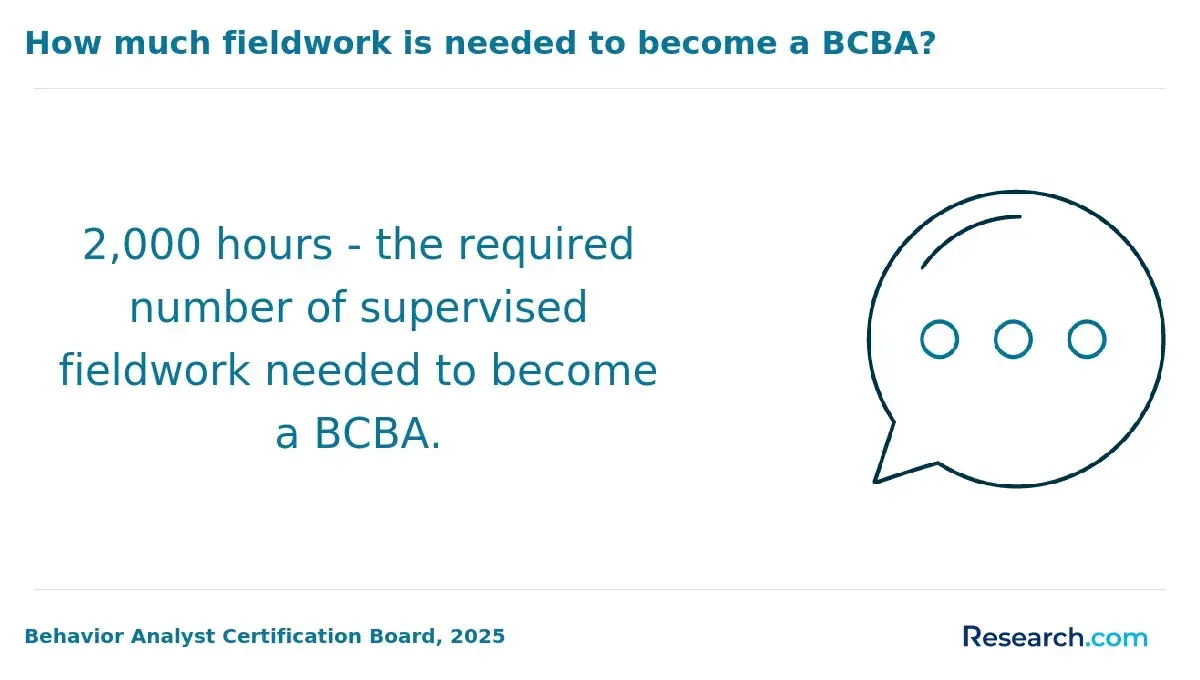
Supervised fieldwork is a major requirement. Candidates must finish between 1,500 and 2,000 hours under a qualified BCBA supervisor. These hours may be completed while enrolled in a cohort model, an independent study format, or a hybrid or campus-based program, but the quality and organization of supervision can vary significantly.
The certification exam tests both foundational concepts and applied skills. Because exam readiness depends on more than completing assignments, students should ask programs how they integrate practice questions, case analysis, ethics review, and feedback. Hybrid or campus BCBA programs yield exam pass rates 10-13 percentage points higher than fully online courses, highlighting the possible advantage of more integrated practical learning.
Licensure planning checklist
- Confirm whether your state licenses behavior analysts.
- Ask whether the program’s curriculum satisfies your state’s educational requirements.
- Verify whether your state requires a jurisprudence exam or additional documentation.
- Clarify who can supervise your fieldwork and how hours must be recorded.
- Check requirements before enrolling, not after graduation.
Students who plan to relocate should be especially careful. A program that works well for certification preparation may still need review against state-specific licensing rules.
Admission requirements for online BCBA programs usually include a bachelor’s degree, official transcripts, and a minimum GPA that is often around 3.0 on a 4.0 scale. Some programs prefer applicants with academic or professional experience in psychology, education, human services, special education, or a related area.
Programs may also request a statement of purpose, resume, letters of recommendation, or evidence of relevant work experience. Applicants should use these materials to show that they understand the demands of behavior analysis, including ethical practice, data-based decision-making, and supervised fieldwork.
Cohort-based programs may evaluate whether applicants can commit to fixed start dates, course sequencing, live meetings, or group-based assignments. Independent study programs may place more emphasis on whether the applicant can manage flexible pacing and arrange support without frequent reminders.
What applicants should ask before applying
- Does the program require a specific undergraduate major?
- Is professional experience in behavior analysis preferred or required?
- Are supervised hours built into the program, or must students arrange them independently?
- Can students enter at multiple points during the year, or only with a cohort?
- What academic support is available if students struggle in quantitative, research, or assessment courses?
Research from PMC article PMC10169946 indicates that program enrollment size influences outcomes: higher enrollment shows a moderate positive correlation with enrollment frequency but a weak negative association with pass rates. Applicants should not assume that a large or popular online program is automatically the strongest choice. The better question is whether the program has enough advising, faculty access, and fieldwork support for its enrollment size.
Online BCBA programs typically take 1.5 to 3 years to complete, depending on format, course load, transfer credits, fieldwork timing, and whether the student studies full time or part time. Cohort programs commonly follow a structured timeline, while independent study programs may allow students to move faster or slower.
A cohort model often works best for students who want a predictable path. The trade-off is that students may have less control over course timing. Independent study can be more adaptable, but delays are common when students pause coursework, underestimate the workload, or struggle to coordinate supervised fieldwork.
Tuition costs for online BCBA programs generally range from $10,000 to $25,000. Cohort programs may use a fixed curriculum price or term-based billing. Independent study programs may charge by credit or course, meaning total cost can depend on pacing, repeated courses, fees, and how long the student remains enrolled.
| Cost or time factor | Why it matters |
| Tuition structure | Per-credit, per-course, or program pricing can change the final cost |
| Supervision fees | Some fieldwork supervision may involve separate costs |
| Books and materials | Required texts, assessment tools, or software may add expenses |
| Exam-related charges | Students should budget for certification exam and application costs |
| Completion pace | Taking longer may increase indirect costs, while rushing can affect learning |
Cohort models may support stronger persistence because deadlines and peer progress create momentum. For example, an online ABA master's cohort at William James College starting in Fall 2022 reported 81% retention after one year and 80% on-time graduation. Students should compare not only tuition but also the likelihood that the program structure will help them finish on schedule.
Online BCBA cohort and independent study programs generally cover core applied behavior analysis topics such as behavioral principles, measurement, assessment, intervention design, ethics, research methods, and supervision. The key difference is not usually what students study, but how they engage with the material and connect it to fieldwork.
Cohort programs often organize curriculum into scheduled modules with instructor-led discussion, case analysis, group problem-solving, and structured feedback. This format can be useful for difficult topics such as functional behavior assessments, behavior intervention plans, experimental design, and ethical decision-making because students can test their reasoning with faculty and peers.
Independent study programs typically present similar content through readings, recorded lectures, quizzes, written assignments, and simulated cases. This can work well for disciplined learners, especially those who already work in applied behavior analysis settings. However, students must be intentional about asking questions and seeking feedback when they do not understand how concepts apply in practice.
| Curriculum area | Cohort experience | Independent study experience |
| Conceptual foundations | Discussed in sequence with classmates and instructors | Studied through self-paced readings and lectures |
| Assessment and intervention | Often reinforced through live case discussion | Often practiced through assignments or simulations |
| Ethics | May include group debate and applied scenarios | Requires independent reflection and written application |
| Research and measurement | Structured feedback can help with technical concepts | Students may need to seek extra clarification |
| Fieldwork integration | May be coordinated more closely with coursework | Depends heavily on student-arranged supervision |
Practicum and supervised fieldwork remain central in both formats. Cohort students may benefit from coordinated expectations and stronger peer networks. Independent learners may have more freedom to align fieldwork with an existing job, but they must confirm that supervision is qualified and properly documented.
Return on investment data shows cohort graduates starting with up to 15% higher salaries, reflecting possible advantages from built-in professional networks and practical readiness. Students should treat this as one factor among many and examine whether a specific program offers the supervision quality, curriculum depth, and career support needed for their goals.
BCBA certification can lead to roles in clinics, schools, hospitals, residential programs, private practice, and organizational settings. BCBAs use behavior analysis to assess needs, design interventions, supervise implementation, train staff or caregivers, and evaluate progress with data.
Common job titles include behavior interventionist, clinical director, school consultant, and organizational behavior specialist. Some BCBAs provide direct clinical oversight for children with autism spectrum disorder. Others work with school teams, manage treatment programs, consult with agencies, or move into supervision and leadership.
Salaries generally range from $60,000 to $100,000 annually, with entry-level roles starting near $60,000 and experienced professionals in supervisory or specialized roles exceeding $100,000. Actual compensation can vary by location, employer type, caseload, years of experience, and whether the role involves clinical supervision or program leadership.
| Career path | Typical work setting | Common responsibilities |
| Behavior interventionist | Clinics, schools, community programs | Support behavior plans and collect progress data |
| School consultant | Public or private schools | Advise teams on assessments, interventions, and student supports |
| Clinical supervisor | ABA clinics or treatment organizations | Supervise staff, review cases, and monitor treatment quality |
| Clinical director | Healthcare or behavioral service organizations | Lead programs, manage teams, and oversee service delivery |
| Organizational behavior specialist | Businesses or agencies | Apply behavior principles to training, performance, and systems |
Completing ABAI-accredited programs enhances exam pass rates by about 11 percentage points, which may improve competitiveness by helping graduates reach certification more reliably. Still, employers also look for practical judgment, ethical decision-making, communication skills, and supervised experience that matches the setting where the candidate wants to work.
What Is the Job Outlook for BCBA Professionals?
The job outlook for BCBA professionals remains cautiously positive, especially in healthcare, education, autism services, developmental disability support, and behavioral health. Demand is tied to the continued need for trained professionals who can design, supervise, and evaluate behavior intervention services.
Several factors support continued demand:
- Increasing numbers of individuals with autism spectrum disorder and developmental disabilities needing skilled behavior intervention.
- Expansion of behavior analysis services into public schools, mental health clinics, and elder care settings.
- Growth in insurance reimbursement for behavior analysis treatment.
At the same time, the path into the profession is not automatic. Pass rates for BCBA certification have declined to 51% in 2025, according to certifyndaba.com, which signals a real barrier for candidates who complete coursework but are not fully prepared for the exam. This makes program selection, fieldwork quality, and exam preparation central to career planning.
Cohort-based programs may help some students move through preparation more consistently because they connect theory, peer discussion, supervision planning, and deadlines. Independent study can still be effective for self-directed learners, but students should build their own support system early through supervisors, mentors, study groups, and professional contacts.
Graduates can strengthen job prospects by seeking supervised experience in the setting where they want to work, documenting competencies carefully, and developing strong communication skills with families, teachers, staff, and interdisciplinary teams. Employers value certification, but they also value candidates who can apply behavior analysis responsibly in real-world environments.
Other Things You Should Know About Applied Behavior Analysis
Prerequisites for 2027 online BCBA programs typically include a bachelor's degree in psychology or a related field, and sometimes specific coursework. Some programs may also require prior experience in behavior analysis, so it's crucial to check individual program requirements.
Students should keep signed fieldwork logs, monthly verification forms, supervisor contact records, and task-list tracking sheets for all supervised hours. The BACB requires documentation that shows the experience met its current supervised fieldwork standards, including the correct hours, activities, and qualified supervisor signatures.
In 2027, cohort model programs may offer adults pursuing BCBA certification structured support and communal learning, while independent study programs provide flexibility for self-driven learners. Cohort models facilitate networking and collaboration, which can be beneficial for adults balancing education with other commitments. Meanwhile, independent study allows personalized pacing.
Ethical practice in applied behavior analysis requires adherence to the Behavior Analyst Certification Board's (BACB) Professional and Ethical Compliance Code. Key considerations include obtaining informed consent, maintaining client dignity, ensuring interventions are evidence-based, and safeguarding confidentiality. Practitioners must avoid conflicts of interest and prioritize client welfare throughout treatment.
- BCBA® Certification and Licensure by State https://www.thebehavioracademy.com/blog/bcba-certification-and-licensure-by-state
- Top Online ABA Master's Degrees Of 2026 | Psychology.org https://www.psychology.org/rankings/best-online-masters-applied-behavior-analysis/
- Association for Behavior Analysis International https://www.abainternational.org/higher-education/tiered-model-of-education/recognized-programs.aspx
- Best Online ABA Programs | Applied Behavior Analysis https://www.appliedbehavioranalysisedu.org/62-best-schools-with-100-online-aba-masters-and-certificate-programs/
- Association for Behavior Analysis International Accreditation Board https://accreditation.abainternational.org/accredited-programs.aspx
- ABA Certification Explained: RBT, BCaBA, BCBA, BCBA-D https://onlinecounselingprograms.com/mental-health-careers/how-to-become-behavior-analyst-bcba/aba-certification-explained/
- BCBA Job Outlook 2025 Shows Strong Growth and Demand https://blossomabatherapy.com/blog/bcba-job-outlook
- BCBA Career Path to Take https://www.besteveraba.com/blog/bcba-career-path-to-take
- The Rate of Job Growth for BCBAs (In 2023) https://www.crossrivertherapy.com/behavioral-analysts/job-growth
- Strategies for Increasing BCBA Salary | Level Ahead ABA https://www.levelaheadaba.com/bcba-salary