2027 Most Important Questions to Ask Before Enrolling in a BCBA Program

Co-Founder and Chief Data Scientist
Choosing a BCBA program is not just a graduate school decision; it affects whether you can meet certification rules, complete supervised fieldwork on time, pass the exam, and qualify for the roles you want. The biggest risks are enrolling in a program that does not match Behavior Analyst Certification Board requirements, underestimating the fieldwork timeline, or choosing an online format without reliable supervision support.
This guide explains how BCBA programs work, what certification requires, how to evaluate accreditation and admission rules, what coursework and fieldwork involve, and how cost, format, salary, and job outlook should factor into your decision. It is written for career changers, educators, psychology graduates, healthcare workers, and anyone comparing in-person, hybrid, or online applied behavior analysis pathways.
Key Things You Should Know
- Accreditation by the Behavior Analyst Certification Board (BACB) is crucial; over 85% of employers prefer graduates from BACB-approved programs as of 2025.
- Consider program completion time and coursework alignment with BACB requirements to ensure eligibility for the BCBA exam, which has a pass rate around 65% nationally.
- Evaluate practicum opportunities and supervision quality, as hands-on experience significantly boosts certification success and practical skill development in this field.
What is a BCBA program and certification?
A BCBA program is graduate-level training designed to prepare students for Board Certified Behavior Analyst certification through the Behavior Analyst Certification Board. The program teaches students how to assess behavior, design evidence-based interventions, collect and interpret data, supervise services, and follow professional ethics in applied behavior analysis.
BCBA certification is the credential that signals a professional has met the education, fieldwork, and examination standards required to practice as a behavior analyst. Certified professionals may work in clinical, educational, healthcare, community, and organizational settings. Common responsibilities include conducting behavior assessments, writing intervention plans, monitoring client progress, training staff or caregivers, and supervising behavior technicians or other team members.
Most BCBA programs include coursework in behavior principles, ethics, research methods, assessment, intervention design, measurement, and data analysis. Some programs emphasize autism spectrum disorders and developmental disabilities, while others prepare students for broader applications such as schools, mental health services, organizational behavior management, or consultation.
Before enrolling, students should confirm whether the program supports certification eligibility, whether faculty have relevant behavior analysis credentials, and how fieldwork supervision is arranged. These details matter because a program can be academically strong but still create delays if its coursework or supervision structure does not align with certification requirements.
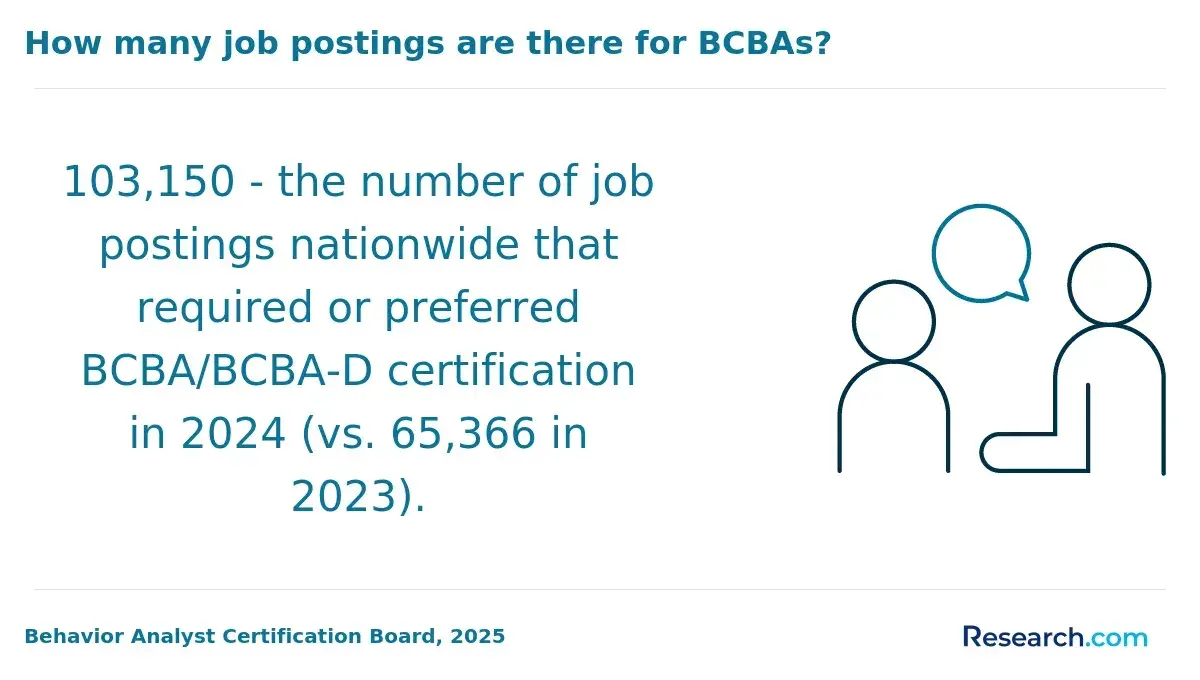
Demand for BCBAs is expanding rapidly, with job openings projected to grow by 14% over the next decade, far exceeding average occupational growth. This growth reflects increased use of behavior analysis in healthcare, schools, clinics, and community agencies. Students who need flexibility can compare online BCBA master's options while checking that the program still meets certification standards.
What are BCBA certification requirements?
BCBA certification requirements are set by the Behavior Analyst Certification Board and generally include graduate education, approved behavior analysis coursework, supervised practical experience, and a passing score on the BCBA examination. Students should treat these requirements as a checklist before selecting a program, not as something to verify after enrollment.
Eligibility criteria include earning a master's degree or higher in behavior analysis, psychology, education, or a related field from an accredited institution. Coursework must align with BACB standards and typically covers ethics, behavioral assessment, intervention strategies, research design, measurement, and experimental design. Candidates also need supervised experience, typically 1,500 hours of fieldwork or 2,000 hours of practicum, overseen by qualified BCBAs.
The BCBA examination tests whether candidates can apply behavior analytic knowledge across core professional tasks. Passing the exam is required for certification. Because exam readiness depends heavily on coursework quality and supervised experience, students should ask programs about pass-rate support, practice resources, faculty availability, and how the curriculum maps to BACB content areas.
Certification can lead to strong salary potential, with median wages around $82,500 nationally and top salaries in states like California exceeding $110,000, according to the U.S. Bureau of Labor Statistics. However, pay varies by employer, setting, location, experience, and whether the role involves supervision or program leadership.
Students comparing BCBA programs should also check state-specific licensure rules. Some states impose requirements beyond BACB certification, and those rules can affect where and how a certified behavior analyst may practice.
What accreditation should BCBA programs have?
BCBA students should verify two separate layers of quality: institutional accreditation and behavior-analysis-specific approval or verification. Institutional accreditation confirms that the college or university meets broader academic standards. Behavior-analysis-specific review helps determine whether the coursework is structured for BCBA certification eligibility.
For certification planning, students should confirm whether the program’s coursework is recognized by the Behavior Analyst Certification Board or otherwise aligned with current BACB requirements. Graduates from programs that do not meet current standards may face extra coursework, certification delays, or exam eligibility problems. Do not rely only on marketing language such as “ABA-focused” or “certification preparation”; ask the program to identify exactly how it meets current BACB requirements.
It is also important to distinguish between a verified course sequence and full program quality. A verified course sequence confirms that a defined set of courses meets specific coursework requirements. It does not automatically guarantee strong supervision, high exam preparation quality, low student debt, or good job placement support. Students should evaluate all of these factors together.
The Behavior Analyst Certification Board's 2025 Certificant Registry and Program Directory shows that only 87% of ABA master's programs met BACB verification in 2025, down from 92% in 2023, due to stricter coursework requirements. This change highlights why students should confirm current status directly before applying or enrolling. Requirements can change, and an older program description may not reflect current certification rules.
When reviewing the best online ABA master's programs, prioritize programs that clearly explain accreditation, coursework verification, exam preparation, and fieldwork expectations. A fast or flexible program is only useful if it keeps you on track for certification.
Admission requirements vary by school, but most BCBA programs expect applicants to have a bachelor's degree from an accredited institution. Common undergraduate backgrounds include psychology, education, behavior analysis, human services, social work, communication sciences, or related fields. Career changers from unrelated majors may still qualify, but they may need prerequisite coursework or stronger evidence of readiness for graduate-level study.
Programs may ask for transcripts, a statement of purpose, letters of recommendation, a resume, and documentation of relevant work or volunteer experience. Competitive applicants usually show a clear interest in behavior analysis, experience working with children or adults who need behavioral support, and the ability to handle data-driven, ethically sensitive clinical or educational work.
Many programs prefer applicants who understand the fieldwork commitment before enrolling. Completing 2,000 hours of supervised fieldwork under a qualified BCBA can be a major logistical challenge. The BACB 2024 Experience Standards Compliance Report revealed that only 62% of candidates met this requirement within 24 months, with an average completion time of 28 months. This means applicants should ask how fieldwork is identified, documented, supervised, and approved.
Students should also confirm whether supervised experience can be completed through their current employer, through university-affiliated placements, or through independently arranged local supervision. Online students should be especially careful: an online course format does not automatically mean online fieldwork supervision will be accepted or available in every location.
Before applying to ABA online programs, ask these questions:
- Does the program accept students from your state?
- Are prerequisite courses required before admission?
- Is the coursework aligned with BACB certification requirements?
- Does the school help students find supervised fieldwork?
- Can fieldwork be completed where you currently live or work?
- Are there additional state licensure requirements you should plan for?
Most BCBA programs take 1.5 to 3 years to complete, depending on enrollment status, course load, program format, and how quickly the student completes supervised fieldwork. Full-time university students often finish coursework in 18 to 24 months. Part-time students, working professionals, and students arranging fieldwork separately may need up to 3 years or more.
The timeline has two parts: academic coursework and supervised experience. Coursework may follow a predictable semester or accelerated schedule, but fieldwork often determines the real completion date. Students who can accrue approved hours through their job may move faster. Students who must find a new placement, pay for supervision, or balance limited client contact hours may take longer.
Some programs advertise accelerated completion, but speed has trade-offs. A shorter schedule can reduce time to certification, but it may require a heavier weekly workload, faster reading pace, more assignments, and tighter coordination with fieldwork. Students who are working full time should be realistic about whether an accelerated format will support learning or simply increase stress.
Online programs can offer more scheduling flexibility, but they do not remove the fieldwork requirement. Students should plan for around 2 to 3 years to complete coursework, supervised experience, and exam preparation. Before enrolling, ask for a sample degree plan, expected weekly workload, fieldwork timeline, and exam preparation sequence.
BCBA program costs vary by institution, delivery format, residency status, and whether the student is completing a full graduate degree or only certification-related coursework. Tuition generally falls between $7,000 and $20,000 for full certification. Online options may reduce commuting and relocation costs, while campus-based programs may offer more direct access to faculty, labs, peer networks, or placement support.
Students should budget beyond tuition. The BCBA exam fee is approximately $245, set by the Behavior Analyst Certification Board. Books, technology fees, application fees, graduation fees, background checks, and transcript costs may also apply. The largest hidden expense is often supervision. Many programs require 1,500 to 2,000 supervised client contact hours, often unpaid. Paying supervisors can add $2,000 to $6,000 to total expenses.
Licensure can also affect total cost and planning. Licensure fees differ by state, with 38 states requiring BCBA licensure and increasing since the previous year. According to the Association of Professional Behavior Analysts, states without licensure show 22% higher job posting volumes but may have differing program costs and requirements. Students should compare not only tuition, but also the cost of becoming eligible to work in their target state.
Financial aid availability varies. Some students may qualify for federal aid through eligible graduate programs, while others may need private loans, payment plans, scholarships, grants, or employer tuition reimbursement. Healthcare providers, schools, autism service organizations, and behavioral health agencies may offer tuition support, but policies differ by employer and may require a work commitment.
Before committing, request a complete cost estimate that includes tuition, fees, supervision, exam costs, books, and possible licensure expenses. A lower-tuition program is not always cheaper if it provides little help with fieldwork or requires paid supervision outside the university.
Yes. Many universities offer online or hybrid BCBA programs that allow students to complete required coursework without relocating. These programs commonly use virtual lectures, discussion boards, live class sessions, assignments, case-based projects, and online assessments. Hybrid programs may combine online coursework with selected campus meetings, intensives, or local fieldwork arrangements.
Online BCBA programs are best for students who need flexibility because of work, caregiving responsibilities, military service, location, or limited access to nearby graduate programs. They can also reduce commuting and housing costs. However, online delivery does not reduce the rigor of certification preparation, and it does not eliminate the need for supervised practical experience.
The most important question is how fieldwork works. Students should ask whether the program helps identify supervisors, whether supervision can occur at a current workplace, what documentation systems are used, and whether the university reviews fieldwork quality. A program with convenient online classes but weak supervision support can delay certification.
According to the 2025 Payscale Behavioral Analyst Salary and Career Report, BCBA-certified professionals recoup their education investment within 2.5 years on average and achieve a 245% ROI over five years. That return depends on completing the credential, passing the exam, and finding appropriate employment, so program quality still matters.
When comparing online programs, look for transparent certification alignment, qualified faculty, strong student support, accessible advising, clear fieldwork guidance, and evidence of graduate outcomes. Convenience should not be the only deciding factor.
A BCBA curriculum covers the scientific, ethical, and practical foundations of applied behavior analysis. Students learn how behavior is measured, why behavior occurs in context, how interventions are selected, and how outcomes are evaluated through data. The goal is not only to prepare students for the exam, but to train them to make defensible clinical and educational decisions.
Core topics typically include principles of behavior, behavior assessment, functional behavior assessment, intervention design, ethics, research methods, measurement, experimental design, supervision, staff training, data analysis, and treatment evaluation. Students may also study verbal behavior, skill acquisition, behavior reduction, caregiver collaboration, cultural responsiveness, and service delivery in schools, clinics, homes, and community settings.
Strong curricula include applied casework. Students should practice writing behavior intervention plans, interpreting graphed data, selecting measurement systems, adjusting interventions based on outcomes, and communicating recommendations to families, teachers, or care teams. These skills are essential because BCBAs are often responsible for decisions that affect client safety, educational progress, and treatment quality.
Faculty expertise can make a measurable difference. Programs staffed exclusively by BCBA-D certified faculty have demonstrated an 18% higher student exam pass rate, according to the Association for Behavior Analysis International 2025 Program Outcomes Database. While faculty credentials are not the only quality marker, they can indicate stronger mentorship, research knowledge, and exam preparation.
Prospective students should review course descriptions, faculty bios, practicum expectations, exam preparation resources, and fieldwork integration. A good curriculum should connect theory to supervised practice, not treat certification coursework and real-world behavior analysis as separate experiences.
BCBA certification can lead to roles in clinics, schools, hospitals, residential programs, community agencies, private practice, and organizational settings. Many BCBAs work with individuals with developmental disabilities, including autism, but the credential can also apply to behavioral health, education, rehabilitation, staff training, and systems improvement.
In clinical settings, BCBAs may conduct assessments, design treatment plans, supervise behavior technicians, train caregivers, and monitor client progress. In schools, they may support students with challenging behavior, collaborate on behavior intervention plans, train teachers, and contribute to individualized education planning. In healthcare or rehabilitation settings, they may help patients develop adaptive skills or reduce behaviors that interfere with care.
Some BCBAs move into consulting, supervision, program management, research support, or organizational behavior management. These roles can shift the focus from direct client services to staff performance, quality assurance, workplace safety, training systems, or program evaluation. The best career path depends on the population a student wants to serve, the preferred work environment, and the level of responsibility desired.
Fieldwork quality has a direct effect on career readiness. Graduates of hybrid ABA programs enjoy a distinct advantage, with fieldwork placement rates at 78%, significantly higher than the 63% reported for fully online graduates, according to the BACB 2025 Fieldwork Verification Data Analysis. This does not mean online programs are unsuitable, but it does show why students should evaluate placement support carefully.
When choosing a program, ask where graduates work, whether the school has relationships with clinics or school districts, and how students are supervised during fieldwork. A strong program should help students build both certification eligibility and practical competence.
What is the BCBA salary and job outlook?
BCBA salary depends on experience, location, employer type, caseload, supervisory duties, and specialization. Entry-level professionals typically earn between $60,000 and $80,000 annually, while experienced BCBAs or those in advanced roles often exceed $90,000. Compensation is often higher in healthcare, private clinics, school systems, metropolitan areas, and roles involving supervision or program leadership.
The job outlook remains strong because schools, healthcare organizations, autism service providers, and community agencies continue to need professionals trained in behavior assessment and intervention. Demand is also influenced by insurance coverage, state licensure rules, public awareness of behavioral health needs, and the availability of supervised providers.
The National University Database of ABA Program Outcomes (2025 Report) highlights that 94% of 2024 BCBA program graduates secured full-time employment within six months, compared to 81% for those from non-accredited programs. This difference reinforces the value of choosing a program with recognized quality markers, strong supervision, and clear certification alignment.
Students should research local job postings before enrolling. A public school role may offer a different salary structure, work calendar, and benefits package than a private clinic or hospital. Private practice may offer more autonomy but can involve business, billing, and compliance responsibilities. Supervisory roles may pay more but also carry greater ethical and administrative responsibility.
To improve long-term earning potential, choose a program that supports exam preparation, high-quality fieldwork, licensure planning, and continuing professional development. Certification is the entry point; sustained career growth depends on competence, ethical practice, supervision skills, and the ability to demonstrate measurable outcomes.
Other Things You Should Know About Applied Behavior Analysis
BCBA candidates in 2027 should be aware of maintaining client confidentiality, ensuring informed consent, and adhering to professional guidelines set by the Behavior Analyst Certification Board (BACB). These ethical considerations are crucial for effective and responsible practice in behavior analysis.
Supervision is a critical component of BCBA training because it ensures that trainees apply theoretical knowledge in real-world situations under the guidance of a qualified supervisor. Effective supervision helps trainees develop clinical skills, ethical practices, and professional decision-making. Without proper supervised experience, candidates cannot meet certification requirements.
A qualifying BCBA coursework sequence must align with the BACB’s current task list and include verified instruction in ethics, measurement, experimental design, behavior assessment, and intervention. Before enrolling, ask whether the program’s coursework is verified for eligibility and whether any additional supervised fieldwork hours are required for exam application.
BCBA candidates must be familiar with the Behavior Analyst Certification Board's professional and ethical code, which guides responsible conduct and client welfare. Key ethical considerations include maintaining confidentiality, obtaining informed consent, avoiding conflicts of interest, and providing evidence-based interventions. Adhering to ethical standards protects clients and upholds the profession's integrity.
- 20+ ABA Certificate Programs [for BCBA Certification] https://abamastersprograms.org/aba-certificate-programs/
- Applied Behavior Analysis (ABA)—Board Certified Behavior Analyst (BCBA) Certification - University of Mount Saint Vincent https://mountsaintvincent.edu/graduate-adult/graduate-programs/applied-behavior-analysis-aba-board-certified-behavior-analyst-bcba-certification/
- Questions to Ask Before Starting ABA Therapy https://centriahealthcare.com/resources/questions-to-ask-before-starting-aba-therapy/
- Choosing Excellence: Discover the Best BCBA Programs Online | Brighter Strides ABA https://www.brighterstridesaba.com/blog/bcba-programs-online/
- Exploring New Career Options for BCBAs https://brightpathwaysaba.com/exploring-new-career-options-for-bcbas/
- Certification Pathways, VCSs, & Accreditation: A Student's Guide https://www.abatechnologies.com/blog/certification-pathways-vcss-accreditation-a-students-guide
- ABA Insights: Important Questions to Ask In a BCBA Interview - Kind Behavioral Health https://kindbh.com/aba-insights-important-questions-to-ask-in-a-bcba-interview/
- How to Become a Behavior Analyst https://onlinecounselingprograms.com/mental-health-careers/how-to-become-behavior-analyst-bcba/
- Understanding the Role of a BCBA® in an Educational Setting https://masteraba.academy/post/understanding-the-role-of-a-bcba-in-an-educational-setting
- Best BCBA Career Path To Take: Ultimate Guide https://www.crossrivertherapy.com/behavioral-analysts/best-bcba-career-path