2027 How to Create a Weekly Study Schedule for BCBA Success

Co-Founder and Chief Data Scientist
BCBA preparation is not only about reading more; it is about deciding what to study, when to study it, how to test recall, and how to fit exam preparation around coursework, fieldwork, employment, and personal responsibilities. A weekly study schedule gives aspiring Board Certified Behavior Analysts a realistic way to cover applied behavior analysis content without relying on last-minute cramming.
This guide explains how to build a practical BCBA study routine, what to include in a strong study plan, how education and supervised fieldwork connect to certification, and how program format, accreditation, career goals, and exam strategy should shape your preparation. It is especially useful for working adults, graduate students, career changers, and candidates who need a repeatable weekly system rather than a vague intention to “study more.”
Key Things You Should Know
- Consistent weekly scheduling boosts retention by up to 40%, critical for mastering BCBA content and maintaining steady progress throughout certification preparation.
- Balancing study blocks with practical ABA supervision hours is essential to meet BCBA 2025 task list requirements and maintain professional competency.
- Integrating active recall and spaced repetition strategies in the study schedule enhances exam readiness, as supported by recent 2024 cognitive research.
How do you create a weekly study schedule for BCBA success?
To create a weekly study schedule for BCBA success, start with your actual available time, not an idealized version of your week. Block study periods around work, fieldwork, classes, commuting, caregiving, and sleep. Then assign each block a specific purpose: learning new content, reviewing prior material, answering practice questions, analyzing mistakes, or completing a timed exam section.
Structured preparation matters because the BCBA exam is broad and application-heavy. Research from the Behavior Analyst Certification Board shows a first-time pass rate of 62%, which means many candidates need more than passive reading to perform well. A weekly schedule helps you cover the task list systematically and prevents weaker domains from being pushed to the end.
Step-by-step weekly planning method
- Audit your time. Identify fixed commitments first, then mark realistic study windows. For many candidates, this means shorter weekday sessions and longer weekend blocks.
- Take a diagnostic assessment. Use the results to identify weak areas such as behavior assessment, intervention design, measurement, experimental design, or ethics.
- Assign topics by priority. Put your weakest topics earlier in the week when your energy is higher. Keep stronger topics in rotation so they do not fade.
- Use active study in every block. Include practice questions, flashcards, scenario analysis, task-list mapping, graph interpretation, or writing sample behavior plans.
- Schedule error review. A missed question is useful only if you determine why you missed it: content gap, misread wording, weak fluency, or poor test strategy.
- Protect rest and recovery. A sustainable schedule is better than an aggressive plan you abandon after two weeks.
Example weekly structure
| Day | Primary focus | Best use of time |
| Monday | Weak domain review | Read targeted notes, answer practice questions, record errors |
| Tuesday | Ethics and professional judgment | Review BACB Task List items and apply them to case scenarios |
| Wednesday | Measurement and data analysis | Practice definitions, graph interpretation, and decision-making from data |
| Thursday | Intervention design | Compare procedures and explain when each is appropriate |
| Friday | Light review | Flashcards, short quizzes, video review, or study-group discussion |
| Weekend | Timed practice and synthesis | Complete longer practice sets, review rationales, update next week’s plan |
If ethics is a weak area, for example, plan 3-4 weekly sessions that combine BACB Task List review with applied case studies. If measurement is weak, schedule repeated shorter sessions rather than one long review block. The goal is not just exposure; it is fluent decision-making under exam conditions.
Candidates who also need academic preparation can compare accredited online BCBA program options that fit their schedule, budget, and certification timeline.
Why is a structured study schedule essential for BCBA certification?
A structured study schedule is essential for BCBA certification because the exam requires broad content knowledge, applied reasoning, and consistent recall. Without a plan, candidates often over-study familiar topics, under-study less comfortable domains, and leave review until the final weeks.
The BACB 2025 Task List includes areas that may appear smaller but still affect performance. For example, the Philosophical Underpinnings section accounts for 7% of questions. A candidate who skips foundational material may struggle with questions that require conceptual reasoning, even if they know common intervention procedures.
What structure does that unplanned studying does not
- Prevents content gaps. A schedule forces every domain into rotation, including ethics, measurement, assessment, intervention, and experimental design.
- Supports long-term retention. Repeated review over time is more effective than a single intense study weekend.
- Reduces decision fatigue. When each study block already has a purpose, you spend less time deciding what to do and more time learning.
- Reveals weak areas sooner. Regular quizzes and progress checks show where you need more practice before the exam date is close.
- Fits real life. Working candidates can plan early-morning, evening, or weekend blocks instead of relying on inconsistent free time.
A strong weekly study routine should still be flexible. If your practice scores show improvement in behavior assessment but continued difficulty with experimental design, shift more time to experimental design the next week. Structure is not rigidity; it is a system for making better adjustments.
Graduate programs can also provide built-in structure through sequenced coursework, faculty support, and supervised preparation. Candidates comparing academic routes may want to review BCBA master's programs that align with certification requirements and study needs.
What are the key components of an effective BCBA study plan?
An effective BCBA study plan combines content coverage, active recall, supervised practice, progress tracking, and recovery time. The plan should tell you not only what to study, but how you will prove that you understand it well enough to apply it on an exam and in practice.
Core components to include
- Task-list alignment. Map study sessions to BACB content areas so no major domain is ignored.
- Topic rotation. Study behavior assessment, intervention design, ethics, measurement, data analysis, and research concepts across multiple weeks.
- Active learning. Use practice exams, flashcards, scenario questions, graph review, and written explanations instead of rereading alone.
- Error analysis. Track missed questions by topic and reason, then schedule targeted repair sessions.
- Fieldwork connection. Link study topics to supervised experience whenever possible so concepts become practical, not abstract.
- Review days. Build in lighter days for spaced repetition and consolidation.
- Rest days. Avoid planning every available hour. Fatigue can reduce accuracy and motivation.
For many candidates, allocating 1-2 hours per day is more sustainable than relying on occasional marathon sessions. Shorter blocks also make it easier to maintain preparation while completing fieldwork, coursework, or employment responsibilities.
Supervised fieldwork should not be treated as separate from studying. Data from the BACB Exam Scoring Report show candidates with over 2,000 hours of supervised experience achieve a 15% higher first-time pass rate compared to those meeting only the 1,500-hour minimum. Use fieldwork to connect definitions, assessment methods, intervention decisions, and ethical issues to real cases, while staying within supervision and confidentiality requirements.
Simple progress-tracking system
| Item to track | Why it matters | How often to review |
| Practice question score | Shows current performance by content area | Weekly |
| Missed-question category | Identifies whether errors come from knowledge, reading, or application | After every practice set |
| Task-list coverage | Prevents over-focusing on familiar topics | Weekly |
| Timed exam stamina | Builds readiness for exam pacing | Biweekly or as scheduled |
| Study consistency | Reveals whether the plan is realistic | Weekly |
Candidates who need a flexible academic route can compare online ABA master's programs that may complement a structured BCBA study plan.
BCBA certification generally requires a graduate-level degree in behavior analysis, education, psychology, or a related field that satisfies Behavior Analyst Certification Board requirements. Candidates typically complete graduate coursework in behavior analysis, ethics, assessment, intervention, measurement, and research methods, followed by supervised fieldwork and the certification exam.
The most common pathway is a master’s degree with coursework designed for BCBA eligibility. Some candidates pursue doctoral study if they want advanced clinical leadership, research, university teaching, or specialized professional roles. Others who already have a graduate degree may complete an approved course sequence or post-master’s certificate if their previous degree does not include the required behavior-analytic coursework.
Common BCBA education routes
| Pathway | Who it may fit | Key consideration |
| Master’s degree in behavior analysis or a related field | Students starting graduate preparation for BCBA eligibility | Confirm that coursework meets current BACB requirements |
| Master’s degree plus approved course sequence | Career changers or graduates whose degree is related but incomplete for BCBA preparation | Verify whether additional courses and fieldwork are needed |
| Post-master’s certificate | Professionals who already hold a graduate degree | Check whether the certificate alone satisfies the coursework gap |
| Doctoral degree | Candidates interested in advanced practice, research, or academic careers | Longer timeline and greater cost may not be necessary for all BCBA roles |
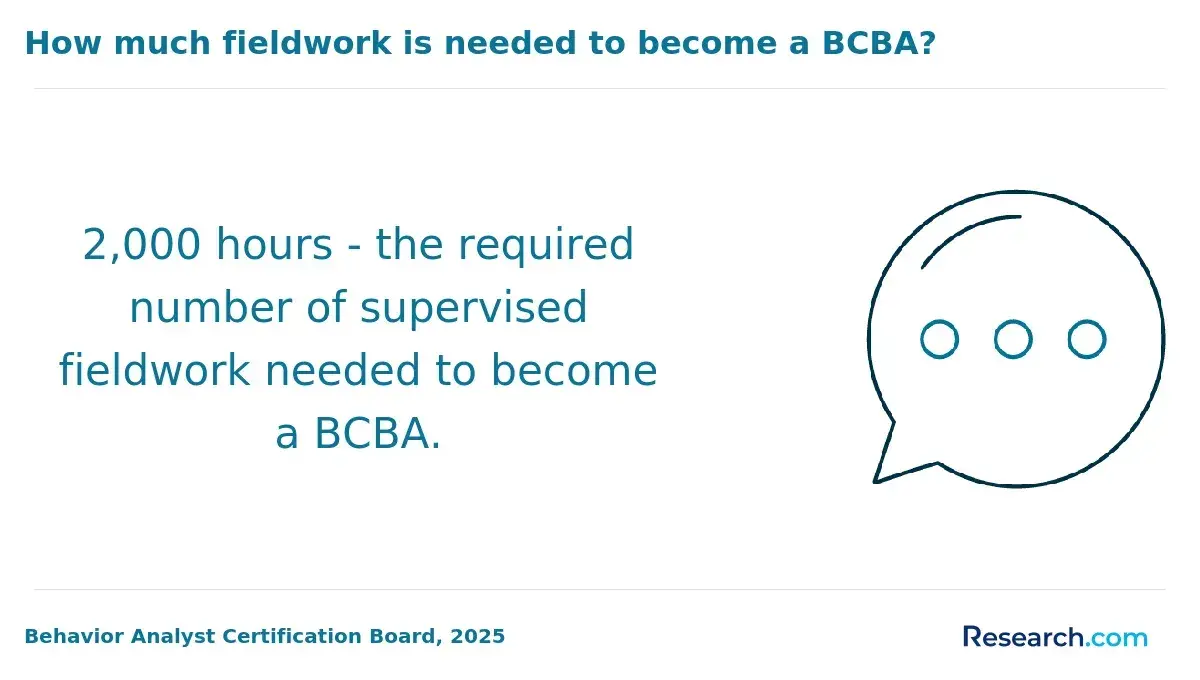
Applicants must also complete 1,500 to 2,000 hours of verified supervised experience through a qualifying practicum, internship, employment arrangement, or other approved fieldwork model supervised by a qualified BCBA. Because requirements can change, students should verify the current BACB handbook before enrolling and again before applying for the exam.
Top candidates preparing for BCBA certification education requirements averaged 22 study hours per week over four months, reflecting a 78% pass rate according to ABA Technologies Prep Analysis. That figure underscores an important point: degree completion and exam preparation overlap, but they are not the same. Coursework builds the foundation; a study plan converts that foundation into exam-ready fluency.
Students comparing graduate options can review flexible online choices in behavioral science masters programs designed for different schedules and academic backgrounds.
BCBA exam eligibility requires candidates to meet graduate education, behavior-analytic coursework, supervised fieldwork, and application requirements established by the BACB. The original requirement framework includes a graduate degree in behavior analysis or a related field and completion of 1,500 hours of supervised independent fieldwork or 2,000 hours of supervised practicum, following BACB standards. Candidates should always confirm the current BACB handbook because eligibility rules, terminology, and pathways may change.
Passing the exam depends on more than knowing definitions. Candidates must apply concepts to scenarios, interpret behavior-analytic procedures, understand ethical obligations, and make sound decisions based on data. A study plan should therefore be built around the BACB task list, regular practice questions, and detailed review of rationales.
Effective strategies emphasize distributed practice over cramming. Research from ABA Technologies shows that 30-45 minute study sessions improve long-term retention by 35% compared to sessions over two hours. Short, focused study blocks work especially well for candidates balancing employment, fieldwork, or graduate coursework.
High-value passing strategies
- Divide content into daily 30-minute blocks, such as ethics on Monday and behavior assessment on Tuesday.
- Use active recall tools such as flashcards, practice exams, and verbal explanations after each session.
- Review missed questions immediately and identify the reason for each error.
- Schedule weekly cumulative review so older topics stay active.
- Prioritize difficult topics early enough for repeated exposure.
- Track progress with BACB-aligned checklists.
- Complete timed practice sets to build pacing and reduce test-day anxiety.
- Join a study group or seek mentorship from certified BCBAs when you need feedback, accountability, or applied examples.
Common mistakes to avoid
- Reading without retrieval. If you cannot answer questions or explain a concept, rereading alone is not enough.
- Ignoring rationales. Correct answers matter, but the reasoning behind them is what improves future performance.
- Studying only favorite topics. Confidence in one domain does not compensate for gaps in another.
- Waiting too long to practice under time limits. Exam stamina should be built gradually.
- Planning a schedule you cannot maintain. Consistency beats intensity when preparation lasts several months.
The best BCBA exam strategy is a repeatable cycle: study a targeted topic, answer questions, review mistakes, revisit the material later, and adjust the next week’s schedule based on evidence rather than guesswork.
Online and campus BCBA programs can both support strong study schedules, but they do so in different ways. Online programs usually offer more control over when and where students complete coursework. Campus programs typically provide more built-in routine through scheduled class meetings, in-person interaction, and immediate access to campus resources.
Online versus campus study support
| Factor | Online BCBA programs | Campus BCBA programs |
| Schedule flexibility | Often better for working adults, caregivers, and students with irregular schedules | More fixed, which can help students who need external structure |
| Accountability | Requires self-discipline, calendar planning, and proactive communication | Class meetings, faculty contact, and peer presence can create routine |
| Study environment | Students must create a distraction-controlled space | Campus libraries, classrooms, and study groups may support focus |
| Peer interaction | Often through discussion boards, video meetings, or virtual groups | More natural opportunities for in-person study groups and networking |
| Commuting impact | No commute can free time for study or fieldwork | Commute time must be included in the weekly plan |
Online learners benefit from setting fixed weekly deadlines even when the program allows asynchronous access. Without those self-imposed deadlines, flexible coursework can become easy to postpone. Campus learners should take advantage of the structure they already have by placing review blocks immediately before or after class, when the material is still fresh.
Both formats require active engagement with practice questions. Candidates completing over 1,500 practice questions weekly during preparation phases have achieved pass rates 20% higher than the average pass rate of 62%, according to the Pass the Big ABA Exam 2025 Survey. The practical lesson is not simply to answer more questions, but to schedule enough time to review why answers are correct or incorrect.
Best scheduling practices by format
- Online learners: Use a digital planner, set recurring study blocks, create artificial deadlines, and avoid treating recorded lectures as optional background material.
- Campus learners: Build routines around class days, use campus study spaces, attend review sessions, and form small study groups with clear goals.
- All learners: Identify your peak focus times and reserve them for difficult domains, practice questions, and timed work.
The better format depends on the student. Choose online learning if flexibility is essential and you can manage your time independently. Choose campus learning if you perform better with fixed schedules, face-to-face support, and a structured academic environment.
BCBA programs should meet the educational standards required for certification eligibility and should clearly show how their coursework aligns with BACB requirements. Students should distinguish between accreditation, verified coursework, and general university approval. A school can be institutionally accredited, but candidates still need to confirm that the specific behavior-analysis coursework supports BCBA eligibility.
Programs should provide a comprehensive curriculum covering ethical considerations, assessment methods, behavior intervention, measurement, experimental design, and other required behavior-analytic content. Students should also look for qualified faculty, transparent supervision support, and clear guidance on exam eligibility.
Students should complete a minimum of 270 graduate-level instructional hours, including at least 180 hours focused specifically on behavior analytic content. Supervised fieldwork is also required, with a mandate of 1,500 hours under qualified supervision to ensure practical experience and readiness for professional challenges.
What to verify before enrolling
- Institutional accreditation. Confirm that the college or university is properly accredited by a recognized accrediting body.
- Behavior-analysis coursework alignment. Ask how the program documents alignment with BACB content requirements.
- ABAI recognition or accreditation. Accreditation from organizations like the Association for Behavior Analysis International (ABAI) can signal that a program meets rigorous behavior-analysis education standards.
- Faculty qualifications. Review whether instructors have BCBA credentials, doctoral preparation, research experience, or relevant clinical expertise.
- Fieldwork support. Determine whether the program helps students locate supervisors, log hours correctly, and understand BACB expectations.
- Exam preparation support. Look for embedded review, practice exams, feedback, and task-list mapping.
Instructional design also matters. Incorporating spaced repetition into study routines enhances learning, particularly for complex ethics content, demonstrated by a 42% improvement in recall accuracy in recent research conducted by Research.com.
Before committing to a program, request written confirmation of how it supports current BCBA eligibility. This is especially important for transfer students, career changers, and candidates using a certificate or post-master’s route.
BCBA certification can lead to roles in schools, clinics, hospitals, home-based services, autism service organizations, developmental disability programs, social services, and organizational settings. The credential is most commonly associated with assessment, intervention planning, supervision, staff training, caregiver consultation, and data-based decision-making.
Common roles include clinical behavior analyst, school-based BCBA, autism specialist, and organizational behavior consultant. Salaries range from around $60,000 for entry-level school-based BCBAs to $95,000-$100,000 for experienced clinical or private practice professionals. Actual compensation depends on location, employer type, caseload, years of experience, supervisory duties, specialization, and whether the role is salaried, hourly, contract-based, or private practice.
Common BCBA career paths
| Role | Typical work | Career considerations |
| Clinical behavior analyst | Assessment, treatment planning, staff supervision, data review | Often found in autism services, clinics, and home-based ABA providers |
| School-based BCBA | Behavior intervention plans, teacher consultation, student support | May offer school-year schedules but can involve complex systems work |
| Autism specialist | Early intervention, family consultation, skill acquisition programming | Strong demand in many service markets, with close attention to ethics and quality of care |
| Organizational behavior consultant | Performance improvement, staff training, systems change | May appeal to BCBAs interested in business, workplace behavior, or leadership |
| Supervisor or program director | Clinical oversight, quality assurance, training, operations | Usually requires experience beyond certification and strong management skills |
BCBAs often advance by developing supervisory expertise, specializing in a client population, moving into program management, opening a practice, or contributing to research and training. Some professionals begin in assistant behavior analyst or behavior technician roles before certification, which can provide practical exposure and income while completing graduate study and supervised fieldwork.
According to data from the BACB Demographic Report, full-time BCBA candidates who study 12-15 hours weekly achieved a 68% exam pass rate-6% higher than non-working peers with less structured study. For career-focused candidates, the takeaway is clear: relevant work experience can support exam readiness when paired with disciplined study rather than used as a substitute for it.
The job outlook for BCBAs in the U.S. remains strong because applied behavior analysis is widely used in autism services, schools, behavioral health, developmental disability support, and other human-service settings. Demand is influenced by insurance coverage, school service needs, provider growth, and increased awareness of data-based behavioral intervention.
Growth is not identical everywhere. Urban and suburban areas may have more employers, specialized clinics, and supervisory positions. Rural and underserved regions may offer fewer organizations but meaningful demand, especially where access to qualified behavior analysts is limited. Candidates willing to work in high-need areas, provide school consultation, or combine clinical and supervisory skills may find broader opportunities.
Factors that can improve employability
- Specialization. Early intervention, school-based services, severe behavior, caregiver training, and organizational behavior management can all shape job options.
- Strong supervision experience. Employers often value candidates who can train staff, monitor treatment integrity, and support ethical service delivery.
- Data fluency. BCBAs must interpret data and adjust interventions, not simply write plans.
- Communication skills. Collaboration with families, teachers, clinicians, administrators, and payers is central to many roles.
- Professional network. Internships, supervised fieldwork, conferences, and mentorship can lead to job leads and references.
Candidates still need to meet rigorous BACB exam standards and demonstrate practical competence. Weekly progress trackers have proven effective, with 74% of users identifying weak areas and improving their results by 12%, according to CertifyNABA Analytics. This type of tracking is useful not only for passing the exam but also for building the self-monitoring habits expected of behavior analysts.
Ongoing professional development is important after certification. The field evolves through research, ethics guidance, payer requirements, school policies, and changing client needs. BCBAs who keep learning and document competent practice are better positioned for long-term career growth.
How to choose a reputable BCBA training program?
Choose a reputable BCBA training program by verifying eligibility alignment first, then comparing academic quality, fieldwork support, exam preparation, cost, format, and student outcomes. A program should make it easy to understand whether its coursework supports BCBA certification requirements and what additional steps you must complete.
Program selection checklist
- Accreditation and eligibility: Is the institution accredited, and does the program clearly align with BACB requirements?
- Curriculum: Does coursework cover BACB Task List competencies in ethics, measurement, assessment, intervention, research methods, and supervision?
- Faculty: Are instructors qualified behavior analysts or subject-matter experts with relevant clinical, research, or supervisory experience?
- Supervised fieldwork: Does the program help students find qualified BCBA-certified supervisors, understand hour requirements, and log experience correctly?
- Exam preparation: Are mock exams, review sessions, practice questions, and feedback built into the program?
- Student support: Are advising, tutoring, office hours, cohort support, or mentorship available?
- Format: Does the online, hybrid, or in-person structure match your work schedule and learning style?
- Cost transparency: Are tuition, fees, materials, supervision costs, and financial aid options clearly explained?
Pass rates and preparation support deserve close attention. BCBA retake pass rates fell to 45% when candidates skipped final-week mock exams, emphasizing the value of structured exam preparation. A good program should help students practice under exam-like conditions and learn from mistakes before test day.
Program format also affects success. Working professionals may prefer online or evening options, but they should confirm that flexible delivery still includes deadlines, instructor access, and academic accountability. Recent graduates may benefit from cohort-based or campus programs that provide routine, peer interaction, and more immediate support.
Questions to ask admissions or program directors
- How does the program document alignment with current BACB requirements?
- Does the program offer comprehensive mock exams?
- Are supervisors BACB-certified?
- Does the school help students secure supervised fieldwork placements?
- How are students trained to log and verify fieldwork hours?
- How rigorous do current students find the coursework?
- What exam preparation support is available before graduation?
- What are the full tuition, fees, materials, and supervision-related costs?
A reputable BCBA training program should be transparent before you enroll. If a school cannot clearly explain coursework alignment, supervision expectations, total cost, or exam support, continue comparing options before making a commitment.
Other Things You Should Know About Applied Behavior Analysis
BCBA candidates should include weekly blocks for behavior-analytic principles, measurement, experimental design, intervention, and ethics. The BACB 2027 BCBA Exam Content Outline organizes the test around these areas, so a schedule should assign time to each domain and reserve one block for full-length practice questions.
BCBA students in 2027 should start by assessing their syllabus and dedicating specific time blocks each week to topics like behavior assessment and intervention planning. Incorporating regular review sessions, scheduling breaks, and using tools like digital calendars can enhance their productivity and make the study schedule effective.
BCBA students often encounter challenges balancing coursework, supervised fieldwork, and exam preparation simultaneously. Managing time effectively and staying organized are crucial, as the field requires both theoretical knowledge and practical application. Additionally, adapting to diverse client needs during supervised experience can be demanding but integral to professional growth.
Data collection is fundamental to Applied Behavior Analysis as it objectively measures client behaviors and progress. BCBAs use various data collection methods, such as frequency counts, duration recording, and interval recording, to evaluate the effectiveness of interventions. This systematic approach ensures that treatment decisions are evidence-based and individualized.
- BCBA Certification Requirements - Bluebell ABA https://bluebellaba.com/blog/bcba-without-masters-degree/
- How Long to Study for Board Certified Behavior Analyst Exam: Optimal Preparation Timeline https://yourhealthmagazine.net/article/healthcare-careers/how-long-to-study-for-board-certified-behavior-analyst-exam-optimal-preparation-timeline/
- Certification Pathways, VCSs, & Accreditation: A Student's Guide https://www.abatechnologies.com/blog/certification-pathways-vcss-accreditation-a-students-guide
- BCBA Certification Requirements & Process - Kids N Heart https://kidsnheartaba.com/blog/bcba-certification/
- BCBA Job Outlook in 2025 Growing Demand and Opportunities https://www.connectncareaba.com/blog/bcba-job-outlook
- Best BCBA Exam Study Materials to Pass on the First Attempt https://www.hopebridge.com/blog/best-bcba-exam-study-materials-to-pass-on-first-attempt/
- How To Start Studying for the BCBA Exam: Beginner's Guide https://www.steadystridesaba.com/how-to-start-studying-for-the-bcba-exam-beginners-guide
- 25+ Affordable ABA/BCBA Online Programs (Masters & Certs) https://abamastersprograms.org/affordable-online-aba-masters-programs/
- How Many Hours to Study for BCBA? | Blossom ABA Therapy https://blossomabatherapy.com/blog/mastering-how-many-hours-to-study-for-bcba
- Is Becoming a BCBA a Good Career in 2026? Salary, Growth, and What to Expect https://mindfulsproutsaba.com/blog/is-becoming-a-bcba-a-good-career-in-2026-salary-growth-and-what-to-expect/