2027 ABA Graduate Certificate Admissions Guide for Working Professionals

Co-Founder and Chief Data Scientist
If you already have a bachelor’s degree and want to move into applied behavior analysis, the main question is not simply whether an ABA graduate certificate is available. It is whether the certificate will meet your career goal, fit your schedule, and satisfy the coursework expectations tied to certification. For working adults, the wrong program can cost time and money without moving them closer to the role they want.
An ABA graduate certificate can be a practical route for teachers, counselors, paraprofessionals, healthcare workers, and career changers who need focused graduate coursework in behavior analysis without immediately committing to a full master’s degree. The best choice depends on admission requirements, course sequence, fieldwork options, accreditation, cost, and whether the program aligns with the Behavior Analyst Certification Board's (BACB) expectations for candidates pursuing BCBA eligibility.
This guide explains what ABA graduate certificates are, who they are best for, what admissions committees usually expect, how long programs take, what the curriculum covers, how online options work, what they cost, and which career outcomes are realistic after completion.
Key Things You Should Know
- ABA graduate certificates in 2026 increasingly target working professionals, offering flexible online formats to balance career and education demands.
- Most programs require a bachelor's degree and coursework aligned with BACB standards, crucial for eligibility to sit for the BCBA exam.
- Employment in ABA is projected to grow 12% through 2030, emphasizing the value of certification for career advancement in healthcare and education fields.
What is an ABA graduate certificate?
An ABA graduate certificate is a focused graduate-level program in applied behavior analysis. It is designed for students who need specialized ABA coursework but do not necessarily want to complete a full degree at the same time. Most programs are built for adults who already hold a bachelor’s degree and want to qualify for new roles, strengthen current practice, or complete coursework connected to BCBA exam preparation.
These certificates usually require 15 to 21 credit hours of graduate coursework. Courses commonly cover behavior principles, measurement, assessment, intervention planning, research methods, ethics, and the use of data to evaluate behavior change. Many programs align their coursework with the Behavior Analyst Certification Board's (BACB) Verified Course Sequence, which is especially important for students who plan to pursue the Board Certified Behavior Analyst (BCBA) exam.
An ABA certificate is not the same as a license, a BCBA credential, or a master’s degree. It is an academic credential. Students who want BCBA certification must confirm that their education, degree level, supervised fieldwork, and examination pathway meet current BACB requirements.
| Credential | What it usually provides | What to verify |
| ABA graduate certificate | Focused graduate coursework in applied behavior analysis | Whether the courses meet BACB coursework expectations for your certification path |
| Master’s degree in ABA or related field | Broader graduate training and often a clearer path toward advanced credentials | Accreditation, fieldwork support, and BCBA exam preparation |
| BCBA credential | Professional certification for qualified behavior analysts | Education, supervised fieldwork, exam eligibility, and ongoing requirements |
Admissions requirements vary, but many programs expect a bachelor’s degree and may prefer applicants with experience in psychology, education, social work, healthcare, or human services. Students from unrelated majors may still be considered, especially if they can show readiness for graduate study and a clear reason for entering the field.
For example, University of Alabama in Huntsville's online M.S. in Applied Behavior Analysis program achieved a 100% BCBA exam pass rate in a recent cohort, showing why students should evaluate program rigor and outcomes, not just convenience. Those comparing flexible routes can also review BCBA online certificate programs as part of their planning.
Who should pursue an ABA graduate certificate?
An ABA graduate certificate is best for professionals who need targeted behavior analysis training and want a shorter academic option than a full graduate degree. It is especially useful for people who already work with students, clients, or patients and want stronger tools for assessing behavior, building interventions, and measuring progress.
Teachers may use ABA training to improve classroom behavior supports, individualized education plans, and interventions for students with developmental or behavioral needs. Mental health professionals may pursue the certificate to add behavior-based assessment and intervention skills to their current practice. Paraprofessionals and aides who work under Board Certified Behavior Analysts (BCBAs) may use graduate coursework as part of a longer plan toward BCBA certification.
The certificate can also fit career changers with unrelated undergraduate degrees, but those applicants should be realistic. ABA coursework is data-driven, ethics-focused, and clinically applied. Students without prior exposure to psychology, education, statistics, or human services may need extra preparation before they feel comfortable in graduate-level courses.
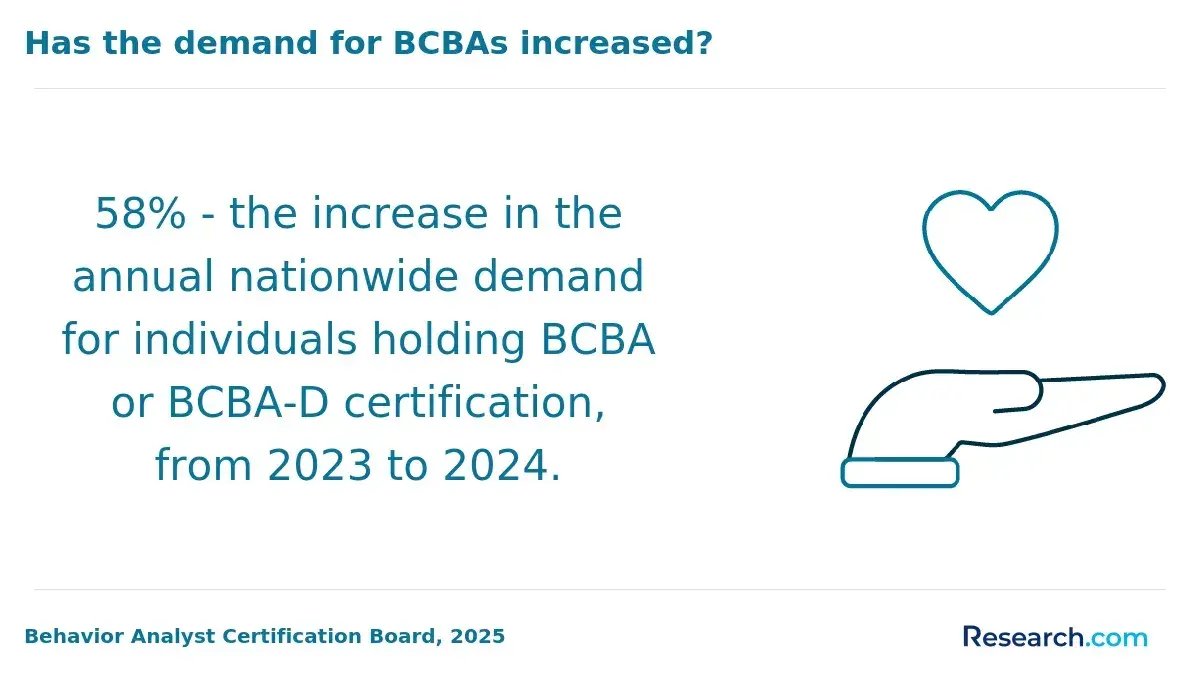
According to the BACB Employment Demand Report, BCBA job postings increased by 52% from 2023 to 2024. That growth makes specialized training attractive, but demand alone should not be the only reason to enroll. The strongest candidates usually have a clear target setting, such as schools, autism services, behavioral health, early intervention, residential programs, or organizational behavior management.
An ABA graduate certificate may be a good fit for:
- Teachers and educators who want to use evidence-based behavior strategies in schools.
- Mental health professionals seeking a more structured behavioral specialization.
- Paraprofessionals and aides planning a pathway toward BCBA certification.
- Working adults who need online, evening, or part-time study options.
- Career changers who want to test the field before committing to a full master’s program.
It may not be the best fit for students who need an entire graduate degree for their intended credential, cannot complete required supervised fieldwork, or want a program that guarantees certification by itself. Candidates who want broader preparation may also compare BCBA master's programs before choosing a certificate-only route.
What are ABA graduate certificate admission requirements?
ABA graduate certificate admission requirements usually start with a bachelor’s degree from an accredited institution. Many programs prefer applicants with academic or professional backgrounds in psychology, education, special education, counseling, social work, healthcare, or a related human services field. However, some programs admit students from other majors if they can show academic readiness and a clear professional purpose.
A minimum GPA requirement of 3.0 or higher is common, although each school sets its own standard. Programs may also review the difficulty of prior coursework, professional experience, and whether the applicant has completed foundational courses that support graduate-level ABA study.
Typical application materials include:
- Official transcripts showing completion of a bachelor’s degree.
- A current resume or curriculum vitae.
- Letters of recommendation from academic or professional references.
- A statement of purpose explaining career goals and interest in ABA.
- Proof of English proficiency, such as TOEFL or IELTS scores, for many international applicants.
Some schools require or recommend prior coursework in statistics, research methods, psychology, behavior analysis, or human development. These prerequisites matter because ABA programs rely heavily on data collection, research interpretation, treatment evaluation, and ethical decision-making. If an applicant lacks this background, the school may require additional coursework before or during the certificate.
Admissions committees also look for evidence that the applicant can manage graduate coursework while meeting work and personal responsibilities. This is especially important in online and part-time programs, where students need strong time management and self-direction.
Applicants planning to pursue BCBA certification should ask direct questions before applying:
- Does the coursework align with BACB expectations for the applicant’s intended certification pathway?
- Does the program include or help arrange supervised fieldwork?
- Are fieldwork sites available in the applicant’s state or region?
- What support does the program provide for BCBA exam preparation?
- Are there state-specific licensure issues the applicant should know about?
For example, Florida Institute of Technology's online ABA program, with a 100% BCBA exam pass rate for 11 candidates (Action Behavior Centers, Top ABA Programs Guide), illustrates why preparation, selectivity, and student support should be part of the admissions decision. Working professionals who need a shorter timeline can compare an accelerated BCBA program online, but they should confirm that speed does not come at the expense of fieldwork planning or academic fit.
How long does an ABA graduate certificate take?
An ABA graduate certificate typically takes 9 to 18 months, depending on credit requirements, course availability, enrollment status, and whether the student is working full time. Full-time students may complete the coursework in under a year. Working professionals more commonly take 12 to 18 months because part-time enrollment is easier to balance with employment and family responsibilities.
Most certificates require between 15 and 25 credit hours. A lighter credit load can shorten the academic timeline, but students should not judge a program by speed alone. The more important question is whether the certificate includes the coursework needed for the student’s career goal and whether the schedule leaves enough time for successful fieldwork, exam preparation, and professional growth.
| Enrollment pace | Typical timeline | Best for | Main trade-off |
| Accelerated or full time | Under a year to about 12 months | Students with flexible schedules and strong academic preparation | Heavy workload and less room for job or family disruptions |
| Part time | 12 to 18 months | Working professionals balancing employment with study | Longer completion time |
| Extended pace | May exceed the standard timeline depending on school policy | Students with changing work schedules or caregiving duties | Delayed credential progress and possible course sequencing issues |
Course format also affects completion time. Fully online programs may offer asynchronous coursework, multiple start dates, and flexible pacing. Hybrid or in-person programs may follow a stricter semester schedule. Students should check whether required courses are offered every term or only once per year, because limited course availability can delay graduation.
According to the BACB Certificant Registry, 88% of BCBA certificants hold a master's degree, while 62% of non-degree holders qualify through verified coursework obtained via certificates. This shows that certificates can be useful, but students need to understand how the certificate fits into the full credentialing pathway.
Prior education or related experience may reduce delays if it satisfies prerequisites or helps the student move quickly through foundational material. However, supervised fieldwork and certification requirements should be planned separately from the academic timeline. Students who may want a broader credential later can also review ABA masters programs online before enrolling in a certificate.
What does an ABA graduate certificate curriculum cover?
An ABA graduate certificate curriculum covers the theory, ethics, assessment methods, and intervention skills used in applied behavior analysis. The goal is to help students understand why behavior occurs, how to measure it, and how to design interventions that are ethical, individualized, and supported by data.
Most programs include coursework in the principles of behavior analysis, behavior measurement, experimental design, functional behavior assessment, behavior intervention, skill acquisition, behavior reduction, ethics, and professional conduct. Students learn how to collect baseline data, identify patterns, evaluate treatment effects, and revise plans when the data show limited progress.
| Curriculum area | What students learn | Why it matters in practice |
| Behavior principles | Core concepts that explain how behavior is learned and maintained | Provides the foundation for assessment and intervention |
| Measurement and data collection | How to define, observe, record, and graph behavior | Helps practitioners make decisions based on evidence rather than impressions |
| Functional behavior assessment | How to identify possible reasons behavior occurs | Supports intervention plans that address function, not just symptoms |
| Intervention design | How to build behavior support and skill-building plans | Connects assessment results to practical strategies |
| Ethics | Professional responsibilities, client rights, supervision, and scope of competence | Reduces risk and supports responsible practice |
Some programs include supervised practicum experiences, while others focus only on coursework and expect students to arrange fieldwork separately. This distinction is critical. Students pursuing BCBA eligibility should confirm not only the course sequence but also how supervised experience will be completed and documented.
Program emphasis can vary. A school-focused certificate may include classroom behavior management, consultation, and special education applications. A clinical program may emphasize autism services, treatment planning, caregiver training, and assessment. A program with an organizational behavior management focus may apply ABA principles to workplace performance and staff training.
It is vital to confirm that the curriculum follows BACB-approved course sequences to qualify for the Board Certified Behavior Analyst (BCBA) exam. For example, Northern Kentucky University's online ABA concentration reported an 88% BCBA exam pass rate according to AppliedBehaviorAnalysisEdu.org. Prospective students should use outcomes like exam pass rates as one signal of quality, while also reviewing advising, faculty expertise, fieldwork support, and course fit.
Are there online ABA graduate certificate programs for professionals?
Yes. Many online ABA graduate certificate programs are built specifically for working professionals who need flexible study options. These programs commonly offer asynchronous lectures, online discussion boards, digital assignments, and part-time course plans. Some also include live virtual sessions for case discussion, faculty interaction, or cohort-based learning.
Online programs can be especially useful for students who cannot relocate, work irregular hours, or live far from universities with ABA coursework. Program lengths typically range from 12 to 24 credit hours, and many schools offer multiple start dates each year so students do not have to wait for a traditional fall semester.
The main advantage of online study is flexibility. The main risk is assuming that online automatically means easier. ABA coursework requires consistent reading, data work, writing, case analysis, and ethical reasoning. Students also need to plan for supervised fieldwork if certification is their goal, because fieldwork is not always included in the online course package.
| Online feature | Why it helps professionals | Question to ask before enrolling |
| Asynchronous classes | Allows students to complete lectures and assignments around work schedules | Are there weekly deadlines or self-paced modules? |
| Live virtual sessions | Provides real-time interaction with instructors and peers | Are sessions required, recorded, or scheduled outside work hours? |
| Part-time plans | Reduces overload for students working full time | How long will the certificate take at the recommended pace? |
| Multiple start dates | Helps students begin sooner | Are all required courses available in each start term? |
| Fieldwork guidance | Supports students pursuing BCBA eligibility | Does the school help identify acceptable supervisors or sites? |
According to data from the BLS Occupational Employment Statistics, median weekly earnings for behavior analysts reached $1,920-about 45% higher than the national median. That earning potential can make an online certificate appealing, but students should still compare tuition, student support, exam preparation, and fieldwork logistics before committing.
Before choosing an online ABA certificate, confirm that the coursework aligns with BACB standards, that the institution is properly accredited, and that the program’s schedule is realistic for your workload. Students should also check whether their state has additional licensure or practice requirements related to behavior analysis.
How much do ABA graduate certificates cost?
Graduate certificates in applied behavior analysis (ABA) usually cost between $12,000 and $18,000 in total tuition for online programs. Most schools charge by the credit hour, often ranging from $500 to $900. A 15- to 20-credit certificate at around $600 per credit places tuition near the lower end of that range, while higher per-credit rates or additional required credits increase the total.
Tuition is only part of the budget. Students should also ask about technology fees, registration fees, textbooks, course materials, background checks, supervision-related costs, and exam preparation expenses. These charges may add a few hundred dollars, and in some cases more, depending on the school and certification plan.
| Cost category | What to check | Why it matters |
| Tuition | Per-credit rate and total required credits | Determines the core cost of the certificate |
| University fees | Technology, registration, distance learning, or student service fees | Can raise the final bill beyond advertised tuition |
| Books and materials | Required texts, assessment tools, and software | Often excluded from tuition estimates |
| Fieldwork costs | Whether supervision is included, employer-based, or paid separately | Can affect affordability for BCBA-focused students |
| Financial support | Employer reimbursement, scholarships, grants, or loans | Reduces out-of-pocket cost when available |
Many ABA students benefit from employer tuition reimbursement, available in approximately 75% of programs. This can substantially reduce the cost for professionals already working in education, autism services, behavioral health, or related settings. Students should ask their employer whether reimbursement requires a minimum grade, continued employment after graduation, or enrollment in an approved institution.
Federal loans, scholarships, and grants may be more limited for certificate programs than for degree programs. Eligibility can depend on whether the certificate is aid-eligible at the institution, the student’s enrollment level, and the school’s financial aid policies. Applicants should contact the financial aid office before applying, not after admission.
A reasonable planning range remains between $12,000 and $18,000 for many online ABA graduate certificates. The best value is not always the cheapest option. Students should weigh cost against accreditation, BACB alignment, faculty access, exam outcomes, fieldwork support, and schedule flexibility.
What careers does an ABA certificate qualify you for?
An ABA graduate certificate can support several behavior-focused career paths, but it does not automatically qualify a graduate for every ABA role. The career outcome depends on the student’s prior degree, work experience, supervised fieldwork, certification status, state requirements, and employer expectations.
The most recognized pathway is toward becoming a Board Certified Behavior Analyst (BCBA). BCBAs assess behavior, design intervention plans, supervise services, monitor progress, train caregivers or staff, and work with individuals with autism spectrum disorder (ASD), developmental disabilities, and other behavioral needs. However, a certificate alone is not the BCBA credential; students must meet the full certification requirements.
Certificate holders may also work in or advance within roles such as behavior interventionist, behavioral health technician, assistant behavior analyst, school-based behavior support staff, program coordinator, case support specialist, research assistant, or organizational behavior management consultant. In schools, ABA training may strengthen a teacher’s ability to support classroom behavior and collaborate with special education teams. In clinical settings, it may support treatment planning and data-based decision-making under appropriate supervision.
| Career path | Typical setting | Important limitation |
| BCBA pathway | Autism services, behavioral health, schools, clinics, community agencies | Requires meeting full certification requirements beyond certificate coursework |
| Behavior interventionist | Schools, clinics, early intervention, home-based services | Scope of practice depends on employer, supervision, and state rules |
| Assistant behavior analyst or support role | Clinical and educational programs | May require additional credentials or supervision |
| Program coordinator | Residential, community, or service agencies | Often requires experience in human services or program operations |
| Organizational behavior management role | Workforce training, performance improvement, consulting | May require business, leadership, or industry-specific experience |
Some professionals combine ABA training with credentials in teaching, counseling, speech therapy, occupational therapy, or social work. In those cases, the certificate may expand skill sets rather than create a standalone career change. Students should be careful not to overstate what the certificate permits within regulated professions.
BCBA salaries average $85,000, representing about a 285% return on investment within five years for mid-career professionals completing the certificate. Salary outcomes vary by certification, setting, geography, experience, and supervisory responsibility, so applicants should compare local job postings before assuming a specific return.
What is the salary outlook for ABA certificate holders?
The salary outlook for ABA certificate holders is strongest for those who use the certificate as part of a pathway toward advanced certification, supervisory roles, or specialized clinical practice. Job growth for ABA certificate holders is robust, with employment in the field expected to increase by 22% over the next decade, nearly triple the average rate across all occupations according to the BLS Occupational Outlook Handbook.
Entry-level salaries range from $45,000 to $60,000 annually, depending on location, employer type, experience, and whether the role is school-based, clinical, home-based, or community-based. Healthcare and private practice roles tend to offer higher starting pay than many education or community service positions, although school roles may provide more predictable schedules and benefits.
Experienced professionals, especially Board Certified Behavior Analysts (BCBAs) holding advanced certificates, often earn between $75,000 and more than $100,000 per year. Higher compensation is more common in supervisory, clinical leadership, consulting, and high-demand metropolitan markets. Salaries can also rise when professionals add expertise in autism services, severe behavior intervention, staff supervision, caregiver training, or organizational behavior management.
| Factor | How it affects salary |
| Certification status | BCBA-level roles generally offer stronger earning potential than support roles. |
| Work setting | Healthcare and private practice may pay more, while schools may offer more stable schedules. |
| Location | Metropolitan and higher cost-of-living regions often provide salary premiums. |
| Experience | Supervisory and advanced clinical experience can increase compensation. |
| Specialization | Clinical, supervisory, and specialized intervention roles may command higher wages. |
Students should treat salary data as a planning tool, not a guarantee. Before enrolling, review job postings in your state, note which roles require BCBA certification, and compare salaries by setting. If relocation is possible, regional demand may improve both job access and compensation.
Which accredited schools offer ABA graduate certificates?
Several accredited U.S. universities offer ABA graduate certificates for students seeking BCBA-related coursework, career advancement, or specialized behavior analysis training. Examples include Georgia State University, Simmons University, and the University of Cincinnati. These institutions offer regionally accredited programs with options that may include online, hybrid, or campus-based study for working professionals.
Accreditation should be the first screening factor. Regional accreditation indicates that the institution meets broad academic quality standards. For students pursuing BCBA eligibility, the next step is to confirm whether the ABA coursework is verified or aligned with BACB requirements for the intended certification pathway. Students should not rely only on marketing language; they should verify details directly with the program and the BACB when needed.
Georgia State University's on-campus M.S. in ABA program is notable for an 86% BCBA exam pass rate, demonstrating the benefits of programs with strong faculty support and rigorous instruction (AppliedBehaviorAnalysisEdu.org, 2024 BACB Data). Pass rates can help applicants evaluate outcomes, but they should be read alongside cohort size, admissions selectivity, student support, and fieldwork access.
Program formats vary. Some certificates are fully online and best for remote learners. Others use hybrid formats with occasional campus meetings or in-person practicum expectations. Simmons University's hybrid ABA certificate meets BCBA coursework requirements with scheduling flexibility. Students should ask whether supervised fieldwork is embedded, arranged through the student’s employer, or completed independently.
When comparing accredited ABA graduate certificate programs, prioritize:
- Verification by the Behavior Analyst Certification Board (BACB).
- Regional accreditation of the institution.
- Clear supervised fieldwork guidance or placement support.
- BCBA exam pass rates and alumni outcomes.
- Faculty experience in applied behavior analysis.
- Flexible scheduling for working professionals.
- Total cost, fees, and financial aid eligibility.
- State licensure considerations for where you plan to practice.
The best program is the one that fits your credential goal, learning format, budget, and fieldwork situation. Convenience matters, but it should not outweigh accreditation, BACB alignment, and evidence that graduates are prepared for the next step in the profession.
Other Things You Should Know About Applied Behavior Analysis
To be eligible for the 2027 ABA Graduate Certificate program, applicants must have a bachelor's degree from an accredited institution and relevant work experience. Some programs may also require a background in psychology or education, and completion of specific prerequisite courses.
Yes, many ABA graduate certificate programs accept students from diverse academic backgrounds, provided they complete prerequisite courses in behavior analysis or related fields. This inclusivity allows individuals from psychology, education, social work, and other disciplines to transition into ABA careers with the appropriate training.
Applicants for BCBA certification must complete a specified number of supervised practicum hours, typically ranging from 1,500 to 2,000 hours depending on the experience pathway. These supervised hours provide practical exposure under qualified mentors to ensure competency in applying behavior analysis techniques.
Yes, maintaining certification usually requires completing continuing education units (CEUs) regularly, often every two years. This ensures that practitioners stay current with evolving research and best practices within applied behavior analysis.
References
- ABA Certification Explained: RBT, BCaBA, BCBA, BCBA-D https://onlinecounselingprograms.com/mental-health-careers/how-to-become-behavior-analyst-bcba/aba-certification-explained/
- BCBA Career Outlook: Essential Guide to Salary and Growth Trends https://www.hiddenlightaba.com/bcba-career-outlook-essential-guide-to-salary-and-growth-trends/
- ABA Careers: Find Applied Behavior Analysis Jobs - LEARN Behavioral https://learnbehavioral.com/careers
- Exploring ABA Therapist Job Outlook | True Progress Therapy https://trueprogresstherapy.com/blog/aba-therapist-job-outlook/
- What Can I Do with an Applied Behavior Analysis Graduate Certificate? https://www.appliedbehavioranalysisprograms.com/faq/what-can-i-do-with-a-applied-behavior-analysis-graduate-certificate/
- Behavior Analysis Certification With an ABA Graduate Certificate https://www.appliedbehavioranalysisedu.org/behavior-analysis-certificates/
- Association for Behavior Analysis International Accreditation Board https://accreditation.abainternational.org/accredited-programs.aspx
- Applied Behavior Analysis Certificate | York College of Pennsylvania https://www.ycp.edu/academics/programs/applied-behavior-analysis-certificate
- Best Online Applied Behavior Analysis (ABA) Graduate Certificate Programs https://www.onlinemastersdegrees.org/graduate-certificate-programs/applied-behavior-analysis-aba/
- ABA Therapist Salary Outlook Guide with Pay Ranges | Blossom https://blossomabatherapy.com/blog/aba-therapist-salary