2027 BCBA Study Guide for Working Professionals

Co-Founder and Chief Data Scientist
Preparing for the BCBA exam while working full time is less about motivation and more about strategy. The exam covers a wide body of behavior-analytic knowledge, and most candidates do not have unlimited hours to reread textbooks, watch lectures, and review every concept from the beginning.
This guide is designed for working professionals who need a practical, time-conscious approach to BCBA exam preparation. It explains how the exam is structured, how to use the BACB Task List, which study methods are most efficient, and how to build a realistic plan that protects both your progress and your well-being.
The goal is not to study more for the sake of studying. The goal is to study with enough precision that each session helps you move closer to passing the exam and practicing confidently as a behavior analyst.
Key Benefits of Studying for the BCBA Exam
- Understand how to prepare for a certification that leads to an average annual salary of $89,075 and provides a clear return on your hard work.
- Position yourself to capitalize on a field with a 58% year-over-year increase in demand for certified professionals, ensuring robust job opportunities upon certification.
- Learn a targeted study approach focused on the 175 scored questions of the exam, cutting through extraneous information to focus on what truly matters for passing.
Why is a BCBA certification worth the effort in 2027?
BCBA certification can be worth the effort because it qualifies professionals for a specialized credential in applied behavior analysis and can expand opportunities in clinical, educational, community, and organizational settings. For working professionals, the decision usually comes down to return on time: whether the coursework, supervised fieldwork, exam preparation, and certification process are likely to support long-term career growth.
The labor market signals are strong. A report from the Behavior Analyst Certification Board (BACB) points to continued employer demand for qualified behavior analysts, especially in states with larger healthcare, education, and behavioral health service systems.
- Unprecedented Growth: Annual demand for BCBAs saw a remarkable 58% increase from 2023 to 2024 alone.
- Geographic Hotspots: Key states like California, Massachusetts, and Texas account for 40% of all new job postings.
- Strong Financial Return: According to ZipRecruiter, the average BCBA salary in 2025 stands at approximately $89,075 per year.
What this means for your career decision
These figures do not guarantee a specific job offer, salary, or promotion. Pay and opportunity vary by state, employer, setting, years of experience, caseload expectations, and supervisory responsibilities. However, the data does show that BCBA certification remains a meaningful credential for professionals who want to work in behavior assessment, intervention planning, staff training, program supervision, or applied behavior analysis leadership roles.
If you are still early in the pathway, choosing an online applied behavior analysis degree can help you build the academic foundation needed for later certification steps. Before enrolling, verify that the program aligns with current BACB requirements, fits your schedule, and provides clear information about coursework, fieldwork support, tuition, and student outcomes.
How is the BCBA exam structured?
The BCBA examination is a computer-based, multiple-choice exam that lasts four hours and includes 185 questions. Of those questions, 175 are scored and 10 are unscored pilot items used for future exam development. Candidates do not know which questions are unscored, so every question should be treated as if it counts.
The structure matters because the exam is not only a knowledge test. It is also a pacing test. You must read carefully, identify the relevant behavior-analytic principle, eliminate distractors, and choose the best answer under time pressure.
- Total Questions: 185 questions total, including 175 scored questions and 10 unscored questions.
- Time Allotted: 4 hours.
- Core Domains: Questions are divided between “Basic Behavior-Analytic Skills” and “Client-Centered Responsibilities.”
- Format: All questions are multiple-choice with four possible answers.
What the exam is really measuring
A common mistake is preparing for the BCBA exam as if it were a vocabulary quiz. Definitions matter, but many questions require applied judgment. You may be asked to interpret a scenario, evaluate an intervention choice, identify an ethical concern, select an appropriate measurement system, or determine the next best clinical action.
That means your preparation should include both content review and scenario practice. After learning a concept, ask yourself how it would appear in a real case: What data would support it? What would make it inappropriate? What ethical or client-centered responsibilities would affect the decision?
How to pace yourself
Because the exam lasts four hours, stamina is part of your preparation. Practice working through question sets without stopping after every item to check the answer. Build the habit of flagging difficult questions, moving forward, and returning later. Spending too long on one item can create pressure that affects easier questions later in the exam.
What is the BCBA Task List, and why is it critical?
The BCBA Task List is the official content blueprint from the Behavior Analyst Certification Board (BACB). It identifies the knowledge and skills the exam is designed to assess, which makes it the most important document in your study process. If your study plan is not organized around the Task List, you risk overstudying familiar topics and underpreparing for tested areas.
Strong BCBA preparation starts by turning the Task List into a working checklist. Programs, review courses, textbooks, flashcards, and mock exams are useful only if they help you master the items the BACB expects candidates to know. Many BCBA degree programs and certification pathways are built around this required body of knowledge, but candidates should still verify current BACB requirements directly before making enrollment or exam plans.
- Defines the Scope: It identifies what the BACB considers essential for competent entry-level practice.
- Guides Your Study: It gives you a structured checklist instead of a vague instruction to “review everything.”
- Prevents Wasted Time: It helps you avoid spending too much effort on content that is interesting but not central to the exam.
How to use the Task List as a study system
Do not treat the Task List as a document you read once. Use it as a tracking tool throughout your preparation. Create a simple rating system for each item, such as 1 for unfamiliar, 3 for partially comfortable, and 5 for exam-ready. Reassess your ratings every week.
For each low-rated item, connect three things: the definition, an applied example, and a practice question. This prevents shallow recognition and builds the kind of flexible understanding needed for scenario-based items. If you consistently miss questions in one Task List area, return to the source material before taking another full mock exam.
How can you create a realistic study schedule while working?
A realistic BCBA study schedule for a working professional depends on consistency, not heroic late-night sessions. The most sustainable plan uses predictable study blocks, clear weekly goals, and built-in recovery time. A schedule that looks impressive but collapses after two weeks is not a good schedule.
Start with an honest time audit. Identify when you are mentally sharp enough for difficult work, when you can handle lighter review, and when you should not schedule study at all. For many working candidates, early mornings, lunch breaks, commute-friendly audio review, and one longer weekend session are more realistic than trying to study for several hours after an exhausting workday.
- Time Blocking: Place study sessions on your calendar as fixed appointments, not optional tasks.
- The Pomodoro Technique: Use focused 25-minute intervals followed by a 5-minute break when concentration is low or the material feels dense.
- Habit Stacking: Attach a short review task to an existing routine, such as reviewing flashcards after breakfast or listening to a lecture during a commute.
A practical weekly structure
A balanced weekly plan should include different types of study, not just repeated reading. For example, use shorter weekday blocks for flashcards, concept review, and question sets. Reserve longer blocks for mock exam sections, data analysis practice, and deep review of weak areas.
- Short sessions: Best for terminology, Task List review, ethics reminders, and error review.
- Medium sessions: Best for reading, lecture review, and practice question sets.
- Long sessions: Best for mock exams, timed practice, and full error analysis.
Protecting your schedule from burnout
Your schedule should include flex time. Build in one or two flexible blocks each week so you can recover from work emergencies, family obligations, or difficult study sessions without feeling that the entire plan has failed. This is especially important for candidates in an accelerated pathway or a fastest BCBA program, where coursework and exam preparation can overlap.
Use missed sessions as data, not as evidence that you are behind forever. If you repeatedly skip a study block, the problem may be the timing, length, or difficulty of the task. Adjust the system rather than relying on willpower alone.
Which study materials are most effective for working professionals?
The most effective BCBA study materials for working professionals are flexible, active, and aligned with the exam blueprint. Passive rereading can feel productive, but it often produces weak recall under exam conditions. Your materials should force you to retrieve information, apply concepts, and identify why an answer is correct or incorrect.
A strong study plan usually combines a primary content source, a question bank or mock exam platform, flashcards, and mobile-friendly review tools. Avoid collecting too many resources. More materials do not automatically create better preparation; they often create indecision and scattered effort.
- Mock Exam Suites: Subscriptions to services like Behavior Development Solutions (BDS) or Pass the Big ABA Exam provide large sets of practice questions and can help simulate the exam format.
- Digital Flashcards: Apps like Anki or Quizlet can support spaced repetition for terminology, concepts, and discriminations between similar principles.
- Audio/Video Content: Podcasts and recorded lectures can help you review during commutes, chores, or low-energy study windows.
How to choose study materials
Before buying another resource, ask whether it solves a specific problem in your preparation. If you are missing questions because you do not know the content, you need better instruction. If you understand the content but make mistakes under pressure, you need timed practice. If you forget terms, you need spaced retrieval. If you cannot explain why answers are wrong, you need deeper error review.
| Study Need | Useful Material | Best Use |
| Building foundational understanding | Course texts, lectures, structured review modules | Use before heavy question practice so you are not guessing through core concepts. |
| Improving recall | Digital flashcards | Use daily in short sessions with spaced repetition. |
| Applying concepts | Practice questions and case scenarios | Review rationales carefully, including the incorrect answer choices. |
| Building exam endurance | Mock exams | Use timed sessions to practice pacing and focus. |
The value of a structured curriculum
Flexible tools are helpful, but they should supplement a coherent curriculum rather than replace one. Well-designed online BCBA masters programs can provide the deeper academic structure many candidates need, especially when paired with supervised experience and targeted exam review. When comparing programs, look beyond tuition and consider faculty expertise, fieldwork guidance, student support, and alignment with certification requirements.
Should you form a study group or work independently?
Whether you should join a study group or study independently depends on your learning style, schedule, discipline, and current weaknesses. Study groups work best when they create accountability and help members explain concepts clearly. Independent study works best when you need control over pace, topic order, and concentration.
The wrong choice can waste time. A social, unfocused group can make you feel busy without improving performance. A completely solo plan can leave you unaware of blind spots if you never have to explain your reasoning to someone else.
- Benefits of a Group: Accountability, shared explanations, exposure to different examples, and opportunities to teach concepts to others.
- Benefits of Studying Solo: Full control over schedule, pace, resources, and review priorities.
- The Hybrid Model: Many working professionals study independently during the week and meet with a small group to review difficult concepts or practice questions.
When a study group is a good choice
A study group may help if you learn by discussion, struggle with accountability, or need practice explaining behavior-analytic concepts in plain language. It can also be useful for ethical and scenario-based questions, where hearing another person’s reasoning can reveal assumptions you missed.
When independent study is better
Independent study may be better if your work schedule changes often, you are easily distracted, or your weak areas are very different from those of the group. It may also be the right choice if group meetings become a way to avoid harder individual tasks, such as reviewing missed questions or taking timed practice exams.
Making a study group work
If you form a group, set rules immediately. Keep the group small, agree on a fixed agenda, assign preparation tasks, and decide how you will handle off-topic discussion. A useful meeting might include a short concept review, a set of practice questions, and a discussion of rationales. A successful study group should feel like professional preparation, not a casual check-in.
What technology can you use to study more efficiently?
Technology can make BCBA exam preparation more efficient by helping you organize materials, automate review, track progress, and study in short windows of time. The best tools reduce friction. They should make it easier to know what to study next, not create another system you have to maintain.
Use a small set of tools consistently. A complicated collection of apps can become a distraction, especially when you are already balancing work, coursework, supervision, and personal responsibilities.
- Spaced Repetition Flashcards: Anki and Quizlet can help you review key terms and concepts at planned intervals instead of cramming.
- Digital Note-Taking: Apps like OneNote or Evernote can store notes, PDFs, web clippings, and examples in a searchable format.
- Project Management Tools: Trello or Asana can be used to create a visual Task List board with columns such as “To Study,” “Reviewing,” and “Mastered.”
A simple technology workflow
Use one place for planning, one place for notes, and one place for retrieval practice. For example, track Task List progress in Trello or Asana, keep concept notes in OneNote or Evernote, and review terminology in Anki or Quizlet. This keeps each tool’s purpose clear.
After every practice session, log missed questions by topic. Over time, patterns will appear. If your errors cluster around assessment, ethics, measurement, or intervention selection, your next study block becomes obvious. This is more efficient than choosing topics based on mood or anxiety.
The caution against digital distractions
Technology should support attention, not compete with it. During study blocks, turn on focus mode, silence notifications, and block distracting websites if needed. If you study on your phone, open only the app you need. The best study technology is not the most advanced tool; it is the tool you can use without losing concentration.
Why are mock exams a critical part of your preparation?
Mock exams are critical because they test more than content knowledge. They measure pacing, endurance, reading accuracy, decision-making under pressure, and your ability to apply concepts in unfamiliar scenarios. A candidate who understands the material in notes may still struggle if they have not practiced exam conditions.
Mock exams should be treated as learning tools, not just score reports. Their greatest value comes from the review process after the exam. A low score can be useful if it identifies exactly what to fix before test day.
- Build Mental Stamina: A four-hour exam requires sustained attention, and that stamina improves with practice.
- Identify Knowledge Gaps: Mock exams show which Task List areas need more review.
- Reduce Test Anxiety: Repeated exposure to the exam format and time limits can make the real testing experience feel more familiar.
When to start mock exams
Use smaller question sets early in your preparation to reinforce learning. Save full-length mock exams for the final two to three months of preparation, when you have reviewed enough material for the results to be meaningful. Taking full mocks too early can create discouragement without giving you useful diagnostic information.
How to analyze your mock exam results
Do not review only the questions you missed. Review the ones you got right as well, especially if you guessed or eliminated answers without confidence. For each item, identify the relevant Task List area, the concept being tested, why the correct answer is best, and why the other three answers are weaker.
Create an error log with categories such as content gap, misread question, ethical reasoning, confusing terminology, or poor pacing. This helps you distinguish between not knowing the material and making preventable exam-taking errors. Your final study plan should be driven by this error log.
How can you manage study-related stress and burnout?
You can manage study-related stress by designing a preparation plan that includes recovery from the beginning. Burnout usually develops when candidates treat rest as something they will earn later. For working professionals, that approach is risky because job demands, coursework, supervision, and personal responsibilities already consume significant energy.
Effective exam preparation requires attention, memory, judgment, and persistence. All of those decline when sleep, nutrition, movement, and downtime are ignored for too long. Rest is not a reward for studying; it is part of the system that makes studying work.
- Schedule Breaks: Use the Pomodoro Technique (25 minutes on, 5 minutes off) during daily sessions and schedule at least one full day off from studying each week.
- Prioritize Sleep: Aim for 7-8 hours of quality sleep per night, since sleep supports memory consolidation and learning.
- Maintain Physical Health: Use regular movement, meals, hydration, and basic self-care to support concentration and stress management.
Warning signs of burnout
Burnout can look like procrastination, irritability, reduced comprehension, constant fatigue, or repeated rereading without retention. It can also show up as avoidance of practice questions because the results feel emotionally loaded. If this happens, do not simply add more hours. Reduce the scope temporarily, return to smaller tasks, and rebuild consistency.
The power of celebrating small wins
BCBA certification is a long process, so progress can feel invisible if you only focus on the final exam. Set weekly goals that are specific and measurable, such as completing one Task List section, reviewing a set number of missed questions, or improving pacing on a timed block. Acknowledging these gains helps maintain motivation and provides reinforcement for the behaviors that lead to success.
What are the core qualities of a successful BCBA?
A successful BCBA needs more than exam knowledge. The role requires analytical skill, ethical judgment, communication, patience, cultural responsiveness, and the ability to make data-informed decisions in real-world settings. According to the U.S. Bureau of Labor Statistics, related professions demand a blend of analytical and interpersonal skills, and that combination is central to behavior-analytic work.
These qualities matter because BCBAs often work with clients, families, educators, caregivers, technicians, and other professionals. Technical recommendations are only useful when they are ethical, understandable, feasible, and responsive to the client’s needs and context.
- Analytical & Problem-Solving Skills: The ability to interpret data, identify functional relations, and adjust interventions based on evidence.
- Communication & Interpersonal Skills: The ability to explain complex concepts clearly to clients, families, supervisees, and other professionals.
- Patience & Compassion: The ability to support individuals and families who may be navigating challenging behavioral, emotional, educational, or developmental needs.
- Unwavering Integrity: A commitment to ethical practice, client dignity, confidentiality, professional boundaries, and the BACB’s Professional and Ethical Compliance Code.
How these qualities connect to exam preparation
Scenario-based questions often test professional judgment as much as technical knowledge. When you review practice items, ask what the most ethical, least intrusive, data-supported, and client-centered response would be. This habit helps you prepare for the exam while also strengthening the decision-making skills you will need in practice.
From student to professional
Exam preparation is part of professional formation. As you study measurement, assessment, intervention, supervision, and ethics, connect each topic to the responsibilities of actual practice. Passing the exam is important, but the larger goal is to become a practitioner who can use behavior-analytic principles carefully, ethically, and effectively.
What should you expect on exam day?
On exam day, expect a structured and secure testing process. Arrive at the testing center at least 30 minutes early so you have time for check-in, identification review, and security procedures. You will need two forms of valid, unexpired identification that exactly match the name on your exam registration.
Personal items are not allowed in the testing room. This includes your phone, watch, wallet, notes, and study materials. The testing center will provide a secure locker for belongings. Knowing these rules in advance reduces last-minute stress and helps you focus on the exam itself.
- Check-In Procedure: Be prepared for a security check, which may include fingerprinting or palm vein scanning.
- Provided Materials: You will be given a whiteboard or scratch paper and markers for making notes.
- Computer-Based Format: The exam is administered on a computer, and a brief tutorial on the testing software is provided before the timer begins.
- Pacing Yourself: The four-hour timer will be visible on your screen. Monitor your pace, flag difficult questions, and return to them later if needed.
The week before the exam
Use the final week to reduce uncertainty. Confirm the testing center location, plan your route, check parking or transit options, and prepare your identification. Avoid trying to relearn large sections at the last minute. Focus instead on light review, error log reminders, pacing strategy, and sleep.
During the exam
Read each question carefully and look for key details that change the answer. If two options seem plausible, return to the principle being tested and eliminate the weaker choice. Do not let one difficult question disrupt your pacing. Flag it, move on, and come back with a clearer mind if time allows.
A calm exam day is built before you enter the testing center. The more familiar you are with the process, format, timing, and question style, the more attention you can devote to the content you have worked hard to master.
Other Things You Should Know About Studying for the BCBA Exam
For a working professional, a study period of 6 to 9 months is a realistic timeframe. This allows for a consistent, measured pace of approximately 10-15 hours of focused study per week without leading to burnout. This duration provides enough time to thoroughly cover the Task List, take multiple mock exams, and remediate weak areas.
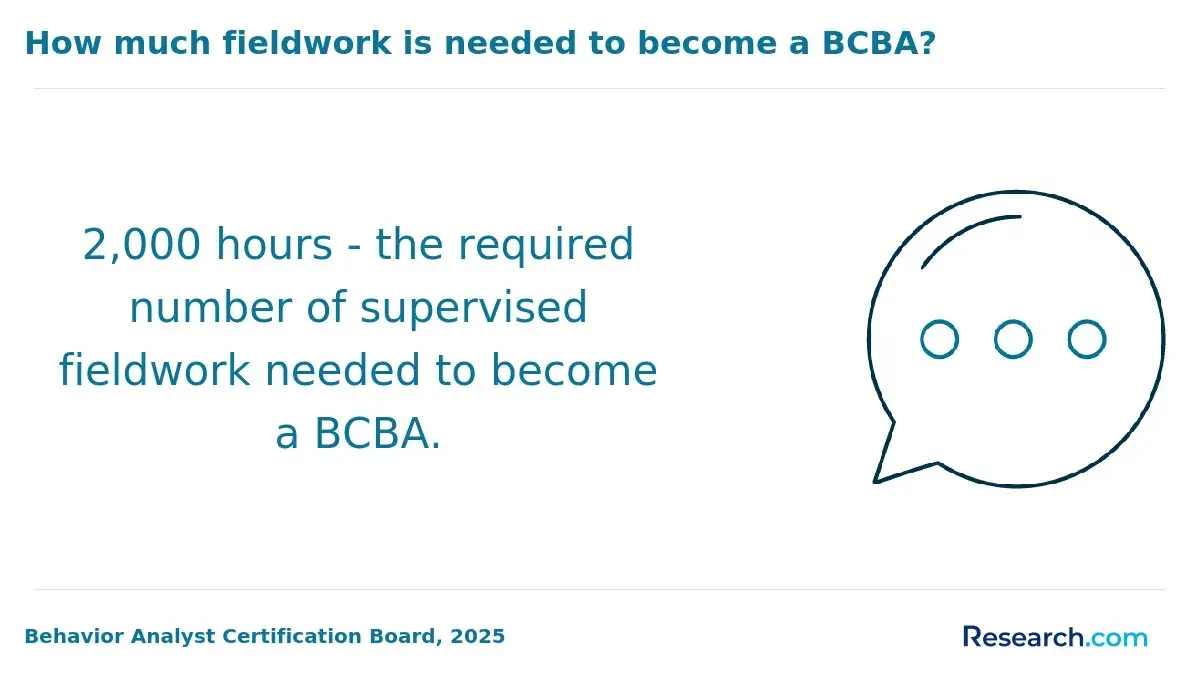
BACB-approved supervised fieldwork counts, including the standard 2,000-hour pathway and the concentrated 1,500-hour pathway. Both require a qualified supervisor, restricted and unrestricted activities, and monthly documentation that meets BACB fieldwork rules before you can apply for the BCBA exam.
References
- Behavior Analyst Certification Board. (2020). BCBA Task List (5th ed.). Retrieved November 10, 2025, from BACB.
- Behavior Analyst Certification Board. (2025). Board Certified Behavior Analyst handbook. Retrieved November 10, 2025, from BACB.
- Behavior Analyst Certification Board. (2025). US employment demand for behavior analysts: 2010–2024. Retrieved November 10, 2025, from BACB.
- U.S. Bureau of Labor Statistics. (2025). Psychologists. In Occupational Outlook Handbook. Retrieved November 10, 2025, from BLS.
- ZipRecruiter. (2025). BCBA salary. Retrieved November 10, 2025, from ZipRecruiter.