2027 How to Become a School Counselor in Delaware

Co-Founder and Chief Data Scientist
Becoming a school counselor in Delaware requires more than a counseling degree. You need the right graduate preparation, supervised school-based experience, Delaware educator licensure, a school counselor certificate, and ongoing professional development after you are hired. The process matters because Delaware serves over 140,000 K–12 public school students, and schools continue to need professionals who can support academic planning, college and career readiness, crisis response, and student mental health.
This guide explains the Delaware school counselor pathway from start to finish. You will learn what degree is required, how long preparation usually takes, which certification steps to complete, how renewal works, what alternative routes may be available, how salaries and job prospects look, and what mistakes to avoid before choosing a program.
Quick Answer: How to Become a School Counselor in Delaware
To become a school counselor in Delaware, you generally need a regionally accredited master’s degree in school counseling or a closely related approved counseling program, supervised practicum and internship experience in K–12 settings, a passing score on the Praxis II: Professional School Counselor exam, an Initial Educator License, and a Delaware Standard Certificate for School Counselor. Delaware school counselors must also renew credentials on a five-year cycle and complete required professional development.
- Delaware school counselors earn an average salary of $60,461 per year, with pay varying by district, experience, education, and added responsibilities.
- The state’s student-to-counselor ratio is 317:1, which points to continued demand for qualified school counseling professionals.
- Employment for educational, guidance, school, and vocational counselors in Delaware is projected to grow by 15% from 2022 to 2032, compared with the national average of 4% for the profession.
- Degree requirements for Delaware school counselors
- School counseling focus areas and specializations
- How long the Delaware pathway takes
- Required Delaware licensure and certification
- Transferring a Delaware school counseling license
- Credential renewal requirements
- Alternative routes into school counseling
- Ethical and legal practice in Delaware schools
- Licensure transitions and related counseling credentials
- Average school counselor salary in Delaware
- Delaware job outlook for school counselors
- Professional resources and mentorship
- Career advancement optionsAdditional advancement summary
What degree do I need to become a school counselor in Delaware?
Delaware’s school counselor pathway is built around graduate-level preparation. A bachelor’s degree alone is not enough for standard school counselor certification. Candidates are expected to complete a master’s program that provides counseling theory, ethical training, human development knowledge, school counseling methods, and supervised practice with K–12 students.
- Master’s degree from a regionally accredited institution: Delaware candidates must complete a master’s degree that includes at least 39 graduate credits. Coursework should cover core counseling areas such as counseling theories, ethics, human development, assessment, consultation, and school counseling program design.
- School-based practicum and internship: The preparation program must include supervised field experience. Delaware references include at least 100 practicum hours and 600 supervised fieldwork or internship hours in K–12 school environments, giving candidates direct experience before full professional practice.
- Elementary or secondary school counseling certification: After completing the degree and fieldwork requirements, applicants pursue the Delaware credential that matches their intended school level. Some candidates prepare for both elementary and secondary settings when their program and internship structure support it.
If your priority is entering the counseling workforce as efficiently as possible, compare Delaware’s school counselor requirements with broader counseling licensure timelines. Research.com’s guide to the fastest way to become a licensed counselor can help you understand how school counseling differs from clinical counseling routes.
| Requirement | What it means for Delaware candidates | Why it matters |
| Graduate degree | A master’s degree from a regionally accredited institution with at least 39 graduate credits | Meets the academic foundation for Delaware school counselor certification |
| Practicum | At least 100 practicum hours | Introduces candidates to supervised counseling practice before a longer internship |
| Internship or fieldwork | 600 supervised fieldwork or internship hours in K–12 settings | Builds readiness for real school counseling responsibilities |
| State certification | Elementary, secondary, or relevant school counselor certification | Authorizes employment as a school counselor in Delaware public school settings |
Are there school counseling specializations in Delaware?
Delaware does not treat every counseling focus area as a separate school counselor license. Instead, graduate programs may offer concentrations, electives, or field experiences that help future counselors build expertise with specific student needs. These focus areas can strengthen your preparation, but you should confirm that the program still meets Delaware school counselor certification requirements.
- Social justice counseling: Emphasizes advocacy, equity, cultural responsiveness, and support for students affected by systemic barriers.
- Child and adolescent counseling: Focuses on developmentally appropriate approaches for children and teenagers, including academic, social, and emotional support.
- Mental health counseling: Helps school counselors recognize concerns, provide school-based support, and coordinate referrals with families and outside providers when appropriate.
- Chemical dependency counseling: Prepares counselors to understand substance use risks, prevention strategies, and early intervention approaches in school communities.
- Couples and family counseling: Builds understanding of family systems and home factors that can affect a student’s attendance, behavior, well-being, and academic progress.
When comparing programs, treat specialization as a secondary factor. Accreditation, state approval, practicum placement quality, internship support, Praxis preparation, and certification alignment should come first. If you are comparing remote or hybrid options, Research.com’s overview of the best online counseling degree programs can help you evaluate format, flexibility, and program fit.
| Focus area | Best fit for students who want to work with | Decision tip |
| Social justice counseling | Diverse school communities and students facing access barriers | Look for coursework in advocacy, equity, and culturally responsive practice |
| Child and adolescent counseling | Elementary, middle, or high school students | Prioritize programs with strong K–12 internship placements |
| Mental health counseling | Students with emotional, behavioral, or crisis-related needs | Confirm the program distinguishes school counseling from clinical licensure |
| Chemical dependency counseling | Students affected by substance use risks or prevention needs | Ask whether related coursework is an elective, certificate, or supervised practice component |
| Couples and family counseling | Students whose school success is affected by family dynamics | Consider whether this focus supports your long-term goals in schools, agencies, or further licensure |
How long does it take to complete a school counseling degree in Delaware?
A Delaware school counseling pathway usually begins with a master’s degree in school counseling or a related approved field. Many programs require 48 credit hours, and full-time students often finish in about two years. Part-time students may need three years or more, especially if they are working while completing coursework and arranging internship hours.
Fieldwork is one of the biggest timeline factors. Delaware requirements may involve either 700 hours of supervised experience in one school setting or 350 hours each in elementary and secondary settings for dual certification. These placements are not just graduation requirements; they are central to becoming employable and meeting state expectations.
Candidates must also pass the Praxis II Professional School Counselor exam. Applicants who do not already have prior school experience may also need to meet an alternative requirement involving three years professional experience or a full-year school counseling internship. Because these requirements can overlap with coursework, your total timeline depends heavily on program design and field placement availability.
- Course load: Full-time study can move faster, while part-time enrollment may extend completion to three years or more.
- Internship structure: The 600 to 700-hour supervised experience can lengthen the program if placements are limited or spread across terms.
- Certification paperwork: Transcript review, exam score reporting, background checks, and application processing can add time after graduation.
- Prior school experience: Candidates with relevant experience may move through certain requirements more smoothly than those entering schools for the first time.
Delaware’s need for trained counselors is tied to its school population of over 140,000 K–12 public school students and the growing attention schools are giving to academic, career, behavioral, and mental health support.
| Pathway factor | Typical impact on timeline | What to ask before enrolling |
| Full-time master’s study | Often about two years | Are internship hours built into the planned sequence? |
| Part-time master’s study | May take three years or more | Are evening, weekend, hybrid, or online courses available? |
| Dual elementary and secondary preparation | May require careful placement planning | Can the program arrange 350 hours each in elementary and secondary settings? |
| Post-graduation certification steps | Can add weeks to months | Who helps with DEEDS, Praxis documentation, and transcript submission? |
What certification is required to work as a school counselor in Delaware?
Delaware school counselors need both educator licensure and a school counselor-specific certificate. The degree qualifies you to apply, but the state credential is what allows you to work in Delaware public school settings.
- Complete an approved graduate preparation program. Make sure the program’s coursework, practicum, and internship meet Delaware school counseling requirements before you enroll.
- Apply through the Delaware Educator Data System. Delaware uses DEEDS as the official educator licensure and certification portal.
- Obtain an Initial Educator License. This Delaware educator license is valid for four years and is generally required before full employment in public schools.
- Apply for the Standard Certificate – School Counselor. This certificate verifies that you meet Delaware’s role-specific standards for school counseling practice.
- Pass the required Praxis exam. Delaware requires the Praxis II: Professional School Counselor exam, Test Code 5421.
- Submit official documentation. Applicants provide transcripts, program completion records, and verification of practicum or internship experiences.
- Complete a fingerprint-supported criminal background check. Background screening is required because school counselors work directly with students.
- Maintain the credential after employment. Counselors later complete professional development and appraisal requirements to move from initial to continuing licensure.
| Credential or step | Delaware requirement | Common mistake to avoid |
| Initial Educator License | Valid for four years | Assuming a master’s degree alone authorizes school employment |
| Standard Certificate – School Counselor | Role-specific Delaware school counseling certificate | Applying for educator licensure but forgetting the school counselor certificate |
| Praxis II exam | Professional School Counselor exam, Test Code 5421 | Waiting until after graduation to start exam planning |
| Background check | Fingerprint-supported screening | Not leaving time for background processing before employment deadlines |
| Official records | Transcripts, program verification, and fieldwork documentation | Failing to keep internship-hour records and supervisor documentation |
Can I transfer my Delaware school counseling license between states?
A Delaware school counseling license does not automatically transfer to every other state. School counselor credentialing is state-based, so a receiving state will usually review your Delaware license, graduate coursework, supervised experience, exam scores, background check history, and employment record before deciding whether you qualify for endorsement or reciprocity.
If you plan to move, expect the new state to ask for some or all of the following:
- Verification of your active Delaware license and school counselor certificate.
- Official transcripts showing graduate coursework and degree completion.
- Documentation of practicum, internship, or supervised school counseling experience.
- Praxis results or additional state-specific exam scores if required by the receiving state.
- New state and federal background checks.
- Time for the licensing agency to review records, which can take weeks to months depending on the state and the completeness of your file.
The most important point is this: portability is easier when your graduate program is well documented and clearly aligned with recognized school counseling standards. Keep syllabi, internship logs, supervisor forms, exam score reports, and certification letters. Those records can prevent delays if another state asks for detailed proof of preparation.
Before accepting a job outside Delaware, contact the receiving state’s education agency directly. Do not rely only on district hiring staff, because employment eligibility and state certification approval are related but not always identical.
How often do Delaware school counselors need to renew their credentials?
Delaware school counselors renew their credentials every five years. Renewal is not just an administrative task; it is how the state confirms that counselors remain current in student support, ethical practice, career development, mental health awareness, and school-based intervention strategies.
- Renewal period: Delaware credentials must be renewed every five years, typically through the employing district or charter school.
- Professional development requirement: Counselors must complete 90 clock hours of professional development, with at least 45 hours focused on direct student services such as guidance or career preparation.
- Online submission: Renewal is generally handled through the Delaware Educator Data System, often with district or school support.
- Documentation: Keep certificates, transcripts, attendance records, and approval forms in case the state or employer needs verification.
- Fees: Delaware does not require a separate renewal fee beyond the initial $100 application fee, although local administrative costs may vary by district.
- Background checks: A new background check is generally not required unless there has been a break in service or an employer requests one.
- Employment status: Employed counselors usually renew through their district or charter school; unemployed counselors may need to coordinate directly with the Delaware Department of Education.
- Timing: Begin early. Districts may notify counselors up to six months before expiration, but the responsibility for avoiding a lapse remains with the credential holder.
| Renewal item | Delaware requirement | Practical advice |
| Renewal cycle | Every five years | Track your expiration date as soon as your credential is issued |
| Professional development | 90 clock hours | Save records throughout the cycle instead of collecting them at the end |
| Direct student services training | At least 45 hours | Choose workshops connected to guidance, career preparation, academic planning, or student support |
| Renewal platform | Delaware Educator Data System | Check that your employer has submitted any required verification on time |
What are the alternative pathways to become a school counselor in Delaware?
Delaware’s traditional route is a graduate school counseling program followed by state licensure and certification. However, career changers, teachers, and applicants with related human services backgrounds may have other options depending on their education, experience, and district needs. These routes still require careful review because alternative does not mean less rigorous.
- Provisional or conditional licensure: Some candidates with related academic preparation may work while completing remaining graduate coursework, testing, or certification requirements.
- Post-baccalaureate certificate options: Applicants who do not already hold a school counseling master’s may use additional graduate study to complete required coursework and supervised internships.
- Experience-based internship flexibility: Certified teachers with three years of experience may be able to meet certain internship expectations differently, although graduate coursework and certification requirements still apply.
- Alternative Routes to Certification: ARTC-style pathways can allow eligible candidates to work while completing required coursework, mentoring, and assessments.
Before choosing an alternative route, confirm three things in writing: whether the pathway leads to Delaware school counselor certification, whether it satisfies the Praxis requirement, and whether your supervised experience will be accepted. If you are still comparing counseling fields, Research.com’s guide to different counseling degree requirements can help you decide whether school counseling, clinical counseling, marriage and family therapy, or substance abuse counseling fits your goals.
| Pathway | Who may consider it | Key caution |
| Traditional master’s in school counseling | Students who know they want K–12 school counseling | Confirm Delaware certification alignment before enrolling |
| Post-baccalaureate coursework | Graduates with related preparation but missing school counseling requirements | Certificate coursework may not replace a required master’s degree |
| Teacher-to-counselor route | Educators with classroom experience who want a student support role | Teaching experience does not automatically equal counseling certification |
| Conditional or provisional route | Eligible candidates hired while finishing requirements | Employment conditions and deadlines must be understood before accepting a role |
How do state policies shape the ethical and legal practices of school counselors in Delaware?
Delaware school counselors work within both professional ethics and state education rules. Their responsibilities include protecting student confidentiality, recognizing when disclosure is required for safety, maintaining appropriate records, supporting equitable access to services, and following district procedures for crisis response, referrals, and parent or guardian communication.
Ethical practice is especially important because school counselors serve students, families, teachers, administrators, and community partners at the same time. Those relationships can create competing expectations. A student may want privacy, a parent may request information, and a school may need documentation. Delaware counselors must know how to balance these responsibilities while keeping student welfare at the center.
School counseling also overlaps with other student support professions. If you are comparing counseling and assessment-focused roles, Research.com’s guide on how to become a school psychologist in Delaware explains a related but distinct pathway.
What are the challenges in navigating licensure transitions for school counselors in Delaware?
School counseling certification is designed for K–12 education settings. It is not the same as a clinical counseling license for independent therapy or private practice. Delaware counselors who later want to move into clinical mental health counseling may need additional coursework, supervised clinical experience, exams, and board approval.
The main challenge is that school counseling and professional counseling use overlapping skills but different regulatory standards. A school counselor may have strong experience in academic planning, crisis response, family consultation, and student support, yet still need clinical supervision hours or coursework to qualify for another credential.
If your long-term goal includes private practice or clinical counseling outside schools, plan early. Compare your graduate curriculum with Delaware’s clinical licensing expectations before you graduate. Research.com’s overview of LPC licensure requirements in Delaware can help you understand how the professional counselor route differs from school counselor certification.
What is the average salary of school counselors in Delaware?
School counselors in Delaware earn an average of $60,461 per year. Reported pay commonly falls between $48,000 and $69,600, while top earners may make up to $82,571 annually. Broader reported figures range from about $22,519 on the low end to $96,083 at the high end.
These numbers should be used as planning estimates, not guarantees. School counselor salaries depend heavily on district pay scales, years of service, credentials, contract rules, school type, and whether the counselor takes on additional paid duties.
| Salary figure | Amount | How to interpret it |
| Average salary | $60,461 per year | A useful statewide benchmark, but not a guaranteed starting salary |
| Common range | $48,000 to $69,600 | Reflects many working counselors across experience levels and employers |
| Top-earner figure | Up to $82,571 annually | More likely for experienced counselors, higher-paying districts, or advanced roles |
| Lowest reported figure | Around $22,519 | May reflect part-time, atypical, entry-level, or reporting differences |
| Highest reported figure | Up to $96,083 | May reflect seniority, location, added responsibilities, or specialized employment settings |
- Experience level: Counselors generally earn more as they move up district salary schedules and gain years in the field.
- Education and credentials: Advanced preparation, endorsements, and relevant professional development can support eligibility for higher-paid roles.
- District and location: Pay can differ between districts because of budgets, contracts, and local cost pressures.
- Employer type: Public, charter, and private schools may use different compensation models.
- Additional duties: Counselors who coordinate programs, supervise activities, or take on leadership responsibilities may receive stipends or added compensation.
- Labor market conditions: Hiring demand can influence competitiveness, but it does not automatically translate into higher pay in every district.
What is the job outlook for school counselors in Delaware?
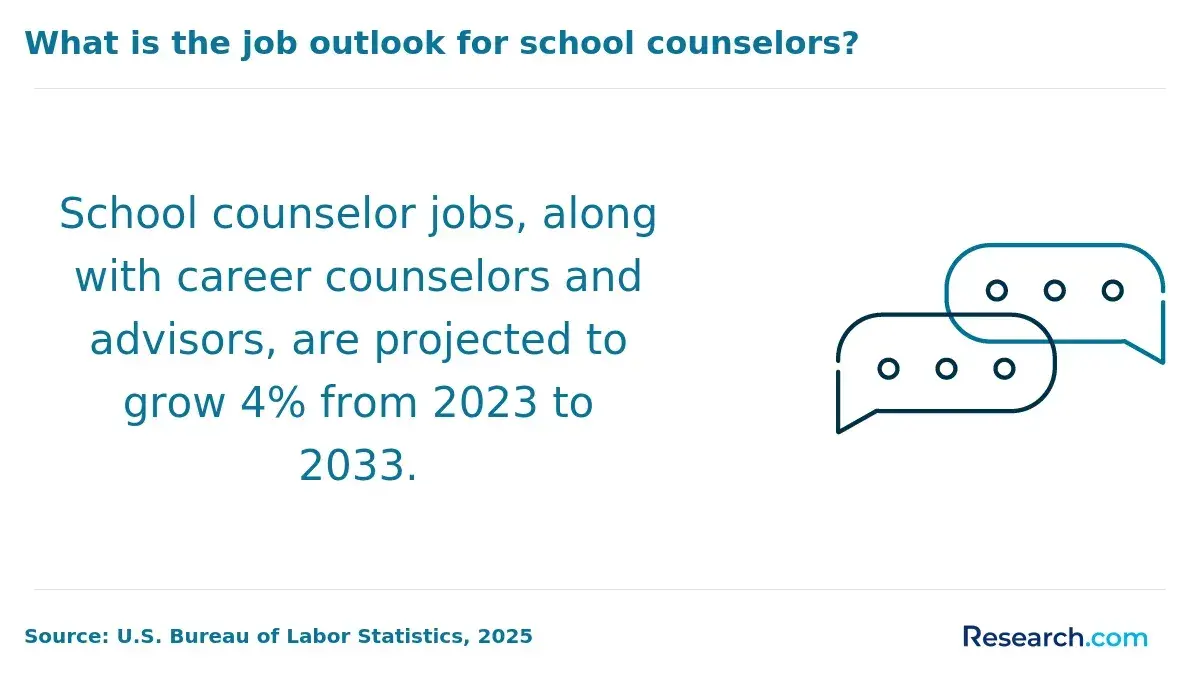
The outlook for Delaware school counselors is favorable. Employment for educational, guidance, school, and vocational counselors in Delaware is expected to grow by 15% from 2022 to 2032, compared with the national average of 4% for the profession. The state also expects around 130 annual job openings in this occupational group.
There are currently around 1,480 school counselors employed across Delaware. The state’s 317:1 student-to-counselor ratio indicates that many counselors still manage substantial caseloads, which helps explain continued attention to hiring and student support capacity.
Demand is shaped by several forces: student mental health needs, college and career readiness initiatives, academic intervention, dropout prevention, behavioral support, and the need for coordinated services between schools, families, and community providers. Technology and AI may also change parts of the work, especially data tracking, scheduling, and early-warning systems, but they do not replace the relationship-based judgment school counselors use when supporting students.
Students interested in school counseling may also benefit from related undergraduate preparation. For example, Research.com’s guide to affordable bachelor’s degrees in substance abuse counseling online can be useful for learners who want a foundation in prevention, behavioral health, and student support before graduate study.
| Job outlook factor | Delaware data or context | What it means for candidates |
| Projected growth | 15% from 2022 to 2032 | Delaware is expected to add opportunities faster than the national average for the profession |
| National comparison | 4% for the profession | The state projection is stronger than the national figure cited |
| Annual openings | Around 130 | Openings include both new positions and replacement needs |
| Current employment | Around 1,480 school counselors | There is an established workforce and ongoing need across school settings |
| Student-to-counselor ratio | 317:1 | Caseload pressure remains an important issue for schools and counselors |
What resources and mentorship opportunities exist for school counselors in Delaware?
New and aspiring Delaware school counselors should not rely only on coursework. Mentorship, district supervision, professional associations, conferences, and peer networks can make the first years in the role more manageable. These supports help counselors interpret state requirements, improve documentation practices, respond to ethical questions, and learn how experienced professionals manage caseloads.
Mentorship is especially valuable during transitions: moving from internship to employment, renewing credentials for the first time, changing districts, taking on leadership duties, or exploring related counseling licenses. If you want a broader look at entering counseling work in the state, Research.com’s guide to the fastest way to become a counselor in Delaware can help you compare credential pathways.
- Ask your graduate program about placement supervisors. Strong internship supervision often leads to better references, clearer documentation, and more realistic job preparation.
- Use district-level mentoring when available. District mentors can help new counselors understand local policies, forms, student information systems, and crisis protocols.
- Attend professional development tied to direct student services. This helps meet renewal requirements while improving daily practice.
- Build a peer consultation group. School counselors benefit from trusted colleagues who can discuss ethical dilemmas, program planning, and workload strategies without violating confidentiality.
What are the career advancement opportunities for school counselors in Delaware?
Delaware school counselors can advance without leaving student support, but they can also move into leadership, administration, policy, or related mental health roles. The best path depends on whether you want more responsibility in schools, broader district influence, clinical work, or higher education.
- Lead school counselor or counseling department chair: Experienced counselors may coordinate services, support colleagues, and help improve counseling programs within a school.
- District counseling coordinator or supervisor: These roles involve program oversight across multiple schools and usually require strong leadership experience.
- Assistant principal or principal: Counselors interested in administration typically need school leadership credentials and Delaware certification for administrative roles.
- Mental health specialist or school psychologist: These paths may require additional graduate education and separate licensure or certification. They are not automatic extensions of school counseling.
- State, association, or policy roles: Experienced counselors can contribute to program development, professional standards, and student support policy.
- Professional association leadership: Active involvement in groups such as the Delaware School Counselor Association can support networking, advocacy, and leadership growth.
- Higher education faculty or trainer: Counselors interested in teaching future professionals often need doctoral-level preparation and research or training experience.
Some counselors pursue additional graduate credentials to expand their scope. If marriage and family therapy is part of your long-term plan, Research.com’s ranking of shortest online MFT programs can help you compare efficient graduate options, though you should still verify Delaware licensure fit before enrolling.
| Advancement goal | Likely next step | Best fit for counselors who want |
| School counseling leadership | Lead counselor, department chair, or program coordinator experience | More influence while staying close to student services |
| District-level leadership | Supervisory experience and program management skills | System-wide impact across multiple schools |
| School administration | Administrative credentials and leadership certification | Broader responsibility for school operations |
| Clinical counseling | Additional LPC-related requirements | Work outside traditional K–12 counseling roles |
| Teaching or training | Advanced graduate education and research preparation | Preparing future counselors or leading professional learning |
What should future Delaware school counselors consider before choosing this career?
School counseling can be meaningful work, but it is not an easy role. Delaware counselors may support academic planning in one hour, respond to a student crisis the next, meet with families later in the day, and then document services or coordinate referrals. The work requires empathy, organization, ethical judgment, communication skills, and comfort working inside school systems.
Before committing to this path, ask yourself whether you want a role that blends counseling, education, advocacy, data-informed planning, and collaboration. If your main goal is long-term individual therapy in private practice, a clinical counseling pathway may be a better fit. If you want to help students succeed within schools and are comfortable working with teachers, administrators, families, and community partners, school counseling may align well with your goals.
Common mistakes to avoid when becoming a school counselor in Delaware
- Choosing a program without checking Delaware certification alignment: A counseling degree is only useful for school counseling if it meets the state’s educator certification expectations.
- Looking only at tuition: Also compare internship support, Praxis preparation, faculty advising, completion timelines, and whether the program helps with DEEDS documentation.
- Assuming online programs automatically qualify: Online or hybrid study can be convenient, but you must confirm that fieldwork and certification requirements are accepted in Delaware.
- Waiting too long to plan practicum and internship hours: School placements can take time to arrange, especially if you need experience across elementary and secondary settings.
- Confusing school counseling with clinical counseling: Delaware school counselor certification is not the same as LPC licensure.
- Relying only on rankings: Rankings can help with discovery, but your decision should be based on state approval, accreditation, cost, placement support, and career fit.
- Not saving documentation: Keep transcripts, syllabi, internship logs, supervisor evaluations, Praxis score reports, and license records for future renewal or out-of-state transfer.
Questions to ask programs before applying
- Does this program meet Delaware school counselor certification requirements?
- How many practicum and internship hours are included, and where are placements completed?
- Can the program support elementary, secondary, or dual certification preparation?
- What is the process for Praxis II: Professional School Counselor exam preparation?
- Who helps students with Delaware Educator Data System documentation?
- Are online students eligible for the same field placement support as campus students?
- What support is available for career changers, teachers, or part-time students?
- How does the program document supervised hours for future reciprocity or endorsement in another state?
Related Articles for Nearby States
- 2027 How to Become a School Counselor in Maryland
- 2027 How to Become a School Counselor in New Jersey
- 2027 How to Become a School Counselor in Pennsylvania
- 2027 How to Become a School Counselor in Virginia
- 2027 How to Become a School Counselor in West Virginia
- 2027 How to Become a School Counselor in New York
- 2027 How to Become a School Counselor in Connecticut
- 2027 How to Become a School Counselor in Rhode Island
- 2027 How to Become a School Counselor in North Carolina
- 2027 How to Become a School Counselor in Ohio
References:
- School Counselor Certification, “How to Become a School Counselor in Delaware” https://www.schoolcounselorcertification.com/guide/how-to-become-a-school-counselor-in-delaware/
- Teach.com, “School Counselor Salary and Jobs Outlook” https://teach.com/online-ed/counseling-degrees/online-masters-school-counseling/school-counselor-salary-and-career-outlook/ Delaware certification reference
- U.S. Bureau of Labor Statistics, “Educational, Guidance, and Career Counselors and Advisors” https://www.bls.gov/oes/2023/may/oes211012.htm Delaware certification reference
- Delaware Department of Education, “School Counseling” https://education.delaware.gov/educators/whole-child-support/school-counseling/ Delaware certification reference
- CareerExplorer, “School Counselor Salary in Delaware” https://www.careerexplorer.com/careers/school-counselor/salary/delaware/ Delaware certification reference
- Wilmington University, “M.Ed. in Elementary and Secondary School Counseling” https://www.wilmu.edu/education/elementary-secondary-school-master-curriculum.aspx Delaware certification reference
- CounselingPsychology.org, “2025 Best Master’s in Counseling Delaware - Online & Affordable Options” https://www.counselingpsychology.org/counseling/schools/delaware/ Delaware certification reference
- University of Delaware School of Education, “School Psychology” https://www.education.udel.edu/masters/school-psychology/ Delaware certification reference
- Delaware Schools Consortium, Frontline Recruitment https://www.applitrack.com/joindelawareschools/onlineapp/default.aspx Delaware certification reference
- HealthGrad, “Delaware Counselor Salary Outlook” https://www.healthgrad.com/mental-health/delaware-counselor-salary/ Delaware certification reference
Key Insights
- Delaware school counselors need graduate-level preparation, supervised K–12 field experience, Praxis testing, educator licensure, and a Standard Certificate for School Counselor.
- The fastest responsible path is not simply the shortest program. Choose a program that clearly supports Delaware certification, field placement documentation, and Praxis readiness.
- Full-time students often complete the master’s pathway in about two years, while part-time students may need three years or more depending on course load and internship scheduling.
- Delaware credentials renew every five years and require 90 clock hours of professional development, including at least 45 hours tied to direct student services.
- The state’s projected 15% employment growth from 2022 to 2032, around 130 annual openings, and 317:1 student-to-counselor ratio suggest a favorable outlook, but salaries and hiring conditions still vary by district.
- School counseling certification is different from clinical counseling licensure. If you may want private practice later, compare school counseling requirements with Delaware LPC requirements before selecting a graduate program.
Other Things You Should Know About Being a School Counselor in Delaware
In 2027, aspiring school counselors in Delaware need a master's degree in school counseling, completion of a state-approved practicum or internship, and passing the PRAXIS School Counselor exam. Apply for certification through the Delaware Department of Education.
The Delaware Department of Education, specifically the Professional Standards Board process, handles school counselor certification. Applicants must meet state educator-preparation standards, complete an approved graduate counseling program, and submit certification materials through Delaware’s educator licensing system.