2027 Cheapest Accredited Online Speech Pathology Degree Programs: Tuition, Fees, and Financial Aid

Co-Founder and Chief Data Scientist

Reviewed by Rhea Paul, PhD
SLP Education & Research Expert
Choosing an affordable online speech pathology degree is harder than comparing tuition rates. The real price depends on accreditation, residency rules, mandatory fees, clinical placement costs, transfer credit, and aid. The U.S. Bureau of Labor Statistics projects speech-language pathologist employment to grow 17% from 2025 to 2035, so demand is strong, but the required education can be expensive.
This guide is for students comparing accredited online options and explains how to identify genuinely low-cost programs, estimate total cost, verify federal aid eligibility, and avoid hidden expenses before enrolling.
Key Things You Should Know
- Western Kentucky University, University of Northern Colorado, East Carolina University for North Carolina residents, and University of Akron are commonly lower-cost options than many private programs, but the lowest-cost school depends heavily on residency and fees.
- A program charging about $700 per credit for 60 credits starts near $42,000 before mandatory university fees, clinical expenses, books, technology, background checks, travel, and possible out-of-state surcharges.
- Net price matters more than sticker price because FAFSA-based federal loans, school scholarships, state grants, assistantships, employer tuition benefits, and transfer credits can reduce out-of-pocket cost, while graduate students generally do not qualify for Pell Grants.
What Are the Cheapest Accredited Online Speech Pathology Degree Programs?
The cheapest accredited online speech pathology degree programs are typically online or hybrid master's programs in speech-language pathology or communication sciences and disorders offered by public universities.
For students who want to become licensed speech-language pathologists, the key credential is usually a master's degree accredited by the Council on Academic Accreditation in Audiology and Speech-Language Pathology, commonly called CAA.
The table below compares lower-cost online or distance-learning options that are commonly considered by cost-conscious students. Tuition changes frequently, and mandatory fees vary by term, residency, and enrollment load, so use these figures as a screening tool rather than a final bill.
| Program | Degree format | Accreditation status to verify | Cost signal | Best affordability fit |
| Western Kentucky University | Online or distance-learning master's pathway in speech-language pathology | CAA-accredited graduate SLP program | Often listed among lower public-university online options, with estimated tuition commonly starting in the low-$40,000 range before fees for a roughly 60-credit curriculum | Students seeking a public university with distance delivery and relatively predictable per-credit pricing |
| University of Northern Colorado | Online master's pathway in speech-language pathology | CAA-accredited graduate SLP program | Extended-campus tuition has commonly placed total tuition in the mid-$40,000 range before variable fees and clinical costs | Students who want a long-established online SLP pathway with a public-university price structure |
| East Carolina University | Distance education master's pathway in communication sciences and disorders | CAA-accredited graduate SLP program | Can be especially affordable for North Carolina residents, while nonresident tuition can change the value calculation substantially | North Carolina residents or students eligible for favorable residency pricing |
| University of Akron | Online or distance-supported graduate speech-language pathology pathway | CAA-accredited graduate SLP program | Public-university pricing may be competitive, but students should confirm online tuition, residency rules, and any clinical course fees | Ohio residents or students comparing regional public options |
| Calvin University | Online master's pathway in speech-language pathology | CAA-accredited graduate SLP program | Private nonprofit pricing may be higher than some public options but can still be competitive depending on scholarships and transfer background | Students comparing private online programs with strong advising and structured cohorts |
A lower published tuition rate does not automatically make a program the cheapest. A student paying higher tuition at a program with stronger scholarships, fewer required campus visits, better clinical placement support, or more accepted transfer prerequisites may pay less in net cost than a student who chooses the lowest per-credit rate.
How Were the Cheapest Online Speech Pathology Degree Programs Ranked?
A fair affordability ranking should compare the full cost of completing the degree, not just the tuition line shown on an admissions page. For speech pathology, this is especially important because clinical education, prerequisite coursework, and state licensure preparation can add costs that are not obvious at first.
The ranking logic used here gives the most weight to cost factors that directly affect what students pay and whether the degree can lead toward licensure. The goal is to identify affordable programs that remain academically and professionally useful.
Follow these steps:
- Confirm that the graduate speech-language pathology program is CAA-accredited or otherwise appropriate for the student's licensing goal.
- Compare published graduate tuition by credit, including whether online students pay in-state, out-of-state, flat-rate, or program-specific tuition.
- Estimate total tuition by multiplying required credits by the applicable tuition rate.
- Add mandatory fees, online course fees, clinical placement fees, background checks, technology charges, books, and required campus-visit costs.
- Review financial aid eligibility, including Title IV participation, scholarships, assistantships, employer benefits, and payment plans.
- Consider value indicators such as clinical placement support, Praxis preparation, completion expectations, state authorization, and licensure alignment.
This approach favors programs that combine reasonable tuition with transparent costs and professional accreditation. It also prevents a common mistake: ranking a school as "cheap" before checking whether students must pay high nonresident tuition or complete expensive prerequisite courses elsewhere.
How Can You Verify the Accreditation of an Online Speech Pathology Degree Program?
Accreditation is the first filter for any affordable speech pathology program because a low-cost degree that does not meet professional or licensure requirements may become very expensive later. Institutional accreditation affects federal financial aid eligibility, while CAA accreditation is the programmatic standard commonly expected for entry-level speech-language pathology master's preparation in the United States.
Students should verify accreditation independently before applying. The following steps help separate legitimate online programs from programs that sound affordable but may not support licensure:
- Search the school's institutional accreditation through the U.S. Department of Education or the Council for Higher Education Accreditation database.
- Check the CAA directory for the exact graduate program name, campus or distance format, accreditation status, and review cycle.
- Confirm whether the program is accredited, in candidacy, or only institutionally accredited; these categories are not the same.
- Ask the program whether its online format is covered under the same accreditation status as its campus program.
- Contact the state licensing board where you plan to work and ask whether the program meets education requirements for speech-language pathology licensure.
- Confirm that the school is authorized to enroll online students in your state, especially if clinical placements occur near your home.
A major red flag is a program that advertises "accredited" without saying whether it means institutional accreditation, CAA accreditation, or both. Another red flag is a school that cannot clearly explain how online students complete supervised clinical hours.
How Much Does an Accredited Online Speech Pathology Degree Really Cost?
The real cost of an accredited online speech pathology degree includes tuition, mandatory fees, clinical education expenses, learning materials, technology, and the cost of any prerequisite courses required before admission.
Tuition is the rate charged for instruction; mandatory fees are required charges that may cover technology, student services, online learning platforms, graduation, clinical tracking, or university operations; total program cost is the estimated full cost to finish; net price is what remains after grants, scholarships, waivers, and other aid that does not have to be repaid.
The table below shows how common cost components affect the final price. This matters because two programs with similar tuition can have very different total costs once fees and clinical requirements are added.
| Cost component | What it includes | Why it changes affordability |
| Tuition | Per-credit, per-term, flat-rate, or program-specific charges | This is the largest cost, but it may exclude required fees and out-of-state surcharges |
| Mandatory university fees | Technology, online learning, student services, registration, graduation, or health-related fees | Fees can add hundreds or thousands over the program and are not always included in tuition estimates |
| Clinical education costs | Background checks, immunizations, liability insurance, drug screening, placement software, travel, and possible lodging | Online students may complete placements locally but still pay site-related costs |
| Prerequisite coursework | Communication sciences, anatomy, phonetics, audiology, language development, or statistics courses required before admission | Students without a CSD background may need extra credits before starting the master's degree |
| Books and materials | Textbooks, assessment materials, software, and exam preparation resources | These are smaller than tuition but can still affect cash flow each term |
| Licensure and certification preparation | Praxis exam, state application fees, transcripts, and certification-related costs | These costs often occur near graduation when students are already managing clinical schedules |
A practical way to estimate cost is to ask each school for a written program cost sheet. If the school only gives a per-credit tuition rate, calculate a rough baseline by multiplying required credits by tuition, then add all mandatory fees and expected clinical costs before comparing programs.
Which Tuition Models Make Online Speech Pathology Degree Programs More Affordable?
Online speech pathology programs use several tuition models, and the best one depends on your residency, schedule, transfer background, and ability to study full time. A model that looks expensive for one student may be cheaper for another if it shortens time to completion or avoids out-of-state tuition.
The table below explains the main tuition models students are likely to encounter when comparing online speech pathology and related online health programs. Students who prefer flexible pacing may also want to understand how self paced online colleges structure tuition, although most clinical SLP master's programs still use fixed cohorts or supervised clinical timelines.
| Tuition model | How it works | When it may lower cost | Possible drawback |
| Per-credit tuition | Students pay for each credit attempted | Useful for part-time students and students who can transfer prerequisites | Total cost rises if extra courses are required |
| Flat-rate tuition | Students pay one rate for a credit range each term | Can lower cost for students who take heavier course loads | May be less flexible for students balancing work and clinical hours |
| Online program tuition | All online students pay the same program rate regardless of residency | Helpful for out-of-state students who would otherwise pay nonresident tuition | May be higher than in-state public tuition |
| Resident tuition | Students pay a lower public-university rate based on state residency | Often the lowest option for residents of the school's state | Nonresidents may pay substantially more |
| Cohort tuition | Students follow a fixed course sequence with a defined program price | Can make budgeting easier and reduce unexpected scheduling delays | Less flexibility if a student needs to pause enrollment |
Students should ask whether tuition is locked for the cohort or can increase each academic year. A small annual increase can affect the final bill if the program takes three years instead of two.
What Fees and Hidden Costs Should Online Speech Pathology Degree Students Expect?
Online students often save on relocation and commuting, but speech pathology programs can still carry fees that are easy to miss. These costs matter because clinical education is hands-on even when lectures are online.
Before enrolling, ask the admissions or student accounts office to identify every required charge by term. The most common hidden or semi-hidden costs include the following:
- Online learning or technology fees charged per credit or per term
- Clinical placement, clinical tracking, or supervision-related fees
- Background checks, fingerprinting, drug screening, immunizations, and health documentation
- Professional liability insurance required for practicum or externship placements
- Travel, parking, lodging, or missed work connected to clinical sites or campus intensives
- Textbooks, assessment kits, simulation tools, software, and Praxis preparation materials
- Graduation, transcript, state licensure, and certification-related fees
- Prerequisite courses required for students without a communication sciences and disorders background
A common mistake is assuming that "fully online" means there are no in-person costs. In speech pathology, clinical practicum and externship requirements usually involve supervised work with clients, and students may need to travel to approved sites or attend short campus sessions depending on the program.
How Does FAFSA and Federal Financial Aid Work for Online Speech Pathology Degree Programs?
FAFSA is the application used to determine eligibility for federal student aid at participating institutions. Online students can qualify for federal aid if the school participates in Title IV programs, the student meets eligibility rules, and the program is an eligible degree or certificate program.
Graduate speech pathology students should pay close attention to loan limits because most SLP entry-level programs are master's degrees. Federal rules allow eligible graduate students to borrow up to $20,500 per academic year in Direct Unsubsidized Loans, with Graduate PLUS Loans potentially available for remaining eligible costs after a credit check.
Use this sequence before committing to an online speech pathology program:
- Confirm that the school participates in federal Title IV aid programs.
- Ask whether the specific online speech pathology program is eligible for federal aid.
- Submit the FAFSA using the school's code and review the Student Aid Index and aid offer.
- Separate gift aid from loans so you know what must be repaid.
- Check whether your enrollment load qualifies as half time or full time for aid purposes.
- Ask whether summer terms, clinical semesters, or prerequisite courses are covered differently.
- Compare the total debt needed to finish, not just the aid offered for the first year.
Similar FAFSA checks are important across online healthcare pathways, including RN to BSN programs, because online format alone does not determine aid eligibility.
Graduate students should be cautious about using loans to cover living expenses unless necessary. Borrowing more than tuition and mandatory fees can make a seemingly affordable program much more expensive after interest.
Which Scholarships, Grants, and Tuition Benefits Can Help Pay for an Online Speech Pathology Degree?
Scholarships, grants, assistantships, tuition discounts, and employer benefits can reduce the net price of an online speech pathology degree. The most valuable aid is gift aid because it does not need to be repaid, but students must check whether awards are renewable and whether online students qualify.
The table below summarizes funding options that may apply to online speech pathology students. Availability varies by school, state, employer, and enrollment status.
| Funding source | What to check | How it may reduce cost |
| School scholarships | Whether online graduate students are eligible and whether the award renews each year | Can directly reduce tuition or fees |
| Department awards | Whether the communication sciences department offers merit, need-based, or diversity-focused aid | May be smaller but targeted to SLP students |
| Graduate assistantships | Whether remote, campus, research, or teaching assistantships are available to online students | May provide tuition support, stipends, or both |
| State grants or workforce programs | Whether your state funds high-need healthcare or school-based service fields | Can help students who plan to work in shortage areas |
| Employer tuition assistance | Annual cap, grade requirements, repayment clauses, and whether the degree must relate to your role | Can reduce out-of-pocket cost while working |
| Professional association scholarships | Eligibility by discipline, membership, academic level, or service commitment | Can supplement school-based aid |
Students comparing allied health programs often find that funding rules differ by discipline; for example, scholarships available in speech pathology may not match those for the best online registered dietitian programs. The safest approach is to build a funding calendar and apply before admission deadlines, not after the first bill arrives.
Can Transfer Credits, Prior Learning, and Competency-Based Study Lower the Cost of an Online Speech Pathology Degree?
Transfer credit can lower costs, but speech pathology students need to understand where transfer savings are realistic. Master's-level SLP programs are tightly sequenced because they must meet accreditation, clinical, and licensure expectations, so schools may limit how many graduate credits can transfer.
The biggest savings often come before the master's program starts. Students without a communication sciences and disorders background may be able to complete lower-cost prerequisite courses at an accredited institution before enrolling in a graduate cohort.
- Ask each program for a prerequisite audit before applying so you do not pay for unnecessary courses.
- Confirm the maximum number of graduate transfer credits accepted and the minimum grade required.
- Check residency requirements, because some schools require a certain number of credits to be completed in-house.
- Compare the cost of post-baccalaureate prerequisite courses across accredited public universities before choosing the fastest option.
- Ask whether older coursework expires, especially for anatomy, audiology, statistics, or language development prerequisites.
- Keep syllabi from previous courses because departments may need them to approve equivalency.
Competency-based tuition is common in some online fields, but it is less common for accredited entry-level SLP master's programs because supervised clinical competencies must be documented carefully.
Students exploring healthcare career changes can compare how transfer rules differ in pathways such as MA to LPN bridge programs online, where prior coursework and licensure goals may be evaluated differently.
How Should Students Compare the Net Price, Quality, and Return on Investment of Online Speech Pathology Degree Programs?
The best-value online speech pathology program is not always the one with the lowest advertised tuition. A stronger value choice is an accredited program with a manageable net price, clear clinical support, licensure alignment, reasonable completion time, and debt that fits the salary range of the profession.
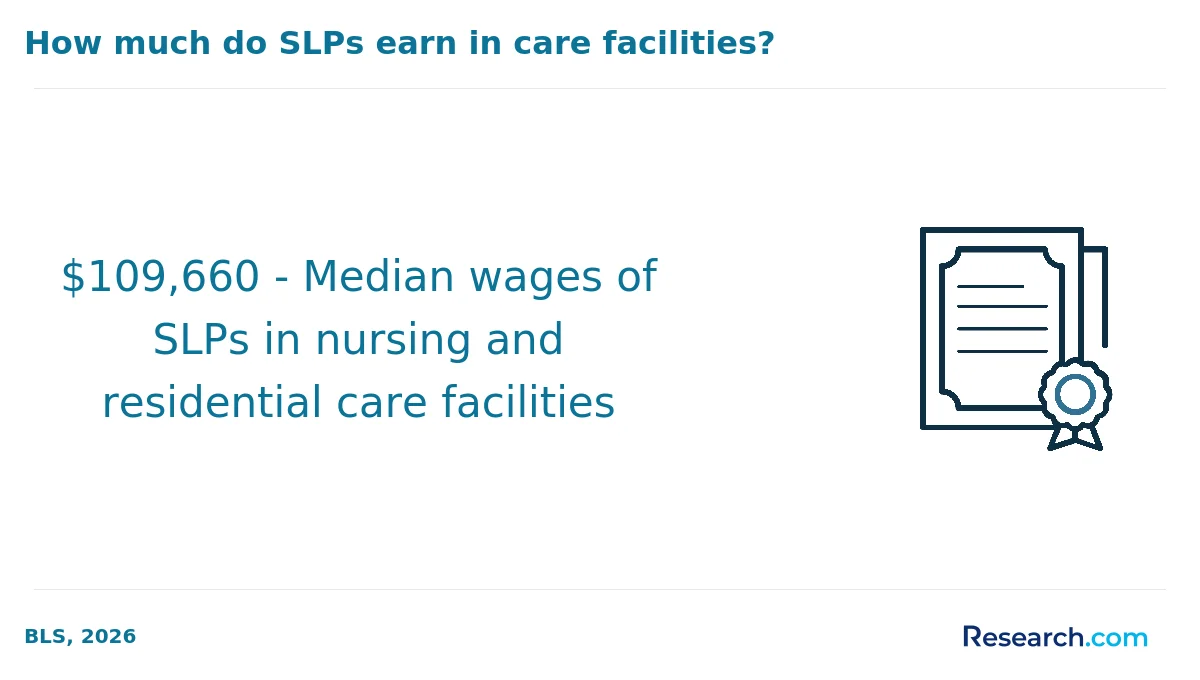
The U.S. Bureau of Labor Statistics reported a 2026 median annual wage of about $97,870 for speech-language pathologists. That figure is a labor-market benchmark, not a salary promise, but it gives students a useful reference point when comparing estimated debt, loan payments, and the time needed to complete the degree.
Use the following questions to compare programs before applying:
- What is the total tuition for the exact number of credits required to graduate?
- What mandatory fees are charged every term, and which fees are one-time charges?
- Does the quoted price include clinical placement, background checks, technology, books, travel, and campus intensives?
- Is the program CAA-accredited and approved for online delivery in your state?
- What percentage of aid is gift aid versus loans that must be repaid?
- Are scholarships renewable, and what GPA or enrollment load is required to keep them?
- How are clinical placements arranged, and what happens if a local placement is unavailable?
- How long do students typically take to finish, and does part-time enrollment increase fees?
- Does the curriculum align with the licensing requirements in the state where you plan to work?
- What student outcomes does the program publish, such as Praxis pass rates, completion rates, or employment-related disclosures?
These questions are especially important for students considering more than one graduate healthcare credential, including an MSN to DNP program, because professional degrees should be evaluated by net cost and career fit together.
The most common affordability mistake is comparing only the first tuition number you see. A better decision comes from comparing total cost, subtracting confirmed gift aid, estimating borrowing, and then weighing the result against accreditation, clinical quality, state licensure fit, and long-term career goals.
Other Things You Should Know About Speech Pathology Degrees
Usually no. In most states, becoming a licensed speech-language pathologist requires a graduate degree, supervised clinical experience, and passing required exams. A bachelor's degree in communication sciences and disorders can prepare you for graduate admission, but it is generally not enough for independent SLP licensure.
Coursework may be online, but clinical training is not purely virtual. Accredited SLP programs require supervised clinical experiences with clients, and students may need local placements, approved externship sites, simulation activities, or short campus visits depending on the school.
Many online SLP master's programs take about two to three years, depending on whether the student enrolls full time, needs prerequisites, or follows a part-time cohort. Clinical placement timing can also affect the graduation timeline.
A speech-language pathologist evaluates, diagnoses, and treats communication and swallowing disorders and typically needs a graduate degree and state licensure. An SLP assistant supports therapy under supervision, and requirements vary by state, employer, and setting.
References
- U.S. Bureau of Labor Statistics - Speech-Language Pathologists https://www.bls.gov/ooh/healthcare/speech-language-pathologists.htm
- ASHA EdFind - Accredited Speech-Language Pathology Programs https://find.asha.org/ed/
- Audiology and Speech-Language Pathology Interstate Compact https://aslpcompact.com/compact-map/
- University of Nebraska at Kearney - Speech-Language Pathology, Master of Science in Education (Online Track) https://www.unk.edu/online/degrees-programs/speech-language-pathology-online.php
- California State University-San Marcos - Online MS in Speech-Language Pathology https://www.csusm.edu/slp/programs/mastersonline/index.html
- New England Institute of Technology - Master of Science in Speech Language Pathology https://www.neit.edu/academics/graduate-degrees/speech-language-pathology-ms
- California State University-Northridge - Master of Science in Communicative Disorders (Online) https://tsengcollege.csun.edu/programs/CDS
- New York University - Online MS, Communicative Sciences and Disorders (Speech@NYU) https://steinhardt.nyu.edu/degree/online-ms-communicative-sciences-and-disorders