2027 Accredited Online Speech Pathology Degree Programs With No GRE or GMAT Requirements

Co-Founder and Chief Data Scientist

Reviewed by Rhea Paul, PhD
SLP Education & Research Expert
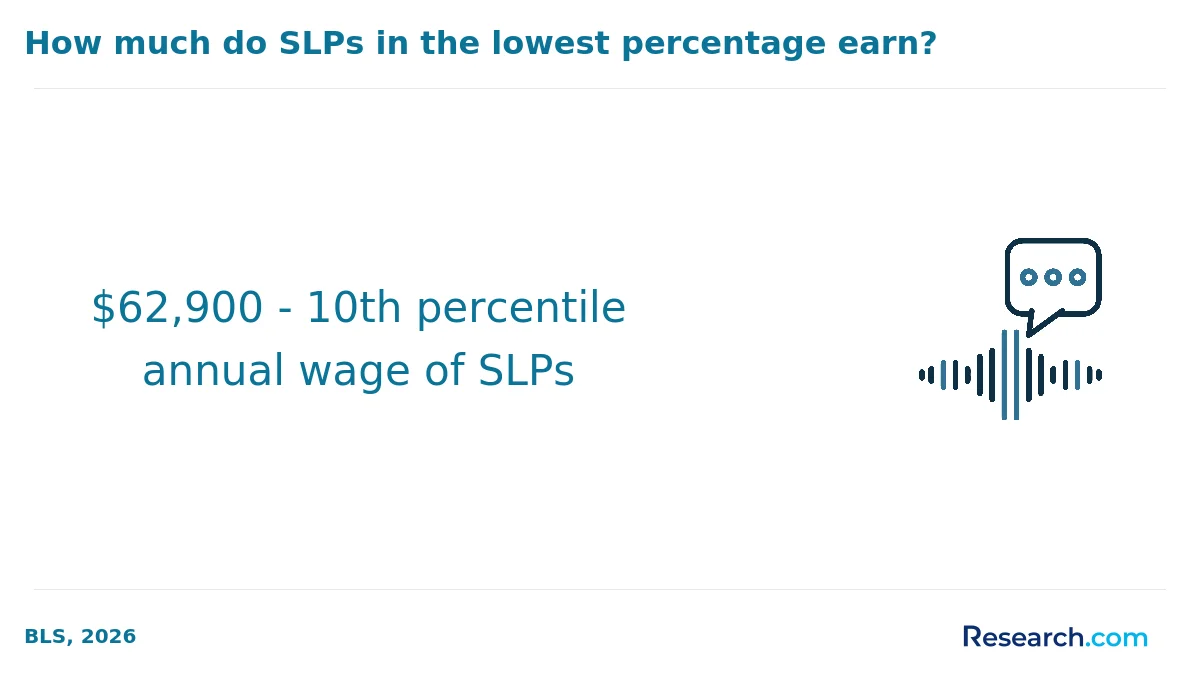
Choosing an online speech pathology program is harder when admissions policies change from test-required to test-optional or test-free. The decision matters because speech-language pathologists need graduate-level preparation, supervised clinical experience, and state licensure. The U.S. Bureau of Labor Statistics reports a 2026 median salary of $97,870 for speech-language pathologists and projects 17% employment growth from 2025 to 2035.
This guide helps prospective students compare accredited online programs without GRE or GMAT requirements, understand what replaces test scores, and decide which program offers the best fit.
Key Things You Should Know
- Most online speech pathology programs that waive standardized tests are master's programs; the GMAT is generally irrelevant, while the GRE may be not required, optional, or waived under specific conditions.
- No-GRE admission does not remove competitiveness: programs still weigh GPA, prerequisite communication sciences coursework, clinical readiness, recommendations, writing quality, and fit with the profession.
- Career value depends more on CAA accreditation, clinical placement support, licensure alignment, total cost, and graduation outcomes than on whether the GRE or GMAT was required.
Which Accredited Online Speech Pathology Degree Programs Do Not Require the GRE or GMAT?
For speech pathology, the degree that usually matters for licensure is the master's in speech-language pathology, communication sciences and disorders, or a closely related title. A bachelor's degree can prepare students for graduate admission, but independent practice as a speech-language pathologist typically requires a qualifying master's degree, supervised clinical hours, and state licensure.
The table below highlights examples of online or distance speech pathology master's programs that have commonly advertised no GRE or no GMAT requirements in recent admissions cycles. Admissions policies can change, so applicants should verify the current catalog, application portal, and Council on Academic Accreditation status before applying.
| Institution | Online speech pathology degree | GRE or GMAT status to verify | Accreditation and fit notes |
| Emerson College | Online Master of Science in Communication Disorders | GRE not required in standard admissions materials; GMAT not used | Designed for students preparing for SLP licensure; review clinical placement and immersion requirements |
| New York University | Online Master of Science in Communicative Sciences and Disorders | GRE not typically required; GMAT not used | Strong fit for students seeking a large university online format with supervised practicum requirements |
| Baylor University | Online Master of Science in Communication Sciences and Disorders | GRE not commonly required; GMAT not used | Applicants should compare start dates, field placement support, and any in-person components |
| Calvin University | Online Master of Arts in Speech-Language Pathology | GRE not generally required; GMAT not used | Useful for students seeking an online cohort model with clinical education requirements |
| James Madison University | Online or distance Master of Science in Speech-Language Pathology | GRE policy should be confirmed for the current cohort; GMAT not used | Often appeals to students who need a public university option with defined clinical expectations |
| University of Northern Colorado | Distance Master of Arts in Speech-Language Pathology | GRE requirement should be verified for the current cycle; GMAT not used | May be a strong option for students who can meet cohort, practicum, and residency expectations |
| Western Kentucky University | Distance or online Master of Science in Speech-Language Pathology | GRE policy should be checked before applying; GMAT not used | Applicants should review state authorization and local clinical placement rules |
The safest way to use this list is as a starting point, not a final ranking. A program that is test-free but expensive, poorly aligned with your state's licensure rules, or weak in clinical placement support may be less valuable than a more selective program with better fit.
Why Have Accredited Online Speech Pathology Degree Programs Eliminated GRE and GMAT Requirements?
Speech pathology programs have reduced GRE reliance for several reasons: standardized tests can add cost and delay, may not reflect clinical communication skills, and are less directly tied to the day-to-day abilities speech-language pathologists need. The trend also reflects a broader shift in graduate admissions toward evidence that is closer to actual professional performance.
Applicants should understand the difference between the main testing policies because they affect strategy. The table below explains what each policy usually means and how to respond.
| Policy type | What it usually means | How applicants should respond |
| Test-required | The GRE must be submitted for the application to be complete | Plan test preparation early and confirm minimum or average score expectations |
| Test-optional | Scores may be submitted but are not required | Submit only if scores strengthen the file compared with the rest of the applicant pool |
| Test-free | Scores are not reviewed even if submitted | Focus on GPA, prerequisites, essays, recommendations, and clinical exposure |
| Conditional waiver | The test is waived for applicants who meet a GPA, degree, or experience threshold | Confirm eligibility in writing before assuming the waiver applies |
For many students, eliminating the GRE saves application time and testing costs. However, it also means the rest of the application carries more weight, especially academic performance in anatomy, phonetics, language development, audiology, and speech and hearing science prerequisites.
What Admissions Criteria Matter Most Without GRE or GMAT Scores?
Without GRE or GMAT scores, admissions committees look more closely at whether the applicant can handle graduate coursework, interact professionally with clients, and complete supervised clinical training. This is especially important in speech pathology because academic knowledge and interpersonal skill both affect readiness for practicum.
The strongest applications usually provide evidence across several areas. Use the following hierarchy to decide where to invest the most effort before submitting:
- Confirm prerequisite coursework first, because missing communication sciences and disorders courses can delay admission or require leveling classes.
- Show academic readiness through cumulative GPA, major GPA, recent upper-division science performance, or successful post-baccalaureate coursework.
- Use the personal statement to explain why speech-language pathology fits your goals, not simply why you want a healthcare career.
- Choose recommenders who can evaluate writing, professionalism, empathy, reliability, and readiness for client-facing work.
- Document relevant exposure, such as observation hours, work with children or adults with communication needs, research assistance, tutoring, bilingual experience, or healthcare support roles.
Students coming from adjacent healthcare or support roles should pay close attention to prerequisite gaps. For example, applicants researching MA to LPN bridge programs online will notice a similar admissions pattern: schools care less about a single test score and more about whether prior coursework, clinical exposure, and professional goals align with the program.
Are No-GRE or No-GMAT Online Speech Pathology Degree Programs Easier to Get Into?
No-GRE and no-GMAT speech pathology programs are not automatically easier to get into. They may be easier to apply to because applicants avoid a standardized test, but admissions can remain competitive because accredited programs must ensure students can complete intensive coursework and clinical requirements.
The key distinction is application friction versus admission selectivity. A test-free program reduces one barrier, but it may raise the importance of other factors. If many applicants are attracted by the no-GRE policy, the program can become more competitive rather than less.
Applicants should consider submitting optional GRE scores only when the scores clearly add value. If your GPA is strong, prerequisites are recent, and recommendations are excellent, weak or average scores may distract from a strong application. If your undergraduate record is uneven but your GRE scores are well above the program's typical profile, optional scores may help demonstrate current academic readiness.
A practical rule is to ask admissions staff whether submitted scores are actively weighed, used only as supplemental evidence, or not reviewed at all. If the answer is unclear, prioritize the parts of the application the program explicitly lists as most important.
Does Skipping the GRE or GMAT Affect Academic Quality or Accreditation?
Skipping the GRE or GMAT does not lower academic quality by itself. Accreditation, curriculum, faculty oversight, clinical supervision, and student outcomes are much better indicators of program quality than a testing requirement. In speech-language pathology, the most important programmatic credential to verify is accreditation by the Council on Academic Accreditation in Audiology and Speech-Language Pathology, commonly associated with ASHA.
Accreditation matters because it signals that the program meets professional standards for curriculum, clinical education, assessment, and preparation for entry into the field. It also affects eligibility for state licensure pathways and the Certificate of Clinical Competence in Speech-Language Pathology, though exact requirements vary by state and credentialing body.
When comparing programs, do not treat "online" as a shortcut. Accredited online SLP programs still require supervised clinical experiences, and many require synchronous classes, campus immersions, simulations, or assigned practicum placements. The online format changes delivery; it does not remove the hands-on training expected of future clinicians.
Which Students Benefit Most From Online Speech Pathology Degree Programs Without GRE or GMAT Requirements?
No-GRE online speech pathology programs are especially useful for applicants whose strengths are better shown through coursework, client-facing experience, language ability, or career maturity than through standardized testing. They can also benefit working adults who would lose months preparing for an exam that may not improve their admission profile.
These programs may be a particularly strong fit for several types of students. The list below can help you decide whether a test-free pathway matches your background.
- Career changers with strong recent prerequisite grades who need a graduate pathway into speech-language pathology without delaying applications for test prep.
- Working adults who need online delivery but can still commit to scheduled classes, fieldwork, and supervised clinical placements.
- Applicants with relevant experience in schools, clinics, early intervention, rehabilitation, special education, tutoring, bilingual services, or caregiver support.
- Students whose undergraduate GPA improved over time and who can show academic readiness through recent coursework rather than a standardized test.
- Applicants who experience test anxiety or face financial barriers but have strong communication, writing, and interpersonal evidence.
Healthcare students comparing mobility pathways should also consider how structured each program is. A nurse looking at RN to BSN programs, for example, may prioritize flexibility, while an aspiring speech-language pathologist must also evaluate whether the online program can support local clinical placements and licensure requirements.
How Do Tuition and Financial Aid Compare for No-GRE Online Speech Pathology Degree Programs?
No-GRE policies can lower application costs, but they do not necessarily make the degree itself cheaper. Tuition, fees, travel for immersions, background checks, clinical onboarding expenses, books, equipment, and lost work hours can matter more than the cost of a standardized test.
For financing, federal loan limits are an important planning point. Federal Student Aid materials for the 2025-26 award year list up to $20,500 per year in Direct Unsubsidized Loans for eligible graduate or professional students; borrowing beyond that may require Grad PLUS Loans, scholarships, employer support, savings, or payment plans. This means applicants should compare total program cost, not just annual tuition.
The table below summarizes cost factors that can differ substantially across no-GRE online speech pathology programs. Use it to ask better questions before enrolling.
| Cost factor | Why it matters | What to ask the school |
| Tuition structure | Programs may charge by credit, term, cohort, or flat rate | What is the estimated total tuition for the full degree? |
| Prerequisite or leveling courses | Students without a CSD background may need additional coursework | Are leveling courses included in the published cost estimate? |
| Clinical placement expenses | Requirements may include screenings, immunizations, insurance, travel, or site fees | Which clinical costs are paid by the student? |
| Residency or immersion travel | Some online programs require in-person sessions | How many campus visits are required, and what expenses should students expect? |
| Time to completion | Longer timelines can increase living costs and delay full-time clinical employment | What is the typical completion time for students in my enrollment track? |
Students comparing graduate healthcare degrees should use the same total-cost lens across fields. For instance, applicants reviewing an MSN to DNP program should look beyond tuition per credit and compare fees, practicum expectations, employer reimbursement, and time away from work.
What Career Outcomes Can Graduates Expect From No-GRE Online Speech Pathology Degree Programs?
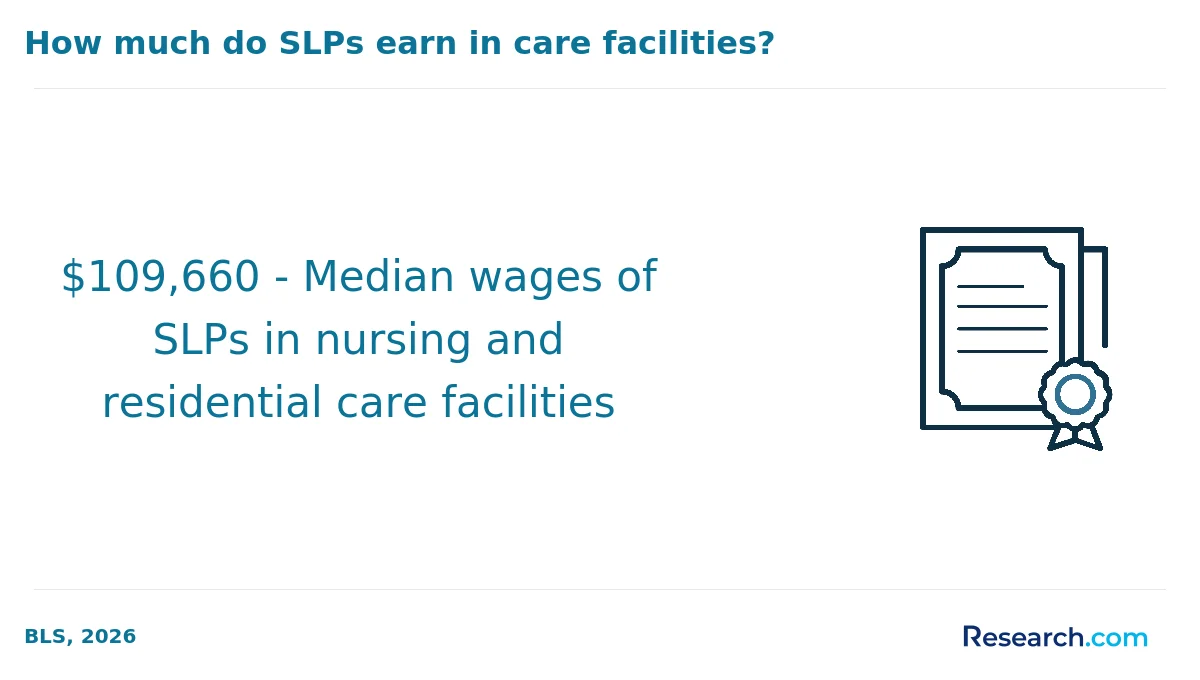
Graduates of accredited online speech pathology programs may pursue roles in schools, hospitals, rehabilitation centers, skilled nursing facilities, private practices, early intervention programs, telepractice, and research or administrative settings. The degree can lead to strong demand, but outcomes depend on licensure, clinical fellowship completion, location, setting, specialization, and labor market conditions.
The BLS 2024 median salary of $95,410 is useful as a national benchmark, not a promise. School-based positions, medical settings, rural shortages, bilingual skills, and pediatric or adult specialization can influence compensation and opportunity. Applicants should ask programs where graduates complete clinical placements, how they support the Clinical Fellowship transition, and whether alumni commonly work in the settings the applicant prefers.
Speech pathology also overlaps with other health and wellness careers, but the training path is distinct. Someone interested in nutrition counseling, for example, may be better served by comparing the best online registered dietitian programs rather than choosing SLP solely because of job growth projections.
The best career fit is usually found by matching the degree to the population you want to serve. If you are drawn to communication, swallowing, language development, voice, fluency, cognitive-communication, or AAC support, speech-language pathology may be a strong match. If you are mainly seeking a flexible online healthcare credential without intensive clinical interaction, another pathway may fit better.
What Common Application Mistakes Reduce Admission Chances to No-GRE Online Speech Pathology Degree Programs?
The most common mistake is choosing a program only because it does not require the GRE. Admissions flexibility is valuable, but it should never replace careful review of accreditation, licensure alignment, clinical placement support, cost, and fit.
Before submitting applications, check for these avoidable errors. Each one can weaken an otherwise promising file or lead to an expensive mismatch.
- Assuming "no GRE" means "low selectivity," when the program may rely heavily on GPA, prerequisites, essays, and recommendations.
- Overlooking CAA accreditation or misunderstanding the difference between institutional accreditation and professional programmatic accreditation.
- Applying with missing prerequisites and no plan for completing leveling coursework before the cohort begins.
- Using a generic personal statement that does not connect past experience to speech-language pathology clients, settings, or goals.
- Choosing recommenders based on job title rather than their ability to describe your readiness for graduate clinical training.
- Ignoring state authorization, licensure rules, and whether the school can place students in your location.
- Comparing tuition per credit without calculating full program cost, fees, travel, and unpaid clinical time.
- Assuming test-waiver policies are permanent instead of confirming the current admissions cycle requirements.
A strong application is specific, evidence-based, and aligned with the program's mission. If you remove the GRE from the file, every other component needs to show that you are ready for graduate-level science, professional communication, ethical practice, and supervised client care.
How Should Students Compare Accredited Online Speech Pathology Degree Programs Without GRE or GMAT Requirements?
The best no-GRE online speech pathology program is not always the cheapest, fastest, or easiest to enter. It is the accredited program that gives you a realistic path to admission, clinical training, licensure, manageable debt, and the work setting you want after graduation.
Use this step-by-step comparison process before applying. It is designed to help you narrow a broad list into a smaller group of programs that are actually viable for your goals.
- Verify CAA accreditation status and confirm that the program's curriculum supports your state's licensure pathway.
- Confirm whether the program is test-free, test-optional, or waiver-based for the exact admissions cycle you plan to enter.
- Compare prerequisite requirements and identify any leveling coursework that adds time or cost.
- Ask how clinical placements are arranged, especially if you live outside the university's home state.
- Calculate total cost using tuition, fees, travel, clinical onboarding expenses, books, and estimated lost work time.
- Review format expectations, including synchronous classes, cohort pacing, campus visits, and full-time versus part-time options.
- Ask for outcome indicators such as completion patterns, Praxis preparation support, clinical fellowship guidance, and employment settings.
- Speak with admissions or program staff before applying to confirm any policy that affects eligibility, state authorization, or placement.
Online learning format should also match your life. Some SLP programs are highly scheduled because clinical training requires coordination, while other online degrees are more independent; students comparing broader flexible options can review self paced online colleges to understand how pacing models differ before assuming every online healthcare program works the same way.
If you are a strong applicant but cannot afford test preparation, a no-GRE program can be a smart choice. If your academic record is weak and you need another way to prove readiness, a test-optional program that reviews strong scores may be better. The right decision is not whether the GRE exists; it is whether the admissions model lets you present your strongest, most honest case for becoming a speech-language pathologist.
Other Things You Should Know About Speech Pathology
Usually, no. A bachelor's degree can prepare you for graduate study or support roles, but independent practice as a speech-language pathologist generally requires a qualifying master's degree, supervised clinical experience, and state licensure.
Many programs take about two to three years, depending on whether you study full time, need prerequisite or leveling courses, and complete clinical placements on schedule. Part-time formats may take longer.
Yes. Even when coursework is online, students must complete supervised clinical experiences. Some programs also require campus visits, simulations, or immersion sessions, so ask about travel and placement expectations before applying.
It depends on the program and your clinical schedule. Some students work during early coursework, but practicum and externship requirements can make full-time employment difficult later in the program.
References
- U.S. Bureau of Labor Statistics - Speech-Language Pathologists https://www.bls.gov/ooh/healthcare/speech-language-pathologists.htm
- ASHA EdFind - Accredited Speech-Language Pathology Programs https://find.asha.org/ed/
- ETS Praxis - Speech-Language Pathology (5331) https://praxis.ets.org/test/speech-language-pathology-5331.html
- Emerson College - Master of Science (M.S.) in Communication Disorders (Speech@Emerson, online) https://speech.emerson.edu/
- Idaho State University - Master of Science in Speech-Language Pathology (Online/Distance Education) https://www.isu.edu/slp/programs-offered/slp-graduate-program/
- Pennsylvania Western University - Master of Science in Speech-Language Pathology https://online.pennwest.edu/programs/speech-language-pathology-grad/index.php
- New England Institute of Technology - Master of Science in Speech Language Pathology https://www.neit.edu/academics/graduate-degrees/speech-language-pathology-ms
- Auburn University, Montgomery - Master of Science in Speech-Language Pathology https://www.aum.edu/degree/ms-speech-language-pathology/