2027 Online Speech Pathology Degree Programs That Accept 60, 75, or 90 Transfer Credits

Co-Founder and Chief Data Scientist

Reviewed by Rhea Paul, PhD
SLP Education & Research Expert
Transfer credits can make or break an online speech pathology degree plan: a school may accept 60, 75, or even 90 credits, but only the credits that fit degree requirements reduce your remaining workload. The stakes are real because the U. S. Bureau of Labor Statistics projects 17% growth for speech-language pathologists from 2025 to 2035, much faster than average. This guide is for transfer and degree-completion students who want to compare programs, estimate cost and time, avoid credit-loss surprises, and choose a path that supports graduate study or related communication-sciences careers.
Key Things You Should Know
- Most online bachelor's programs in speech pathology, communication sciences and disorders, or speech and hearing science require about 120 credits total; transferring 60, 75, or 90 credits can leave about 60, 45, or 30 credits, but only if those credits apply to general education, electives, prerequisites, or major requirements.
- A 90-credit transfer limit is not automatically better than a 60-credit limit because many schools still require institutional residency, upper-division major courses, and specific speech-language-hearing prerequisites to be completed through the degree-granting university.
- Before enrolling, request an official transfer evaluation, a remaining-degree audit, and a written estimate of billable credits; this is the only reliable way to compare completion time, tuition, and whether older, community college, military, exam, or prior-learning credits will count.
How Many Transfer Credits Can You Apply Toward an Online Speech Pathology Degree?
The table below shows how 60-, 75-, and 90-credit transfer scenarios usually affect a 120-credit bachelor's degree. Use it as a planning framework, not as a guarantee, because every school's catalog and audit rules differ.
| Transfer-credit scenario | Typical credits remaining in a 120-credit bachelor's degree | Best fit | Main risk to check |
| 60 transfer credits | About 60 credits remaining | Students with an associate degree or two years of prior college coursework | Lower-division credits may satisfy general education but not upper-division major requirements |
| 75 transfer credits | About 45 credits remaining | Students with an associate degree plus additional coursework, or students changing majors after several semesters | Credits may fill electives while still leaving core speech pathology prerequisites unfinished |
| 90 transfer credits | About 30 credits remaining | Degree-completion students who already have substantial college credit and need a final year of study | Residency, upper-division, and major-course rules may prevent all 90 credits from reducing time to graduation |
For speech pathology transfer students, the most important question is not "What is the maximum number of credits accepted?" It is "Which requirements will I still need after transfer?" A student with 75 credits that match the curriculum can sometimes finish faster than a student with 90 credits that mostly transfer as free electives.
Which Online Speech Pathology Degree Programs Accept 60, 75, or 90 Transfer Credits?
The table below summarizes the types of online speech pathology-related programs most likely to accept 60, 75, or 90 transfer credits. Because school policies change, verify the current catalog, transfer maximum, grade minimum, and residency rule before applying.
| Program type | Typical transfer-credit fit | What the program may be called | Who should consider it |
| Associate-to-bachelor speech pathology pathway | Often works well for students transferring about 60 credits | B.S. or B.A. in Communication Sciences and Disorders, Speech-Language Pathology, or Speech and Hearing Science | Students who completed an associate degree and need upper-division major coursework |
| Online bachelor's completion program with CSD major | May work for students transferring 60 to 90 credits, depending on major requirements | Degree completion in Communication Disorders, Communicative Sciences, or Speech-Language-Hearing Sciences | Students with substantial prior credit who still need a major aligned with graduate prerequisites |
| General health sciences or human development degree with speech-related electives | May accept high credit totals, including up to 90 credits at some institutions | Health Sciences, Human Services, Rehabilitation Studies, or Interdisciplinary Studies | Students interested in related fields, but who must separately confirm graduate SLP prerequisites |
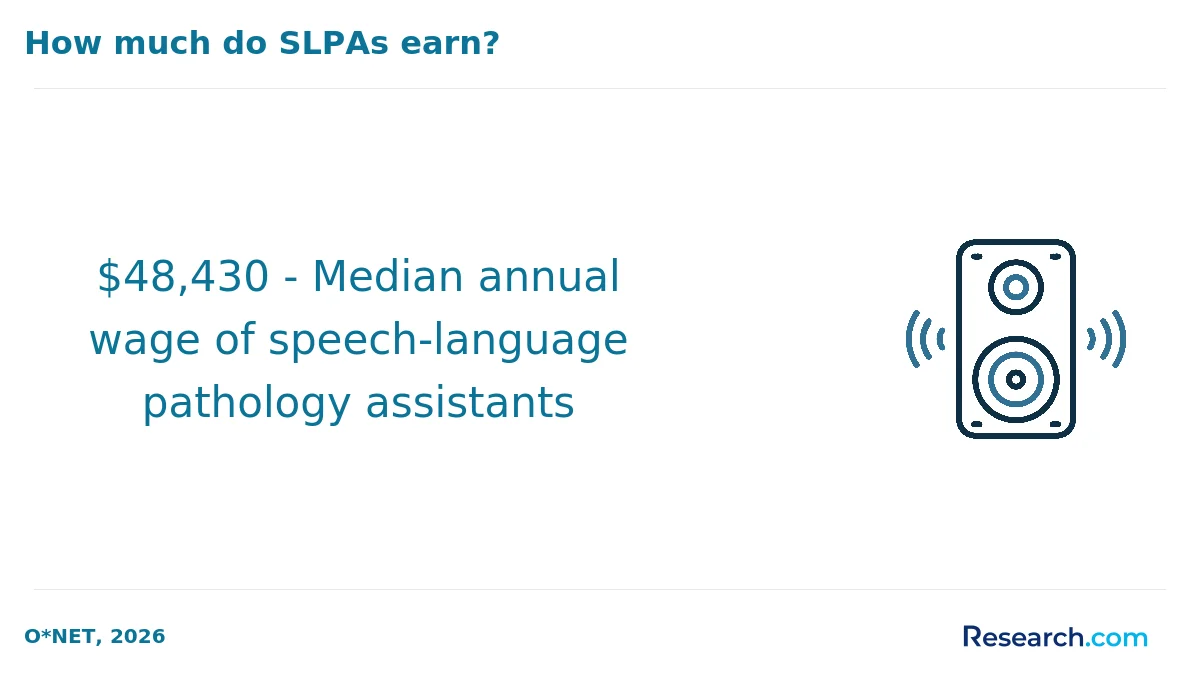
| Speech-language pathology assistant-focused bachelor's or certificate pathway | Transfer rules vary widely and may depend on state practice requirements | SLPA preparation, Speech-Language Pathology Assistant, or Communication Disorders support track | Students seeking support roles, especially in states that recognize SLPA pathways |
If your long-term goal is to become a licensed speech-language pathologist, prioritize programs that clearly map to graduate school prerequisites. A bachelor's degree in the field can strengthen preparation, but U.S. speech-language pathologists generally need a master's degree, supervised clinical experience, and state licensure. The BLS reported a 2026 median annual wage of $97,870 for speech-language pathologists, but that figure reflects the occupation overall and should not be treated as an outcome guaranteed by any undergraduate program.
A practical way to compare programs is to sort them by how they handle your actual transcript, not by advertised transfer generosity. Ask each school for the same three items: maximum transferable credits, credits that will apply to the major, and credits that must be completed in residence.
How Can You Tell Whether Transfer Credits Will Actually Apply Toward Your Speech Pathology Degree?
Before you rely on a transfer estimate, separate the evaluation into these decision points. This sequence helps prevent the common mistake of assuming that every accepted credit reduces graduation requirements.
- Confirm institutional accreditation at both the sending and receiving schools, because many universities restrict transfer from non-accredited or nationally accredited institutions.
- Check minimum grades, since many programs require at least a C for major, prerequisite, or transfer-equivalency credit.
- Ask whether each course transfers as an exact equivalent, a general subject-area credit, or a free elective.
- Identify which credits satisfy speech pathology prerequisites such as anatomy and physiology of speech, phonetics, language development, audiology, speech science, or hearing science.
- Request a degree audit showing remaining requirements, not just a total number of accepted credits.
- Get the audit in writing before depositing or registering, especially if your enrollment decision depends on finishing within a specific timeframe.
The table below explains the difference between credit labels you may see on a transfer evaluation. Understanding these labels can help you challenge errors and compare schools more accurately.
| Transfer evaluation label | What it usually means | Impact on your degree plan |
| Direct equivalent | Your previous course matches a course in the receiving school's catalog | Most useful because it may satisfy a specific requirement |
| General education credit | Your course meets a broad category such as writing, math, social science, or humanities | Useful if you still need general education requirements |
| Major elective | Your course is accepted within the discipline but does not replace a required course | Helpful only if the major allows elective space |
| Free elective | The university accepts the credit, but it does not match a specific requirement | May not shorten your path if your elective area is already full |
| Not transferable | The course does not meet the school's transfer rules | Does not reduce credit requirements or cost |
Red flags include vague promises such as "we accept up to 90 credits" without a course-by-course audit, refusal to identify remaining major requirements before enrollment, or an estimate that excludes residency and upper-division rules. A strong transfer-friendly program will show exactly how each prior course affects graduation.
What Types of Previous College Credits Can Transfer Into an Online Speech Pathology Degree?
Previous college credits that transfer into an online speech pathology degree usually come from regionally accredited colleges, community colleges, four-year universities, military training, standardized exams, dual-enrollment coursework, and occasionally prior-learning portfolios. Health and education fields often have especially detailed course-equivalency rules, similar to how transfer pathways are scrutinized in programs such as RN to BSN programs.
The most transferable courses are often general education classes and lower-division prerequisites. However, speech pathology majors may be more selective with courses tied directly to communication sciences because graduate schools and state boards may expect specific content coverage.
The table below shows common credit sources and how they may apply to an online speech pathology-related bachelor's degree.
| Credit source | How it may apply | What to verify |
| Community college coursework | Often applies to general education, electives, and some lower-division prerequisites | Whether two-year college credits are capped separately from total transfer credits |
| Four-year university coursework | May apply to general education, upper-division electives, or equivalent major courses | Whether upper-division speech or CSD courses match the receiving school's curriculum |
| Dual-enrollment credits | May count if transcripted by an accredited college | Whether the college transcript, not just the high school transcript, is required |
| AP, IB, or CLEP exams | May satisfy general education or elective requirements | Minimum scores and whether exam credits count toward transfer maximums |
| Military training | May apply as elective or subject-area credit after review | Whether the school uses ACE recommendations and how those credits fit the degree |
| Prior-learning assessment | May provide elective or professional-experience credit at some institutions | Whether portfolio credits can count toward residency, major, or only electives |
For students planning graduate study in speech-language pathology, course content matters as much as credit totals. A course titled "Child Development" may transfer as a social science elective at one school but satisfy a language-development prerequisite at another. Send syllabi when asked; they can make the difference between elective credit and a direct requirement match.
How Do Residency and Upper-Division Requirements Affect Speech Pathology Transfer Students?
Residency requirements determine how many credits you must complete through the school that awards your degree. Upper-division requirements determine how many advanced junior- or senior-level credits you need, often within the major. These two rules can limit the practical value of transferring 75 or 90 credits into an online speech pathology program.
For example, a university may accept up to 90 transfer credits toward a 120-credit bachelor's degree but still require the final 30 credits to be completed in residence. Another may require 30 to 45 upper-division credits, with a set sequence of speech and hearing science courses. In both cases, the school can accept many credits while still requiring you to complete a substantial amount of coursework after transfer.
The comparison below shows why a high transfer maximum should be evaluated alongside residency and upper-division rules.
| Policy factor | Why it matters | Question to ask |
| Institutional residency | Sets the minimum number of credits you must take from the graduating institution | How many credits must I complete at your university after transfer? |
| Major residency | May require a certain number of speech pathology or CSD courses at the school | How many major courses must be completed through your department? |
| Upper-division requirement | Prevents a degree from being completed entirely with lower-division transfer credits | How many 300- or 400-level credits will I still need? |
| Final-credit rule | Some schools require the last 30 credits to be taken in residence | Can I transfer additional credits after enrollment, or must my final credits be taken here? |
| Major sequence | Some speech courses must be taken in a specific order | Which required courses are prerequisites for later courses? |
This is why the "best" transfer option is not always the school with the highest transfer cap. Students in healthcare degree-completion fields face a similar issue when comparing clinical or advanced-practice pathways, such as an MSN to DNP program, where previously earned credits help only when they align with program-level requirements.
A good rule of thumb is to compare programs by remaining required credits, not by maximum accepted credits. If one school accepts 90 credits but leaves 42 required credits because of major sequencing, while another accepts 75 and leaves 36, the second option may be faster and cheaper.
How Does the Transfer Credit Evaluation Process Work for an Online Speech Pathology Degree?
The transfer credit evaluation process starts with admission materials but should end with a degree-specific plan. Many students receive a preliminary estimate first and an official evaluation later. Do not treat the preliminary estimate as final unless the school clearly states that it is binding.
Use the following process to get an evaluation that is detailed enough for a real enrollment decision. The goal is to move from "how many credits transfer?" to "what exactly must I still complete?"
- Collect official transcripts from every college attended, including dual-enrollment institutions and schools where you withdrew or earned only a few credits.
- Request exam-score reports or military transcripts if you want AP, CLEP, DSST, IB, Joint Services Transcript, or Community College of the Air Force credits reviewed.
- Apply or request a pre-admission review if the school offers one, but ask whether the review is unofficial or official.
- Submit syllabi for speech, hearing, linguistics, anatomy, physiology, psychology, or statistics courses that may satisfy specific prerequisites.
- Ask for a written degree audit that lists completed requirements, unmet requirements, remaining credits, and projected course sequence.
- Confirm whether transfer credits affect financial aid pace, satisfactory academic progress, scholarship eligibility, or flat-rate tuition assumptions.
- Compare at least two schools using the same transcript and the same remaining-degree questions.
Common mistakes include enrolling before the official audit is complete, assuming an associate degree automatically waives all lower-division requirements, overlooking elective caps, and failing to ask whether courses can be reclassified after syllabus review. If an advisor says a course "should transfer," ask whether it will satisfy a named requirement in the speech pathology degree plan.
Transfer evaluations also matter for students exploring adjacent healthcare routes. For instance, students comparing communication disorders with practical nursing pathways such as MA to LPN bridge programs online should expect different rules for clinical coursework, prior training, and state approval.
How Long Does It Take to Finish an Online Speech Pathology Degree With 60, 75, or 90 Transfer Credits?
Completion time depends on remaining credits, course availability, prerequisites, term length, and whether you study full time or part time. In a simple 120-credit bachelor's structure, 60 accepted and applied credits leave about half the degree, while 90 accepted and applied credits leave about one academic year. In practice, speech pathology students may need extra terms if required courses are sequenced or offered only once per year.
The table below gives a realistic planning estimate for students whose transfer credits apply cleanly. Use it to start the conversation with advisors, then adjust based on your degree audit.
| Applied transfer credits | Approximate credits remaining | Possible full-time timeline | Possible part-time timeline | Planning caveat |
| 60 credits | 60 credits | About 4 semesters at 15 credits per semester | About 7 to 10 terms at 6 to 9 credits per term | Likely includes most upper-division major courses |
| 75 credits | 45 credits | About 3 semesters at 15 credits per semester | About 5 to 8 terms at 6 to 9 credits per term | May still require a structured sequence of CSD courses |
| 90 credits | 30 credits | About 2 semesters at 15 credits per semester | About 4 to 5 terms at 6 to 9 credits per term | Residency or major rules may set the true minimum |
Online enrollment can help working adults stay enrolled, but asynchronous courses do not always mean self-paced graduation. Speech pathology-related programs may require courses such as phonetics, audiology, language development, speech science, or clinical observation preparation in a specific order. If you need to graduate quickly, ask for a term-by-term plan showing when each remaining course is offered.
Students planning for graduate school should also consider application timing. Finishing a bachelor's degree one term earlier may not shorten the path if graduate applications are annual, prerequisite grades are pending, or observation requirements are incomplete. A slightly longer undergraduate plan that protects GPA and prerequisite completion can be the better decision.
How Much Can Transfer Credits Reduce the Cost of an Online Speech Pathology Degree?
Transfer credits can reduce the cost of an online speech pathology degree because most online programs charge tuition by the credit. The basic calculation is straightforward: every requirement you do not have to retake can reduce tuition, fees tied to enrollment load, textbook costs, and time away from full-time work. However, savings depend on applied credits, not merely accepted credits.
To estimate the cost impact, multiply remaining billable credits by the school's tuition rate and mandatory fees. The examples below use a simple illustrative tuition rate of $400 per credit so you can see how the math works; replace it with each school's actual rate before making a decision.
| Applied transfer credits | Credits billed if degree requires 120 total credits | Illustrative tuition at $400 per credit | What to compare |
| 60 credits | 60 remaining credits | $24,000 | Whether a lower tuition rate offsets a longer remaining path |
| 75 credits | 45 remaining credits | $18,000 | Whether extra accepted credits reduce major requirements or only electives |
| 90 credits | 30 remaining credits | $12,000 | Whether residency rules prevent the bill from dropping below 30 credits |
Published national tuition data can help you understand why credit loss matters. The National Center for Education Statistics' 2024 Digest reported that average undergraduate tuition and required fees vary sharply by sector, with public four-year institutions generally far below private nonprofit institutions. For transfer students, this means the same 15-credit difference can have a very different financial effect depending on whether the program charges a lower public online rate, a higher private rate, or additional distance-learning fees.
When comparing offers, look beyond tuition per credit. Ask whether the school charges online course fees, transcript evaluation fees, proctoring fees, technology fees, graduation fees, or differential tuition for upper-division courses. Also check whether scholarships require full-time enrollment, because a part-time adult learner may not receive the aid advertised on a general tuition page.
Use this short checklist before choosing the lowest advertised price. It helps you compare total degree cost instead of only the sticker tuition.
- Ask for the number of remaining billable credits after the official transfer evaluation.
- Multiply remaining credits by tuition per credit and add mandatory fees.
- Check whether any accepted credits do not reduce the degree because they fall into unused electives.
- Compare the cost of retaking prerequisites against the benefit of meeting graduate school admission requirements.
- Confirm financial aid eligibility if you will enroll less than full time or finish in fewer than two semesters.
Students comparing speech pathology with other health-related online degrees, such as the best online registered dietitian programs, should remember that transfer generosity is only one part of cost. Accreditation, supervised practice requirements, graduate prerequisites, and licensure pathways can all affect total investment.
Can Prior Learning, Military Training, Exams, or Certifications Count Toward an Online Speech Pathology Degree?
Some online speech pathology-related bachelor's programs award credit for prior learning, military training, standardized exams, or professional certifications. These options can be helpful for adult learners, but they usually apply more easily to general education or elective requirements than to core speech pathology major courses.
Prior-learning policies are expanding across many adult-focused degree programs, but each institution sets its own limits. Students should ask whether alternative credits count toward the overall transfer maximum, institutional residency, major residency, or only free electives.
The list below shows common nontraditional credit options and how to approach them. The purpose is to identify possible savings without assuming these credits will replace specialized CSD coursework.
- AP, IB, CLEP, and DSST exams: These may satisfy general education requirements such as writing, social science, math, or humanities if your scores meet the school's cutoffs.
- Military training: Schools may evaluate Joint Services Transcript or Community College of the Air Force coursework using ACE recommendations, but credits often apply as electives unless they match a requirement.
- Professional certifications: Certifications in healthcare, education, interpreting, or human services may be reviewed, but they rarely replace speech science, phonetics, audiology, or language-development courses without departmental approval.
- Portfolio-based prior learning: Some universities let adult learners document college-level learning from work experience, though portfolio credits may be capped and may not count toward the major.
- Workplace or continuing education training: Noncredit training may need ACE, NCCRS, or institutional review before it can be considered for academic credit.
Alternative credit is most useful when it fills remaining electives or general education categories. It is less useful if your audit shows that every remaining course is a required upper-division speech pathology class. Ask the department, not only admissions, whether nontraditional credits can satisfy any major-specific requirements.
This distinction is common across healthcare education. In advanced professional pathways, including an MSN to DNP program, schools may recognize prior graduate work but still require program-specific outcomes, residency, or capstone requirements. Speech pathology transfer students should expect a similar emphasis on required competencies.
Do Older College Credits Expire When Transferring Into an Online Speech Pathology Degree?
Older college credits do not automatically expire, but they may be reviewed differently depending on the subject. Many schools accept older general education credits if they were earned at an accredited institution with acceptable grades. Courses tied to current professional knowledge, technology, science, or clinical preparation may face stricter review.
In speech pathology-related programs, older credits most often raise questions when they involve anatomy and physiology, hearing science, statistics, psychology, child development, or major communication-disorders content. A school may accept the credits as electives but decline to use them for current prerequisites if the content no longer matches the catalog.
The table below shows how schools commonly treat older credits. Policies vary, so use this as a guide for questions to ask rather than a universal rule.
| Older credit type | How it is commonly treated | Best next step |
| English composition, humanities, history, or general social science | Often transferable if accredited and graded acceptably | Confirm whether the course satisfies a general education category |
| Statistics or research methods | May transfer, but some programs prefer recent coursework for graduate preparation | Ask whether recency affects graduate prerequisites or major requirements |
| Anatomy, physiology, speech science, or hearing science | May require syllabus review because content alignment matters | Submit syllabi and ask for a direct-equivalency decision |
| Technology-heavy or clinical support courses | May be considered outdated more quickly | Ask whether retaking the course is recommended or required |
| Developmental or remedial coursework | Usually does not count toward bachelor's degree credit | Do not include it in your expected transferable-credit total |
If your credits are 10 or more years old, do not assume they are unusable. Instead, gather syllabi, catalog descriptions, and transcripts. A department may approve older coursework if the learning outcomes still match, especially for foundational subjects. Conversely, even recent credits may fail to apply if they do not align with the degree plan.
The safest strategy is to ask two separate questions: "Will the credit transfer?" and "Will it satisfy this specific requirement?" That second question is the one that determines whether older credits shorten your path, reduce tuition, or simply appear on your transcript as elective credit.
Other Things You Should Know About Speech Pathology
Sometimes, but graduate transfer rules are usually much stricter than bachelor's transfer rules. Many speech-language pathology master's programs limit transfer credits, require recent graduate-level coursework, and require approval from the academic department. Always ask the graduate program directly.
No, not by itself. In the U.S., speech-language pathologists generally need a qualifying master's degree, supervised clinical experience, and state licensure. An online bachelor's degree can prepare you for graduate admission or related support roles, depending on the program and state rules.
Not always. Some schools accept 60 individual credits without a completed associate degree, while others give smoother general education credit to students who completed an approved transfer associate degree. The completed credential can help, but the course-by-course fit still matters.
Not automatically. Choose the program that leaves you with the fewest useful remaining requirements at a reasonable cost and pace. A school accepting 90 credits may still require more major coursework than a school accepting 75 credits if your prior classes do not match the speech pathology curriculum.
References
- U.S. Bureau of Labor Statistics - Speech-Language Pathologists https://www.bls.gov/ooh/healthcare/speech-language-pathologists.htm
- ASHA EdFind - Accredited Speech-Language Pathology Programs https://find.asha.org/ed/
- ETS Praxis - Speech-Language Pathology (5331) https://praxis.ets.org/test/speech-language-pathology-5331.html
- California State University-San Marcos - Online MS in Speech-Language Pathology https://www.csusm.edu/slp/programs/mastersonline/index.html
- Idaho State University - Master of Science in Speech-Language Pathology (Online/Distance Education) https://www.isu.edu/slp/programs-offered/slp-graduate-program/
- Pennsylvania Western University - Master of Science in Speech-Language Pathology https://online.pennwest.edu/programs/speech-language-pathology-grad/index.php
- Nova Southeastern University - SLP Program - Master of Science in Speech-Language Pathology https://osteopathic.nova.edu/degrees/masters/speech-language-pathology/index.html
- University of Nebraska at Kearney - Speech-Language Pathology, Master of Science in Education (Online Track) https://www.unk.edu/online/degrees-programs/speech-language-pathology-online.php