2027 Accredited Online Speech Pathology Degree Programs That Accept the Most Transfer Credits

Co-Founder and Chief Data Scientist

Reviewed by Rhea Paul, PhD
SLP Education & Research Expert
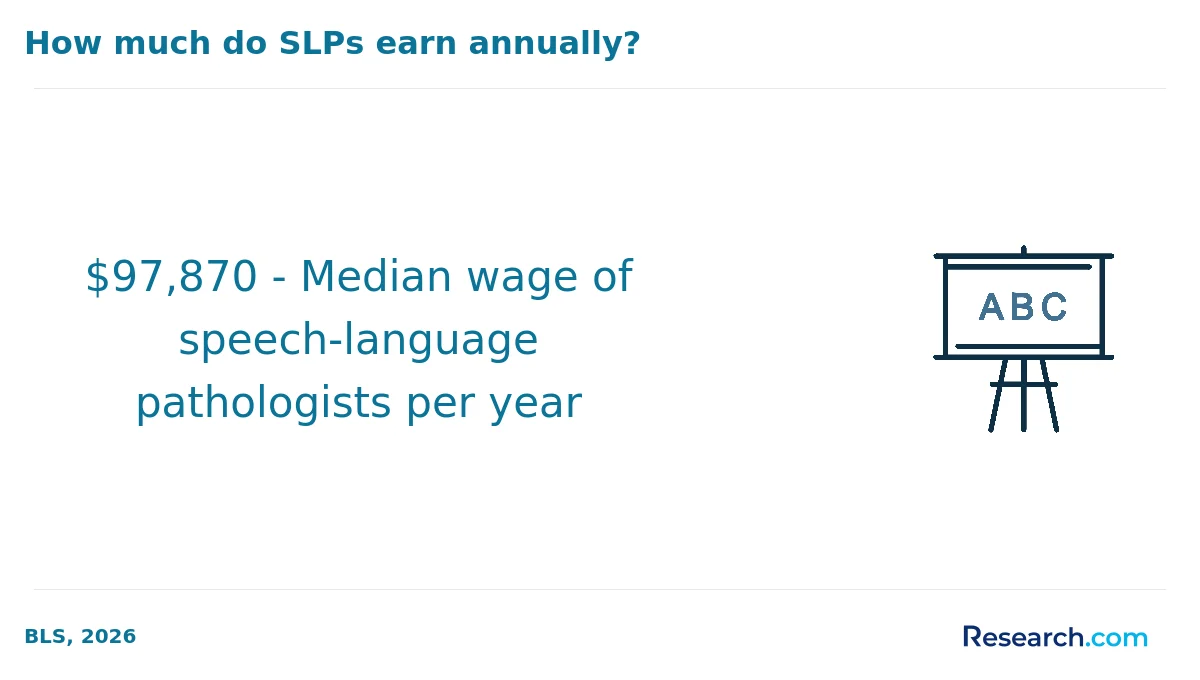
Choosing an online speech pathology degree can be challenging for individuals with existing college credits, as it's essential to know which programs will accept and utilize them effectively. Transfer policy is crucial because the Bureau of Labor Statistics reports a median annual wage of $97,870 for speech-language pathologists in May 2026, with entry into the profession requiring a graduate degree and licensure.
This guide is designed for transfer students, associate-degree holders, career changers, and returning adults who aim to compare accredited online options, estimate remaining credits, avoid unnecessary coursework, and select a program that can minimize both time and tuition costs.
Key Things You Should Know
- For online bachelor's programs in communication sciences and disorders, speech and hearing science, or speech-language pathology preparation, the most transfer-friendly schools commonly allow up to about 90 credits toward a 120-credit degree, but actual usable credits depend on equivalency, grades, residency rules, and major requirements.
- Transfer credits are most valuable when they satisfy general education, prerequisite science, statistics, psychology, linguistics, or major-prep requirements; elective-only credit may increase your transcript total without meaningfully shortening the degree.
- CAA accreditation generally applies to entry-level master's programs in speech-language pathology, not most bachelor's programs, so students should verify institutional accreditation for the online bachelor's and plan ahead for a CAA-accredited master's if they want SLP licensure.
Which Accredited Online Speech Pathology Degree Programs Accept the Most Transfer Credits?
The accredited online programs that tend to accept the most transfer credits are usually bachelor's completion or transfer-friendly bachelor's programs in communication sciences and disorders, communicative disorders, or speech and hearing science. These degrees are commonly used as preparation for graduate study in speech-language pathology, audiology, deaf education, or related health and education fields.
Because official transfer awards are student-specific, the best comparison is not simply the advertised maximum. A program that allows 90 transfer credits may still require you to complete 45 or more credits if your previous courses do not match its major sequence.
The table below summarizes online options students often compare when looking for high-transfer speech pathology pathways; always confirm the current catalog, state authorization, tuition, and transfer evaluation with the institution before enrolling.
| Online program to compare | Degree area | Transfer-credit potential to verify | Best fit | Important limitation |
| University of Cincinnati Online | BS in Communication Sciences and Disorders | Often suitable for students seeking a high-transfer bachelor's pathway, subject to university residency and course-equivalency rules | Students with general education credits or an associate degree who want a structured path toward SLP graduate prerequisites | Major coursework may still need to be completed in sequence |
| Eastern New Mexico University | BS in Communicative Disorders | Transfer-friendly public university pathway; students should verify maximum accepted credits and upper-division residency requirements | Cost-conscious transfer students comparing online public-university options | Accepted credits may not all apply directly to the major |
| Western Kentucky University | BS in Communication Disorders | May be favorable for students with prior college coursework; final transfer depends on WKU equivalencies and degree requirements | Students who need an online undergraduate route into communication disorders coursework | Program sequencing can affect completion speed even with many credits |
| Utah State University | Online communicative disorders and deaf education-related bachelor's options | Transfer students should verify campus residency, major prerequisites, and whether prior coursework meets departmental requirements | Students interested in speech-language, hearing, and deaf education foundations | Some professional goals may require additional graduate study |
| Northern Arizona University | BS in Communication Sciences and Disorders | Potentially transfer-friendly for students bringing completed lower-division coursework, subject to institutional transfer policies | Arizona and out-of-state students seeking an online CSD bachelor's option | State authorization and clinical-career planning should be checked early |
| Arizona State University Online | BS in Speech and Hearing Science | Transfer applicability depends on ASU's credit limits, major map, and accepted course equivalencies | Students who want a large online university with speech and hearing coursework | Community college and four-year transfer caps may differ |
| Idaho State University | Communication sciences and disorders-related online options | Students should confirm the latest online availability, transfer ceiling, and departmental requirements | Students comparing public-university speech and hearing science pathways | Not every accepted course may replace a required major course |
The practical takeaway is that several accredited institutions may let transfer students bring in a large share of a 120-credit bachelor's degree, but the "most" transfer credits only matter if those credits reduce the exact courses left on your degree audit. If your goal is to become a licensed speech-language pathologist, prioritize a bachelor's route that keeps you eligible for graduate admission rather than one that simply maximizes elective transfer credit.
How Do Online Speech Pathology Degree Programs Evaluate Transfer Credits?
Online speech pathology-related programs evaluate transfer credits through an official transcript review, usually after admission or after you submit transcripts for a preliminary review. The evaluation checks whether each previous course came from an accredited institution, whether the grade meets the school's minimum, whether the course content matches a requirement, and whether the credit fits within residency and degree limits.
Most schools separate "accepted credit" from "applied credit." Accepted credit means the institution recognizes the course. Applied credit means the course counts toward a specific general education, prerequisite, major, or elective requirement. That distinction is critical because a student may transfer many credits and still have a long path if the credits do not satisfy speech-language pathology preparation requirements.
Before choosing a program, students should understand the main review categories used by registrars and departments. These categories explain why two schools can evaluate the same transcript differently.
- Institutional source: Credits from regionally or nationally accredited colleges are usually easier to review than credits from unaccredited providers or noncredit training.
- Course equivalency: A course is more likely to satisfy a requirement if the title, catalog description, credit hours, and learning outcomes closely match the receiving school's course.
- Grade minimum: Many programs require a minimum grade, often higher for major or prerequisite courses than for general electives.
- Course age: Some schools scrutinize older science, statistics, or clinical-preparation coursework, especially if content has changed substantially.
- Residency requirement: Even if many credits transfer, the school may require a minimum number of credits to be completed through that institution.
- Department approval: Speech, hearing, anatomy, language development, phonetics, and audiology-related courses may need faculty review before they replace major requirements.
A common mistake is assuming that an unofficial estimate from admissions is the same as a final degree audit. It is not. Students should ask for a written evaluation showing which credits apply to general education, major requirements, prerequisites, upper-division requirements, and free electives.
How Can Transfer Credits Shorten an Online Speech Pathology Degree?
Transfer credits can shorten an online speech pathology-related bachelor's degree by reducing the number of credits you must complete after enrollment. Since many bachelor's degrees require about 120 credits, a student entering with an associate degree or substantial prior coursework may be closer to graduation than a first-time student, especially if the program accepts credits toward general education and lower-division requirements.
The table below shows how transfer volume can affect a typical 120-credit bachelor's pathway. It is an estimate, not a promise, because speech and hearing science major courses may need to be taken in a set order.
| Transfer credits that apply to the degree | Approximate credits remaining in a 120-credit degree | Possible completion pattern | What to watch |
| 30 credits | 90 credits | About three academic years at full-time pace | Many general education and major courses may remain |
| 60 credits | 60 credits | About two academic years at full-time pace | Works best when associate-degree credits satisfy broad requirements |
| 75 credits | 45 credits | About 18 months to two years depending on course rotation | Major sequencing may prevent an accelerated finish |
| 90 credits | 30 credits | About one academic year if required courses are available | Residency rules and upper-division requirements may still apply |
Students comparing online formats should also look at pacing. Some programs use traditional semesters, while others offer shorter terms, asynchronous courses, or more flexible scheduling. If schedule control is your top concern, comparing self-paced online colleges can help you understand how pacing models differ, even though speech pathology major courses may still follow a fixed sequence.
The fastest route is usually the one where your credits line up with the degree plan, not necessarily the one with the highest transfer-credit ceiling. A student with 60 well-matched credits may finish sooner than a student with 85 credits that transfer mostly as electives.
How Much Can Transfer Credits Reduce the Cost of an Online Speech Pathology Degree?
Transfer credits can reduce the cost of an online speech pathology-related degree by lowering the number of credits you pay for at the new institution. This matters because tuition varies widely across public, private nonprofit, and private for-profit institutions, and online students may also pay technology, distance-learning, transcript, graduation, and proctoring fees.
One useful benchmark is the College Board's 2024-25 national pricing data, which reported average published tuition and fees of $11,610 for in-state students at public four-year institutions and $43,350 at private nonprofit four-year institutions. Those figures are not speech-pathology-specific, but they show why reducing credits can matter: the same transfer award can have a much larger dollar impact at a higher-tuition school.
The table below illustrates how transferred credits may reduce tuition exposure when a program charges by the credit. It uses simple per-credit examples so students can adapt the math to each school's actual tuition and fee schedule.
| Credits avoided through transfer | Savings at $350 per credit | Savings at $600 per credit | Savings at $900 per credit |
| 30 credits | $10,500 | $18,000 | $27,000 |
| 60 credits | $21,000 | $36,000 | $54,000 |
| 90 credits | $31,500 | $54,000 | $81,000 |
To estimate your own savings, multiply the number of credits that apply to the degree by the school's per-credit tuition, then subtract any added fees, residency-course costs, repeated courses, or prerequisite courses you still need. Do not count credits that transfer only as unused electives if they do not reduce the courses required for graduation.
A higher-priced program can still be the better financial choice if it accepts substantially more applicable credits, offers stronger advising, or keeps you on track for graduate admission. Conversely, a low tuition rate may not save money if the school rejects many of your previous courses or requires you to retake major prerequisites.
Can Military, Professional, or Prior Learning Credits Transfer to an Online Speech Pathology Degree?
Some online speech pathology-related degree programs consider military training, professional certifications, standardized exams, or prior learning assessment, but these credits are usually less predictable than traditional college coursework. Schools may use American Council on Education recommendations, departmental review, portfolio assessment, CLEP, DSST, Advanced Placement, International Baccalaureate, or institutional challenge exams.
These credits can be helpful for general education or elective requirements, but they are less likely to replace specialized speech-language pathology preparation courses such as phonetics, speech science, language development, audiology, anatomy and physiology of speech mechanisms, or clinical observation requirements. Programs want to confirm that students have the academic foundation needed for graduate-level work.
Students with health care experience should be especially careful. Work as a medical assistant, nursing assistant, paraprofessional, behavioral technician, or school aide may strengthen your application story, but it may not automatically convert into CSD major credit. If you are comparing allied-health bridge options more broadly, resources on MA to LPN bridge programs online can show how credit-for-experience rules differ in more clinically structured pathways.
Before relying on nontraditional credit, ask the school these questions and request the answers in writing. This reduces the risk of enrolling based on credits that later fail to apply to the degree.
- Does the program accept ACE-reviewed military or workforce training, and does it apply to required categories or only electives?
- Is there a maximum number of credits allowed from CLEP, DSST, AP, IB, portfolio assessment, or professional training?
- Can prior learning credit satisfy general education requirements, upper-division requirements, or major requirements?
- Will graduate programs in speech-language pathology view those credits as acceptable prerequisites?
- Are there fees for portfolio review, challenge exams, transcript evaluation, or credit transcription?
Which Types of Previous College Credits Transfer Best to Online Speech Pathology Degrees?
The credits that transfer best to online speech pathology-related degrees are usually lower-division general education courses, standard introductory sciences, statistics, psychology, linguistics, and communication-related courses from accredited colleges. These courses are easier to match because many institutions offer comparable versions.
Major-specific courses can also transfer, but they often require a closer faculty review. A course titled "Introduction to Communication Disorders" may transfer easily at one school and count only as an elective at another if the receiving program's version includes different content, credit hours, or prerequisites.
The table below explains which prior credits tend to be most useful for students pursuing speech-language pathology preparation online.
| Previous credit type | Transfer strength | Where it usually applies | Student action |
| English composition, humanities, social sciences, college math | Strong | General education | Check whether the school accepts a completed general education block or associate degree |
| Statistics, biology, physics or chemistry, psychology | Strong to moderate | General education, graduate-school prerequisites, or supporting requirements | Confirm whether the course meets SLP graduate prerequisite expectations |
| Phonetics, language development, speech science, audiology | Moderate | Major requirements if content matches | Submit syllabi and catalog descriptions for department review |
| Education, child development, special education | Moderate | Electives, supporting requirements, or related prerequisites | Ask whether these credits help with school-based career goals |
| Old vocational, remedial, or noncredit courses | Weak | Usually not applicable or elective only | Do not assume these courses reduce graduation requirements |
One red flag is a program that advertises a generous credit limit but does not clearly show how transfer courses apply to the major. A useful evaluation should identify remaining courses, not just total credits accepted.
How Do Transfer Agreements Affect Online Speech Pathology Degree Completion?
Transfer agreements can make online speech pathology degree completion more predictable by mapping courses from one institution to another in advance. These agreements may include articulation agreements, statewide transfer pathways, associate-to-bachelor's agreements, general education transfer blocks, or community college partnerships.
For students with an associate degree, an agreement can reduce uncertainty because it may guarantee that a completed block of courses satisfies lower-division or general education requirements. However, it may not guarantee admission to a competitive major, graduate school, or licensure-track program. Speech-language pathology preparation still depends on whether the degree includes the prerequisites expected by graduate programs.
Health professions often use transfer pathways differently. For example, students researching RN to BSN programs will see that bridge degrees commonly build on a specific license and prior clinical education. Speech pathology bachelor's programs are different: they usually prepare students for graduate admission rather than convert an existing license into a higher credential.
When evaluating a transfer agreement, focus on the degree audit impact. The agreement is most valuable if it reduces remaining required credits, prevents course duplication, and keeps you eligible for the next step, such as a CAA-accredited master's program.
What Transfer Policies Should Students Compare Before Choosing an Online Speech Pathology Degree?
Students should compare transfer policies before applying because each school defines "maximum transfer credits" differently. Some cap credits from two-year colleges separately from four-year institutions. Others limit transfer into the major, require a minimum number of upper-division credits, or exclude courses below a certain grade.
The most important policies are the ones that change your remaining time and cost. A transfer-friendly program should provide a clear path from your existing transcript to graduation, not just a large theoretical credit maximum.
Use this checklist before committing to a program. It will help you separate strong transfer value from marketing language.
- Request an official or formal preliminary transfer evaluation before enrollment, not just a verbal estimate.
- Ask how many credits are accepted and how many apply directly to degree requirements.
- Confirm the minimum grade required for general education, prerequisite, and major courses.
- Check whether there is a course-age limit for science, statistics, speech, hearing, or clinical-preparation coursework.
- Review the minimum residency requirement and the minimum number of credits that must be completed through the school.
- Ask whether upper-division major courses must be taken at the institution even if similar courses appear on your transcript.
- Confirm whether online students pay different tuition, fees, or out-of-state rates.
- Ask whether the bachelor's curriculum aligns with common prerequisites for CAA-accredited master's programs in speech-language pathology.
- Verify institutional accreditation and, for future graduate study, understand that CAA accreditation applies to qualifying master's programs rather than most bachelor's programs.
- Compare the final remaining-credit total across schools, not the advertised transfer maximum.
A stricter transfer policy is not always a bad sign. If a program protects academic sequencing, provides strong preparation for graduate admission, and prevents gaps in prerequisite knowledge, retaking a small number of courses may be worth the added cost.
Which Students Benefit Most From Transfer-Friendly Online Speech Pathology Degree Programs?
Transfer-friendly online speech pathology-related programs are especially useful for students who have already completed general education courses, earned an associate degree, stopped out of college with significant credits, or want to change careers without starting over. They can also help working adults who need online flexibility while preparing for graduate study.
These programs may be a strong fit for students in the following situations. The key is that previous coursework must apply to the new degree plan.
- Associate-degree holders: Students with an AA or AS degree may be able to satisfy many lower-division requirements, especially if the receiving school honors a general education block.
- Former education or psychology majors: Coursework in child development, learning, language, behavior, and statistics may support speech-language pathology preparation.
- Health care workers changing fields: Prior anatomy, biology, psychology, or communication coursework may help, though clinical job experience may not become major credit.
- Students returning after stopping out: A transfer-friendly online program can convert usable prior credits into a clearer path to degree completion.
- Career changers planning for graduate school: A second bachelor's or post-baccalaureate pathway may help fill CSD prerequisites, depending on prior education.
Students should avoid choosing a program primarily for its transfer maximum if they need a highly specific graduate-school prerequisite sequence, state licensure preparation, or close faculty mentoring. In related health fields, students comparing pathways such as the best online registered dietitian programs will see a similar pattern: accreditation, supervised practice, and professional eligibility can matter more than raw transfer totals.
The students who benefit most are those who obtain multiple evaluations, compare remaining courses, and choose the program that gives them the shortest credible path to their actual goal.
How Should Students Choose an Online Speech Pathology Degree Based on Transfer Efficiency?
Choosing an online speech pathology degree based on transfer efficiency means looking beyond the highest advertised credit limit. The best program is the one that accepts the most useful credits, leaves the fewest required courses, fits your schedule, stays affordable, and supports your next step into graduate education or a related career.
Use a simple decision process before applying or enrolling. This helps you compare programs based on real completion value rather than assumptions.
- Clarify your end goal: licensed speech-language pathologist, audiologist, speech-language pathology assistant where available, graduate-school applicant, or related education or health role.
- List every prior institution attended and order official transcripts early, including community college, four-year college, military, AP, CLEP, or prior learning records.
- Identify programs with institutional accreditation and online delivery that fits your state, schedule, and career plan.
- Request transfer evaluations from at least two or three schools so you can compare remaining credits, not just accepted credits.
- Ask each school for a remaining-course plan by term, including major sequencing and course availability.
- Calculate total estimated tuition and fees based on credits left after transfer, then compare that figure with financial aid eligibility.
- Verify whether the bachelor's curriculum supports admission to CAA-accredited master's programs if your goal is SLP licensure.
- Choose the program with the strongest combination of applicable transfer credit, academic preparation, advising, affordability, and completion timeline.
Transfer efficiency is also relevant for students considering future graduate pathways. In nursing, for instance, an MSN to DNP program may evaluate prior graduate coursework differently from undergraduate transfer credits. Speech pathology students should apply the same logic: each level of education has its own transfer rules, accreditation expectations, and professional outcomes.
The smartest choice is rarely the school with the biggest number on its transfer page. It is the school that turns your existing transcript into the lowest-risk path toward graduation and the next credential you actually need.
Other Things You Should Know About Speech Pathology
Not always. Many master's programs accept students from other majors, but they often require prerequisite coursework in communication sciences and disorders, speech and hearing science, statistics, biological science, physical science, and social science. A transfer-friendly bachelor's can help if it fills those prerequisites efficiently.
They can be, if the institution is properly accredited and the coursework meets the graduate program's prerequisite expectations. Graduate admissions committees typically focus on academic preparation, grades, prerequisite completion, recommendations, and fit, not only whether courses were online.
In most cases, no. Licensed speech-language pathologists generally need a graduate degree, supervised clinical experience, and state licensure. A bachelor's degree is usually a preparation step, not the final credential for independent SLP practice.
You may need to apply before receiving an official evaluation, but you should not enroll or commit financially until you understand how your credits apply to the degree. Ask for a written degree plan showing remaining requirements, estimated timeline, and total cost.
References
- U.S. Bureau of Labor Statistics - Speech-Language Pathologists https://www.bls.gov/ooh/healthcare/speech-language-pathologists.htm
- ASHA EdFind - Accredited Speech-Language Pathology Programs https://find.asha.org/ed/
- O*NET OnLine - Speech-Language Pathologists https://www.onetonline.org/link/summary/29-1127.00
- Delaware Valley University - Master of Science in Speech-Language Pathology (M.S.) https://delval.edu/programs/graduate-programs/speech-language-pathology
- New York University - Online MS, Communicative Sciences and Disorders (Speech@NYU) https://steinhardt.nyu.edu/degree/online-ms-communicative-sciences-and-disorders
- University of Scranton - Master of Science (M.S.) in Speech-Language Pathology https://www.scranton.edu/academics/pcps/health-and-human-performance/programs/speech-language-pathology/index.shtml
- Maryville University - Master of Science in Speech-Language Pathology https://www.maryville.edu/masters/speech-language-pathology/
- New England Institute of Technology - Master of Science in Speech Language Pathology https://www.neit.edu/academics/graduate-degrees/speech-language-pathology-ms