2027 Best Online Artificial Intelligence Degree Programs

Co-Founder and Chief Data Scientist
Choosing an online artificial intelligence degree is not just a question of finding a recognizable university name. You need to know whether the program teaches the right technical skills, fits your schedule, is properly accredited, offers enough project-based learning, and can realistically support your career goals. This guide is written for prospective students comparing online AI degree options for 2027, including working professionals, career changers, and students planning for roles in machine learning, data science, robotics, AI research, or applied AI development.
Below, you will find a practical breakdown of what online AI programs usually include, how long they take, what they may cost, which admissions requirements to expect, how online study compares with campus learning, and how to evaluate career outcomes without relying only on rankings or marketing claims.
Quick Answer: Is an Online Artificial Intelligence Degree Worth Considering?
An online artificial intelligence degree can be a strong option if you already have or are willing to build a solid foundation in programming, mathematics, statistics, and computer science. Online AI programs can prepare graduates for roles such as AI engineer, machine learning specialist, data scientist, robotics engineer, data engineer, and AI research scientist. Reported salaries in the field are high, with a median salary for professionals with an AI degree of approximately $145,080 per year, although actual earnings depend heavily on role, experience, employer, location, and technical portfolio.
What are the main benefits of earning an online artificial intelligence degree?
- Career flexibility: Graduates may pursue AI-related jobs in technology, healthcare, finance, manufacturing, government, education, and research organizations.
- Strong earning potential: AI analysts make an average of $100,058 annually, data engineers earn around $129,716 per year, AI research scientists have an average salary of $130,117, and lead data scientists can earn about $165,018 per year.
- Study options for working adults: Online formats make it easier to continue working, manage family responsibilities, or study without relocating to a campus.
- Access to technical specialization: Many programs allow students to focus on machine learning, robotics, natural language processing, computer vision, AI ethics, or applied AI systems.
What can I expect from an online artificial intelligence degree program?
An online AI degree usually blends computer science, applied mathematics, statistics, programming, data analysis, and ethical decision-making. Students typically learn how intelligent systems are designed, trained, evaluated, deployed, and monitored. The technical core often includes machine learning, neural networks, deep learning, natural language processing, algorithms, data structures, and model evaluation.
Good programs do more than assign readings and exams. They require students to build models, analyze datasets, complete coding projects, test systems, document results, and explain trade-offs. Some programs also include internships, capstone projects, research components, or industry-sponsored assignments. These experiences matter because employers often want evidence that graduates can apply AI concepts to messy, real-world problems rather than only discuss theory.
Where can I work with an online artificial intelligence degree?
AI graduates can work for large technology companies, startups, consulting firms, healthcare organizations, banks, insurers, retailers, manufacturers, logistics companies, government agencies, universities, laboratories, and nonprofit organizations. Employers use AI for tasks such as fraud detection, predictive analytics, medical imaging support, customer personalization, autonomous systems, natural language tools, robotics, risk modeling, and operations optimization.
Some graduates move into research-focused roles, especially if they complete a graduate-level program with advanced mathematics and a strong project portfolio. Others work in applied roles where the main task is to design, implement, evaluate, and maintain AI-enabled systems inside business or public-sector environments.
How much can I make with an online artificial intelligence degree?
Compensation varies by job title, region, industry, prior experience, and technical specialization. AI analysts make an average of $100,058 annually, while data engineers earn around $129,716 per year. AI research scientists have an average salary of $130,117, and lead data scientists can earn about $165,018 per year.
High-paying roles are often concentrated in competitive markets and may require strong evidence of skill, such as production-level coding experience, cloud deployment knowledge, published research, advanced mathematics, or a portfolio of completed machine learning projects. Students should treat salary figures as directional information, not guaranteed outcomes.
| Role | Reported Average Salary | Typical Focus |
| AI Analyst | $100,058 annually | Uses AI tools and data analysis to support business or operational decisions. |
| Data Engineer | $129,716 per year | Builds and maintains data pipelines that support analytics and AI systems. |
| AI Research Scientist | $130,117 | Develops or studies advanced AI models, algorithms, and methods. |
| Lead Data Scientist | $165,018 per year | Guides modeling strategy, data science teams, and applied AI projects. |
- Best online artificial intelligence degree programs for 2027
- How long does an online artificial intelligence degree take?
- Online AI degree vs. on-campus AI program
- Average cost of an online artificial intelligence degree
- Financial aid options for online AI students
- Admissions requirements and prerequisites
- Common courses in online AI degree programs
- AI degree specializations to compare
- How to choose the best online AI program
- Career paths after an online AI degree
- Should software development training complement AI study?
- Which accreditation standards matter?
- What career services should online AI programs provide?
- How can certifications strengthen an AI career?
- Common challenges in online AI programs
- How to think about ROI for an online AI degree
- Job market outlook for AI graduates
- How AI study can connect with biotechnology
- How online AI curricula stay current
- Can an online AI degree lead to high-paying tech roles?
- Why industry and academic partnerships matter
- How AI programs develop soft skills
- How online AI programs support lifelong learning
- Ethical issues in artificial intelligence careers
- How AI supports health informatics work
- AI and cyber security intersections
- Emerging AI trends affecting online programs
- Why data science strengthens AI training
- AI and interdisciplinary bioinformatics careers
- Digital learning tools used in online AI programs
- How accelerated online programs shorten the path to an AI degree
List of the Best Online Artificial Intelligence Degree Programs for 2027
How do we rank schools?
Because an AI degree can require a major investment of time and money, students should understand how any ranking is built before using it to make a decision. Research.com’s ranking methodology is designed to organize program information using transparent, data-informed criteria. For this list, the Research.com team reviewed information from the following sources:
- IPEDS database;
- Peterson’s database, including the Distance Learning Licensed Data Set;
- College Scorecard database; and
- National Center for Education Statistics.
Use the following list as a starting point, not as the only factor in your decision. Before applying, confirm the credential type, tuition, curriculum, accreditation, transfer policies, and online delivery format directly with the institution.
1. Stanford University
Stanford offers online AI learning options associated with a university known for major contributions to computer science, machine learning, robotics, and human-centered technology. Students interested in interdisciplinary AI may find value in the program’s emphasis on technical depth, research exposure, and responsible AI decision-making.
- Program Length: Two to four years
- Tracks/Concentrations: Machine Learning, Robotics, AI Ethics
- Cost per Credit: $1,500
- Required Credits to Graduate: 36 credits
- Accreditation: WASC Senior College and University Commission (WSCUC)
2. Massachusetts Institute of Technology (MIT)
MIT is closely associated with AI innovation, engineering, and applied research. Its online AI-related offering can appeal to students who want exposure to machine learning concepts, advanced technical instruction, and applied AI topics such as healthcare use cases and real-world problem solving.
- Program Length: Two years
- Tracks/Concentrations: Deep Learning, AI in Healthcare
- Cost per Credit: $1,800
- Required Credits to Graduate: 32 credits
- Accreditation: New England Commission of Higher Education
3. Carnegie Mellon University
Carnegie Mellon is widely recognized for AI, robotics, and computer science research. The program is a strong match for students drawn to autonomous systems, computer vision, and technical projects that require both algorithmic knowledge and collaborative engineering practice.
- Program Length: 18 months
- Tracks/Concentrations: Computer Vision, Autonomous Systems
- Cost per Credit: $1,400
- Required Credits to Graduate: 30 credits
- Accreditation: Middle States Commission on Higher Education (MSCHE)
4. University of California, Berkeley
UC Berkeley combines strengths in computer science, cognitive science, public policy, and research. Students interested in machine learning, natural language processing, and the social implications of AI may find the program’s technical and ethical orientation especially relevant.
- Program Length: Two years
- Tracks/Concentrations: Machine Learning, AI Ethics
- Cost per Credit: $1,200
- Required Credits to Graduate: 36 credits
- Accreditation: WSCUC
5. Georgia Institute of Technology
Georgia Tech is a practical choice for students seeking a technical AI education with options connected to data science, robotics, and applied computing. Its lower listed cost per credit may make it attractive to students comparing affordability alongside academic reputation.
- Program Length: Two to three years
- Tracks/Concentrations: Data Science, Robotics
- Cost per Credit: $850
- Required Credits to Graduate: 33 credits
- Accreditation: Southern Association of Colleges and Schools Commission on Colleges (SACSCOC)
6. Columbia University
Columbia may be a good fit for students who want to connect AI with business, finance, marketing, or enterprise technology. The program’s focus on AI in business and natural language processing can support careers where technical systems must solve organizational problems.
- Program Length: Two years
- Tracks/Concentrations: AI in Business, Natural Language Processing
- Cost per Credit: $1,600
- Required Credits to Graduate: 36 credits
- Accreditation: MSCHE
7. University of Illinois at Urbana-Champaign
The University of Illinois at Urbana-Champaign emphasizes technical foundations in areas such as machine learning and neural networks. Students planning for research, product development, or entrepreneurship may value a curriculum that combines theory, experimentation, and industry-connected learning.
- Program Length: Two years
- Tracks/Concentrations: Machine Learning, Neural Networks
- Cost per Credit: $1,000
- Required Credits to Graduate: 32 credits
- Accreditation: Higher Learning Commission (HLC)
8. University of Southern California
USC offers an AI program with attention to engineering, ethical application, and socially relevant uses of technology. It may appeal to students who want to work on AI systems connected to public benefit, healthcare access, climate-related problems, or responsible technology development.
- Program Length: Two to three years
- Tracks/Concentrations: AI for Social Good, AI Engineering
- Cost per Credit: $1,600
- Required Credits to Graduate: 36 credits
- Accreditation: WSCUC
9. Purdue University
Purdue is suited to students who want a rigorous program with attention to AI systems, automation, and robotics. Its project-based orientation can help students connect classroom concepts with implementation challenges in engineering and technology settings.
- Program Length: Two years
- Tracks/Concentrations: AI Systems, Robotics
- Cost per Credit: $950
- Required Credits to Graduate: 30 credits
- Accreditation: HLC
10. University of Texas at Austin
UT Austin offers AI study with specialization options such as cognitive computing and autonomous systems. Students interested in interdisciplinary projects may benefit from a program that connects AI with fields such as neuroscience, psychology, and advanced computing.
- Program Length: Two years
- Tracks/Concentrations: Cognitive Computing, Autonomous Systems
- Cost per Credit: $1,100
- Required Credits to Graduate: 33 credits
- Accreditation: SACSCOC
Key Findings
- Online AI degrees can support high-paying technical career paths, but salary depends on role, location, experience, employer, and demonstrated skills.
- Most listed online AI programs require 30 to 36 credits and commonly take 18 months to three years, depending on enrollment pace.
- Listed per-credit tuition ranges from $850 to $1,800, so total cost should be compared alongside scholarships, employer aid, fees, and time to completion.
- Strong programs include hands-on projects, machine learning foundations, ethical AI training, and career support, not just recorded lectures.
- Students should verify accreditation, admissions requirements, credential type, and curriculum currency before enrolling.
How long does it take to complete an online artificial intelligence degree program?
An online AI degree commonly takes two to three years, especially for students balancing graduate study with work. The exact timeline depends on credit requirements, course availability, transfer credit policies, prerequisite coursework, and whether the student enrolls full time or part time. Students comparing AI programs may also want to review related pathways such as an online computer science degree, since many AI programs build on computer science foundations.
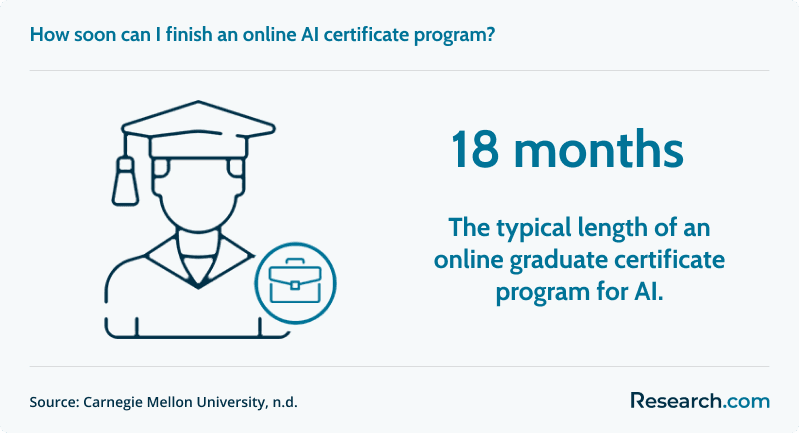
Some programs advertise faster completion options, including accelerated tracks that can take as little as 18 months. These schedules can be useful for professionals who want to move quickly, but they require consistent weekly time, strong coding readiness, and the ability to complete intensive technical coursework without long breaks. Students considering a faster pace can also compare the structure of an accelerated computer science degree.
| Enrollment Format | Typical Timeline | Best For |
| Accelerated | As little as 18 months | Students with strong technical preparation and significant weekly study time. |
| Full time | About two years | Students who can prioritize school and move through courses on a planned sequence. |
| Part time | Two to three years or longer | Working professionals, caregivers, and students who need more flexibility. |
How does an online artificial intelligence degree compare to an on-campus program?
Online and campus-based AI degrees can cover similar academic content, including machine learning, neural networks, algorithms, data systems, AI ethics, and applied projects. Both formats may lead to advanced technical roles and are often compared with other highest-paying master's degrees because AI skills are relevant across many industries.
The main difference is delivery. Online students usually complete lectures, assignments, labs, discussions, and team projects through learning platforms and collaboration tools. Campus students may have easier access to in-person labs, faculty conversations, and local networking, while online students gain flexibility and avoid relocation. The better choice depends on your learning style, schedule, need for structure, and access to professional opportunities.
| Factor | Online AI Degree | On-Campus AI Program |
| Schedule | Usually more flexible, with asynchronous or hybrid coursework. | Often follows fixed class times and campus-based schedules. |
| Networking | Depends on virtual events, group projects, alumni platforms, and career services. | May offer more spontaneous in-person networking and lab interaction. |
| Hands-on work | Uses cloud platforms, virtual labs, coding assignments, and remote collaboration tools. | May include physical labs, campus research groups, and in-person project spaces. |
| Best fit | Working adults, remote learners, and students who cannot relocate. | Students who prefer face-to-face instruction and campus immersion. |
What is the average cost of an online artificial intelligence degree program?
The cost of an online AI degree typically ranges from $28,000 to $58,000, although the programs listed in this guide show total program costs from $28,000 to $50,000. Your final cost may be affected by tuition rate, required credits, institutional fees, books, software, technology requirements, residency rules, and whether you qualify for employer assistance or scholarships.
Online study can reduce some expenses associated with campus attendance, such as relocation and commuting. However, students should not assume online always means inexpensive. Compare total program cost, not only per-credit tuition. Also consider whether the degree helps you build skills connected to the highest-paying jobs in the computer science field, but remember that no program can guarantee a salary outcome.
The table below summarizes common cost ranges for online AI programs.
| Cost Factor | Typical Range |
| Total Number of Credits | 30 to 36 |
| Per-Credit Cost | $850 to $1,800 |
| Total Program Cost | $28,000 to $50,000 |
What are the financial aid options for students enrolling in an online artificial intelligence degree program?
Online AI students may be eligible for many of the same funding sources available to campus students, depending on the institution and program. Start with Federal financial aid if the school and program participate in eligible aid programs. Students may also compare institutional scholarships, graduate assistantships, payment plans, private scholarships, veterans benefits, and employer tuition reimbursement.
Working professionals should ask their employer whether AI, data science, software engineering, or analytics coursework qualifies for tuition assistance. Students who want a shorter or lower-cost credential before committing to a full degree may also compare accredited online certificate programs, especially if they need to build prerequisites or test their interest in AI.
What are the prerequisites for enrolling in an online artificial intelligence degree program?
Many online AI programs expect applicants to hold a bachelor’s degree in computer science, engineering, mathematics, statistics, data science, or a related technical field. Applicants are commonly expected to know at least one programming language and to have completed coursework in calculus, linear algebra, probability, statistics, and algorithms.
Students without a computer science background may still have options, but they should expect bridge coursework or additional preparation. If your background is outside computing, compare programs designed for non-CS students, such as a master’s in computer science pathway, before applying to a mathematically intensive AI program.
| Requirement Area | Common Expectation |
| Bachelor's Degree Programs | Computer Science, Engineering, Mathematics, or other related fields |
| Programming Languages | Python, Java, and C++ |
| Mathematical Skills | Calculus, Linear Algebra, Statistics |
What courses are typically in an online artificial intelligence degree program?
Online AI programs usually begin with technical foundations and then move into specialized applications. Core coursework often includes machine learning, neural networks, deep learning, natural language processing, algorithms, data structures, probability, statistics, database systems, and AI ethics. Students who enjoy interactive systems, simulations, and applied programming may also find overlap with an online game development degree, especially in areas such as graphics, agents, and simulation.
More advanced courses may cover robotics, computer vision, reinforcement learning, cloud-based machine learning, AI product development, autonomous systems, model interpretability, and responsible AI governance. Look for programs that require portfolio-ready assignments, because applied work is often more persuasive to employers than a transcript alone.
What types of specializations are available in online artificial intelligence degree programs?
Specializations help students align coursework with a specific career direction. The right concentration depends on whether you want to build AI products, analyze data, conduct research, work in robotics, or focus on responsible technology use.
- Machine learning: Focuses on algorithms that learn patterns from data and support prediction, classification, recommendation, and decision systems.
- Robotics: Emphasizes autonomous systems, sensors, control, perception, and physical or simulated intelligent machines.
- Natural language processing: Covers computational approaches to text, speech, chatbots, translation, summarization, and language understanding.
- AI ethics: Examines fairness, transparency, privacy, accountability, bias, and the social consequences of automated decision-making.
Students who want careers built around modeling and analytics should also compare AI specializations with data science roles, since the two fields often overlap but are not identical.
How to choose the best online artificial intelligence degree program?
The best online AI program is the one that matches your preparation, career goals, budget, learning style, and need for support. Reputation matters, but it should not be the only deciding factor. A prestigious program with limited advising, weak project work, or poor fit for your schedule may be less useful than a well-supported program with a curriculum aligned to your target role.
Start by checking accreditation, total cost, admissions prerequisites, course sequence, faculty expertise, specialization options, project requirements, and career services. Then evaluate whether the program teaches current tools while still building durable foundations in mathematics, algorithms, software engineering, and model evaluation.
| Question to Ask | Why It Matters |
| Is the institution properly accredited? | Accreditation affects credibility, financial aid eligibility, transferability, and employer recognition. |
| Does the curriculum include hands-on AI projects? | Projects help demonstrate practical ability to employers. |
| Are prerequisites clearly stated? | AI coursework can be difficult without programming, statistics, and linear algebra preparation. |
| What career support is available to online students? | Remote students need access to advising, employer connections, portfolio help, and interview preparation. |
| How often is the curriculum updated? | AI tools change quickly, but programs should balance new technologies with stable technical fundamentals. |
What career paths are available for graduates of online artificial intelligence degree programs?
Graduates may pursue roles in AI engineering, data science, machine learning engineering, robotics, research, business analytics, automation, and intelligent systems development. A graduate’s exact options depend on prior experience, degree level, technical portfolio, coding ability, and industry knowledge. For example, a student with software engineering experience may move toward AI engineering, while a student with a statistics background may pursue machine learning or data science work.
Common job titles include AI engineer, data scientist, machine learning specialist, robotics engineer, data engineer, AI analyst, and AI research scientist. Students should review job postings early to identify the tools, languages, frameworks, and domain knowledge employers expect in their desired role.
Should I pursue an online software development degree to complement my AI studies?
Software development training can be valuable for AI students who need stronger coding, systems design, testing, version control, or deployment skills. AI models rarely exist in isolation; they must be integrated into applications, pipelines, APIs, cloud services, and user-facing tools. For that reason, students who want to become AI engineers or machine learning engineers may benefit from combining AI coursework with software engineering fundamentals.
An online software development degree may be especially useful for learners who are strong in mathematics but less experienced in building production-ready software. However, students who already have substantial development experience may be better served by targeted AI electives, a graduate AI program, or specialized certifications.
What accreditation standards should you look for in online AI degree programs?
Accreditation helps confirm that a school meets recognized academic quality standards. For online AI degrees, students should first verify institutional accreditation from an appropriate recognized accrediting body. This matters for federal aid, credit transfer, graduate admissions, and employer confidence. Program-specific endorsements can also be useful, but institutional accreditation is the first checkpoint.
Students planning to continue into advanced computing study should be especially careful. A degree from an unaccredited or poorly recognized institution may limit future options, including admission to an online master computer science program or other graduate pathways.
What career support services do online AI degree programs offer?
Strong online AI programs should provide career services that are accessible to remote learners, not only campus students. Look for resume review, technical interview preparation, portfolio guidance, virtual career fairs, employer information sessions, alumni networking, internship support, and mentoring from faculty or industry professionals.
Students entering higher education for the first time may need additional advising around transfer credits, degree planning, and foundational courses. In some cases, online associate degree programs can provide a lower-cost starting point before moving into a bachelor’s or graduate-level AI pathway.
How can professional certifications enhance your AI career?
Certifications can help demonstrate tool-specific or platform-specific competence, especially in areas such as cloud computing, data analytics, cyber security, and machine learning operations. They are not a replacement for a rigorous degree, but they can strengthen a resume when paired with projects and relevant work experience.
Students interested in secure AI systems, adversarial machine learning, or responsible deployment may consider cyber security training as a complement to AI. For example, comparing options such as an accelerated cyber security degree online can help students understand how security expertise may broaden their technical profile.
What are the common challenges in online artificial intelligence degree programs?
Online AI programs require discipline, mathematical persistence, and comfort with independent troubleshooting. Students may struggle if they underestimate the weekly workload, enter without enough programming experience, avoid asking for help, or treat online flexibility as a lack of structure. AI courses can move quickly, especially when they combine theory, coding, statistics, and project deadlines.
Another challenge is building a professional network remotely. Students should intentionally participate in discussion boards, virtual labs, group projects, office hours, and career events. Learners who want to add another practical technical specialty may also compare cheap cybersecurity degrees, particularly if they are interested in AI security, privacy, or risk management.
What is the return on investment for an online AI degree?
ROI depends on more than tuition. Students should compare total program cost, time out of the workforce, financing costs, employer reimbursement, expected salary change, portfolio strength, and whether the program leads to roles they actually want. A lower-cost program with strong projects and career support may produce better value than a more expensive program with limited practical application.
Before enrolling, estimate your current salary, target salary range, expected time to graduation, and realistic job transition timeline. If affordability is the main concern, you may also compare a cheap online IT degree as a broader technical pathway that can still support careers in systems, data, cloud, and enterprise technology.
What is the job market for graduates with an online artificial intelligence degree program?
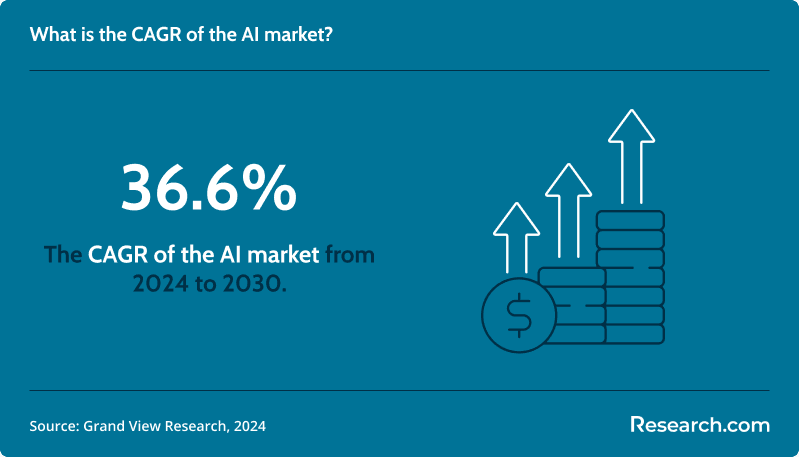
The job market for AI talent is competitive and expanding across many sectors, but it is not automatic. Employers increasingly want candidates who can combine AI knowledge with software engineering, data management, communication, and domain expertise. The global AI market is projected to grow at a CAGR (compound annual growth rate) of 36.6% from 2024 to 2030, which reflects broad organizational interest in AI tools and services.
Students can improve their prospects by building a portfolio, learning commonly used tools, completing internships or applied projects, contributing to open-source work when appropriate, and practicing technical interviews. AI hiring is often skills-based, so evidence of what you can build and explain matters.
How can an online AI degree complement advanced studies in biotechnology?
AI skills are increasingly useful in biotechnology because biological research produces large, complex datasets. Machine learning can support genomic analysis, drug discovery workflows, predictive modeling, image analysis, and pattern recognition. Students who want to work at the intersection of AI and biotechnology should choose coursework that includes data modeling, statistics, bioinformatics exposure, and ethical handling of sensitive data.
Students planning a deeper biotechnology path can compare AI coursework with a specialized biotechnology master online to decide whether they need stronger biological science training, stronger computational training, or both.
How do online AI degree programs keep pace with evolving technology?
AI changes quickly, so strong programs regularly review course content, update tools, add new case studies, and incorporate emerging methods without abandoning fundamentals. Students should look for evidence that faculty engage with current research, industry practice, open-source tools, and modern computing platforms.
At the same time, a program should not chase every trend at the expense of core knowledge. Durable skills in statistics, algorithms, model evaluation, software development, and data management remain essential. Students interested in AI applications in healthcare operations may also benefit from reviewing the most affordable online bachelor’s degrees in health information management.
Can an online AI degree pave the way to top paying tech jobs?
An online AI degree can support a path toward high-paying technology roles when it is paired with strong technical ability, relevant projects, and career strategy. Employers hiring for advanced AI, machine learning, and data roles often look for candidates who can explain models, write reliable code, manage data workflows, and communicate results to technical and nontechnical audiences.
Students aiming for top paying tech jobs should focus on building a portfolio, selecting rigorous electives, practicing coding interviews, and gaining experience through internships, work projects, or research assignments.
How do industry and academic partnerships enhance online AI degree programs?
Partnerships between universities and employers can improve online AI programs by connecting students with current case studies, guest speakers, applied projects, internships, and emerging workplace expectations. These partnerships are most valuable when they lead to meaningful student experience rather than only promotional branding.
Interdisciplinary partnerships can also help students apply AI beyond traditional software roles. For example, students who want to master bioinformatics online may benefit from programs that connect AI, biology, data science, and computational research.
How do online AI degree programs cultivate essential soft skills?
AI professionals need more than technical accuracy. They must explain model limitations, document assumptions, collaborate with software teams, communicate with business leaders, and consider ethical consequences. Online programs can build these skills through team projects, peer reviews, presentations, written reports, discussion forums, and capstone experiences.
Students should choose programs that require communication and collaboration, not just solo coding assignments. Those interested in broader engineering careers may also compare cheap engineering colleges to understand alternative ways to build technical and project-management skills.
How do online AI degree programs support lifelong learning and continuous professional development?
AI professionals must continue learning after graduation because tools, frameworks, regulations, and employer expectations change. Strong online AI programs encourage lifelong learning through alumni access, webinars, advanced electives, research exposure, professional communities, and updated course materials.
Students should ask whether graduates retain access to career services, networking platforms, or continuing education resources. Candidates comparing long-term options can review AI online programs to identify formats that support continued professional growth.
What are the ethical considerations in artificial intelligence careers?
AI professionals make decisions that can affect privacy, fairness, safety, employment, healthcare access, financial decisions, and public trust. Ethical concerns include biased training data, lack of transparency, inappropriate data use, weak security, overreliance on automated outputs, and unclear accountability when systems cause harm.
Students should look for programs that treat AI ethics as part of technical practice, not as a single isolated lecture. Responsible AI training should include bias testing, model documentation, data governance, explainability, privacy protection, and risk assessment. This is especially important in healthcare, finance, hiring, education, criminal justice, and public safety.
How can an online AI degree support advancements in health informatics?
AI can support health informatics by helping professionals analyze clinical data, improve decision support tools, model patient risk, manage medical information systems, and identify patterns in large healthcare datasets. Students interested in this area should choose coursework in data privacy, healthcare analytics, predictive modeling, and ethical AI use in sensitive environments.
A student who wants to combine technical AI knowledge with healthcare systems expertise may also consider a health informatics degree online as a complementary or alternative path.
What are the intersections between artificial intelligence and cyber security in online degree programs?
AI and cyber security intersect in several ways. AI can help detect anomalies, analyze threats, automate monitoring, and identify suspicious behavior. At the same time, AI systems themselves can create risks, including data leakage, model manipulation, adversarial attacks, and misuse of automated tools.
Students interested in secure AI development should study both AI and security fundamentals. An online cyber security degree can provide a structured path for learners who want to focus on protecting systems, data, and intelligent applications.
What are the emerging trends in artificial intelligence and how are they shaping online degree programs?
Online AI programs are adjusting to a field shaped by machine learning, deep learning, natural language processing, automation, responsible AI, and model governance. These trends are changing what students need to know. It is no longer enough to understand algorithms in theory; students must also understand data quality, deployment, evaluation, monitoring, fairness, and practical limitations.
Natural language processing has become especially important as organizations adopt tools for search, chat, summarization, translation, documentation, customer support, and content workflows. Students who want to work in NLP should look for coursework covering language models, text processing, evaluation methods, and ethical use of generated content.
Ethical AI and governance are also becoming central. As AI systems are used in sensitive settings, professionals must understand privacy, bias, accountability, explainability, and compliance expectations. Programs that integrate these topics throughout the curriculum may better prepare graduates for real-world AI work.
Students comparing affordability and specialization can review the cheapest online masters in artificial intelligence programs and evaluate whether lower tuition still includes current tools, strong faculty support, and meaningful applied projects.
How can integrating data science enhance online AI degree programs?
Data science strengthens AI study because AI systems depend on data preparation, statistical reasoning, feature engineering, experimentation, and interpretation. Students who understand both AI and data science are better prepared to evaluate whether a model is useful, valid, explainable, and appropriate for a given problem.
Learners who want a stronger analytics foundation may compare AI degrees with an affordable data science master degree online, especially if their target roles include data scientist, machine learning analyst, or applied analytics specialist.
Can an online AI degree support interdisciplinary careers in bioinformatics?
An online AI degree can support bioinformatics careers when students also build knowledge of biology, genomics, statistics, databases, and scientific computing. AI techniques can help identify biological patterns, support predictive modeling, and analyze complex research datasets used in healthcare and biotechnology.
Students who want to specialize in this area may compare AI programs with the best online bioinformatics masters programs to determine whether they need a stronger life sciences curriculum, a stronger AI curriculum, or a combined pathway.
What digital learning tools are integrated in online AI degree programs?
Online AI programs often use learning management systems, cloud coding environments, virtual labs, video lectures, discussion platforms, collaborative coding tools, data visualization software, and machine learning frameworks. The best tools are not just convenient; they allow students to practice workflows that resemble professional AI development.
Students comparing fast-paced graduate options can review the fastest artificial intelligence master's degree online, but they should confirm that speed does not reduce access to projects, faculty feedback, and technical support.
How can accelerated online programs streamline your path to an AI degree?
An online accelerated bachelor's degree or accelerated graduate pathway can help motivated students complete coursework faster through condensed terms, year-round scheduling, or heavier course loads. Some accelerated AI-related programs can be completed in as little as 18 months, but the pace can be demanding.
Accelerated formats work best for students who already have strong preparation in programming, mathematics, and independent study. They may not be ideal for learners who need substantial prerequisite coursework or who can only study a few hours per week. Before enrolling, ask how many hours students typically spend weekly, whether courses overlap, and what happens if you need to slow down.
Students considering this route can compare options for an online accelerated bachelor's degree and decide whether a faster timeline supports their goals without creating unnecessary academic or financial risk.
Common Mistakes to Avoid When Choosing an Online AI Degree
- Choosing by ranking alone: Rankings can help narrow options, but they cannot tell you whether a program matches your goals, schedule, prerequisites, or budget.
- Ignoring accreditation: Always verify institutional accreditation before applying, especially if you plan to use financial aid or pursue further graduate study.
- Looking only at tuition per credit: Compare total cost, fees, software needs, transfer credits, and time to completion.
- Underestimating math and coding requirements: AI coursework often requires calculus, linear algebra, statistics, algorithms, and programming ability.
- Assuming online means easier: Online AI programs can be just as rigorous as campus programs and may require more self-direction.
- Neglecting career services: Remote students should confirm they have access to internships, portfolio support, interview preparation, and employer networking.
- Expecting salary outcomes to be guaranteed: AI salaries can be high, but outcomes depend on experience, location, skill level, portfolio, and market conditions.
Key Insights
- An online AI degree is most valuable when it combines rigorous technical foundations, hands-on projects, ethical AI training, and accessible career support.
- Most listed programs require 30 to 36 credits, with timelines ranging from 18 months to three years and per-credit costs from $850 to $1,800.
- Students should verify accreditation, credential type, curriculum, prerequisites, and total cost directly with each school before applying.
- AI career paths can be lucrative, but employers usually expect proof of applied skill through projects, coding ability, data experience, and clear communication.
- The strongest program choice is not always the most famous or fastest option; it is the one that fits your background, target role, budget, and capacity to complete demanding technical work.
References:
- BLS. (2024). Computer and Information Research Scientists. https://www.bls.gov/ooh/computer-and-information-technology/computer-and-information-research-scientists.htm
- ZipRecruiter. (2024). Artificial Intelligence Analyst Salary. https://www.ziprecruiter.com/Salaries/Artificial-Intelligence-Analyst-Salary
- ZipRecruiter. (2024). Artificial Intelligence Research Scientist Salary. https://www.ziprecruiter.com/Salaries/Artificial-Intelligence-Research-Scientist-Salary
- ZipRecruiter. (2024). Data Engineer Salary. https://www.ziprecruiter.com/Salaries/Data-Engineer-Salary
- ZipRecruiter. (2024). Lead Data Scientist Salary. https://www.ziprecruiter.com/Salaries/Lead-Data-Scientist-Salary
Other Things You Should Know About Online Artificial Intelligence Degree Programs
Yes, if the program is regionally accredited and includes a recognized bachelor’s or master’s degree in artificial intelligence, computer science, or data science. Employers also look for coursework in machine learning, Python, statistics, and capstone projects with real datasets.
In 2027, top online AI degree programs like those from Georgia Tech, Stanford Online, and the University of Illinois Urbana-Champaign offer robust industry partnership internships. These programs facilitate hands-on experience with leading AI companies, ensuring students gain practical skills and industry connections essential for career advancement.
Students typically need a strong background in mathematics, programming, and statistics for 2027 online AI degree programs. Specific universities may also require completion of introductory computer science courses or relevant work experience to ensure preparedness for advanced AI coursework.
In 2027, some top online AI degree programs renowned for their affordability and value include Georgia Tech's Online Master of Science in Computer Science with a specialization in Machine Learning, and the University of Illinois at Urbana-Champaign's Master of Computer Science in Data Science. Both programs provide extensive AI coursework at competitive tuition rates.