Pharmacist Employment Trends for New Graduates

Co-Founder and Chief Data Scientist
A pharmacist job may be available after graduation, but the setting, location, schedule, and training it requires can change the value of a Pharm.D. degree. For prospective students and new graduates, national job growth is only part of the decision: local openings, residency expectations, licensing timelines, and education costs matter too.
This guide explains where opportunities differ, what employers may expect, and how to evaluate a pharmacy program or first job without treating a national salary figure as a personal forecast.
Key Things You Should Know
- The Bureau of Labor Statistics projects 5% growth in pharmacist employment from 2025-2035 and about 12,500 openings per year; those national figures do not describe competition for a particular location or specialty.
- The pharmacist median annual pay was $140,910 in May 2025, but a new graduate's offer depends on the role, employer, region, and hours.
- An accredited Pharm.D. is the usual U.S. education route, not a license. Hospital and specialty roles may favor residency-trained applicants, while many other pharmacist jobs do not require residency.
What employment trends are new pharmacist graduates facing?
The Bureau of Labor Statistics (BLS) projects 5% growth in pharmacist employment from 2025-2035, with about 12,500 openings per year. Openings include positions created by workers leaving the occupation, so the figure should not be read as the number of new specialty jobs or offers available to recent graduates.
The practical trend is a more varied first-job market than "retail versus hospital." Community pharmacies still employ pharmacists, while health systems, clinics, specialty pharmacies, and other employers seek different combinations of dispensing, clinical, communication, and operational skills. Automation may change routine workflows, but it does not make local staffing needs or patient-facing work uniform across employers.
Before committing to pharmacy school, compare likely entry-level openings in the places you could actually work with the cost of training. An affordable route through pharmacy education is useful only if its credential matches the pharmacist role you want; a shorter pharmacy-related degree is not a substitute for a Pharm.D. and licensure.
What education is required to become a licensed pharmacist?
For the standard U.S.-educated pathway, a prospective pharmacist completes a Doctor of Pharmacy (Pharm.D.) professional program accredited by the Accreditation Council for Pharmacy Education (ACPE), then meets a state board's licensing requirements. Undergraduate pre-pharmacy courses are preparation for admission, not the professional degree. Schools differ on required prerequisites and whether applicants need a bachelor's degree.
The professional curriculum combines pharmacy science, therapeutics, patient care, and supervised practice. Introductory pharmacy practice experiences (IPPEs) and advanced pharmacy practice experiences (APPEs) put students in practice settings; their scheduling and placement arrangements vary by program. A pharmaceutical sciences degree, pharmacology degree, or pharmacy technician qualification does not automatically qualify its holder for pharmacist licensure. Internationally educated pharmacists follow a different eligibility process governed by the relevant board and National Association of Boards of Pharmacy (NABP).
Students changing fields can explore pharmacy doctorate options after chemistry, but should ask each school to evaluate completed coursework rather than assuming prior science credits satisfy every prerequisite.
How does pharmacist job outlook vary by practice setting?
The BLS national projection covers pharmacists across settings; it cannot tell a graduate how many entry-level positions will be available in a particular city or department. This comparison shows why the setting matters when judging an opening.
| Practice setting | Typical work | Common entry consideration |
| Community pharmacy | Dispensing, counseling, vaccinations where authorized, and pharmacy operations | Employer staffing model, schedule, and state-permitted services |
| Hospital or health system | Medication-use oversight and work with care teams | Residency may be preferred or required for some positions |
| Ambulatory care clinic | Longitudinal medication management with a care team | Clinical experience and applicable state practice rules |
| Specialty or mail-order pharmacy | Complex therapies, patient support, and distribution workflows | Therapy-area knowledge and role-specific operational skills |
A pharmacist role should not be confused with a pharmacy technician role. Technician training can be a way to explore a workplace, but even the fastest online pharmacy degree programs should be checked for the exact credential awarded: a short program does not replace the professional Pharm.D. or state pharmacist licensure.
Licensed pharmacists may pursue hospital, ambulatory care, specialty pharmacy, managed care, public health, or medication-safety work. Pharmaceutical manufacturers and research organizations also employ people with pharmacy expertise in medical information, regulatory affairs, and other functions, although an active pharmacist license is not required for every industry position.
Entry routes differ. A postgraduate year one (PGY1) residency develops broad practice experience; a postgraduate year two (PGY2) residency concentrates on a specialty. A fellowship is generally a different, often industry-focused training route. Some roles accept direct-entry applicants, while others prefer postgraduate training or relevant experience. Board certification, where available, is a separate specialty credential - not a state license or an automatic result of residency.
If drug development rather than patient-care practice is the goal, compare the actual hiring requirements before pursuing a Pharm.D. Other scientific or doctoral study with a shorter time commitment may be worth examining, but neither program length nor a doctorate alone establishes eligibility for a pharmacist position.
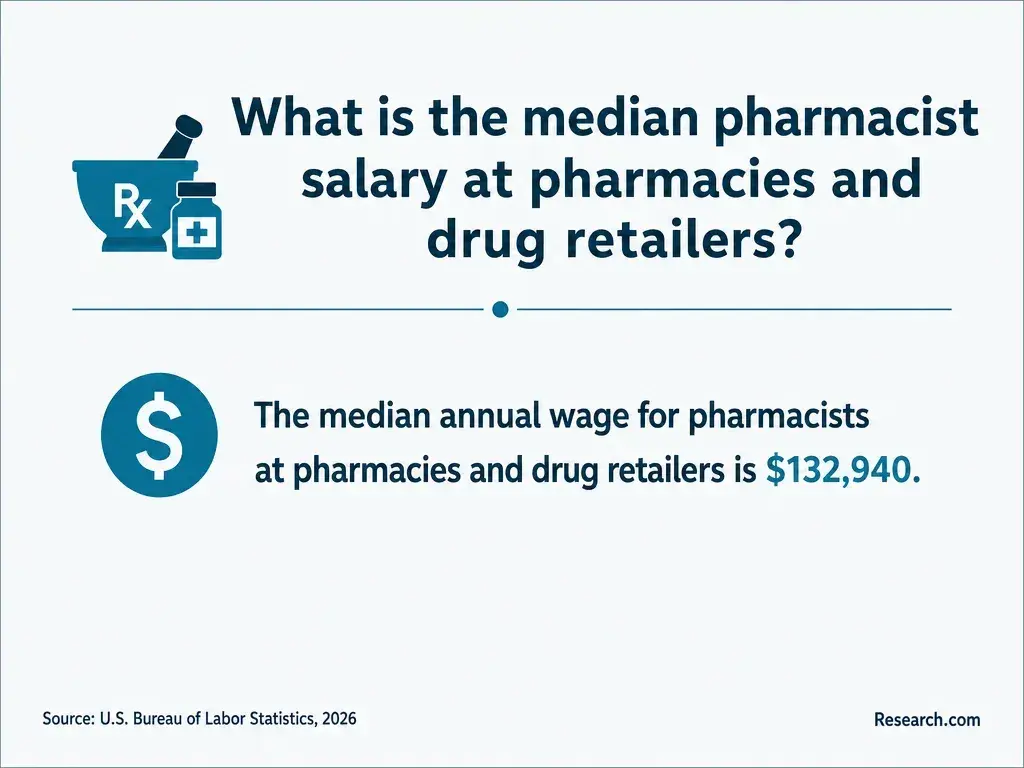
The BLS reports pharmacist median annual pay of $140,910 in May 2025. A median describes the occupation as a whole, not a starting salary or a pay rate for every industry. Offers can vary with employer, geography, experience, shift requirements, and whether a position is full-time; a high annual figure also says little about workload or living costs.
For a useful comparison, request the base rate, expected hours, shift and weekend terms, benefits, relocation support, and any repayment obligations in writing. Compare those terms with local living costs and your likely education debt. When considering affordable pharmacy doctoral education, budget for required fees, rotations, travel, and licensing costs - not tuition alone. Federal borrowing rules changed for many new graduate and professional borrowers beginning July 1, 2026, so confirm current aid eligibility with each school rather than relying on an older loan estimate.
A Pharm.D. graduate must satisfy the board of pharmacy in each jurisdiction where they seek a pharmacist license. The usual U.S.-educated route includes an eligible Pharm.D., required supervised experience, the North American Pharmacist Licensure Examination (NAPLEX), and any applicable law examination or other board requirements. Passing the NAPLEX alone does not issue a license.
Jurisprudence rules are jurisdiction-specific: a board may use the Multistate Pharmacy Jurisprudence Examination (MPJE), the Uniform Multistate Pharmacy Jurisprudence Examination (UMPJE), another assessment, or no separate jurisprudence exam. Intern registration, background checks, application procedures, and timing also vary. Check the current board instructions for the jurisdiction where you intend to work before scheduling exams or accepting a start date.
Program duration is only one part of a realistic employment timeline. When comparing online Pharm.D. program timelines, include in-person labs or immersions, IPPEs and APPEs, graduation, and board processing. Online coursework does not mean clinical training or licensure can be completed remotely.
Competition is most useful to assess by role and location, not by one national label. An applicant open to multiple settings and regions has a different search from one seeking a specific clinical specialty in a single city. Employer preferences may include rotation performance, references, prior technician or intern experience, residency, and the ability to obtain a license by the planned start date.
Residency can strengthen an application for some clinical positions, but places are competitive and it is not a universal hiring requirement. Applicants should examine individual job postings before treating postgraduate training as either essential or unnecessary. Likewise, a vacancy does not establish that its employer will hire a newly licensed pharmacist without the experience listed.
For readers still deciding when to apply to school, pharmacy programs for applicants still completing requirements may offer different admissions timelines. Confirm what must be finished before matriculation; an earlier application does not remove prerequisites or shorten the later licensing process.
ACPE accredits professional pharmacy programs; it does not certify individual graduates or grant pharmacist licenses. Institutional accreditation concerns the college or university, while state authorization for distance education concerns whether a program may enroll students in particular states. These are distinct checks, especially for an online or hybrid program with clinical placements.
Published NAPLEX results can provide context, but compare the same reporting period and examine cohort size, first-time versus repeat attempts, and whether results are available for the pathway you are considering. Exam performance is not an employment rate. Ask schools for documented residency placement or employment outcomes if those outcomes are central to your decision, and clarify how each measure was calculated.
Prior credits can affect cost and completion time, but the receiving school decides how they apply. Review pharmacy programs with transfer pathways alongside each school's written credit evaluation; acceptance of prerequisite coursework does not mean transfer into the professional Pharm.D. curriculum.
Choose a program against the first jobs you would realistically pursue. The following factors separate an attractive description from a pathway you can complete, finance, and use for licensure.
- Eligibility: Confirm current ACPE professional-program status, admissions prerequisites, and intended-state licensure eligibility; check institutional accreditation and distance-education authorization separately.
- Total cost: Compare tuition and required fees on the same basis, then include supplies, travel, possible rotation housing, and financing under current aid rules.
- Schedule and placements: Ask who arranges IPPEs and APPEs, where placements may occur, and whether campus attendance or time away from work is required.
- Career evidence: Review comparable NAPLEX reporting, available graduate outcomes, rotation settings, and support for the employers or residencies you intend to pursue.
A lower advertised price or faster schedule can be a good trade-off, but not if unexpected travel, limited placement options, or unsuitable scheduling make completion harder. Use compare pharmacy doctorate options as a starting point, then verify current program details directly before paying a deposit.
How can new pharmacists improve their employment prospects?
Start with the job requirements you can control rather than applying to every pharmacist posting identically. This sequence helps turn school experience into a credible application.
- Choose target settings and locations, then compare current postings for required licensure, schedules, experience, and stated residency preferences.
- Document specific rotation responsibilities, patient-care skills, operational experience, and references without overstating work performed under supervision.
- Confirm the target board's licensing steps early and give employers a realistic date when you expect to meet them.
- Apply across suitable employers and locations; pursue residency or fellowship when it supports the work you want and the added training time is feasible.
For prospective students, the same planning starts before enrollment: check pharmacy program application requirements against your completed prerequisites and intended career setting. For graduates, a common mistake is assuming a Pharm.D. alone meets every posting's licensing, experience, and specialty requirements.
Other Things You Should Know About PharmD
An employer may make an offer conditional on licensure, but when you may begin pharmacist duties depends on state law and employer policy. Confirm the offer's deadline and what work, if any, you may perform before licensing.
It can demonstrate familiarity with pharmacy workflows and teamwork. It does not replace Pharm.D. coursework, supervised professional training, or pharmacist licensing requirements.
No. Residency provides structured training, not a job guarantee. Its value depends on the positions you seek, the program's experiences, and the employer's hiring criteria.
Do not assume so. Pharmacist licensing is jurisdiction-specific, and a move may require a new license through the applicable board process. Check that board's current requirements before planning a transition.
- Pharmacist Licensure Guide | Department of State https://www.pa.gov/agencies/dos/resources/professional-licensing-resources/licensure-processing-guides-and-timelines/pharmacist-guide
- Role of Pharmacy Residency Training in Career Planning - PMC https://pmc.ncbi.nlm.nih.gov/articles/PMC4319808/
- Emerging Trends from the 2024 National Pharmacy Workforce Study - School of Pharmacy https://pharmacy.wisc.edu/2025/06/16/emerging-trends-from-the-2024-national-pharmacy-workforce-study/
- PharmD Graduation & Career Outcomes | Presbyterian College https://www.presby.edu/graduate-programs/pharmacy/outcomes/
- Key Outcomes | The Ohio State University College of Pharmacy https://pharmacy.osu.edu/education/doctor-pharmacy/key-outcomes
- Outcomes of postgraduate fellowships and residencies for nurse practitioners: An integrative review - ScienceDirect https://www.sciencedirect.com/science/article/pii/S8755722324000759
- Pharmacists and pharmacies: Health at a Glance 2025 | oecd.org https://www.oecd.org/en/publications/2025/11/health-at-a-glance-2025_a894f72e/full-report/pharmacists-and-pharmacies_4763efdf.html
- Trends in the Pharmacist Workforce and Pharmacy Education | ajpe.org https://www.ajpe.org/article/S0002-9459(23)01074-4/fulltext
- From PharmD Graduate to PGY1 Pharmacy Resident | accp.com https://careers.accp.com/career-resources/on-the-job-3/from-pharmd-graduate-to-pgy1-pharmacy-resident-a-clinical-pharmacy-career-path-137