How to avoid losing credits when changing PharmD programs

Co-Founder and Chief Data Scientist
Changing Doctor of Pharmacy (Pharm.D.) programs can mean repeating courses, delaying clinical rotations, or paying for an extra term - even when both schools teach similar material. If you are considering a transfer, the safest decision starts with a written evaluation of where you would enter the new curriculum, not a verbal estimate of how many credits might count. This guide explains what schools evaluate, which records to gather, and how to compare graduation time, cost, and licensure requirements before you leave your current program.
Key Things You Should Know
- The receiving pharmacy school decides whether prior work satisfies its Pharm.D. requirements; accepted credit does not necessarily mean advanced placement in its course sequence.
- Ask for a written degree audit showing your entry term, remaining courses, introductory and advanced pharmacy practice experiences, and expected graduation term before withdrawing.
- Compare the full cost of any added term, not just transferred credit hours; federal borrowing rules changed for many new graduate and professional borrowers beginning July 1, 2026.
How does PharmD credit transfer work when changing pharmacy schools?
A receiving school usually evaluates two different things: whether a previous course earns credit and whether it replaces a particular requirement in its professional Pharm.D. curriculum. The second decision matters more. A school might accept a pharmacology course as credit but still require its integrated pharmacotherapy sequence before you can progress.
Professional coursework is different from undergraduate pre-pharmacy prerequisites. A biology course may satisfy an admission prerequisite without replacing any professional Pharm.D. course. If you are still completing prerequisites rather than enrolled in a Pharm.D. program, guidance on how to transfer coursework toward pharmacy prerequisites addresses that separate decision.
Best next step: Ask the receiving school which office makes final equivalency and placement decisions, when those decisions become binding, and whether it will review your records before you commit to enrollment.
Which PharmD programs accept transfer students and advanced standing?
There is no nationwide list that guarantees a place for a Pharm.D. transfer student. Schools may accept transfers only when seats are available, only at certain entry points, or not at all. Advanced standing means entering beyond the beginning of the professional curriculum; admission as a transfer does not automatically provide it.
Check each prospective school's current transfer policy and ask whether it accepts students from your specific program and accreditation status. Also ask whether you must apply through PharmCAS or directly to the school, whether an interview is required, and when placement is confirmed. Some pharmacy programs with alternative entry pathways address applicants finishing prerequisites; that is not the same as accepting professional Pharm.D. transfer credit.
Do not resign your current seat based on an admissions offer that leaves your year of entry undecided. Request the proposed entry point and remaining requirements in writing.
How can ACPE accreditation protect your PharmD credits?
The Accreditation Council for Pharmacy Education (ACPE) accredits professional Pharm.D. programs. Checking the official ACPE program record helps you assess the standing of both your current and prospective programs, but accreditation does not require one school to accept another school's courses. The receiving institution still determines equivalencies and progression.
Institutional accreditation is a separate matter, as is a school's authorization to enroll a student located in a particular state through distance education. If a hybrid pathway is under consideration, use online Pharm.D. program selection as a starting point, then independently confirm the current ACPE record, authorization for your location, and where required in-person work occurs.
If your current program's accreditation status has changed, obtain its official record and ask prospective schools how that status affects admission, transfer review, and your intended licensing jurisdiction. Do not assume the answer from the school's institutional accreditation alone.
Transfer prospects depend less on a course title than on its content, level, assessment, and place in the receiving curriculum. Standalone coursework may be easier to compare than an integrated sequence, but no category is automatically transferable.
Pre-pharmacy science and general education courses are typically reviewed against admission prerequisites, including any school-specific grade, laboratory, or course-age rules. Review pharmacy school prerequisite expectations separately from professional-course transfer rules so you do not count the same coursework toward the wrong requirement.
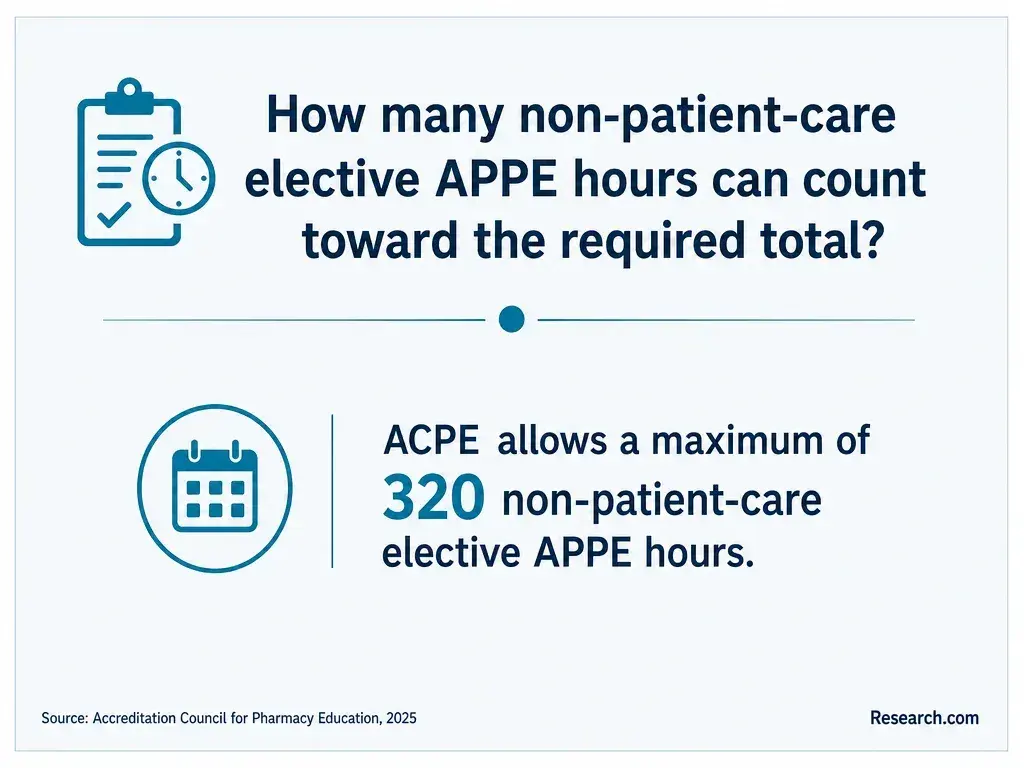
Professional courses such as medicinal chemistry, pharmacokinetics, and therapeutics require detailed content review. Introductory pharmacy practice experiences (IPPEs) and advanced pharmacy practice experiences (APPEs) also depend on documented hours, activities, supervision, site approval, and the receiving school's experiential standards. An unfinished rotation is especially unlikely to be interchangeable without a school-approved plan.
An equivalency review asks whether prior learning satisfies a specific requirement - not merely whether two courses sound alike. Schools may compare learning outcomes, contact hours, laboratories, assessments, grades, and when the material was completed. An integrated patient-care sequence can make a standalone course difficult to substitute, even if much of the subject matter overlaps.
Sequence placement can outweigh the number of credits accepted. If a required course is offered only once each academic year, one missing prerequisite may delay later courses or APPEs. That risk is particularly important when comparing accelerated online pharmacy programs, where a tightly scheduled cohort may have fewer opportunities to make up a course.
Ask for two separate answers: "Which requirements will my prior work satisfy?" and "What is the earliest term I can take every remaining required course and rotation?" A credit total without a term-by-term plan cannot establish your graduation date.
Requirements vary, but a transcript alone rarely shows enough about professional coursework or rotations. Assemble a review packet before application deadlines, and ask whether unofficial copies are sufficient for an initial assessment.
The following records help a receiving school evaluate both admission eligibility and placement:
- Official transcripts from every college attended, plus your current Pharm.D. transcript when available.
- Course syllabi from the terms you took them, including learning outcomes, schedules, lab work, assessments, and credit or contact hours.
- Your current program's catalog, curriculum sequence, grading policies, and any requested letter confirming good academic standing.
- IPPE and APPE records showing completed hours, settings, activities, preceptors, evaluations, and any unfinished requirements.
- Documentation of undergraduate prerequisites, including lab details and approved substitutions where applicable.
If you are moving from undergraduate study into your first professional program, the documentation for Pharm.D. admission after pre-pharmacy coursework may be more relevant than a professional transfer packet. Confirm each school's document and submission rules rather than assuming PharmCAS requirements cover everything.
Compare the published curricula term by term, then have the receiving school validate your proposed placement. Similar total credit requirements can hide different course orders, assessment rules, and rotation schedules.
This worksheet keeps the comparison focused on facts that determine whether a transfer saves time or creates a delay. Fill in the first two columns from current catalogs and request written confirmation of the receiving school's decisions.
Compare the remaining timeline alongside total expenses, not against a school's advertised program length. Resources on affordable pharmacy studies with a focused timeline can help frame that trade-off, but only your individual degree audit can establish whether a particular pathway shortens your Pharm.D.
Potentially. Delivery format alone does not determine whether campus-based professional coursework is equivalent to coursework in an online or hybrid Pharm.D. pathway. The receiving program still applies its admission, course-equivalency, and cohort-placement rules.
"Online" also does not mean fully remote or self-paced. Ask about live classes, campus visits, hands-on labs, in-person assessments, and IPPE/APPE placements. Find out who coordinates and approves sites, whether placement near home is possible, and what travel, intern registration, background checks, or immunizations you would need. Comparing online doctorate lengths does not establish a Pharm.D. transfer timeline or replace these professional training requirements.
Before enrolling from another state, confirm distance-education authorization separately from ACPE accreditation and from the rules governing clinical placements and eventual pharmacist licensure in your intended jurisdiction.
The financially important measure is the cost to finish from today at each school. Count remaining tuition and mandatory fees, plus any repeated courses, additional term, housing, travel for campus sessions or rotations, required supplies, and lost earnings from a later graduation. Compare like units: a per-credit charge is not a total-program price.
A useful scenario comparison has three outcomes: remain in your current program; transfer with the proposed advanced placement; and transfer with a less favorable placement if a pending equivalency is denied. For each, record the expected graduation term and the school's written estimate of remaining charges. Use pharmacy doctorate financial planning to identify cost categories, then get individualized figures from both schools.
Ask both financial aid offices how the move affects your aid year, enrollment classification, satisfactory academic progress, existing loans, and eligibility under current federal rules. Borrowing provisions changed for many new graduate and professional borrowers beginning July 1, 2026; do not rely on an older assumption that Grad PLUS will cover any gap.
How can changing PharmD programs affect pharmacist licensure eligibility?
A transfer should preserve a viable route to graduation from a qualifying professional Pharm.D. program, but the degree itself is not a pharmacist license. State boards set licensing requirements, which can include intern registration or experiential documentation, the North American Pharmacist Licensure Examination (NAPLEX), and a jurisdiction-specific law requirement. Do not assume every jurisdiction uses the MPJE; some use the UMPJE or a different process.
Before accepting an offer, ask the prospective school how it will document previously completed experiential work and support required placements. Check the board of pharmacy in the state where you intend to practice for its current education, intern-hour, examination, and application rules. A shorter credential discussed among short online pharmacy degree timelines should not be mistaken for a substitute for a qualifying Pharm.D. when pharmacist licensure is your goal.
Decision rule: Transfer only when the receiving school has confirmed your placement and remaining requirements in writing, your cost-to-finish comparison is acceptable, and your intended licensing board's requirements remain achievable. If any of those answers is pending, keep your current program options open.
Other Things You Should Know About PharmD
Usually you can inquire or apply before leaving, but application and good-standing rules vary. Staying enrolled while decisions are pending may protect your current seat; confirm both schools' deadlines and withdrawal policies.
It depends on the receiving school's admission policy and your academic standing. Disclose the course accurately and ask whether remediation or a successful repeat is required before review.
Institutional scholarships generally do not transfer automatically. Ask the prospective school's aid office about its awards and check whether leaving your current school triggers repayment or other conditions.
Do not assume your former seat will remain available. Readmission may depend on space, academic standing, curriculum changes, and time away; request the policy before withdrawing.
- Pharmacist - Florida Board of Pharmacy https://floridaspharmacy.gov/pharmacist/
- .14 Evaluation and Review Process for Transfer of Courses and Credits. | Library of Maryland Regulations https://regs.maryland.gov/us/md/exec/comar/13B.06.02.14
- Staying Eligible | Federal Student Aid https://studentaid.gov/understand-aid/eligibility/staying-eligible
- Introductory Pharmacy Practice Experiences (IPPE) | buffalo.edu https://pharmacy.buffalo.edu/academics/pharmd/experiential-education/introductory-pharmacy-practice-experiences--ippe-.epa-and-educational-outcomes.html
- Transfer Policy | Howard University College of Pharmacy https://pharmacy.howard.edu/academic-programs/four-year-entry-level-pharm-d-program/transfer-policy
- IPPE & APPE | UTHSC https://www.uthsc.edu/pharmacy/current-students/oel/ippe-appe.php
- School of Pharmacy Admissions | Notre Dame of Maryland University https://ndm.edu/academics/school-of-pharmacy-health-professions/admissions-2/
- FAQ | OSU College of Pharmacy - Oregon State University https://pharmacy.oregonstate.edu/programs-admissions/pharm-d/faq
- College of Pharmacy Course Descriptions | University of South Carolina https://academicbulletins.sc.edu/pharmacy/course-descriptions/
- Graduation & Licensure | Washington State University https://pharmacy.wsu.edu/pharmd/experiential-services/graduation-licensure/