Pharmacy School Pathway From High School to Licensure

Co-Founder and Chief Data Scientist
Becoming a pharmacist takes more than choosing a college major. You need to plan undergraduate prerequisites, enter a professional Doctor of Pharmacy (Pharm.D.) program, complete supervised training, and qualify for a state license. The choices you make early can affect your timeline, borrowing, and ability to practice where you want to live.
This guide is for high school students, college students, and career changers who want a clear route from their starting point to licensure - and a way to compare programs before committing.
Key Things You Should Know
- The usual U.S. route is undergraduate prerequisites followed by an accredited Pharm.D. program and state licensure; a bachelor's degree is not required by every pharmacy school.
- Allow roughly six to eight years after high school for a conventional pathway, although program designs and individual prerequisites change the timeline. Graduation alone does not authorize practice.
- The Bureau of Labor Statistics reports pharmacist median annual pay of $140,910 in May 2025 and projects 5% employment growth from 2025-2035. Compare that career potential with the full cost of the route, not tuition alone.
What Is the Pharmacy School Pathway From High School to Licensure?
The pathway has distinct stages: prepare for college-level science, complete a pharmacy school's prerequisite courses, earn a professional Pharm.D., and meet the licensing board's requirements in the state where you intend to practice. Pre-pharmacy describes preparation for admission; it is not a pharmacist credential.
Use this sequence as a planning guide, then check the rules of your target schools and state board before fixing your schedule:
- In high school, build a foundation in biology, chemistry, mathematics, and communication; explore pharmacy work through lawful observation or entry-level employment.
- Choose an undergraduate route that covers the specific Pharm.D. prerequisites you will need, whether or not you plan to finish a bachelor's degree.
- Apply to Pharm.D. programs, complete their professional coursework and supervised clinical experiences, and graduate.
- Apply to a state board, satisfy its examination and other requirements, and wait for the board to issue your pharmacist license before practicing independently.
Some pharmacy application eligibility pathways let students apply while prerequisites are in progress. Admission under that condition does not waive the requirement to finish them before the school's specified deadline.
What Education Is Required to Become a Licensed Pharmacist?
For the standard U.S.-educated route, students complete the prerequisites required for admission and graduate from a qualifying professional Pharm.D. program. An undergraduate biology, chemistry, pharmacology, or pharmaceutical sciences degree may provide useful preparation, but it does not replace the Pharm.D. for this route. Internationally educated pharmacists follow a separate eligibility process, which may include NABP foreign graduate certification, before seeking state licensure.
A bachelor's degree can be valuable if you want a broader undergraduate education or a backup career option. It can also add time and expense if a school admits students after fewer undergraduate credits. Students with existing science credits should compare pharmacy education after undergraduate science coursework against each school's course-by-course prerequisites; a degree title alone does not establish eligibility.
Postgraduate residency, fellowship, and specialty board certification are separate from the education and state license required to enter pharmacist practice. An employer may prefer additional training for a particular position, but it is not universally required.
How Does Accreditation Affect Pharmacy School and Pharmacist Licensure?
The Accreditation Council for Pharmacy Education (ACPE) accredits professional Pharm.D. programs, not individual pharmacists. Before enrolling, check the program's current status in ACPE's official directory and ask how that status affects graduates' licensing eligibility in your intended state. Do not rely solely on a university's general accreditation or an old program brochure.
Three approvals answer different questions: ACPE professional-program accreditation concerns the Pharm.D.; institutional accreditation concerns the college or university; and distance-education state authorization concerns whether an institution may enroll students in a particular state. Authorization does not by itself establish pharmacist licensing eligibility or permission to arrange clinical placements there.
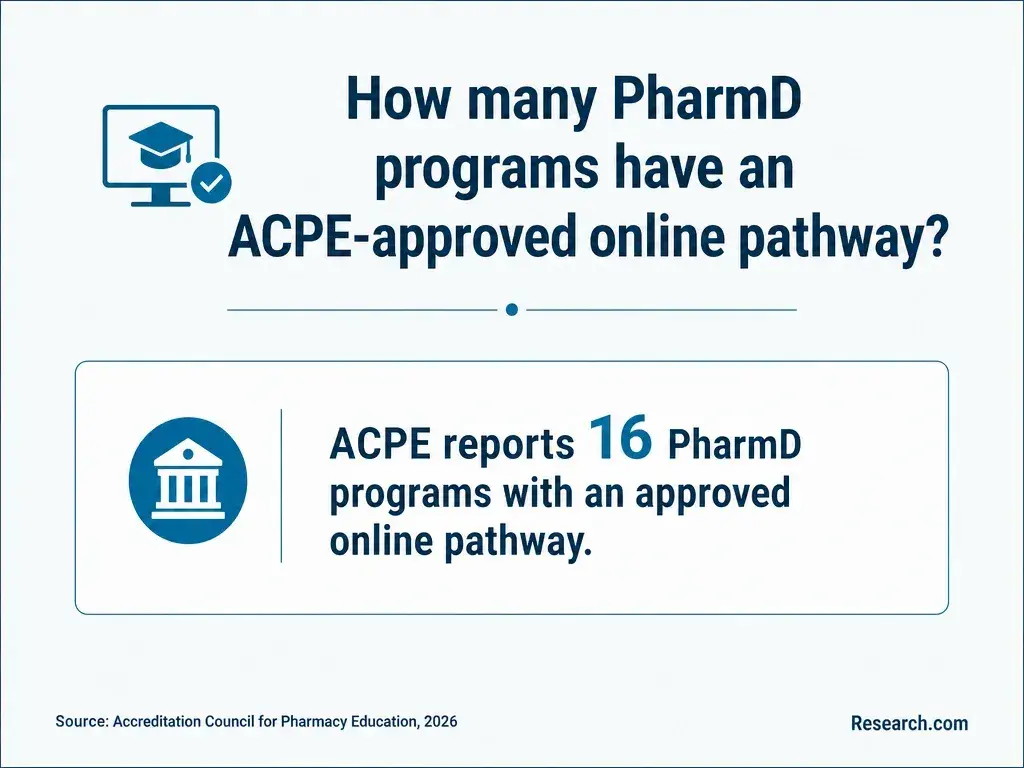
These distinctions are especially important when comparing Doctor of Pharmacy distance learning programs. Confirm professional accreditation, your state's enrollment and placement rules, and your licensing board's education requirements separately.
Your main choice is how to reach the professional Pharm.D. curriculum. The routes below differ in flexibility and time commitment, but none eliminates the need to meet licensing requirements.
| Pathway | How it works | Principal trade-off |
| Prerequisites, then Pharm.D. | Complete required undergraduate courses before entering a separate professional program. | Allows a later school choice, but course requirements may differ across schools. |
| Bachelor's degree, then Pharm.D. | Finish an undergraduate degree before applying. | Provides a completed credential, potentially with more time and cost. |
| Direct-entry or combined pathway | Enter a school's structured undergraduate-to-Pharm.D. sequence after high school. | Offers early planning, but progression conditions and flexibility vary. |
| Accelerated professional curriculum | Complete an eligible Pharm.D. program on a compressed academic schedule. | May shorten enrollment, but leaves less room for breaks or paid work. |
When assessing accelerated Pharm.D. programs, compare the entire route - not just the professional curriculum. A shorter Pharm.D. schedule may not help if you still need substantial prerequisite coursework, and an intensive calendar may limit earnings while enrolled.
Requirements vary by program. Schools may specify undergraduate science and general education courses, laboratory work, minimum grades or GPA, recommendations, an interview, and application materials. A published minimum is an eligibility threshold, not a promise of admission. The Pharmacy College Admission Test (PCAT) was retired in 2024; it is not a current exam applicants can schedule.
Before selecting undergraduate classes or submitting applications, work through these checks for each school:
- Match its current prerequisite list to your transcript, including labs, minimum grades, and any course-age rules.
- Ask how it evaluates AP or IB credit, community-college classes, online labs, international coursework, and courses still in progress.
- Confirm whether it uses PharmCAS, and identify any separate supplemental application, interview, recommendation, and deadline requirements.
- Ask when all prerequisites must be complete and obtain clarification on unusual credits before paying application fees.
A guide to pharmacy school prerequisites can help you form questions, but the school's current admissions policy controls whether your particular coursework qualifies.
The professional curriculum moves from drug science and clinical reasoning to supervised patient care. Students typically study how medicines work, evaluate drug therapy, communicate with patients and other clinicians, and address medication safety. Coursework may also cover dispensing systems, compounding, law, and public health. Students perform clinical tasks only within the supervision and legal authority applicable to their training.
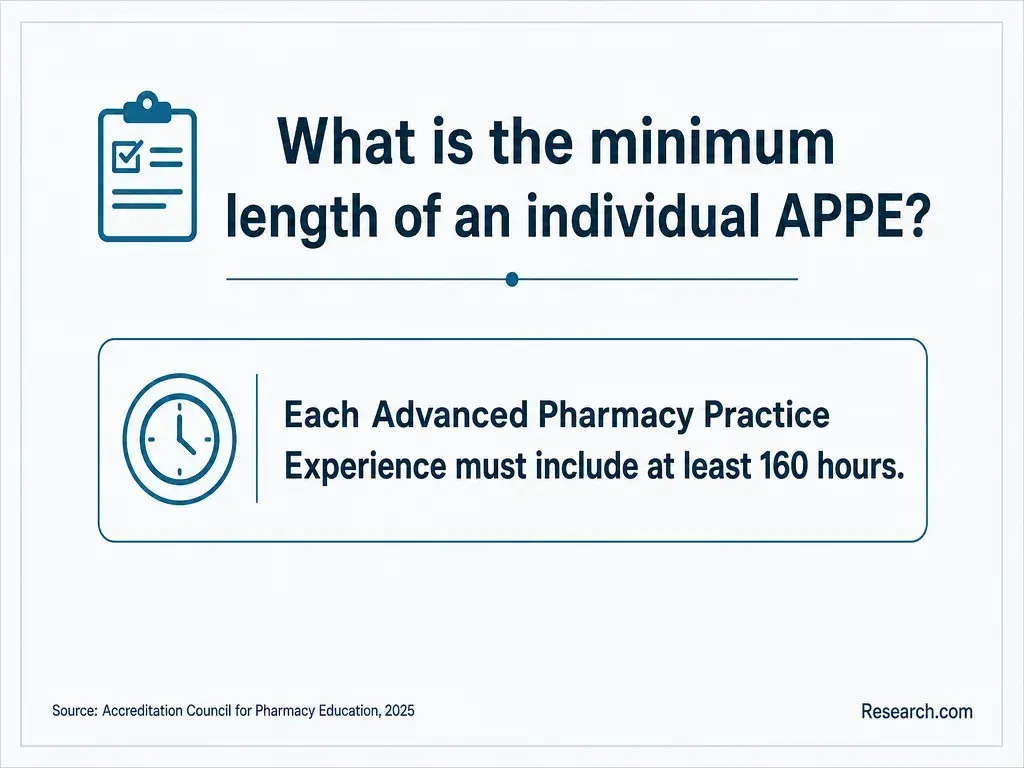
Experiential education includes introductory pharmacy practice experiences (IPPEs) and later advanced pharmacy practice experiences (APPEs). APPEs place students in practice settings such as community, hospital, or other patient-care environments. Ask a program who secures and approves sites, where rotations may occur, and whether travel, intern registration, background checks, or immunizations are required.
Previous college courses usually address admission prerequisites rather than replace professional Pharm.D. courses. If you hope to apply prior college credits to pharmacy programs, get a written evaluation from the receiving school specifying whether each credit satisfies a prerequisite or counts toward the professional curriculum.
A conventional plan often combines about two to four years of undergraduate preparation with a four-year Pharm.D. curriculum. Some schools offer different schedules. Your actual finish date depends on prerequisite sequencing, admission timing, the professional calendar, and any interrupted enrollment.
Advertised tuition is not the full educational cost. Compare schools over the same period and include mandatory fees, prerequisite courses, supplies, technology, insurance or health requirements, clinical-rotation travel or housing, and licensing-related expenses. A lower tuition figure can lose its advantage if a program requires more travel or cannot apply credits you have already earned. Use a breakdown of pharmacy doctorate tuition and fees as a starting point, then request each school's current, individualized cost-of-attendance estimate.
Financial aid deserves a separate check. Federal borrowing rules changed for many new graduate and professional students beginning July 1, 2026; do not budget on the assumption that Grad PLUS or a previously advertised loan limit will cover any shortfall. Ask the financial aid office how your enrollment date, student classification, and eligibility affect available aid before accepting an offer.
Some Pharm.D. programs deliver part of their instruction online, but "online" does not mean fully remote, asynchronous, or compatible with full-time employment. Programs may require live classes, in-person labs or campus sessions, proctored assessments, and supervised IPPEs and APPEs at approved practice sites.
Compare the actual calendar as well as pharmacy program tuition and length. Request the dates and locations of required campus visits, the expected weekly schedule, and the rotation-placement policy. Ask whether the school can approve sites near you, who finds preceptors, and what happens if local placements are unavailable. A flexible lecture schedule may still lead to travel or extended time away from work during rotations.
Graduation starts the licensing process; it does not complete it. U.S. jurisdictions set their own application, examination, and related requirements. The North American Pharmacist Licensure Examination (NAPLEX) assesses pharmacy practice knowledge. Jurisprudence requirements vary: a jurisdiction may use the Multistate Pharmacy Jurisprudence Examination (MPJE), the Uniform MPJE (UMPJE), another process, or no separate jurisprudence exam. Check your state board and NABP's current instructions rather than assuming the MPJE applies everywhere.
Use the following order to avoid paying for an exam or making a moving plan on a mistaken assumption:
- Identify the board in the jurisdiction where you first want to practice and review its graduate eligibility and application rules.
- Confirm its required exams, intern-hour or registration rules, background-check process, and any additional documentation.
- Follow the board's and NABP's instructions for exam eligibility, registration, and any score-transfer plans.
- Verify that the board has issued your license before accepting duties that require an independently licensed pharmacist.
Be wary of short online pharmacy degree timelines when your goal is pharmacist licensure: a short certificate or technician program does not substitute for a qualifying Pharm.D. and the applicable state process.
What Careers, Salaries, and Job Outlook Follow Pharmacy School?
Licensed pharmacists may work in community pharmacies, hospitals, ambulatory clinics, specialty pharmacy, or other settings, subject to employer needs and state scope-of-practice rules. The Bureau of Labor Statistics reports median annual pay for pharmacists of $140,910 in May 2025 and projects 5% growth from 2025-2035, with about 12,500 openings per year. Those occupation-wide figures are not an offer of pay or a forecast for any one specialty or location.
A postgraduate year-one (PGY1) residency develops broad practice skills; a PGY2 residency focuses on a practice area. Fellowships often emphasize research, industry, or another defined field. These opportunities have their own selection requirements and are not universally necessary for pharmacist jobs. Board of Pharmacy Specialties certification is a separate specialty credential - not a state license - and has its own eligibility rules.
Decide whether you want to practice as a pharmacist before committing to the Pharm.D. investment. Pharmacy technician work is a different occupation that does not ordinarily require a Pharm.D.; research or other pharmacy-adjacent goals may call for another degree. Even shortest online doctoral programs should be evaluated against the job you want: a faster doctorate in another field does not establish pharmacist licensing eligibility.
Other Things You Should Know About PharmD
Yes, if the schools you target accept your coursework when you apply. Check their course-age policies and use the time to gain relevant experience, address missing prerequisites, or save for application costs.
Often, but the feasible hours depend on class scheduling, campus requirements, and rotations. Ask current students and the program for sample schedules before relying on employment income.
Not automatically. The destination board determines whether you qualify through license transfer or another application route and whether additional examinations or conditions apply.
Review NABP's retake policies and your board's rules before registering again; waiting periods, attempt limits, and eligibility procedures may apply. Ask your school about remediation support.
- Promoting Internship Excellence: Key Strategies Employed by Pharmacy Schools for Successful Development - PMC https://pmc.ncbi.nlm.nih.gov/articles/PMC10710273/
- 49 Pa. Code § 27.26. Pharmacy internship. | pacodeandbulletin.gov https://www.pacodeandbulletin.gov/secure/pacode/data/049/chapter27/s27.26.html
- Pharmacist Licensure | iowa.gov https://dial.iowa.gov/licenses/health-professions/pharmacy/pharmacist-licensure
- Pharmacist Licensure Guide | Department of State https://www.pa.gov/agencies/dos/resources/professional-licensing-resources/licensure-processing-guides-and-timelines/pharmacist-guide
- Initial Pharmacist Licensure Information | ky.gov https://pharmacy.ky.gov/professionals/Pages/Initial-Pharmacist-Licensure-Information-.aspx
- Types of Financial Aid: Grants, Work-Study, and Loans | studentaid.gov https://studentaid.gov/understand-aid/types
- Pharmacist Licensure by Exam - Texas State Board of Pharmacy https://www.pharmacy.texas.gov/applicants/pharmacist-exam.asp
- How to Apply to the PharmD Program | Texas A&M University Irma Lerma Rangel College of Pharmacy https://pharmacy.tamu.edu/pharmd/apply.html
- Pharmacy Experiential Education Rotations | University of Health Sciences and Pharmacy in St. Louis https://www.uhsp.edu/academics/pharmd-program/pharmacy-experiential-education/
- How to Become a Pharmacist | School of Pharmacy https://pharmacy.llu.edu/about-us/school-news/how-become-pharmacist