Pharmacist Salary Versus Pharmacy School Debt

Co-Founder and Chief Data Scientist
A pharmacist's salary can look attractive until you compare it with years of tuition, living costs, and loan payments. If you are considering a Doctor of Pharmacy (Pharm.D.) degree, the useful question is not whether the occupation pays well in general. It is whether a particular program's total cost makes sense for the work you want and the income you could realistically earn.
This guide shows you how to compare debt with pay, account for time and licensing requirements, and identify when a lower-cost program, or a different pharmacy career, may be the better choice.
Key Things You Should Know
- The median annual pay for pharmacists was $140,910 in May 2025, according to the Bureau of Labor Statistics (BLS). That is gross pay, not money available for loan payments.
- There is no useful universal debt cutoff: compare each school's projected balance at graduation with a repayment estimate based on your likely starting job, interest rates, and living expenses.
- A lower tuition quote may still produce more debt if it requires extra prerequisite courses, relocation, travel for rotations, or more time away from paid work.
How does pharmacist salary compare with pharmacy school debt?
Pharmacist pay can support repayment, but a national median cannot establish whether your pharmacy school debt is manageable. The comparison must use the balance you expect to owe when repayment begins - not tuition alone - and a plausible salary for your intended location and practice setting. Gross salary also has to cover taxes, housing, insurance, retirement saving, and other expenses.
Use the same assumptions for every school you are considering. The following sequence turns a salary-versus-debt comparison into a decision you can test.
- Request each school's full cost-of-attendance estimate and add any expenses you expect that its estimate does not adequately reflect.
- Subtract confirmed scholarships, savings, and support you can use without borrowing; include interest that may accrue while you study.
- Estimate payments under repayment options for which your actual loans qualify, then compare those payments with a conservative take-home-pay and living-expense budget.
- Test what happens if you earn less than expected, work fewer hours, or take a postgraduate training position before entering your intended role.
If a plan works only with the national median salary and no financial setbacks, consider a cheaper accredited program, a different funding plan, or another entry route. Reviewing pharmacy degree entry options can help you compare pathways, but an easier admission route is not necessarily the least expensive route to licensure.
What is the average pharmacist salary and earning potential?
The BLS reports median annual pay of $140,910 in May 2025 for pharmacists. A median is the midpoint of employed pharmacists' pay, not an entry-level offer or a prediction for a new graduate. Earnings vary with location, employer, schedule, experience, and responsibilities; compare actual offers or local postings with your proposed loan payments before committing to a program.
Pharmacy technician work is a different occupation and does not ordinarily require a Pharm.D. Its median annual pay was $45,750 in May 2025, according to the BLS. That lower pay does not make the role a poor choice: if your goal is to enter pharmacy work without qualifying as a pharmacist, the shorter and potentially less costly route may fit better. Compare shorter pharmacy programs with career potential by the jobs they actually prepare you for, not by the word "pharmacy" in the credential.
How much does pharmacy school cost, and how much debt do students graduate with?
There is no single pharmacy school price or graduate debt figure that reliably describes an individual applicant. Tuition differs by program and residency classification, while borrowing depends on aid, savings, living arrangements, and previous education. An advertised tuition figure is therefore a starting point, not a debt projection.
Costs outside tuition are particularly important when two programs appear similarly priced. Compare these categories using each school's current published charges and your own circumstances.
- Before enrollment: prerequisite courses, application costs, and any required relocation.
- During the Pharm.D.: mandatory fees, books and clinical references, technology, supplies, housing, transportation, and health-related requirements.
- During clinical training and after graduation: possible rotation travel or temporary housing, exam and licensing fees, and interest on borrowed funds.
Federal borrowing rules changed for many new graduate and professional borrowers beginning July 1, 2026. Do not assume an older loan-limit figure or automatic access to Grad PLUS applies to you; confirm your classification, eligibility, limits, and any transition rules with the school's aid office and Federal Student Aid. An online Pharm.D. cost comparison may reveal lower advertised tuition, but include required in-person training and travel before judging affordability.
For the usual U.S.-educated pathway, students complete a school's undergraduate prerequisites and then its professional Pharm.D. curriculum. Pre-pharmacy coursework is preparation for admission; it is not itself a pharmacy degree or a pharmacist license. A completed bachelor's degree is not a universal admission requirement, and schools set their own course, laboratory, grade, and credit policies.
Applicants coming from biology or chemistry should check which prior courses satisfy each school's requirements rather than assume their major covers everything. Guidance on pharmacy school after biology or chemistry can help frame that comparison. A pharmaceutical sciences, pharmacology, or pharmacy technician credential does not automatically qualify its holder for pharmacist licensure. Internationally educated pharmacists follow a separate eligibility process that depends on the licensing jurisdiction.
A traditional professional Pharm.D. curriculum commonly takes four academic years after prerequisites, although school calendars and accelerated formats vary. The full time-to-career calculation also includes any missing prerequisite courses, the licensing process, and optional postgraduate training. Time in school matters financially because it can increase living expenses and delay full-time pharmacist earnings.
Some accelerated pharmacist education options compress the academic calendar. Compare their total charges, breaks, workability, and clinical placement schedule - not just the graduation date. A faster curriculum is not automatically cheaper or easier to combine with employment.
The Accreditation Council for Pharmacy Education (ACPE) accredits professional pharmacy education programs, not individual pharmacists. Check a program's current status in ACPE's official records and confirm that it meets the educational requirements of the state where you intend to seek a license. Also examine outcomes and student support: accreditation is an essential screening factor, not proof that every graduate passes an exam or obtains a particular job.
Institutional accreditation and authorization to enroll online students in a state are separate matters; neither replaces ACPE professional-program accreditation or a state board's licensure rules. If you are investigating pharmacy degree eligibility options, confirm exactly which conditions must be completed before admission or enrollment in the professional curriculum. Conditional entry should not be mistaken for conditional permission to practice.
Graduating with a Pharm.D. does not itself authorize pharmacy practice. A U.S. graduate generally must meet a state board's education and experiential requirements, pass the North American Pharmacist Licensure Examination (NAPLEX), satisfy any applicable law-exam requirement, and receive the board's license. Jurisdictions differ on intern registration and jurisprudence testing; do not assume every state uses the Multistate Pharmacy Jurisprudence Examination (MPJE). Some jurisdictions began transitioning to the Uniform Multistate Pharmacy Jurisprudence Examination (UMPJE) in 2026.
Before choosing a school, check the board rules for the jurisdiction where you expect to practice, including any requirements affecting clinical placements. Even a degree featured among online doctorate program length comparisons cannot shorten or replace the board's licensing process. Passing an exam alone does not issue a license.
Professional Pharm.D. study brings pharmaceutical science together with patient care. Students typically learn how medicines work, how to evaluate drug therapy, how to communicate with patients and other clinicians, and how to prevent medication errors. Supervised introductory pharmacy practice experiences (IPPEs) build early workplace skills; advanced pharmacy practice experiences (APPEs) apply them in clinical settings. Course sequences and placements differ by school.
Previous science coursework may satisfy admission prerequisites without replacing professional courses or rotations. If that distinction changes your expected completion time, review transfer credits for pharmacy school and obtain a written evaluation from the receiving program. Do not budget on the assumption that credits will transfer merely because both institutions are accredited.
Online or hybrid instruction may reduce routine trips to campus, but it does not make pharmacist training fully remote. Programs may require scheduled live classes, campus sessions, hands-on labs, and in-person IPPEs and APPEs. Campus-based programs also require time at clinical sites; neither format guarantees placements near home or compatibility with full-time work.
For either format, ask who arranges and approves rotations, where students have recently been placed, and what travel, site clearance, and intern-registration obligations students handle themselves. An online pharmacy program comparison is most useful when you compare those commitments alongside total cost, accreditation, and licensure eligibility, not delivery labels alone.
What pharmacist careers and job outlook can graduates expect?
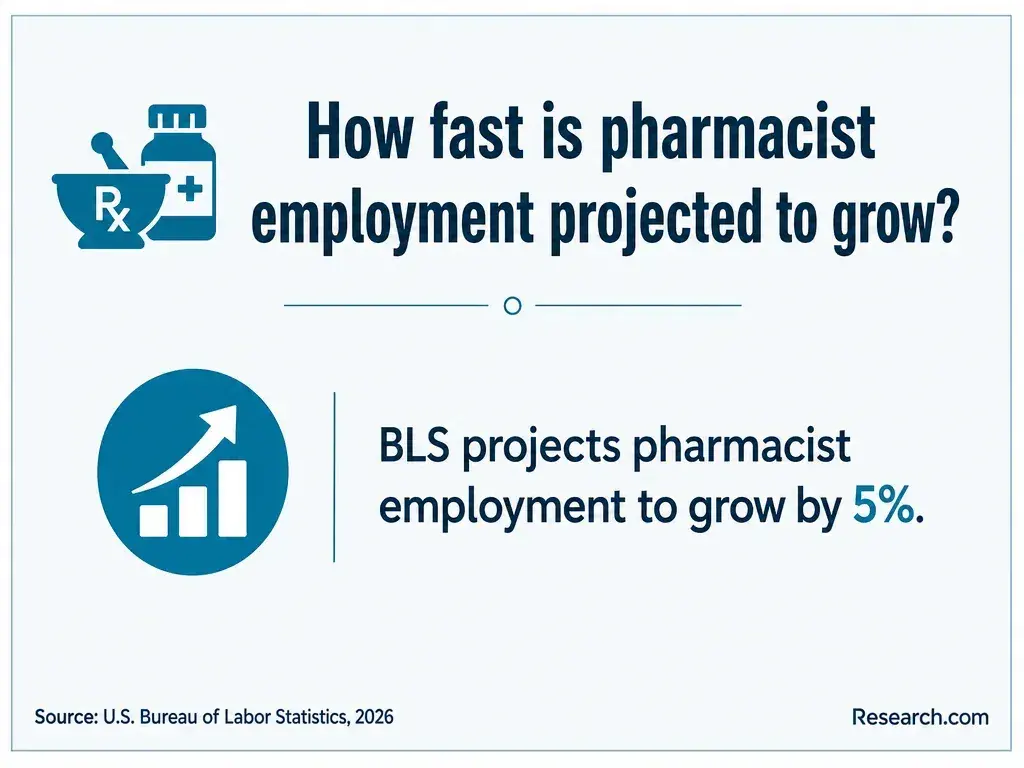
Pharmacists work in settings including community pharmacies, hospitals, clinics, and specialty pharmacy services. Duties and hiring preferences differ. The BLS projects 5% pharmacist employment growth from 2025 to 2035 and about 12,500 openings per year. Those occupation-wide projections indicate opportunities, not the likelihood of a particular graduate obtaining a preferred role or salary.
Some graduates enter practice after licensure; others pursue postgraduate year one or year two residencies, fellowships, or later specialty board certification. These are distinct from the state license and are not universal requirements. If your target job does not require pharmacist licensure, compare the debt and foregone work time of a Pharm.D. with a more direct route. In particular, accelerated online pharmacy degree pathways should not be assumed to qualify someone for pharmacist licensure merely because they lead to pharmacy-related work.
Other Things You Should Know About PharmD
Potentially. Eligibility depends on the borrower's loan type, qualifying employer, repayment history, and current program rules - not the pharmacist job title alone. Verify the requirements before relying on forgiveness in a school budget.
Some employers offer loan assistance, but it varies by position and contract. Treat it as a benefit only when the terms are in a written offer; check service commitments and what happens if you leave.
You generally remain responsible for money already borrowed, subject to applicable school refund and loan rules. Ask about withdrawal deadlines and contact your loan servicer before making a decision.
Refinancing may change your rate or payment, but refinancing federal loans into a private loan generally gives up federal repayment and forgiveness protections. Compare those lost options with any proposed savings before signing.
- Federal Student Loan Repayment Plans | studentaid.gov https://studentaid.gov/manage-loans/repayment/plans
- Cost of Attendance (Budget) | 2025-2026 Federal Student Aid Handbook https://fsapartners.ed.gov/knowledge-center/fsa-handbook/2025-2026/vol3/ch2-cost-attendance-budget
- Break-Even Income Analysis of Pharmacy Graduates... - PMC https://pmc.ncbi.nlm.nih.gov/articles/PMC4857639/
- Tips for paying off student loans more easily | consumerfinance.gov https://www.consumerfinance.gov/paying-for-college/repay-student-debt/student-loan-debt-tips/
- Tuition & Fees - Doctor of Pharmacy https://pharmacy.wisc.edu/pharmd/tuition-fees/
- Considering a Career in Pharmacy? What You Need to Know | PCOM https://www.pcom.edu/pharmacy/career-in-pharmacy.html
- Cost of Attendance " Pharm.D. Admissions " | ufl.edu https://admissions.pharmacy.ufl.edu/financial-aid/anticipated-expenses/
- Managed Care/Payer | pharmacist.com https://www.pharmacist.com/Career/Career-Pathways/Career-Option-Profiles/Managed-Care-Payer
- Average Pharmacy School Debt: What to Know | collegeave.com https://www.collegeave.com/articles/average-pharmacy-school-debt/