PharmD Application Timeline Planner by Cohort Start Date

Co-Founder and Chief Data Scientist
A pharmacy school deadline is only one date in a longer admissions process. Prerequisite courses, transcripts, recommendations, interviews, and enrollment conditions can determine whether you can join the cohort you want.
This planner helps prospective Doctor of Pharmacy (Pharm.D.) students work backward from a fall, spring, or summer start, identify school-specific deadlines, and decide whether their target cohort is realistic - or whether waiting for the next one would make for a stronger application.
Key Things You Should Know
- Choose a target cohort first, then plan backward roughly 12-18 months; treat that window as a planning guide, not a universal admissions deadline.
- Record each school's actual application deadline, prerequisite-completion deadline, and deposit date separately.
- A submitted PharmCAS application is not necessarily a complete school application. Check financing before accepting an offer: federal borrowing rules changed for many new graduate and professional borrowers beginning July 1, 2026, and eligibility depends on the student and aid year.
How do PharmD application timelines vary by cohort start date?
Work backward from the first day of the professional Pharm.D. curriculum, not from the beginning of a calendar year. Fall starts are common, but a school may offer a spring or summer cohort - or only one entry point. Accelerated programs can have different course calendars without necessarily offering more application opportunities. Consider fast-track Doctor of Pharmacy programs only after confirming their entry terms and prerequisite deadlines.
Use this comparison worksheet for each school on your shortlist. The timing ranges are planning prompts; the school's current admissions page and, where applicable, PharmCAS directory control the actual dates.
| Target cohort | When to begin planning | School and start date | Application deadline | Last prerequisite deadline |
| Fall | About 12-18 months before classes | ________ | ________ | ________ |
| Spring | About 12-18 months before classes | ________ | ________ | ________ |
| Summer | About 12-18 months before classes | ________ | ________ | ________ |
A spring or summer start does not imply a later application deadline than a fall start. Ask each program which application cycle serves your intended cohort, especially when its start date falls near a cycle boundary.
When should you start preparing for a PharmD application?
Start when you can still change your course schedule - not merely when the application opens. A 12-18-month runway gives you time to resolve missing labs or courses offered only once a year; applicants with completed prerequisites may need less time. Advice about how quickly can an online pharmacy degree be completed may describe credentials other than the professional Pharm.D., so do not use a shorter degree timeline to set your pharmacist-training start date.
Build one calendar per prospective school. These steps keep tasks with different deadlines from collapsing into a single "apply by" date:
- Mark the cohort start and the last term in which you may finish outstanding prerequisites.
- Check whether the school uses PharmCAS, a direct application, or both a common and supplemental application; record every deadline and time zone.
- Request prerequisite reviews early if course equivalencies, labs, or older credits are uncertain.
- Allow time for recommendations, transcripts, any required experiences, and a school-specific statement or interview.
- Reserve time after an offer for the deposit, final transcripts, financial aid, and enrollment or clinical-clearance requirements.
What are the PharmD application deadlines and PharmCAS requirements?
PharmCAS is the centralized application service used by many - but not all - U.S. pharmacy schools. Its cycle-wide procedures are distinct from each program's deadline and requirements. A school may set an earlier priority deadline, require a supplemental application, or require materials to be received or verified by a specified date. Compare admission pathways for pharmacy students using each school's current policy rather than assuming one application route or deadline applies everywhere.
For every program, record whether its deadline means submit, all materials received, or application verified. Check transcript and recommendation instructions in the current PharmCAS cycle and the school directory, then leave a buffer for processing. Submitting at the last minute can leave no time to correct a missing item.
The Pharmacy College Admission Test (PCAT) was retired in January 2024. Do not schedule it as part of a current application plan; check the school's published policy for any other assessment it actually requires.
Prerequisites are pre-professional coursework completed before the professional Pharm.D. curriculum. Schools commonly assess science, mathematics, and general education preparation, but their exact courses, labs, minimum grades, grade-point averages, and course-age policies differ. A bachelor's degree is not universally required. Some schools allow courses in progress when you apply but require successful completion before matriculation; see apply to pharmacy school while finishing prerequisites for the distinction between applying and starting.
Make a separate course audit for each school, rather than assuming similar course titles establish equivalency:
- Match every required course and lab to a completed or planned course and note the term it will finish.
- Flag AP/IB, community-college, online-lab, repeated, international, or older coursework for a written school-specific ruling.
- Record any minimum grade or GPA as an eligibility threshold, not a prediction of admission.
The receiving school decides how prior credit satisfies its prerequisites. Acceptance as prerequisite credit does not mean the same courses transfer into the professional Pharm.D. curriculum.
Schools may weigh academic preparation, recommendations, pharmacy or patient-facing experience, service, interviews, and written responses differently. Their policies also differ on bachelor's degrees, course substitutions, interviews, and conditional admission. Applicants changing fields can explore Pharm.D. programs for chemistry majors, but a science major should still request a course-by-course prerequisite check.
Use the same questions for each school: Which items are mandatory versus recommended? What must be finished at application, interview, and enrollment? Is admission rolling, and if so, when are interview slots or seats allocated? If your target cohort requires an unavailable course, favor a later start over assuming the school will waive it. A published minimum is not a guaranteed offer.
After submission, monitor both PharmCAS, if used, and the school's applicant portal. A program may wait for verification or missing materials, invite you to interview, issue an offer or waitlist decision, and set separate deadlines for a deposit and final documents. If plans change, ask about deferral rather than assuming an offer carries into another cohort. Applicants considering another school should investigate pharmacy programs with transfer pathways; moving between professional curricula is a separate decision from having undergraduate prerequisites accepted.
An offer may be conditional on final grades or other enrollment checks. Before paying a deposit, confirm the start date, remaining prerequisites, total expected costs, and refund policy. Keep copies of written answers to any exception or credit-evaluation questions.
Online coursework can reduce routine campus travel, but it does not make a professional Pharm.D. fully remote or self-paced. Compare online Pharm.D. pathways for future pharmacists with campus programs by checking live-class schedules, required campus visits and labs, examinations, and clinical placements - not just the label "online."
Both formats include supervised experiential education: introductory pharmacy practice experiences (IPPEs) and advanced pharmacy practice experiences (APPEs). Ask who approves and coordinates sites, whether placements can be near home, and what travel, intern registration, background checks, or immunizations may be required. A current pharmacy job should not be assumed to substitute for a rotation. For a working applicant, the decisive question is whether the full course and rotation schedule is workable.
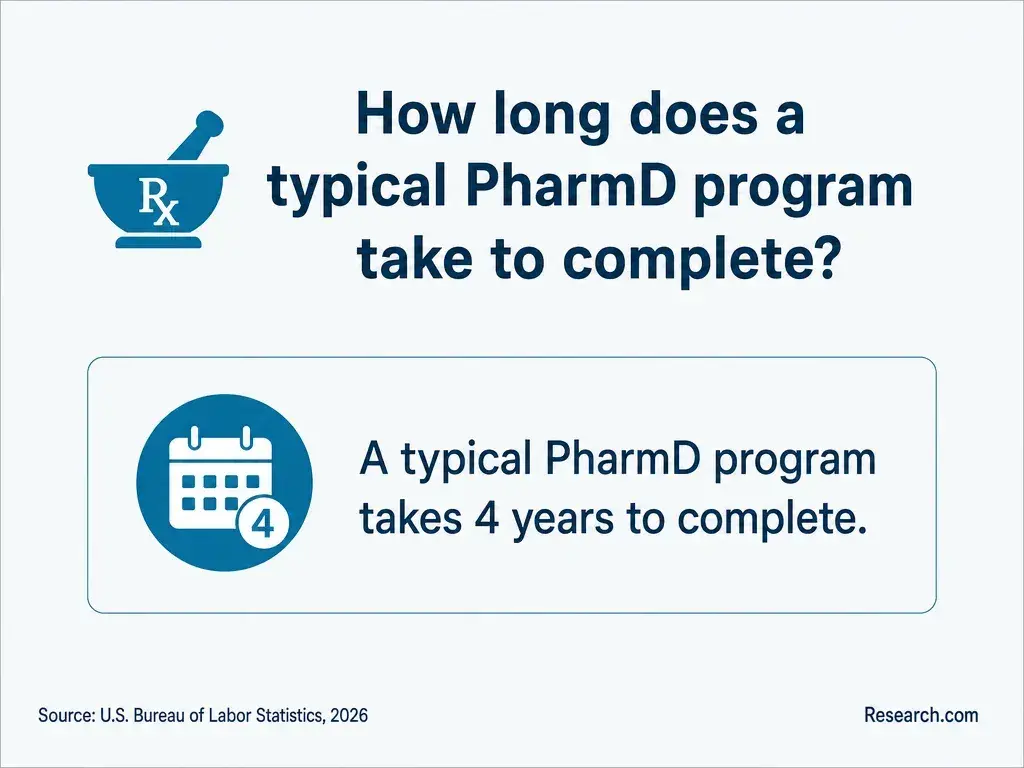
The professional curriculum generally takes several academic years after required pre-professional study; accelerated and other calendars vary by school. Count unfinished prerequisites before comparing advertised completion times. For pharmacy doctorate financial planning, compare the cost of reaching licensure eligibility, not tuition alone.
Request each school's current cost-of-attendance estimate and note what it includes. The following costs can differ substantially by location and delivery format:
- Prerequisite courses, professional tuition, mandatory fees, books, technology, and supplies.
- Campus visits, clinical-rotation travel or housing, immunizations, background checks, and any required registration.
- Living expenses during full-time study and later licensure-application and examination costs.
Ask the financial aid office for a student-specific estimate for your entry year. Federal borrowing rules changed for many new graduate and professional borrowers beginning July 1, 2026; do not assume a past student's loan eligibility or access to Grad PLUS applies to you. Compare any funding gap with the earnings you may forgo during prerequisites and professional study.
Before committing to a cohort, check the program's current professional accreditation status in the Accreditation Council for Pharmacy Education (ACPE) program records. Institutional accreditation is a separate matter. For distance education, also confirm the school can enroll you in your state and arrange or approve required clinical placements there. Generic online doctoral program duration comparisons do not establish that a degree meets pharmacist-licensure education requirements.
A Pharm.D. does not itself grant a pharmacist license. U.S.-educated graduates generally must meet their state board's eligibility requirements and pass the North American Pharmacist Licensure Examination (NAPLEX), along with any applicable state law examination and other board requirements. Do not assume every jurisdiction uses the Multistate Pharmacy Jurisprudence Examination (MPJE): jurisprudence requirements vary, and some jurisdictions began transitioning to the Uniform Multistate Pharmacy Jurisprudence Examination (UMPJE) in 2026. Check the board where you intend to practice before choosing an exam or making a relocation plan.
What careers, salaries, and job outlook follow a PharmD degree?
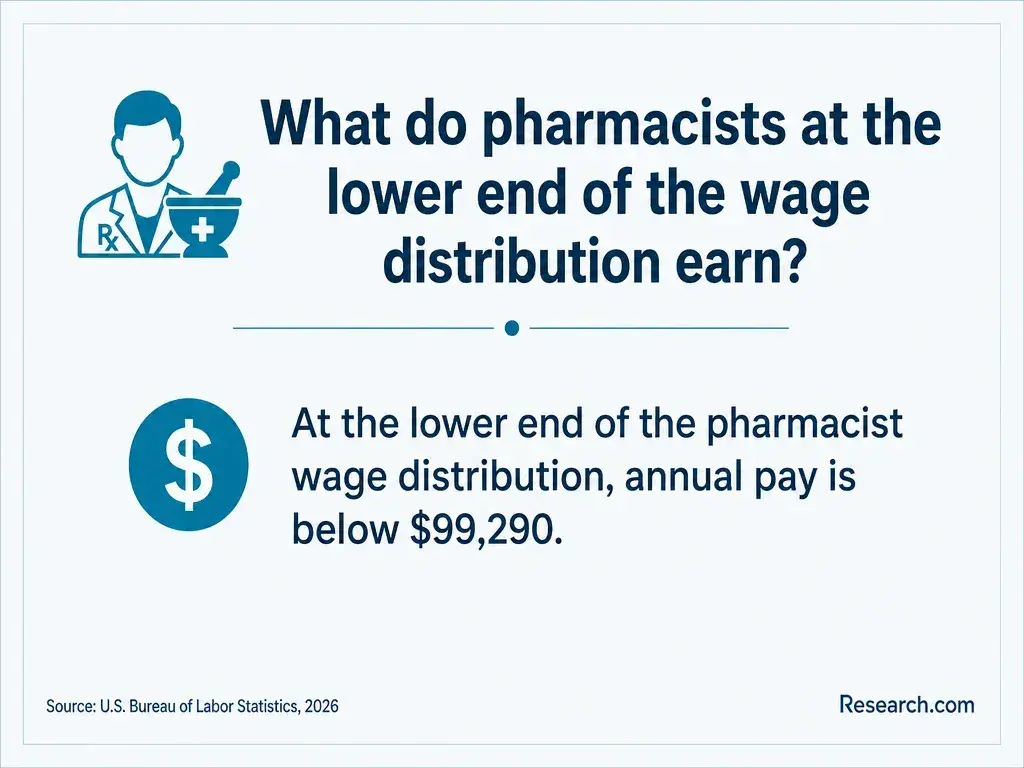
A Pharm.D. is the educational route toward pharmacist licensure, with potential work in community, hospital, ambulatory care, and other practice settings after state requirements are met. The Bureau of Labor Statistics reports pharmacist median annual pay of $140,910 in May 2025 and projects 5% growth, 2025-2035, with about 12,500 openings per year. Those occupation-wide figures are context for a long-term decision, not a new graduate's salary offer or a guaranteed return on tuition.
A residency is postgraduate training, a fellowship is a different postgraduate pathway often associated with research or industry, and specialty board certification is a credential separate from state licensure; none is universally required for pharmacist jobs. If your intended role is pharmacy technician rather than pharmacist, it does not ordinarily require a Pharm.D. Weigh that distinction when using pharmacy degree planning for cost and time: choose the professional degree because the work you want requires or meaningfully benefits from pharmacist training, not because it is the longest available credential.
Other Things You Should Know About PharmD
That depends on the school's application and reapplication policies. Ask whether it permits a second entry-term choice and whether materials or fees carry forward.
Do not assume so. Ask whether the school offers a new review, requires a fresh application, or has a formal carryover policy.
Possibly, but only if the school permits it. Contact admissions promptly and get written confirmation of any changed deadline, prerequisite condition, or application requirement.
Follow the current application service and school instructions. You may be able to submit before all materials arrive, but your file may remain incomplete; confirm the applicable receipt or verification deadline first.
- Chapter 9 - Vaccination Requirement https://www.uscis.gov/policy-manual/volume-8-part-b-chapter-9
- School-Determined Requirements | 2024-2025 Federal Student Aid Handbook https://fsapartners.ed.gov/knowledge-center/fsa-handbook/2024-2025/vol1/ch1-school-determined-requirements
- UCSF PharmD degree program https://pharmd.ucsf.edu/home
- Doctor of Pharmacy (PharmD) | usc.edu https://mann.usc.edu/program/doctor-of-pharmacy-pharmd/
- How to Get Great Letters of Recommendation for Grad School | UW Professional & Continuing Education https://www.pce.uw.edu/news-features/articles/great-letters-recommendation-grad-school
- PharmD Application Process - School of Pharmacy https://pharmacy.wisc.edu/pharmd/application-process/
- International Applicants | umich.edu https://sph.umich.edu/admissions/international-applicants.html
- College Application Deadlines and What They Mean | The Emerson Grad Life Blog https://websites.emerson.edu/grad-life/2024/10/01/college-application-deadlines-and-what-they-mean/
- Pharmacy Timeline - Berkeley Career Engagement https://career.berkeley.edu/get-into-grad-school/health-professional-schools/pharmacy/pharmacy-timeline/
- Health Sciences Application for Admission | tccd.edu https://tccdforms.tccd.edu/Forms/HealthSciencesProgramApplication