
Statistics Prerequisites for PharmD Programs

Co-Founder and Chief Data Scientist
A statistics course can look like a straightforward pharmacy school prerequisite until one program accepts it and another asks for a different course or credit amount. If you are planning pre-pharmacy classes or checking credits you already earned, the safest choice depends on your target Doctor of Pharmacy (Pharm.D.) programs - not a general admissions checklist.
This guide explains which courses may qualify, how online and transfer credit are evaluated, and what to ask admissions offices before you spend time or money on a class.
Key Things You Should Know
- There is no single nationwide Pharm.D. statistics prerequisite: check each program's current course, credit, grade, and completion rules.
- An introductory statistics or biostatistics course may qualify, but its title alone does not establish equivalency; a syllabus can help the school evaluate it.
- Three semester credits is a common course size, not a universal requirement. Get written confirmation before relying on AP, online, quarter-system, or transfer credit.
What statistics course is required for PharmD program admission?
Many Pharm.D. programs list statistics among their pre-professional prerequisites - college coursework completed before entry into the professional degree. A listing might say "statistics," specify introductory statistics, or identify an acceptable equivalent. Other programs organize their math requirements differently. The course that counts is the one your intended school accepts for its current admissions cycle.
Read the requirement alongside its minimum grade, credit amount, and completion deadline. A course may be acceptable in subject matter but still fail to meet a school's credit or grading rule. Applicants returning to school should also check whether a program limits the age of prerequisite coursework; pharmacy school routes for returning students are worth comparing only after confirming which outstanding courses must be finished before enrollment.
Do PharmD programs accept biostatistics or introductory statistics?
Either may be accepted, depending on the program. Admissions staff may consider the course level, department, credits, and syllabus rather than its title alone. Biostatistics often applies statistical methods to health or biological data; that focus can be relevant to pharmacy, but it does not make the course an automatic substitute.
The comparison below shows why the course description matters more than a familiar name.
| Course type | Potential fit | What may require closer review |
| College-level introductory statistics | May match a broadly worded statistics requirement | Whether its credits and course level meet the school's rule |
| Biostatistics | May meet a statistics requirement when it teaches comparable methods | Whether the school accepts a biology- or health-focused course |
| Research methods with some statistics | May provide useful preparation | Whether statistics is substantial enough to count as the prerequisite |
Students coming from biology, chemistry, or pre-pharmacy study can use Doctor of Pharmacy pathways after pre-pharmacy study to identify programs to investigate, then ask each one to evaluate the actual statistics course.
How many credits of statistics do PharmD prerequisites require?
Three semester credits is a common size for a college statistics course, but it is not a nationwide Pharm.D. admissions rule. Check the exact number and credit system on each program's current prerequisite list. A quarter-system course may need a credit conversion, and a course with fewer credits may not satisfy a requirement even if its subject matter is appropriate.
If you must take statistics solely for admission, include its tuition, required materials, and scheduling in your education budget. A lower-priced Pharm.D. does not necessarily offset additional prerequisite expenses; compare those costs when exploring lower-cost online Pharm.D. pathways. Online professional study may still include in-person requirements.
A suitable introductory course generally develops the ability to summarize data, understand probability and sampling, interpret confidence intervals, test hypotheses, and examine relationships using methods such as correlation or regression. These skills help students read clinical evidence and evaluate claims about treatments during the professional Pharm.D. curriculum.
Course coverage is an evaluation aid, not a substitute for a school's stated policy. For example, a research methods class may discuss study design without teaching enough statistical analysis to qualify. If you are considering faster Doctor of Pharmacy routes, check prerequisite sequencing early: an otherwise suitable statistics class is of little use for an accelerated start if it ends after the program's completion deadline.
Often they can, but the receiving Pharm.D. program decides. Confirm that the course awards college credit on an official transcript and meets the program's policies on course level, grading, and online delivery. An online certificate of completion is not necessarily equivalent to transcripted college coursework.
Keep the prerequisite's delivery format separate from the professional degree's format. If you also plan to pursue Doctor of Pharmacy study online, verify that program's accreditation and any campus, laboratory, and in-person clinical requirements separately. Permission to take prerequisite statistics online does not mean the Pharm.D. can be completed entirely from home.
Policies vary. A school may accept Advanced Placement (AP) Statistics only when it appears as college credit on an official transcript, may require a particular score, or may insist on a college-level course instead. For coursework completed at another college, the receiving program decides whether the credits meet its statistics prerequisite; credit appearing on your current transcript does not, by itself, settle that decision.
Ask whether the school needs both the original institution's transcript and a syllabus. Also distinguish prerequisite credit from transfer into the professional Pharm.D. curriculum: approval for one does not imply approval for the other. That distinction matters when reviewing pharmacy transfer credit requirements.
Statistics is only one possible part of pre-pharmacy study. Programs commonly specify science coursework such as chemistry and biology, along with other math or general education requirements, but the exact courses, laboratory components, credits, and grades vary. Do not assume that a completed bachelor's degree is required - or that it replaces missing prerequisites.
Compare each school's published checklist against your transcript before choosing an additional statistics class. For pharmacy programs for nontraditional applicants, pay particular attention to course-age policies and whether prior coursework meets current lab requirements. An admissions minimum establishes eligibility for review, not a promise of admission.
First, a statistics grade must meet any minimum prerequisite grade the program sets. Beyond that threshold, the course may contribute to an overall or prerequisite GPA review, depending on the school. A strong grade can demonstrate quantitative readiness, but one course does not determine an admission decision by itself.
If you are considering a retake, ask how the school treats repeated grades and whether both attempts must be reported. Compare the time and expense of a retake with its likely admissions value; an online pharmacy degree cost comparison should not obscure the separate cost of prerequisite coursework. No published minimum GPA or course grade guarantees acceptance.
Start with each target school's current admissions page or PharmCAS school listing, if that school uses PharmCAS. Because policies can change between application cycles, confirm the answer with the program before enrolling in a borderline course or relying on credit already earned.
Use this sequence to get a decision you can act on:
- Record the school's exact statistics wording, required credits, minimum grade, and deadline for completing prerequisites.
- Send admissions staff the course number, institution, credit system, description, and syllabus; disclose whether it is online, AP-based, or transfer coursework.
- Ask whether the course is approved for your intended entry cycle and whether any conditions remain, such as an official transcript or final grade.
- Save the written response and check whether a later change in course content or program policy requires another review.
Be especially careful if a search for the quickest online pharmacy study routes surfaces a short non-Pharm.D. credential. Confirm that any statistics course earns acceptable college credit; a short pharmacy program does not itself satisfy Pharm.D. admission requirements.
What education and licensing steps follow PharmD prerequisite completion?
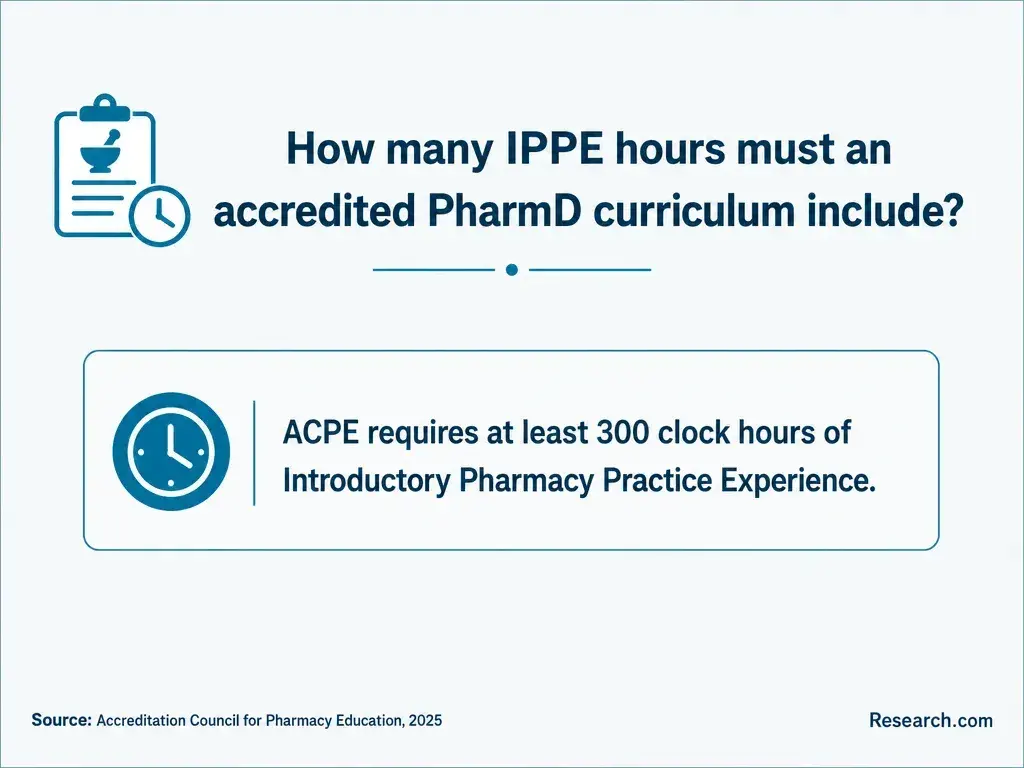
Meeting prerequisites makes you eligible to pursue a program's admissions process; it does not complete pharmacy education. After admission, students undertake the professional Pharm.D. curriculum, including supervised introductory and advanced pharmacy practice experiences. When comparing programs, verify professional-program accreditation through the Accreditation Council for Pharmacy Education (ACPE). ACPE accreditation is distinct from institutional accreditation and, for online study, state authorization.
Graduation alone does not issue a pharmacist license. U.S.-educated graduates must meet the relevant state board's requirements, which generally include the North American Pharmacist Licensure Examination (NAPLEX) and may include a jurisdiction-specific law examination and other conditions. Postgraduate residency or fellowship training is separate from licensure and is not required for every pharmacist role. Likewise, accelerated online doctoral education should not be assumed to provide an accredited Pharm.D. route or eligibility for pharmacist licensure.
Other Things You Should Know About PharmD
Not automatically. Calculus and statistics teach different material. Ask the program whether it explicitly allows a substitution before relying on calculus credit.
A separate statistics lab is not a standard assumption. Check the program's course listing for any lab or other component it specifically requires.
That depends on the school's grading policy and how the credit appears on your transcript. Seek written approval, particularly if the program requires a minimum letter grade.
Possibly, but programs set their own rules for international coursework and may require a designated credential evaluation. Confirm both the evaluation process and whether the course satisfies statistics specifically.
- U.S. Graduate Pharmacy References | EducationUSA https://educationusa.state.gov/your-5-steps-us-study/research-your-options/graduate/graduate-student/what-graduate-programs-a-4
- School-Determined Requirements | 2024-2025 Federal Student Aid Handbook https://fsapartners.ed.gov/knowledge-center/fsa-handbook/2024-2025/vol1/ch1-school-determined-requirements
- Are Prerequisite Courses Barriers to Pharmacy Admission or the Keys to Student Success? - PMC https://pmc.ncbi.nlm.nih.gov/articles/PMC10159397/
- FAQ | OSU College of Pharmacy - Oregon State University https://pharmacy.oregonstate.edu/programs-admissions/pharm-d/faq
- Early Credit | lsu.edu https://www.lsu.edu/admissions/academics/early-credit.php
- Academic Policies and Procedures | ggc.edu https://catalog.ggc.edu/content.php
- Doctor of Pharmacy (PharmD) - Prospective Students https://www.pharmacy.umaryland.edu/academics/pharmd/prospective-students/
- PharmD FAQs - UNC Eshelman School of Pharmacy https://pharmacy.unc.edu/education/pharmd/pharmd-admissions-faqs/
- Admissions: USC Mann PharmD Program https://mann.usc.edu/program/doctor-of-pharmacy-pharmd/admissions/
- Distance Doctor of Pharmacy | University of Findlay https://pharmdonline.findlay.edu/programs/online-pharm-d


