How to choose between online and in-person pharmacy school

Co-Founder and Chief Data Scientist
Choosing an online or in-person pharmacy school is not simply a choice between studying at home and attending class on campus. Both paths must prepare you for hands-on training, and an online program may still require travel, scheduled classes, and full-time clinical rotations. If you are considering a U.S. Doctor of Pharmacy (Pharm.D.) degree, this guide will help you compare the commitments that affect daily life and total cost - and identify what to verify before you enroll.
Key Things You Should Know
- Choose a Pharm.D. program accredited by the Accreditation Council for Pharmacy Education (ACPE), then separately confirm distance-learning authorization and the requirements of the state where you intend to seek licensure.
- An online Pharm.D. can reduce routine commuting, but expect required in-person skills training and supervised clinical rotations; ask for the actual calendar before assuming you can keep a full-time job.
- Compare total costs, not tuition alone. The U.S. Bureau of Labor Statistics reports pharmacist median annual pay of $140,910 in May 2025, but that occupational median does not predict your earnings or make a costly program a sound investment.
What is the difference between online and in-person pharmacy school?
The main difference is where and how you complete classroom instruction. An online or hybrid Pharm.D. may deliver lectures and discussions remotely, while a campus program conducts most instruction in person. Neither format eliminates the professional degree's hands-on requirements. "Online" also does not necessarily mean self-paced: programs may have live classes, fixed exam times, and required campus visits.
This comparison highlights the practical differences to check with each school. A program's published schedule, rather than its delivery label, determines how flexible it is for you.
| Decision factor | Online or hybrid Pharm.D. | In-person Pharm.D. |
| Weekly learning | More instruction away from campus; live sessions may still be mandatory | Regular campus classes, labs, and meetings |
| Hands-on work | Scheduled in-person labs or immersions and supervised practice experiences | Campus labs and supervised practice experiences |
| Location costs | Possible travel and temporary housing for required activities | Possible relocation or ongoing commuting costs |
| Best potential fit | Students who can study independently and accommodate required travel | Students who prefer frequent face-to-face instruction and campus access |
Start with online pharmacy education options if location is your main constraint, but check each option's actual credential and attendance requirements. If reliable access to instructors, classmates, and campus facilities matters more than reducing commutes, an in-person program may be the better choice.
Are online pharmacy schools accredited and recognized for licensure?
Online delivery does not prevent a professional Pharm.D. program from holding ACPE accreditation. What matters is the specific professional program's current status, not a general claim that its university is accredited. Institutional accreditation, ACPE professional-program accreditation, and a school's authorization to enroll distance-learning students in your state address different questions.
Before applying, look up the program in ACPE's official directory and ask the school whether it can enroll you and arrange required in-person activities where you live. Then ask the pharmacy board in the state where you hope to practice whether the program and your planned training meet its licensure rules. State authorization to study online is not, by itself, approval of a clinical placement or a promise of pharmacist licensure.
Be especially cautious when comparing accelerated online doctoral education: a short doctorate in another subject is not interchangeable with a professional Pharm.D. for the U.S.-educated pharmacist licensure pathway.
What degree do you need to become a licensed pharmacist?
For the usual U.S.-educated pathway, you complete required pre-professional coursework, graduate from a qualifying professional Pharm.D. program, and meet your state board's examination and other licensing requirements. Pre-pharmacy science courses prepare you to enter the professional program; they are not the Pharm.D. itself. A bachelor's degree is not universally required for admission, although individual schools set their own rules.
A degree in pharmaceutical sciences, pharmacology, or pharmacy technology does not automatically qualify its holder for pharmacist licensure. Pharmacy technicians perform a different occupation under applicable state rules. Internationally educated pharmacists may have a separate certification and licensure pathway and should consult the relevant board and the National Association of Boards of Pharmacy (NABP).
If you already have substantial science coursework, explore an online Pharm.D. for students with prior science study, but request a course-by-course prerequisite evaluation. Previous study may satisfy entry requirements without shortening the professional curriculum.
Both formats should prepare students to apply pharmaceutical science to medication use and patient care. Professional coursework commonly covers topics such as pharmacology, therapeutics, calculations, drug information, patient communication, and medication safety. Programs differ in sequencing, electives, assessment methods, and how students practice and demonstrate skills.
An online program may teach concepts through recorded or live instruction and virtual cases, then require in-person assessments or labs for skills that cannot be established through videos alone. Campus programs offer more routine access to physical labs, but that does not establish that every campus program provides better instruction. Compare syllabi, access to faculty, required attendance, skills assessments, and support when students struggle.
Some shorter pharmacy doctorate pathways use a compressed academic calendar. Ask whether a shorter timeline changes breaks, weekly workload, or rotation scheduling before treating it as a more flexible option.
Requirements vary by school and may include specified undergraduate prerequisite courses and labs, minimum grades, transcripts, recommendations, an interview, and an application through PharmCAS or the school's own process. A published minimum is an eligibility threshold, not an admission guarantee. The Pharmacy College Admission Test (PCAT) was retired in January 2024; do not plan around taking it.
Applicants comparing formats should request a prerequisite review early, particularly if they have community-college credits, online labs, older science courses, or an unfinished bachelor's degree. The receiving school decides which credits it accepts and whether they meet particular requirements. Some schools permit an application while courses are in progress but require completion before enrollment.
If that timing affects your choice, review options to apply to pharmacy school while finishing prerequisites, then confirm the current school-specific policy, deadline, and conditions directly with admissions.
Many professional Pharm.D. curricula take four academic years after prerequisite study; accelerated calendars and other structures vary. Ask each school for a term-by-term plan showing classes, campus visits, introductory practice, and advanced rotations. The shortest advertised curriculum may not be your fastest route if you still need prerequisites or cannot meet its intensive schedule.
For cost, compare the full amount you would need to attend - not just a tuition figure. The following categories can differ substantially between an online student who travels for required activities and a campus student who relocates.
| Cost category | What to compare |
| School charges | Tuition across all required terms, mandatory fees, and any summer enrollment |
| Course requirements | Books, clinical references, technology, testing, and lab supplies |
| In-person attendance | Campus travel, lodging, commuting, or relocation |
| Clinical and licensing preparation | Rotation travel or housing, required clearances, and exam-related expenses |
Use each school's current cost-of-attendance estimate and your own location-based budget for Pharm.D. tuition planning. Ask the financial aid office how your enrollment and borrower status affect aid. Federal borrowing rules changed for many new graduate and professional borrowers beginning July 1, 2026, so do not rely on an older loan-limit or Grad PLUS estimate.
Online students complete required hands-on work in person. Programs may bring students to campus for labs and skills assessments. They also arrange or approve supervised introductory pharmacy practice experiences (IPPEs) and advanced pharmacy practice experiences (APPEs) at practice sites. APPEs generally involve more sustained, advanced clinical work than introductory experiences.
A nearby placement is not automatic. Ask who finds and approves sites and preceptors, when rotations occur, and whether you may need to travel or temporarily relocate. Students may also need intern registration, background checks, immunizations, and compliance with site-specific rules. A current pharmacy job should not be assumed to replace a required rotation.
Be wary of an advertised online pharmacy degree duration without checking the credential: a short program may not be a professional Pharm.D. Even when coursework is remote, full-time rotations can make continued full-time employment impractical.
Graduation does not issue a pharmacist license. State boards determine eligibility and generally require the North American Pharmacist Licensure Examination (NAPLEX), along with other applicable requirements. Jurisprudence testing varies by jurisdiction: depending on the state and current transition rules, an applicant may encounter the Multistate Pharmacy Jurisprudence Examination (MPJE), the Uniform MPJE (UMPJE), another assessment, or different procedures. Some jurisdictions began transitioning to the UMPJE in 2026.
Before choosing a school, check your intended state board's current rules for education, intern experience, application steps, and exams. This is especially important if you plan to move or complete rotations across state lines; another state may assess your education and experience differently. Passing an exam alone does not confer a license.
If you are considering pharmacy degree programs for transfer students, ask the receiving school how professional courses and practice experiences would count, then check whether your intended licensing board has additional requirements. Transfer credit and qualifying intern experience are not necessarily the same thing.
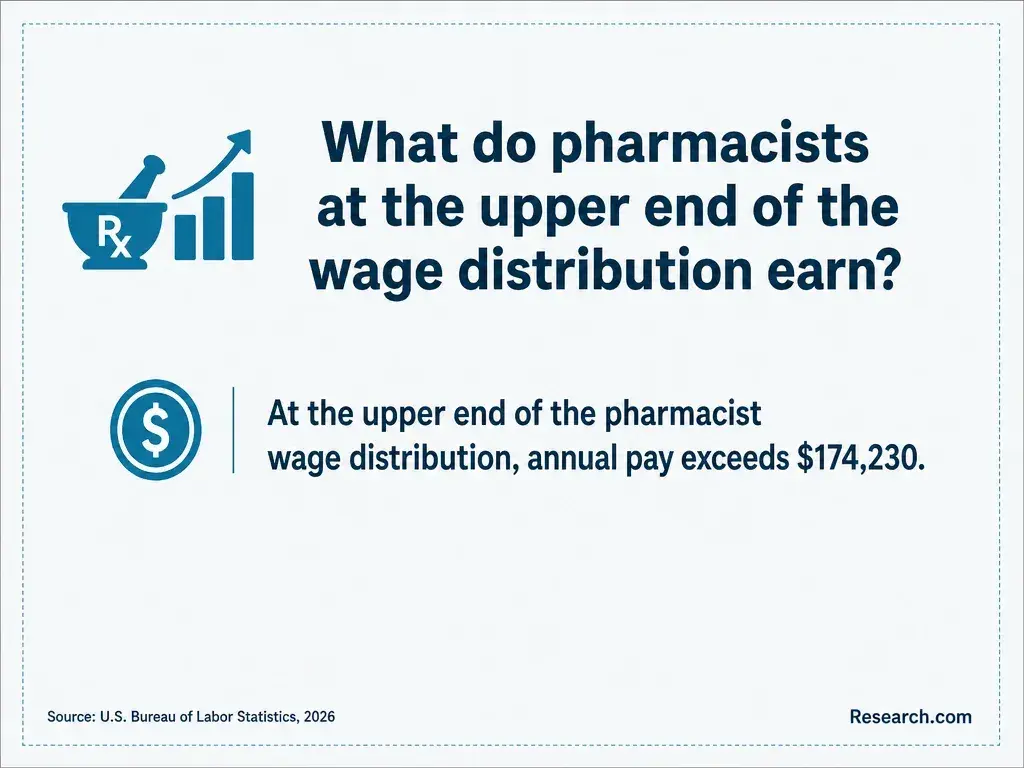
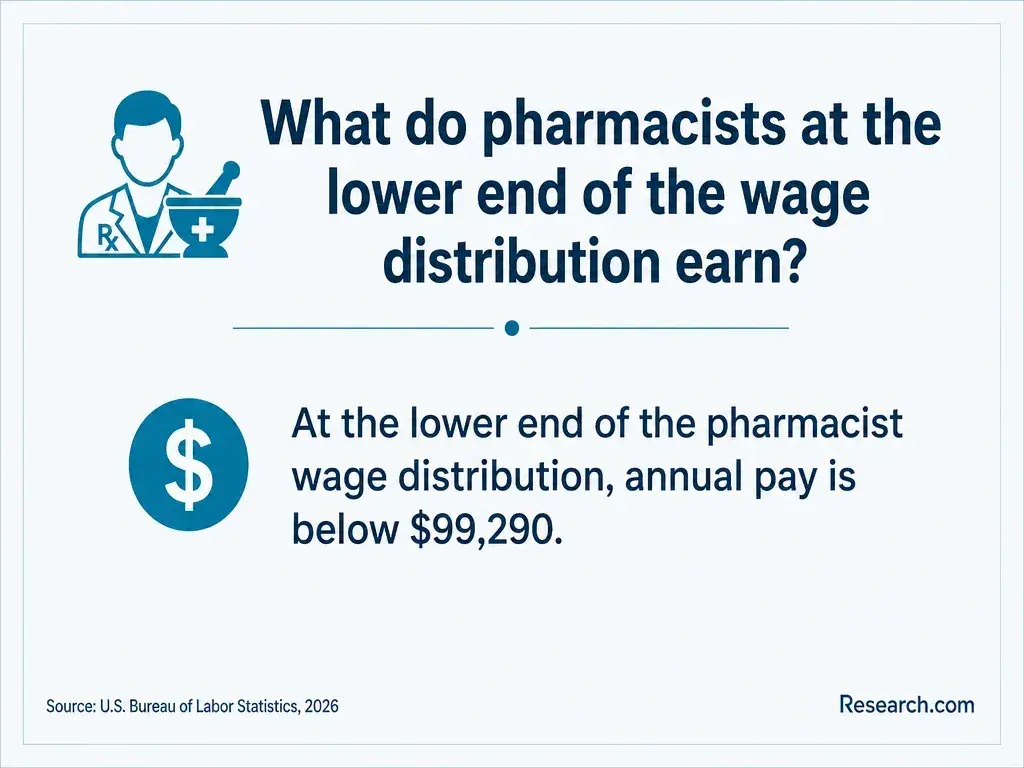
Licensed pharmacists work in settings such as community pharmacies, hospitals, health systems, ambulatory care, and specialty pharmacy. The U.S. Bureau of Labor Statistics reports median annual pay of $140,910 in May 2025 and projects 5% employment growth from 2025-2035, with about 12,500 openings per year. These are occupation-wide figures, not starting salaries or outcomes for graduates of either delivery format.
Some positions favor postgraduate training. A residency provides structured practice training; a fellowship generally emphasizes a different specialized training or research path. Board certification is a separate specialty credential, not a substitute for state licensure. None is universally required for pharmacist jobs.
When comparing affordable pharmacy studies with a focused timeline, weigh likely debt and time away from work against the positions you actually want. If your goal is a pharmacy technician role rather than licensed pharmacist practice, a Pharm.D. may be unnecessary.
How can you choose a reputable online or in-person pharmacy program?
Shortlist programs only after confirming that their professional credential and required locations work for you. Then compare written answers - not broad claims of convenience or prestige. Use these checks to make a decision you can act on:
- Verify the specific Pharm.D. program's current ACPE status and confirm distance-learning authorization separately if you will study online.
- Ask admissions to evaluate your prerequisites and provide the complete course sequence, attendance rules, and dates of required campus activities.
- Get the rotation placement policy in writing, including who secures sites, possible travel, and what happens if a preferred local site is unavailable.
- Compare total costs and current aid eligibility, then review published NAPLEX outcomes with their cohort sizes and reporting periods rather than treating a single figure as a guarantee.
- Confirm your intended state board's current licensure rules before paying a deposit.
Resources describing pharmacy schools with accessible admissions can help you identify possibilities, but accessible admission is not a measure of program quality. Choose online if its verified schedule and placements solve a real location problem; choose campus if routine in-person learning better supports you and its location costs are manageable. Neither format removes the need to plan for clinical training and licensure.
Other Things You Should Know About PharmD
Possibly, if you meet your state's technician rules and your employer can accommodate your classes and rotations. Technician work can provide useful exposure, but it does not automatically satisfy Pharm.D. practice requirements.
Only if the school offers that option and approves the change. Ask whether courses match term for term and whether switching would delay graduation or change tuition.
Diploma and transcript wording is set by the institution. Ask the registrar for the exact wording if it matters to you; do not infer it from promotional materials.
Yes, graduates may apply if they meet each residency's eligibility requirements. Programs assess applicants individually, and neither hybrid delivery nor graduation guarantees a position.
- GAC - Chapter 480-2 LICENSURE AS A PHARMACIST https://rules.sos.ga.gov/gac/480-2
- Pharmacy - Rhode Island Department of Health https://health.ri.gov/licensing/pharmacy
- Understanding College Costs | studentaid.gov https://studentaid.gov/resources/prepare-for-college/students/choosing-schools/consider-costs
- U.S. Graduate Pharmacy References | EducationUSA https://educationusa.state.gov/your-5-steps-us-study/research-your-options/graduate/graduate-student/what-graduate-programs-a-4
- PharmD Remote Pathway | CU School of Pharmacy https://pharmacy.cuanschutz.edu/degreesandprograms/pharmd/remote-pharmd
- Pharmacy (PharmD) - Bouvé College of Health Sciences https://bouve.northeastern.edu/programs/pharmacy-pharmd/
- Student Performance - School of Pharmacy https://pharmacy.ku.edu/student-performance
- Can You Really Earn a Pharm.D. Online? Here's What to Expect - Lake Erie College of Osteopathic Medicine https://lecom.edu/can-you-really-earn-a-pharm-d-online-heres-what-to-expect/
- Pharmacy Intern License Information | Rhode Island Small Business Development Center https://web.uri.edu/pharmacy/academics/pharmd/resources/pharmacy-intern-license-information/
- PharmD FAQs - UNC Eshelman School of Pharmacy https://pharmacy.unc.edu/education/pharmd/pharmd-admissions-faqs/