How Tuition Increases Affect the Total Cost Of a PharmD

Co-Founder and Chief Data Scientist
A Pharm.D. tuition quote may cover only the first academic year, while the professional program lasts several years. For prospective pharmacy students, that gap can change both the amount paid and the amount borrowed.
This guide shows how to project tuition increases, identify costs beyond tuition, and compare schools on a consistent basis. You'll leave with a practical way to test whether a program remains financially workable - not just whether its current price looks manageable.
Key Things You Should Know
- An annual tuition increase affects each later year's bill; compare projected program tuition, not just the first-year rate.
- Fees, prerequisite coursework, living costs, and rotation travel can raise the total cost even when tuition stays flat.
- Borrowing can cost more than the amount billed because interest accrues; confirm your 2026-27 aid eligibility before relying on loans to cover a projected increase.
How do tuition increases affect the total cost of a PharmD?
A tuition increase raises the price of the years still ahead of you. If a school sets a new rate each year, a student who compares programs using only first-year tuition may understate the eventual bill. The effect is greater when increases compound: each new rate builds on the preceding rate rather than the original one.
For a four-year program with constant annual tuition in the first year, call that amount T and the assumed annual increase g. Projected tuition is T × [1 + (1 + g) + (1 + g)² + (1 + g)³], before fees. This is a planning scenario, not a prediction: schools may set different increases, change fees separately, or offer a published tuition guarantee.
The borrowing effect depends on when bills come due, what aid is available, and how much you pay without loans. Borrowed increases may also accrue interest, making eventual repayment higher than the added tuition itself. When comparing Doctor of Pharmacy programs with manageable tuition, ask whether published rates are guaranteed for your entering cohort or subject to annual change.
What expenses make up the total cost of a PharmD program?
The total educational cost includes more than the advertised professional-program tuition. The categories below show which charges to compare across schools and which may change as tuition rises.
| Cost category | What it can include | Why it matters to the comparison |
| Tuition and required fees | Professional coursework, university fees, labs, and technology | Fees may rise independently of tuition or be excluded from a quoted rate. |
| Preparation and course materials | Unmet prerequisites, textbooks, clinical references, and supplies | Previously completed coursework may reduce preparation costs only if the school accepts it. |
| Attendance and experiential education | Housing, transportation, campus visits, and clinical-rotation travel | Placements or required in-person activities can create costs not visible in the tuition quote. |
| Professional requirements | Background checks, immunizations, intern registration where required, and licensure applications and exams | Timing and charges vary by program and jurisdiction. |
Ask the school for its current cost-of-attendance estimate, but treat it as a planning tool rather than a personal bill. A student assigned to a distant clinical site may spend more on travel or temporary housing. Before paying for additional courses, check how pharmacy programs review transfer credits: the receiving school decides which prerequisite or professional credits, if any, apply.
How can students estimate future PharmD tuition and borrowing costs?
Build a year-by-year comparison for each school rather than multiplying its current tuition by the program length. Use the same assumptions for every option, and keep school-confirmed charges separate from your own estimates.
This sequence captures the information most likely to change your decision:
- Record each school's published tuition and required fees for your entering academic year, noting whether charges are per credit, term, or year.
- Ask whether tuition is locked for your cohort; if not, model unchanged tuition alongside a clearly labeled increase scenario.
- Add expected prerequisite, living, campus-visit, rotation, and licensure costs in the years when they are likely to occur.
- Subtract only scholarships or employer support you are eligible to receive, and check whether awards renew in later years.
- Estimate what remains to borrow each year, then use your loan servicer's or Federal Student Aid's current repayment tools to examine interest and monthly-payment implications.
Federal borrowing rules changed for many new graduate and professional borrowers beginning July 1, 2026. Do not assume an older Grad PLUS arrangement or borrowing limit will apply to you; confirm your student classification, aid-year rules, and any transitional eligibility with each school's financial aid office. If unfinished prerequisites affect your budget, review pharmacy program preparation requirements before treating an admission offer as the start of your only remaining education costs.
The professional Pharm.D. curriculum commonly takes four academic years after required pre-professional coursework, though some schools offer accelerated calendars. Prerequisites may add time before entry; a completed bachelor's degree is not universally required. School-specific sequencing, repeated courses, or a leave of absence can also change the finish date.
Time affects cost in competing ways. A shorter program may reduce living expenses and allow an earlier move toward pharmacist employment, but its tighter calendar can limit paid work and compress tuition bills into fewer years. Compare the full projected price and feasible work schedule - not just the graduation date - when considering accelerated Pharm.D. degree options.
Schools set their own prerequisite courses, laboratory policies, minimum grades, application materials, and deadlines. Some require a specified amount of college coursework rather than a bachelor's degree. Programs may use PharmCAS, the centralized pharmacy-school application service, but applicants must check each school's current instructions and any supplemental requirements. The Pharmacy College Admission Test, or PCAT, was retired in 2024 and is not a current exam applicants can plan to take.
Admission requirements have a direct cost implication: missing prerequisites can mean additional tuition and delayed entry, while an application minimum does not guarantee acceptance. Even when comparing pharmacy schools that may be easier to enter, check your individual prerequisite evaluation and the total cost of reaching matriculation before committing to a school.
Online or hybrid instruction may reduce routine commuting or relocation costs, but it does not necessarily eliminate travel. A program can require scheduled live classes, campus-based labs or assessments, and in-person introductory and advanced pharmacy practice experiences. Campus-based students face similar rotation-related travel risks when placements are not nearby.
For an accurate comparison, request each program's required visit schedule, placement policies, and expected student responsibilities for transportation and housing. Also confirm distance-education authorization for your location separately from the program's accreditation and your intended state's licensure rules. An online Pharm.D. program selection should account for these obligations rather than treating "online" as fully remote or self-paced.
Professional Pharm.D. coursework typically develops knowledge of medicines, patient assessment, therapeutics, medication safety, and pharmacy practice. Supervised introductory pharmacy practice experiences (IPPEs) and advanced pharmacy practice experiences (APPEs) apply that learning in practice settings. These requirements are distinct from undergraduate pre-pharmacy prerequisites, even when both include science courses.
Curriculum design matters financially because labs, learning resources, and rotations can carry separate charges or limit time available for paid work. Students considering online pharmacy programs for science-background students should ask which prior courses satisfy entry prerequisites, which professional courses must still be completed, and whether rotation locations could add travel expenses. Prior science study does not automatically shorten the professional curriculum.
Accreditation by the Accreditation Council for Pharmacy Education (ACPE) is a fundamental check when selecting a U.S. professional Pharm.D. program. Verify the particular program and its current status in ACPE's official records before comparing prices. Institutional accreditation and authorization to offer distance education are separate matters; neither substitutes for checking professional-program accreditation.
A lower tuition quote is not a bargain if the program does not support your intended path to pharmacist licensure. Conversely, accreditation does not establish that a school is affordable or guarantee an individual graduate a license. Comparisons with fast online doctoral study in other fields should not obscure that pharmacist preparation requires the appropriate professional degree and supervised education.
Graduation does not itself issue a pharmacist license. U.S.-educated applicants generally need to satisfy their state board's eligibility rules and pass the North American Pharmacist Licensure Examination (NAPLEX), along with any applicable law examination and other jurisdiction-specific requirements. Depending on the jurisdiction, the law assessment may be the MPJE, the UMPJE, another process, or no separate jurisprudence exam; confirm the current rule with the board where you plan to practice.
Budget for applications, examinations, and any required intern registration rather than assuming those charges are included in tuition. Be cautious with claims about online pharmacy education duration: a shorter pharmacy-related credential does not replace a qualifying Pharm.D. and state licensure process for someone seeking to practice as a pharmacist.
What salary and job outlook can PharmD graduates expect?
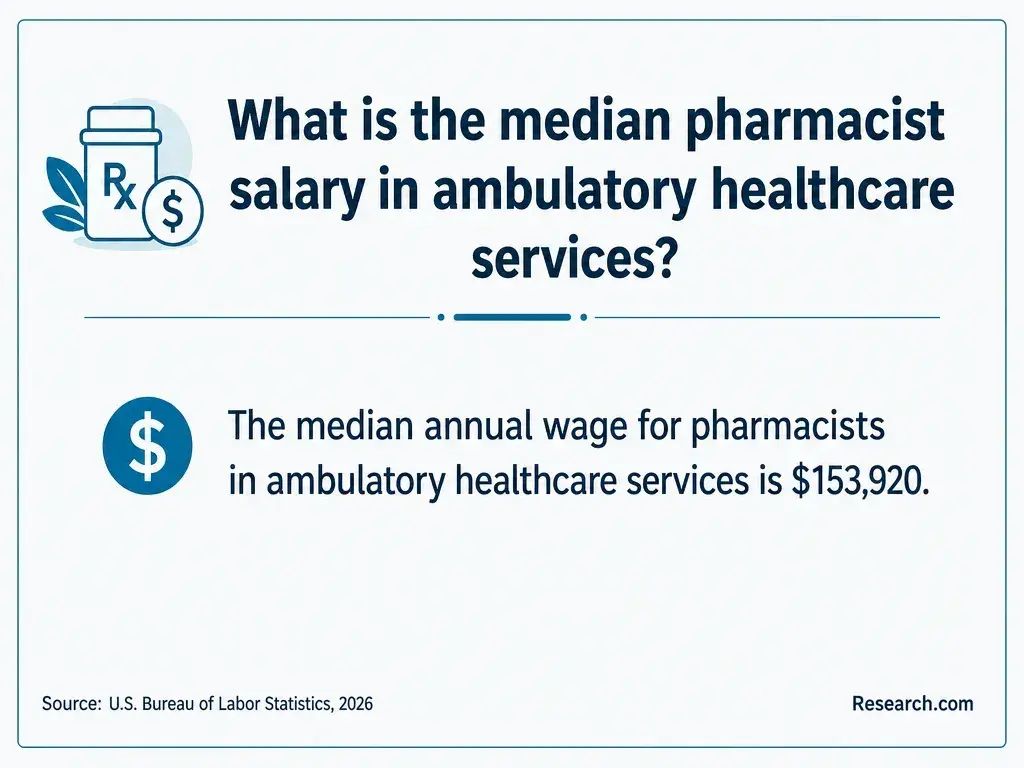
The Bureau of Labor Statistics reports median annual pay for pharmacists of $140,910 in May 2025 and projects 5% job growth from 2025-2035, with about 12,500 openings per year. Those national occupation figures are useful context for weighing educational debt, not a starting-salary estimate or a promise that a particular program's cost will pay off.
Compare projected loan payments with the pay you could reasonably expect in your intended location and practice setting, allowing for taxes and other obligations. If your goal does not require pharmacist licensure, examine cost-effective pharmacy degree options before taking on Pharm.D. debt. Pharmacy technician work, for example, is a separate occupation and does not ordinarily require a Pharm.D.; it should not be evaluated using pharmacist pay figures.
Other Things You Should Know About PharmD
It may, but schools set their own deposit policies. Ask whether the deposit is credited to tuition, when it becomes nonrefundable, and what happens if you decline the offer.
Possibly, but residency rules vary by institution and state. Do not budget for a later in-state rate without written confirmation that you can qualify while enrolled.
Some employers offer education assistance, but eligibility, payment timing, and continued-employment obligations vary. Obtain the policy in writing before subtracting the benefit from projected costs.
No. A payment plan changes when you pay an assessed bill, not how the school sets future tuition. Check for plan fees and missed-payment penalties when comparing payment options.
- A Theoretical Framework for Estimating the Rate of Return to a Pharmacy Education Anywhere - PMC https://pmc.ncbi.nlm.nih.gov/articles/PMC7560068/
- Interest Rates and Fees for Federal Student Loans | studentaid.gov https://studentaid.gov/understand-aid/types/loans/interest-rates
- Cost of Attendance (Budget) | 2025-2026 Federal Student Aid Handbook https://fsapartners.ed.gov/knowledge-center/fsa-handbook/2025-2026/vol3/ch2-cost-attendance-budget
- 20 USC 1087ll: Cost of attendance | house.gov https://uscode.house.gov/view.xhtml
- Student Tuition and Fees | Standard Practice Guides https://spg.umich.edu/policy/601.39
- Pharmacy Tuition and Fees - KU Financial Aid https://financialaid.ku.edu/calculate-costs/tuition-and-fees/pharmacy
- Tuition & Fees | Albany College of Pharmacy and Health Sciences https://www.acphs.edu/admissions-aid/tuition-aid/tuition-fees/
- Student loan interest 101: How it works and when it adds up | About the University of Cincinnati https://www.uc.edu/blog/student-loan-interest-101--how-it-works-and-when-it-adds-up.html
- Pharm.D. and Graduate Programs Tuition and Fees | AACP https://www.aacp.org/research/pharmd-and-graduate-programs-tuition-and-fees
- What Goes into the Cost of Pharmacy School? | elfi.com https://www.elfi.com/the-average-cost-of-pharmacy-school/