
PharmD accreditation probation: what applicants should check

Co-Founder and Chief Data Scientist
An offer from a Doctor of Pharmacy (Pharm.D.) program on accreditation probation deserves a closer look, not an automatic rejection. The distinction matters because probation signals a problem the program must correct, while an actual loss of accreditation could disrupt a student's path to graduation and pharmacist licensure. This guide is for applicants weighing an offer or building a school list. It explains how to verify the program's status, assess its corrective plan, check licensing implications, and decide whether the remaining risk is acceptable.
Key Things You Should Know
- Accreditation probation does not, by itself, mean a Pharm.D. program has lost Accreditation Council for Pharmacy Education (ACPE) accreditation. Verify the current designation and the next review date in ACPE's official program records.
- Before depositing, request the school's written corrective plan, recent outcomes, and a contingency plan for students if accreditation is lost. Confirm licensure eligibility with the board of pharmacy where you expect to apply.
- Compare the full cost and time to graduation, not just the probation label. For new borrowers starting on or after July 1, 2026, changed federal professional-student loan rules can make an unexpectedly longer or more expensive path harder to finance.
What does PharmD accreditation probation mean for applicants?
ACPE accredits the professional Pharm.D. program. Probation is an adverse accreditation designation indicating that ACPE has identified deficiencies requiring correction; it is not the same as withdrawal of accreditation. Applicants should find out which standards are at issue, what evidence of improvement is required, and when ACPE expects to review progress.
The designation does not tell you, on its own, whether teaching, clinical placements, finances, or student assessment caused the concern. Nor does a school's institutional accreditation resolve a problem with its professional pharmacy program. Admission eligibility is a separate question: pharmacy degree eligibility requirements vary by school and should not be mistaken for evidence that a program is in good accreditation standing.
Can students graduate from a PharmD program on accreditation probation?
Generally, yes: probation alone does not prevent an accredited program from teaching students or awarding Pharm.D. degrees. The consequential question is whether its accreditation will remain in place through a student's expected graduation. No applicant can treat a corrective plan or projected review date as a guarantee of that outcome.
Ask whether required introductory and advanced pharmacy practice experiences - IPPEs and APPEs - remain available on schedule, and whether any curriculum changes could delay your cohort. Be cautious when comparing advertised online pharmacy education duration: a shorter pharmacy-related credential is not necessarily a professional Pharm.D. or a route to pharmacist licensure.
How can applicants verify a pharmacy program's ACPE accreditation status?
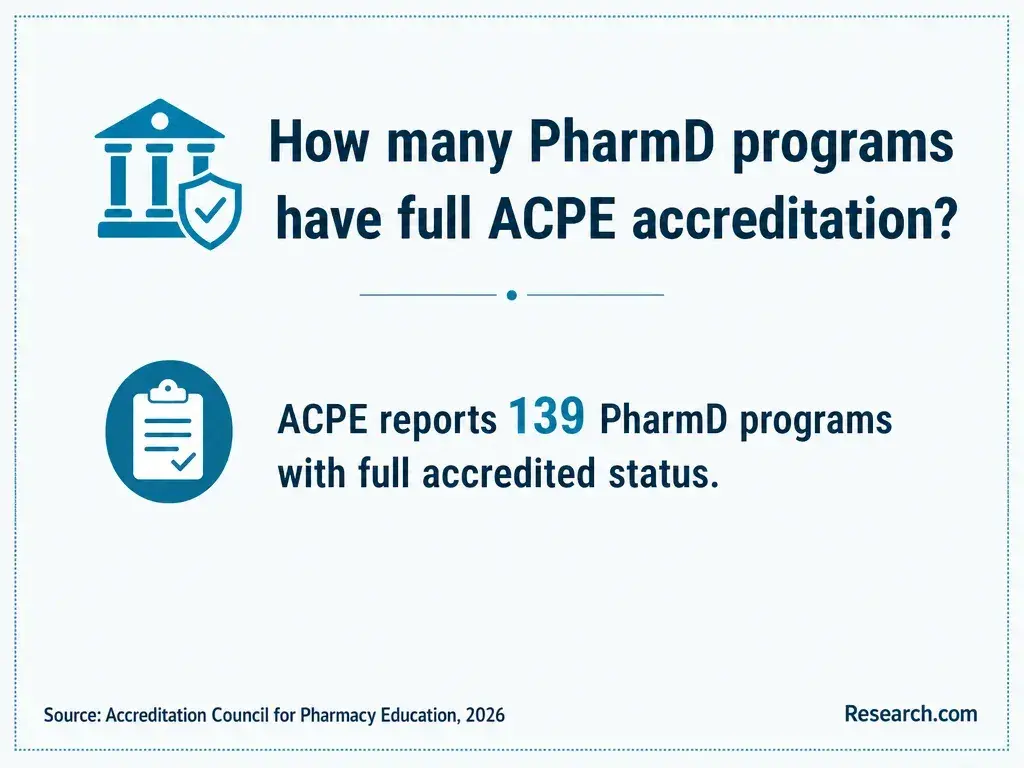
Look up the specific professional degree program in ACPE's official directory and review its current status, any probation notation, and available accreditation actions. Match the listing to the campus or pathway in your offer; do not rely on an undated admissions page or a statement that the university is accredited.
Save a dated copy of the ACPE record and ask the school for its most recent public accreditation communication. If you are considering pharmacy doctorate programs with distance learning, also verify where required in-person instruction and rotations occur. ACPE program accreditation, institutional accreditation, and authorization to serve students in a particular state answer different questions.
Probation does not automatically disqualify a graduate from licensure. State boards of pharmacy set licensing requirements, however, and the program's status at relevant points in a student's education may matter if accreditation changes. Before enrolling, send the program's exact name and ACPE status to the board in the state where you intend to seek your first license and ask how its rules would apply to your anticipated graduation.
Separate the stages: undergraduate pre-pharmacy courses satisfy possible admission prerequisites; the professional Pharm.D. prepares students for licensure; and the state board decides whether an applicant meets its education, examination, and other requirements. A prior biology or chemistry degree does not replace the professional degree. Applicants considering pharmacy degree options for science majors should check the credential each route actually awards.
Request a written explanation that connects each cited deficiency to a measurable remedy. A useful review should establish not merely what the school intends to do, but what it has completed and how students could be affected before the next ACPE decision.
- Identify the ACPE findings, required reports, next review date, and person accountable for each remedy.
- Ask for evidence already available, such as changes to staffing, assessment, student support, or rotation capacity relevant to the findings.
- Check whether current cohorts have faced delayed courses, limited placements, or changed graduation schedules.
- Obtain the school's written contingency process, including who would advise students and how records would be provided if the status worsens.
If the contingency involves another institution, remember that the receiving school decides whether professional credits transfer. Policies for pharmacy school prior learning credits are not a promise that completed Pharm.D. courses will count elsewhere.
The North American Pharmacist Licensure Examination (NAPLEX) is one part of pharmacist licensure; probation alone is not an automatic NAPLEX ban. Examination eligibility and authorization involve the applicable board of pharmacy and the National Association of Boards of Pharmacy (NABP). Ask the board how it would evaluate graduates of this specific program if its accreditation status changed before you finished.
Review the school's published NAPLEX results as one measure of preparation, comparing the same reporting year and distinguishing first-time results from repeat attempts. Results from earlier cohorts cannot predict yours or settle an accreditation concern. An accelerated online pharmacy program still needs a credible plan for professional coursework and clinical experiences; a faster calendar does not bypass examination or board requirements. Passing the NAPLEX does not itself issue a license, and jurisdictions differ in their law-exam requirements, including use of the MPJE or UMPJE.
Send the same questions to admissions and the person responsible for accreditation, then request written answers. Specific responses make it easier to compare the school's assurances with ACPE's record and with another offer.
- Which ACPE findings led to probation, and where can I read the current action and the school's response?
- What corrective work is complete, what remains, and when is the next ACPE review?
- Have course sequencing, IPPEs, APPEs, preceptor availability, or graduation dates changed for current students?
- If accreditation is withdrawn, what documented arrangements and advising would be available to my cohort?
- What would happen to my deposit or enrollment commitment if the accreditation status changes before classes begin?
Applicants with prior coursework should also get an individual prerequisite evaluation. Pharmacy admission pathways for nontraditional students may allow different application timing, but flexibility in admission does not reduce the need to resolve accreditation questions before committing.
Use the same evidence for every offer: ACPE status, expected graduation timing, required placements, licensing-board feedback, and total cost. This comparison sheet keeps a reassuring statement from one school from outweighing verifiable facts from another. Fill the final columns from current documents, not estimates supplied verbally.
| Comparison field | Program A | Program B |
| ACPE professional-program status and date checked | ________ | ________ |
| Next ACPE review or action date, if applicable | ________ | ________ |
| Expected graduation date and required in-person placements | ________ | ________ |
| Written response from intended licensing board | ________ | ________ |
| Tuition, mandatory fees, rotation travel, and other required costs | ________ | ________ |
| Published NAPLEX results and reporting cohort | ________ | ________ |
| Documented contingency if accreditation changes | ________ | ________ |
A school on probation may remain a reasonable choice if its documented response is convincing and the costs and risks are manageable. An otherwise suitable accredited alternative may be preferable when the probation findings remain unresolved, the contingency is vague, or a delay would be difficult to fund. When you compare online Pharm.D. costs, include travel and housing for required in-person work. Check your own aid eligibility under current federal loan rules rather than assuming a school's advertised tuition can all be borrowed.
Loss of ACPE accreditation is materially different from probation. It can jeopardize a current student's planned route to a qualifying degree and future licensure; the effect depends on the timing, any approved arrangements, and the rules of the relevant state board. Do not assume students will automatically transfer, keep every credit, or qualify for the NAPLEX.
If ACPE announces withdrawal, obtain the effective date and written instructions directly from the school, check ACPE's published action, and contact your intended licensing board promptly. Compare any proposed continuation arrangement with a direct application or transfer elsewhere, including lost credits, additional tuition, and time. Guides to doctoral programs with accelerated timelines cannot establish that an alternative will accept your Pharm.D. coursework or preserve your original graduation date.
How do PharmD career outcomes and salaries compare across programs?
Compare program-level outcomes where definitions are clear: graduation, NAPLEX performance, placement into employment or postgraduate training, and the size of each reported cohort. Ask whether results include all graduates and whether jobs are pharmacist roles. A residency or fellowship may suit particular career goals, but neither is universally required for pharmacist employment; specialty board certification is a separate credential, not a state license.
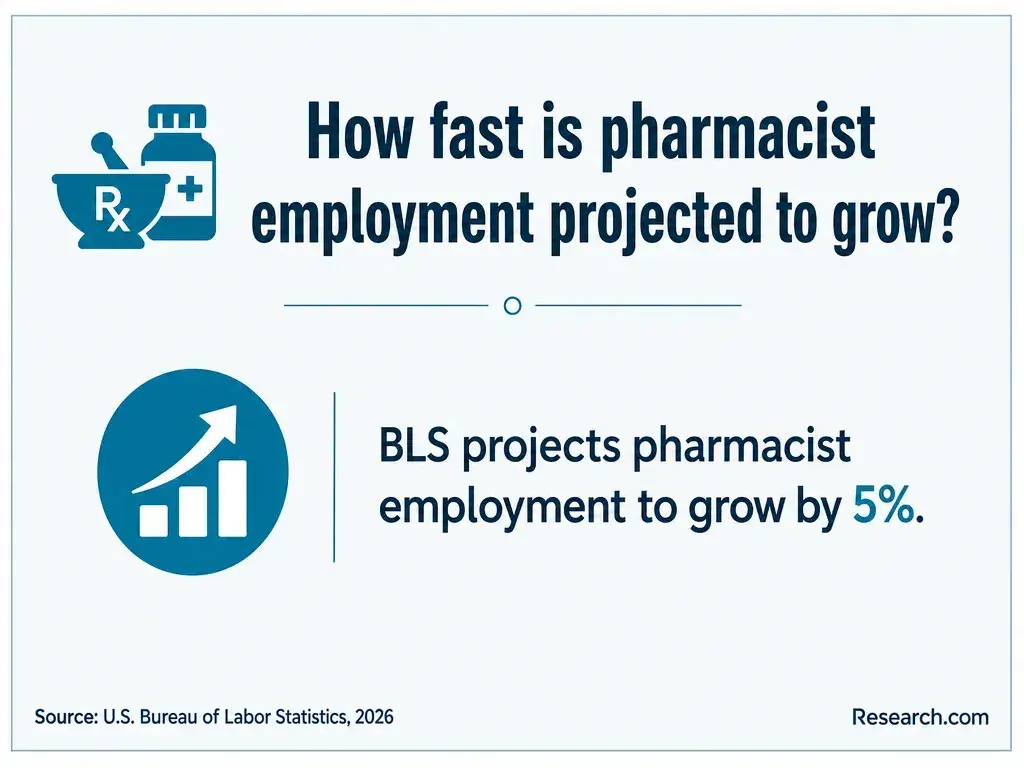
The Bureau of Labor Statistics reports median annual pay for pharmacists of $140,910 in May 2025 and projects 5% job growth, 2025-2035. Those national occupation figures do not measure the earnings of a particular school's graduates or erase the cost of a delayed degree. When evaluating affordable pharmacy studies with a focused timeline, confirm that the option awards the professional credential you need and compare likely borrowing with the time and uncertainty involved.
Other Things You Should Know About PharmD
If the school participates in PharmCAS for your application cycle, follow its listed application process. Probation does not, by itself, determine whether a school uses PharmCAS; confirm any supplemental requirements with the program.
Deferral is a school-specific policy, not an automatic applicant right. Ask whether your offer, deposit, prerequisites, and scholarship would carry forward, and get the terms in writing.
No general rule makes that automatic. Review the award's renewal terms and ask the school how an enrollment delay or program change would affect it.
Residency programs set their own eligibility and selection criteria. Ask prospective programs about their requirements rather than assuming that a past probation designation determines the result.
- Consumer Information and School Reporting | ed.gov https://fsapartners.ed.gov/knowledge-center/fsa-handbook/2024-2025/vol2/ch6-consumer-information-and-school-reporting
- U.S. Graduate Pharmacy References | EducationUSA https://educationusa.state.gov/your-5-steps-us-study/research-your-options/graduate/graduate-student/what-graduate-programs-a-4
- Pharmacist Licensure Exams - Office of the Professions - Nysed https://www.op.nysed.gov/professions/pharmacist/frequently-asked-questions/pharmacist-licensure-exams
- Accreditation Status - School of Pharmacy https://pharmacy.ku.edu/accreditation-status
- CPE Program Accreditation - ACPE https://acpe.edu/programs/accreditation
- Program Measurements | University of Health Sciences and Pharmacy in St. Louis https://www.uhsp.edu/academics/pharmd-program/program-measurements/
- Accreditation Council for Pharmacy Education (ACPE) | chea.org https://www.chea.org/accreditation-council-pharmacy-education
- PharmD Program Accreditation | Accreditation Council for Pharmacy Education https://www.acpe-accredit.org/program/pharmd-program-accreditation/


