Pharm.D. Prerequisites That Require a Lab Component

Co-Founder and Chief Data Scientist
A science course can appear to meet a pharmacy school prerequisite until an admissions office notices that its laboratory was missing, separate, or delivered in an unaccepted format. For prospective Doctor of Pharmacy (Pharm.D.) students, that can mean another course and a delayed start.
This guide identifies the subjects most likely to need labs, explains where schools differ, and shows how to get a reliable course-equivalency decision before you enroll or apply.
Key Things You Should Know
- General chemistry, organic chemistry, and biology are the subjects most commonly paired with required labs; microbiology, anatomy, physiology, and physics lab rules vary more by program.
- A lecture does not automatically satisfy its lab requirement. Schools may evaluate lab credit, format, grade, and course age separately.
- Before paying for a course, compare each target school's current prerequisite list and obtain written guidance on any uncertain lab equivalency, especially for online or transferred work.
Which PharmD Prerequisites Require a Laboratory Component?
Start with general chemistry, organic chemistry, and biology, these are the most likely Pharm.D. prerequisite subjects to include laboratory work. A school may also require labs with microbiology, anatomy, physiology, or physics. There is no nationwide lab checklist, so a course that qualifies at one school may leave a gap at another.
A laboratory component is supervised practical coursework associated with a subject, whether it appears on the transcript as part of a combined lecture-and-lab course or as a separate course. The distinction matters because completing the lecture alone may not earn credit for the lab. The following overview shows common patterns, not universal admission requirements.
| Prerequisite subject | Common lab pattern | Important variation |
| General chemistry | Lab commonly accompanies the required sequence | A separate lab may be needed for each lecture course |
| Organic chemistry | Lab commonly accompanies required coursework | Schools differ on sequence length and lab pairing |
| General biology | Lab commonly accompanies required coursework | Accepted course titles and sequences vary |
| Microbiology; anatomy and physiology; physics | Lab requirements depend more heavily on the school | Some schools require the subject but not its lab, or accept different course combinations |
Applicants with existing coursework should compare what their transcripts actually show against every target school's requirements. Guidance on pharmacy admissions for students with prior credits can help frame that planning, but only the receiving school can decide whether a particular course satisfies its prerequisite.
Do All Pharmacy Schools Require the Same PharmD Lab Prerequisites?
No. Pharm.D. programs set their own admission prerequisites. They may differ on the subjects required, the number and level of courses, whether a lab is mandatory, minimum grades, acceptable substitutions, coursework-age limits, and when unfinished courses must be completed. A completed bachelor's degree is not a universal requirement.
Check the current admissions page for each school and, where applicable, its entry in the current Pharmacy College Application Service (PharmCAS) directory. PharmCAS is a centralized application service used by many, but not all, pharmacy schools; its application process does not replace a program's own prerequisite rules. A school may allow courses to be in progress when you apply yet require satisfactory completion before matriculation.
Build a school-by-school list rather than choosing courses from a generic pre-pharmacy plan. Different admission pathways for pharmacy students can make an apparent shortcut misleading if it omits a target program's lab. A published minimum establishes eligibility for review, not guaranteed admission.
Which Chemistry and Biology Courses Need Labs for PharmD Admission?
General chemistry and organic chemistry are the first sequences to inspect. A program that requires both may specify labs alongside each sequence or identify particular lecture-and-lab courses. Do not assume that one stand-alone organic chemistry lab covers every required lecture, or that a survey course meets a requirement intended for science majors.
General biology also commonly includes lab work. Course names such as introductory biology, cell biology, and biological sciences are not interchangeable simply because they contain "biology." Schools decide whether the course content and level match their prerequisite and whether its lab provides acceptable credit.
If you are choosing courses before settling on a school, preserve flexibility by comparing the full science sequences at your likely programs. Students coming from a chemistry background may find pharmacy doctorate options after chemistry useful for exploring pathways, but prior chemistry study does not automatically replace biology or a specifically required lab.
Sometimes. These subjects are where a general checklist is especially risky. One school may require microbiology with a lab; another may accept microbiology lecture alone or not list it as a prerequisite. Anatomy and physiology may appear as separate courses or a combined sequence, with differing lab expectations. Physics can likewise be required with or without a lab.
Read the requirement's wording carefully: "recommended" is not the same as "required," and a lab listed under an accepted course combination may not apply to every alternative. If you must choose between course options, ask admissions which combination fulfills both the subject and lab requirement before registering.
A shorter pharmacy-related credential cannot be assumed to cover these courses. Discussions of online pharmacy degree duration may involve credentials other than the professional Pharm.D.; neither a short program nor a pharmacy technician qualification automatically satisfies pharmacist-education prerequisites.
They can if the receiving pharmacy school accepts the specific course and lab format. Policies may distinguish an in-person lab, a scheduled remote lab using physical materials, and a virtual simulation. Acceptance of an online lecture does not establish acceptance of its online lab, and an exception offered for one admission cycle should not be assumed to remain in effect.
Send the admissions office the course description and syllabus, including how experiments are performed, assessed, and recorded for credit. Ask whether its policy applies to the term in which you will take the course. Keep the reply with your application records; an informal assurance from the course provider is not an equivalency decision by the pharmacy school.
Online professional study is a separate question from online undergraduate prerequisites. When exploring online Pharm.D. pathways for future pharmacists, check required in-person activities and clinical placements rather than assuming the degree can be completed entirely remotely.
An equivalency review determines whether a course you took - or plan to take - meets a receiving school's particular requirement. An official transcript documents completed credit, but it may not show enough detail about a separate lab, course content, or delivery method to settle the question.
Use this sequence for each uncertain course before committing time or tuition:
- Copy the exact prerequisite wording from the target school's current admissions materials, including any lab, grade, and completion-date conditions.
- Gather the course number, title, credits, institution, term, catalog description, and syllabus; identify the lab separately if it has its own number.
- Ask the school's admissions or designated prerequisite-evaluation office whether the lecture and lab each satisfy the stated requirement.
- Save the written response and confirm whether approval is preliminary until official transcripts or final grades are received.
This is particularly important for community-college, Advanced Placement or International Baccalaureate, repeated, military, international, and transferred coursework. Rules differ, and acceptance of prerequisite credit is not the same as transferring credit into the professional Pharm.D. curriculum. The receiving institution makes the final determination; general advice about how to transfer courses into a pharmacy degree cannot approve an individual lab.
Labs are only one part of admission. Schools may evaluate prerequisite grades and GPA, recommendations, an interview, pharmacy exposure, and other application materials. Check whether the school uses PharmCAS, requires a supplemental application, and sets separate deadlines for submission and completion of in-progress coursework. The Pharmacy College Admission Test (PCAT) was retired in January 2024; do not plan around taking it as a current entrance exam.
Budget for the whole route, not just professional-program tuition. Extra lab courses can add tuition, supplies, commuting, and time away from work; later expenses may include required fees, clinical-placement travel, and licensing applications. Comparisons of lower-cost online pharmacy degree programs require particular care because the programs may lead to different credentials and may not eliminate in-person requirements.
If borrowing is part of your plan, confirm your classification and eligibility with the school's financial aid office. Federal borrowing rules changed for many new graduate and professional borrowers beginning July 1, 2026, so older descriptions of loan availability may not apply to your start date.
There is no single prerequisite timeline. It depends on what you have already completed, whether required science courses form sequences, when labs are offered, and each school's deadline for finishing outstanding work. A student missing one lab may be able to add it sooner than a student who must begin a chemistry sequence, but a course offered only in certain terms can change the plan.
Map backward from your intended matriculation term. Place sequential lectures and their labs on an actual course schedule, then mark application deadlines and the last date each pharmacy school permits prerequisites to be finished. Confirm that the lab will appear on an official transcript in time for the school's review.
Broad comparisons of online doctoral study duration are not substitutes for this calendar: pre-professional coursework occurs before the professional Pharm.D. curriculum, and a shorter doctorate in another field does not qualify someone for pharmacist licensure.
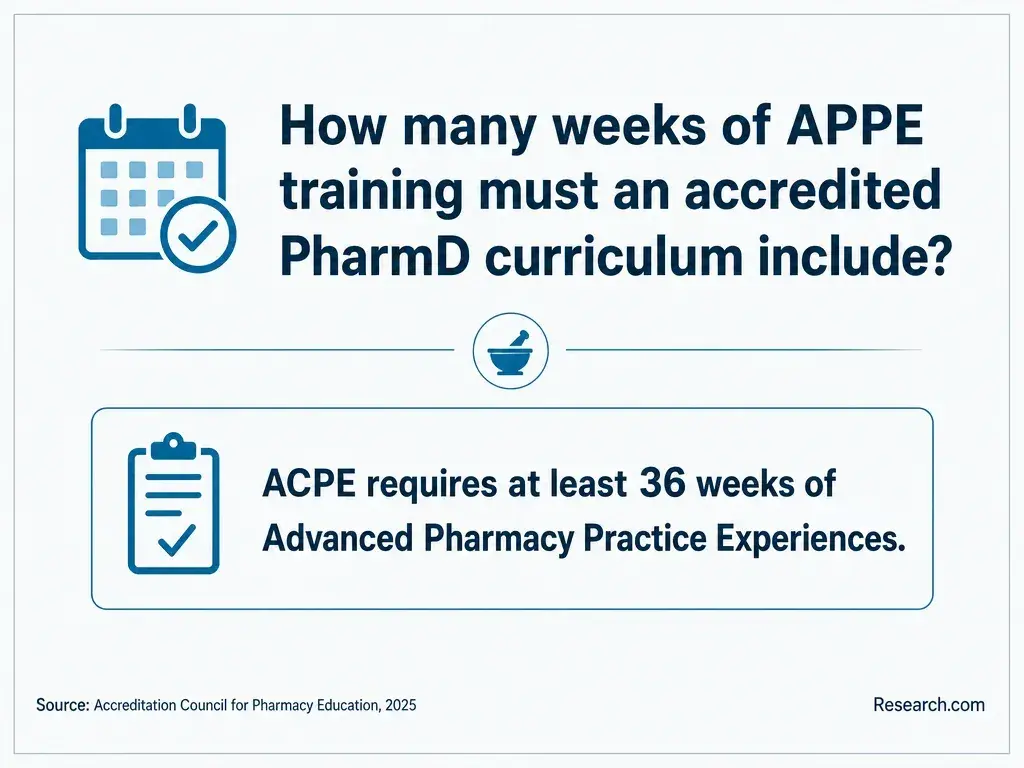
Prerequisites establish eligibility to seek admission, they are not the professional degree. After admission, students complete a Pharm.D. curriculum that includes supervised pharmacy practice experiences. Graduates then must meet the requirements of the jurisdiction where they seek a pharmacist license, which generally include examination and may include other conditions. The North American Pharmacist Licensure Examination (NAPLEX) is part of the licensing process, but passing it does not itself issue a license.
Jurisprudence requirements vary by jurisdiction. Some use the Multistate Pharmacy Jurisprudence Examination (MPJE), some have transitioned to the Uniform Multistate Pharmacy Jurisprudence Examination (UMPJE), and requirements elsewhere differ. Check the relevant state board and the National Association of Boards of Pharmacy before planning exams or internship registration.
Keep these stages separate when evaluating online Pharm.D. program timelines: fewer prerequisite gaps may speed your application plan, but they do not waive professional coursework or state licensing conditions. For career context, the Bureau of Labor Statistics reports pharmacists' median annual pay of $140,910 in May 2025; that occupational median is not a predicted salary for an individual graduate.
How Can You Choose an Accredited PharmD Program?
First, confirm the current professional-program accreditation status of each candidate in the Accreditation Council for Pharmacy Education (ACPE) program records. ACPE accredits pharmacy education programs, not individual pharmacists. Institutional accreditation and authorization to enroll distance-learning students are separate matters; neither answers whether a particular prerequisite lab will be accepted.
Then compare programs on the criteria that affect your decision: your outstanding courses and labs, written equivalency decisions, admission conditions, full educational costs, delivery schedule, and clinical-placement expectations. For online or hybrid options, ask about in-person labs or campus visits, where practice experiences can occur, and any applicable state authorization or placement restrictions. Published licensure-exam outcomes can add context, but no outcome guarantees yours.
Finally, weigh the cost of filling prerequisite gaps alongside professional-program costs. A comparison of affordable pharmacy doctoral education is most useful when it accounts for required travel and fees as well as tuition. Choose your target schools before buying additional lab courses, and obtain school-specific answers to unresolved requirements.
Other Things You Should Know About PharmD
Usually, work experience and academic prerequisites are evaluated separately. Ask the admissions office whether it offers any formal waiver; do not assume pharmacy employment substitutes for transcripted lab credit.
Possibly. The receiving school must decide whether the courses together match its requirement, especially if their content or timing differs. Submit both course descriptions for review.
That depends on the program's grading policy and any applicable term-specific exception. Check whether the school requires a letter grade for prerequisites before choosing pass/fail grading.
Often that depends on the colleges offering and evaluating the courses. Confirm that your college permits the enrollment arrangement and that each target pharmacy school will accept the completed pairing.
- Are Prerequisite Courses Barriers to Pharmacy Admission or the Keys to Student Success? - PMC https://pmc.ncbi.nlm.nih.gov/articles/PMC10159397/
- PharmD Prerequisites - Doctor of Pharmacy https://pharmacy.wisc.edu/pharmd/prerequisites/
- PharmD Preprofessional Requirements | Ernest Mario School of Pharmacy https://pharmacy.rutgers.edu/pharmd-preprofessional-requirements/
- PharmD Application Process and Requirements | umich.edu https://pharmacy.umich.edu/pharmacy-programs/pharmd-program/application-process-requirements/
- Verifying Your Prerequisite Course Work | ucsf.edu https://pharmd.ucsf.edu/admissions/reqs/academic/verify
- Prerequisite Coursework | College of Pharmacy | NEOMED https://www.neomed.edu/pharmacy/admissions/paths/prerequisites/
- PharmD Program Prerequisites - Temple School of Pharmacy https://pharmacy.temple.edu/pharmdprereqs
- Prerequisites, Admission Requirements - Pharmacy | UT Tyler https://www.uttyler.edu/academics/colleges-schools/pharmacy/admissions/prerequisites/index.php
- Online Course Prerequisites | PharmCAS https://www.pharmcas.org/school-directory/explore-and-compare/online-course-prerequisites