Campus immersions in the St. John Fisher online PharmD program

Co-Founder and Chief Data Scientist
St. John Fisher University's online Doctor of Pharmacy (Pharm.D.) pathway brings much of the coursework online, but it does not eliminate campus visits or in-person clinical training. That distinction matters if you must arrange time off work, travel, or caregiving. This guide explains what campus immersions are, how they fit alongside rotations, and which scheduling and cost details to get in writing before accepting an offer. It is for prospective students deciding whether the online pathway is practically workable - not just academically appealing.
Key Things You Should Know
- St. John Fisher's online Pharm.D. pathway includes required in-person campus immersions; "online" does not mean fully remote or self-paced.
- Do not budget around an assumed number of visits: obtain the current cohort's immersion calendar, including dates, length, and attendance rules, directly from the university.
- Campus immersions are separate from in-person introductory and advanced pharmacy practice experiences, which may create larger work and travel commitments.
What are campus immersions in the St. John Fisher online Pharm.D. program?
Campus immersions are scheduled periods when students in St. John Fisher University's Wegmans School of Pharmacy online Pharm.D. pathway attend activities in person. They complement online instruction with work that benefits from physical facilities, equipment, and direct interaction with faculty and classmates. They are required parts of the professional degree pathway, not optional visits or substitutes for clinical rotations.
The key distinction when you choose an online Pharm.D. program is between where lectures take place and where you must demonstrate skills. Ask for a sample academic calendar rather than interpreting "online" as permission to complete every requirement from home.
How many campus immersions does the St. John Fisher online Pharm.D. require?
The precise number of required immersions should be confirmed against the calendar for your entering cohort. A dependable current total, with the length and timing of each visit, is not established here; presenting an unconfirmed count could leave you with an inaccurate travel budget. Ask admissions for a written schedule covering the entire pathway, not just the first term, and ask whether dates or requirements can change.
Count visits, days away, and nights of lodging separately. One longer immersion can cost more or require more leave than several shorter visits. If you are also considering pharmacy programs with shorter completion times, verify that the credential is a professional Pharm.D.; a shorter pharmacy-related program is not necessarily a route to pharmacist licensure.
What happens during St. John Fisher Pharm.D. campus immersions?
Immersions provide an in-person setting for applied pharmacy learning and assessment, such as practicing patient-care communication, working through clinical scenarios, and developing laboratory or dispensing skills under faculty direction. The activities and assessments assigned to a particular visit can vary by course and cohort. Request the current immersion agenda if you need to know which sessions involve laboratory equipment, simulations, or graded practical work.
Previous science study can help with the academic foundation, but it does not replace supervised professional-skills instruction. Students hoping to build on prior biology or chemistry coursework should distinguish accepted prerequisite credit from requirements within the Pharm.D. curriculum. During an immersion, students practice as learners; attendance does not authorize independent pharmacy practice.
Plan for required visits to St. John Fisher University's campus in Rochester, New York. The dates, session lengths, daily hours, and any attendance or make-up provisions need to come from the current cohort calendar. Before enrolling, ask whether an immersion starts early enough to require travel the preceding day and whether assessments or other in-person activities occur outside the advertised visit dates.
Immersion dates are only one part of the schedule: live online classes, examinations, and clinical placements may also have fixed times. General discussions of online doctorate completion periods are therefore a poor substitute for this program's calendar. If you work or provide care, compare the actual dates with your available leave before making a deposit.
Both pathways lead through professional Pharm.D. education at St. John Fisher; the practical difference is how students participate in coursework between required in-person activities. This comparison highlights the scheduling trade-off rather than assuming one pathway is academically easier.
| Decision factor | Online pathway | Campus pathway |
| Course participation | Substantial instruction online, with scheduled course requirements | Regular participation on campus |
| Hands-on learning | Required campus immersions plus in-person experiential training | Campus-based activities plus in-person experiential training |
| Travel trade-off | Less routine commuting may be offset by Rochester trips | Ongoing access to campus may require a local commute or relocation |
| Work planning | Online access does not make fixed sessions or rotations optional | Regular campus attendance and rotations also constrain work hours |
Neither format removes the need to plan around clinical training. Compare the complete pharmacy degree affordability and completion time picture: tuition, housing or commuting, immersion travel, and income you may forgo can change which pathway costs you less.
The professional Pharm.D. curriculum develops knowledge of medicines and their use alongside patient assessment, communication, medication safety, and pharmacy practice skills. Online coursework must be integrated with supervised skills training and experiential education; it is not simply an online collection of undergraduate science classes. For exact courses, assessments, and the sequence of immersions, use the current Wegmans School of Pharmacy curriculum plan for the online pathway.
Course sequencing matters if you expect to keep working or already hold science credits. Compare the published schedule with accelerated Pharm.D. programs only after checking which prerequisites you have completed and how each program schedules its in-person training. A faster calendar is not automatically a more flexible one.
Applicants need qualifying pre-professional coursework before beginning the professional Pharm.D. curriculum. The current admissions materials - not a general description of pharmacy school - should determine the exact prerequisite courses, laboratories, minimum grades, application materials, deadlines, and any conditions for courses still in progress. Do not assume that a completed bachelor's degree is required or that previously earned credits will satisfy a particular prerequisite without the school's evaluation.
If you are applying before your last prerequisites are finished, compare the university's stated conditions with guidance on pharmacy programs for applicants still completing requirements. Ask admissions to confirm when outstanding courses must be completed and whether your planned labs qualify. The Pharmacy College Admission Test was retired in 2024, so an old reference to a PCAT requirement should not guide a current application.
Ask the university for the current online pathway's term-by-term plan and its 2026-27 tuition and required-fee schedule. A reliable current total cost is not established here, and multiplying an advertised rate by an assumed credit load would omit expenses that vary by student. Confirm whether the online and campus pathways have different tuition or fees before comparing them.
Your budget should account for costs beyond billed tuition. Request an itemized estimate covering these categories:
- Required university fees, technology, books, and clinical resources.
- Travel, lodging, meals, and time off work for each campus immersion.
- Transportation or temporary housing for clinical rotations, plus required screening or health documentation.
- Licensure-related examinations and applications after graduation.
Use pharmacy doctorate tuition and fees comparisons as a starting point, not as a substitute for a personalized cost-of-attendance estimate. If you expect to borrow, ask financial aid how current federal rules apply to your enrollment; borrowing options changed for many new graduate and professional students beginning July 1, 2026.
Students must complete supervised, in-person pharmacy practice experiences in addition to campus immersions. Introductory pharmacy practice experiences (IPPEs) introduce practice settings and patient-care responsibilities during the curriculum. Advanced pharmacy practice experiences (APPEs) involve more extensive supervised work later in the program. A rotation takes place at an approved practice site with an appropriate preceptor; online coursework does not turn it into a remote placement.
Before committing, ask Fisher's experiential education team which placements it coordinates, which locations it can approve near you, and when schedules are released. Also ask about site and state requirements for intern registration, background checks, immunizations, travel, and availability. A nearby placement or substitution of your current pharmacy job should not be assumed.
Prior study or work experience raises a separate credit question. If pharmacy transfer planning matters to you, get a written evaluation from the receiving school; prior credits and employment do not automatically waive supervised Pharm.D. rotations.
How does the St. John Fisher Pharm.D. prepare graduates for pharmacist licensure?
The Pharm.D. is the professional education component of the U.S. pharmacist pathway. Before enrolling, verify the Wegmans School of Pharmacy professional program's current Accreditation Council for Pharmacy Education (ACPE) status and confirm that the online pathway and your intended state of enrollment are covered by the university's applicable approvals. ACPE program accreditation, institutional accreditation, distance-education authorization, and eligibility for a particular state license are distinct questions.
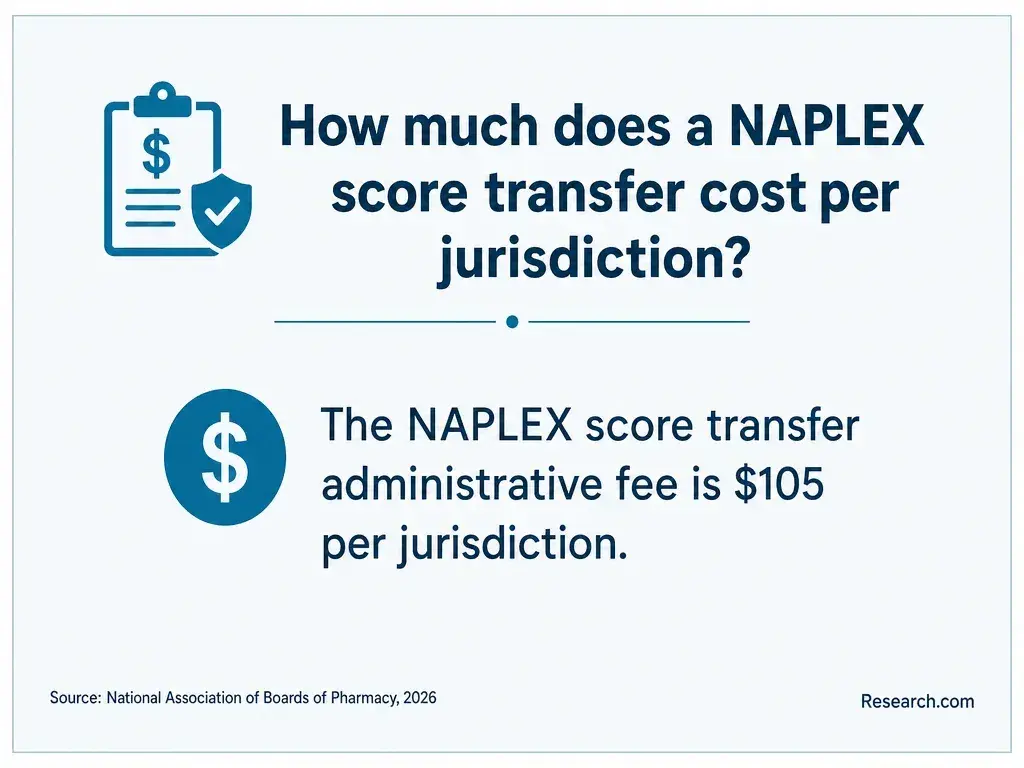
After graduation, applicants must meet their licensing board's requirements, which generally include the North American Pharmacist Licensure Examination (NAPLEX) and may include a jurisdiction-specific law examination, internship requirements, and other conditions. Do not assume every jurisdiction uses the Multistate Pharmacy Jurisprudence Examination (MPJE); some began transitioning to the Uniform MPJE (UMPJE) in 2026. Passing an exam or earning a Pharm.D. does not itself issue a license.
When comparing pharmacy schools and entry standards, keep admission thresholds separate from graduation and licensure requirements. Ask Fisher and the board in the state where you intend to practice to confirm the steps that apply to you. Residency, fellowship, and specialty board certification are separate postgraduate options, not universal prerequisites for a pharmacist license.
Other Things You Should Know About PharmD
Do not assume a virtual substitute is available. Ask the program which activities require physical attendance and whether any exception is possible.
Request the current attendance and make-up policy in writing. A missed graded activity may affect course progression, so ask when and how it could be completed.
Students can contact the university's accessibility or disability services office to discuss the accommodation process and documentation. Arrange that conversation before travel, particularly if laboratory activities or timed assessments are involved.
Ask for the current equipment and materials list before budgeting. Requirements can depend on the courses scheduled during each visit; do not assume all supplies are included in tuition.
- Cost of Attendance (Budget) | 2025-2026 Federal Student Aid Handbook https://fsapartners.ed.gov/knowledge-center/fsa-handbook/2025-2026/vol3/ch2-cost-attendance-budget
- Understanding College Costs | studentaid.gov https://studentaid.gov/resources/prepare-for-college/students/choosing-schools/consider-costs
- ADA Requirements: Testing Accommodations https://www.ada.gov/resources/testing-accommodations/
- FAQ - Fisher Pharm.D. Online | SJF-PHA https://onlinepharmd.sjf.edu/admissions/faq/
- Graduate Programs | Online Doctor of Pharmacy (Pharm.D.) | St. John Fisher University https://www.sjf.edu/graduate-programs/doctor-of-pharmacy-pharmd-online/
- What does college actually cost? | About the University of Cincinnati https://www.uc.edu/blog/hidden-costs-of-college.html
- Experiential Education - Pharmacy | Long Island University https://liu.edu/pharmacy/academic-programs/pharmD/Experiential-Education
- PharmD Experiential Program | CU School of Pharmacy https://pharmacy.cuanschutz.edu/degreesandprograms/pharmd/experiential-program
- Experiential Education - Albany College of Pharmacy and Health Sciences https://www.acphs.edu/pharmacy/doctor-of-pharmacy-pharmd/experiential-education/
- Experiential Education | Washington State University https://pharmacy.wsu.edu/pharmd/experiential-services/