PharmD Financial Aid With Transfer Credits

Co-Founder and Chief Data Scientist
Transfer credits can reduce the cost of a Doctor of Pharmacy (Pharm.D.) degree, but they can also change your enrollment status, aid eligibility, and graduation date. This guide is for applicants bringing undergraduate coursework into pharmacy school and Pharm.D. students considering a move between programs.
It explains which credits may count, how to compare aid offers and remaining costs, and what to get in writing before committing to a school.
Key Things You Should Know
- Undergraduate prerequisite credits may satisfy admission requirements without replacing courses in the professional Pharm.D. curriculum; the receiving school decides how each credit applies.
- Accepted credits can shorten your remaining coursework, but a school's satisfactory academic progress rules and your enrollment level can affect aid. Ask for a term-by-term aid estimate, not just a transfer-credit total.
- Federal borrowing rules changed for many new graduate and professional borrowers beginning July 1, 2026. Confirm your 2026-27 loan eligibility and any applicable transition rule before relying on a previous aid package.
How does financial aid work for PharmD students with transfer credits?
The receiving school evaluates your credits, places you in its curriculum, and determines your financial aid using its eligible program costs, your enrollment, and your individual aid history. Aid awarded by your former school does not automatically move with you. Submit the Free Application for Federal Student Aid (FAFSA) for the applicable aid year and add the new school; its financial aid office must then assess your eligibility.
Ask admissions for a course-by-course transfer evaluation and financial aid for a term-by-term cost and funding estimate. Compare the two together. A school might accept many credits yet require you to wait for a course offered only once a year, leaving you with more living expenses than the credit total suggests. Comparisons of affordable online Pharm.D. programs can help identify possibilities, but advertised tuition alone cannot establish your personal net cost.
Do transfer credits affect PharmD financial aid eligibility?
Yes, sometimes. Prior undergraduate credits that meet admission prerequisites are different from credits accepted toward the professional degree. Either may affect your academic placement, but the school's written aid policies determine how accepted credits count toward satisfactory academic progress (SAP) - the pace and maximum timeframe students must meet to keep receiving federal aid. A large transfer award can leave less room for repeated or additional courses under that timeframe.
Enrollment also matters. If accepted credits leave you below the enrollment level required for a particular loan or scholarship in a term, your funding may change even if your tuition falls. Ask the aid office to check your SAP standing, anticipated enrollment each term, existing borrowing, and whether you are classified as an undergraduate or professional student for the aid in question. Pharmacy application requirement flexibility is a separate issue: permission to finish a prerequisite later does not guarantee aid for that coursework or admission to the professional program.
Can you transfer credits into an accredited PharmD program?
Often, but admission credit and degree credit are not interchangeable. A school may accept biology or chemistry taken elsewhere to satisfy a pre-pharmacy prerequisite while awarding no advanced standing in its professional Pharm.D. sequence. Transfer of professional pharmacy courses can be more restrictive because schools must evaluate course content, sequencing, laboratory work, and supervised experiential education. Neither shared accreditation nor a matching course title guarantees acceptance.
The receiving school has the final say. Request a written evaluation identifying which courses meet prerequisites, which replace professional courses, which count only as electives, and which do not apply. If you are changing Pharm.D. programs, ask separately whether introductory or advanced pharmacy practice experiences (IPPEs or APPEs) can count and whether repeating a rotation is required. Guidance on how to transfer courses into a pharmacy degree is a starting point, not a substitute for that individual evaluation.
There is no dependable nationwide "most credits accepted" ranking for Pharm.D. programs. A published transfer-credit ceiling may include undergraduate electives but say little about advanced standing in the professional curriculum. Schools also evaluate transcripts individually. For a useful comparison, ask each program how many of your credits apply, which required courses remain, and your earliest realistic graduation term.
That distinction is especially important when comparing pharmacy degree programs with accelerated schedules: a shorter schedule or another pharmacy-related credential does not establish that a professional Pharm.D. will accept more credits or qualify its graduate for pharmacist licensure. Favor the program that reduces your verified remaining time and cost - not the one advertising the largest possible transfer allowance.
Depending on the student and program, options may include institutional scholarships, outside scholarships, employer assistance, and federal loans. Aid available while completing undergraduate prerequisites can differ from aid available after entering the professional Pharm.D. curriculum; do not assume a grant or loan from one stage continues into the next. Prior borrowing and the school's cost of attendance also matter.
Federal loan rules changed for many new graduate and professional borrowers beginning July 1, 2026, including access to Grad PLUS, with transition provisions that may apply to some existing borrowers. Have the aid office identify your classification, applicable rules, remaining eligibility, and any transition provision in writing for 2026-27. If you are moving from a science major into pharmacy, resources on pharmacy education after undergraduate science coursework can help you distinguish prerequisite planning from financing the professional degree.
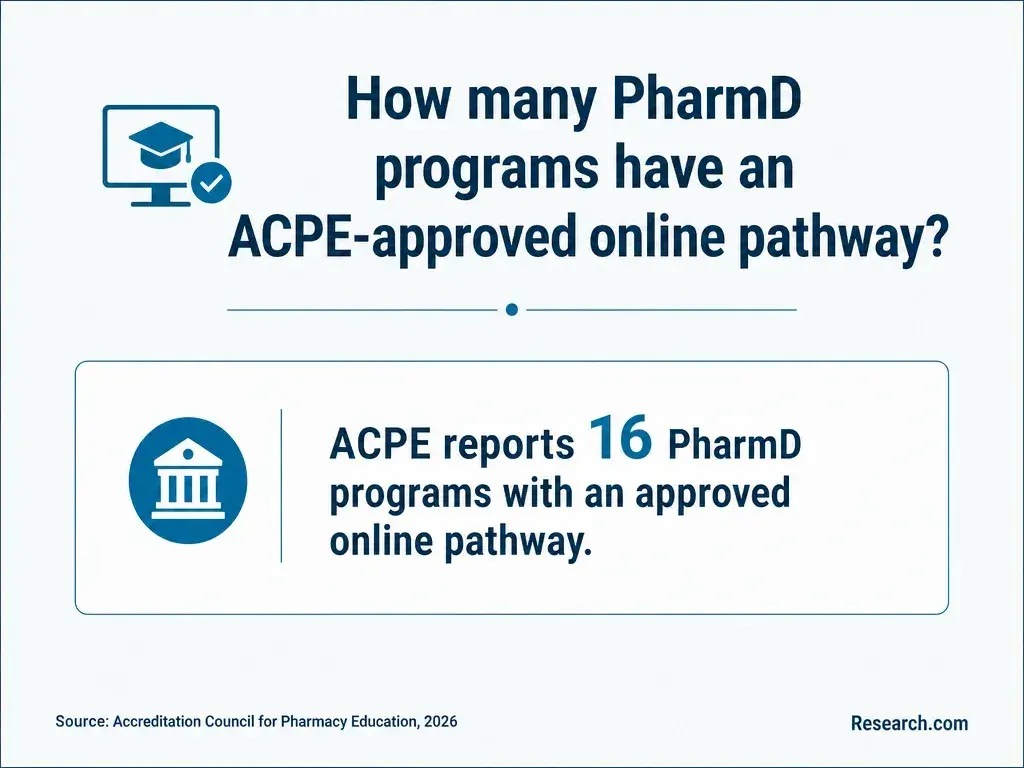
Check the Accreditation Council for Pharmacy Education (ACPE) status of the professional Pharm.D. program, not just the university's institutional accreditation. Institutional accreditation, ACPE program accreditation, and permission to enroll or place distance-learning students in a particular state are distinct. When moving between schools, obtain written confirmation that accepted courses and experiences fit the receiving program's graduation requirements.
A Pharm.D. degree does not itself issue a pharmacist license. State boards set licensure requirements, which typically include examination and other conditions; jurisprudence exam requirements vary by jurisdiction, and some jurisdictions began using the Uniform Multistate Pharmacy Jurisprudence Examination (UMPJE) in 2026 rather than the MPJE. State rules may also affect intern registration and rotation sites. These distinctions matter when considering Doctor of Pharmacy distance learning programs, especially if you plan to complete clinical experiences outside the school's home state.
Requirements vary by school and by whether you are transferring undergraduate prerequisites or seeking entry from another Pharm.D. program. Schools may review specific courses and labs, grades, GPA, course age, transcripts from every prior college, recommendations, and an interview. Some require an explanation of why you are leaving a professional program and documentation of good standing. A bachelor's degree is not universally required. The Pharmacy College Admission Test (PCAT) was retired in 2024, so it is not a current exam to plan around.
Check the current school admissions page and, if the school uses it, its PharmCAS listing; not every program uses PharmCAS. Confirm whether unfinished prerequisites can be completed before matriculation, whether online labs or community-college courses qualify, and when a final transcript is due. A guide to pharmacy program applicant requirements may help you frame questions, but meeting a published minimum does not guarantee admission or transfer credit.
There is no reliable time or price reduction per transferred credit. Professional courses may run in a fixed cohort sequence, and IPPEs and APPEs still require approved, supervised experiences. A waived prerequisite can save coursework before admission without shortening the professional program; an accepted professional course may save tuition but not a full term if the next required course is unavailable.
Compare each school's written remaining-course plan with its tuition and required fees by term. Add prerequisites you still need, books and clinical resources, equipment, background checks, immunizations, campus travel, rotation travel or housing, and anticipated licensure-related costs. Include lost earnings if the schedule limits work. Published online Pharm.D. program timelines can provide context, but your evaluated credits and course sequence determine whether an advertised timeline applies to you.
Potentially, yes. An online or hybrid format does not itself rule out credit evaluation or federal aid, but eligibility depends on the specific program and student. "Online" also does not mean self-paced or entirely remote: programs may require scheduled classes, campus labs or immersions, and in-person IPPEs and APPEs at approved sites. Before enrolling, confirm who arranges placements, whether travel is likely, and whether the school can enroll you and support placements in your state.
Ask for the same written credit decision and aid estimate you would request from a campus program, plus a calendar of required in-person activities. General comparisons of online doctorate time to completion should not be used to predict a Pharm.D. timeline; professional coursework and clinical requirements make the comparison unreliable.
How can you compare PharmD programs for cost, credits, and career outcomes?
Build your comparison around remaining cost through graduation, not credits accepted or first-year tuition alone. The table separates factors that are easy to overlook when two offers appear similar.
| Factor | What the comparison should show |
| Credit decision | Prerequisites satisfied, professional courses replaced, and courses still required |
| Time | Earliest graduation term under the actual course and rotation schedule |
| Cost | Remaining tuition, required fees, prerequisite costs, travel, and living expenses |
| Funding | Scholarships, term-by-term aid eligibility, and projected borrowing needs |
| Professional pathway | ACPE status, placement logistics, and published licensure-exam outcomes in context |
A pharmacist's median annual pay was $140,910 in May 2025, according to the Bureau of Labor Statistics. That occupational figure is useful career context, not a salary promise or evidence that a higher-cost program will pay off. If schools publish NAPLEX outcomes, compare the reporting periods and cohort sizes rather than treating one result as a guaranteed outcome.
Use pharmacy program tuition and length comparisons to develop a shortlist. Before paying a deposit, get the credit evaluation, remaining-term schedule, full cost estimate, aid determination, and any placement or state-authorization conditions in writing. A lower-cost offer is stronger when its graduation timeline and required experiences are workable - not merely when its advertised price is lower.
Other Things You Should Know About PharmD
That depends on the receiving school's academic policy. It may award credit without including the old grades in its institutional GPA, while still reviewing every prior transcript for admission. Ask how grades are treated for both purposes.
Your existing loans remain your responsibility; they do not transfer to the new school. A gap in qualifying enrollment can affect repayment or a grace period. Notify your loan servicer and check your enrollment status before leaving your current program.
Room and board may be a qualified 529 expense if you meet enrollment requirements and stay within the school's published cost-of-attendance allowance. Keep the school's figures and your expense records, particularly if a rotation requires temporary housing.
Not necessarily. A school may require a separate international transcript evaluation and may decline professional-course equivalencies. A foreign-educated pharmacist seeking U.S. licensure may also face a separate certification pathway; admission or transfer credit does not replace state licensing requirements.
- School-Determined Requirements - FSA Partner Connect https://fsapartners.ed.gov/knowledge-center/fsa-handbook/2026-2027/vol1/ch1-school-determined-requirements
- Staying Eligible | Federal Student Aid https://studentaid.gov/understand-aid/eligibility/staying-eligible
- Satisfactory Academic Progress | UT Dallas https://finaid.utdallas.edu/maintaining-aid/satisfactory-academic-progress/
- Programs / Pharmacy / Tuition & Aid | Touro University California https://tu.edu/programs/pharmacy/tuition--aid/index.php
- OBBBA Financial Aid Updates - Scarlet Hub https://scarlethub.rutgers.edu/obbba-financial-aid-updates/
- Scholarships and Financial Aid - UW School of Pharmacy https://sop.washington.edu/pharmd/student-affairs/financial-aid-scholarships-awards/
- Graduate Financial Aid Is Changing | SJF-PHA https://onlinepharmd.sjf.edu/admissions/tuition-and-financial-aid/federal-fin-aid-changes/
- PharmD Program Transfer Eligibility and Application | UNT Health Fort Worth https://www.unthealth.edu/college-of-pharmacy/transfer-process.html
- Transfer Toolkit - Tuition, Financial Aid and Scholarships | NCCCS https://www.nccommunitycolleges.edu/transfer-advising-toolkit/draft-transfer-toolkit-tuition-financial-aid-and-scholarships/
- Federal Student Loan Changes Effective July 1, 2026 | Student Financial Services https://financialservices.indianatech.edu/federal-student-loan-changes-effective-july-1-2026/