How to Build a Weekly Schedule for Online Pharmacy School

Co-Founder and Chief Data Scientist
An online Doctor of Pharmacy (Pharm.D.) program can reduce commuting without making pharmacy school self-paced. Live classes, exams, hands-on training, and clinical placements may still control much of your week. If you are comparing programs or trying to keep a job while enrolled, you need a schedule built around those fixed commitments - not just lecture videos. This guide shows you how to map a workable week, estimate your available study time, and recognize when a program's requirements would make your current work or family arrangements unsustainable.
Key Things You Should Know
- Put required live sessions, exams, campus visits, and clinical shifts on the calendar first; fit flexible coursework around them.
- Plan study and assignment blocks across all seven days, but protect recovery time and leave a buffer for clinical or deadline changes.
- Before enrolling, obtain the program's actual term calendar and rotation policies: "online" does not mean fully remote, asynchronous, or compatible with full-time employment.
How do you build a weekly schedule for online pharmacy school?
Build the schedule in layers, starting with commitments you cannot move. Use the current course syllabi and program calendar rather than an advertised description of flexibility. The following sequence gives you a repeatable way to plan each term:
- Enter fixed obligations: live classes, assessments, labs, clinical shifts, employment, caregiving, and travel. Mark required campus dates separately because they may disrupt an entire week.
- List each course's weekly lectures, readings, practice work, and deadlines. Estimate the time from your own recent pace, then revise after the first weeks of classes.
- Reserve focused blocks for learning new material and shorter blocks for retrieval practice, such as working through drug-therapy cases without notes.
- Place assignment work ahead of its deadline, not just on the due date. Keep an open block for technical problems, a longer task, or a changed clinical shift.
- Check the total against sleep, meals, transportation, and a meaningful break. If the week does not fit, change a commitment rather than repeatedly borrowing time from rest.
- Review the calendar at the end of each week and rebuild it when courses, exams, or rotations change.
A faster academic calendar may compress the same scheduling pressures into fewer terms. If you are considering accelerated Pharm.D. programs, compare their term-by-term calendars rather than assuming a shorter path leaves more weekly free time.
What does an online pharmacy school schedule typically include?
A professional Pharm.D. schedule can include live discussions, recorded instruction, quizzes, group cases, skills assessments, and supervised practice. Introductory pharmacy practice experiences (IPPEs) introduce students to practice settings; advanced pharmacy practice experiences (APPEs) involve more extensive rotations later in the curriculum. Schools set their own course sequence and calendars, so these activities will not occupy the same weeks at every program.
Account for tasks that are easy to overlook: meeting with a group across time zones, preparing for a skills demonstration, completing placement paperwork, and traveling to a lab or clinical site.
Previous undergraduate coursework may satisfy an admission prerequisite, but it does not automatically replace professional Pharm.D. courses or experiences. Check the receiving school's pharmacy degree credit transfer policies before removing anything from your projected schedule.
How many hours per week does online pharmacy school require?
There is no reliable universal weekly-hour figure. The workload depends on course load, how much instruction is live, your preparation for each subject, and whether a clinical experience is underway. A lecture-heavy week may allow you to move independent study blocks; a rotation week may be governed largely by site hours and travel.
To test whether a term fits, total its required meeting and placement hours first. Add commuting and your own realistic estimates for lectures, reading, practice questions, assignments, and exam preparation.
Compare that total with the hours left after work and essential personal obligations. Repeat the calculation for an ordinary week, an exam week, and a rotation week; the busiest version often determines whether a job schedule is feasible.
Be cautious with claims about short online pharmacy degree timelines. A brief pharmacy-related credential is not necessarily a professional Pharm.D., and a faster Pharm.D. pathway does not remove required clinical education.
Give your employer the program's fixed dates and expected rotation periods before agreeing to a continuing shift pattern. Predictable shifts are easier to plan around than an on-call schedule, but neither should be assumed compatible with every term. Ask whether hours can be reduced or rearranged when labs, exams, or clinical placements occur.
Separate income needs from scheduling assumptions. Reduced work may mean replacing earnings while paying tuition, technology costs, campus-travel expenses, or rotation-related travel and housing.
Compare the full cost of attendance and your likely work capacity when evaluating budget-friendly pharmacy education options; a lower tuition figure alone does not settle that trade-off. Do not assume your current pharmacy job can count as a required rotation. The school must approve sites, preceptors, and experiences under its policies.
Use the least movable activity to organize each week. Attend required live sessions at their scheduled times; place recorded lectures where you can pause and take notes; prepare for hands-on labs before traveling; and treat clinical shifts as fixed until the site and school confirm otherwise.
Keep a separate calendar for campus immersions and placement deadlines so they cannot disappear among routine assignments. Ask the school who arranges and approves placements, whether a site near you is possible, and what happens if one is unavailable.
A placement may require travel, time away from work, an approved preceptor, health documentation, background screening, or state-specific intern registration. Comparing a Pharm.D. with fast online doctoral study can obscure this distinction: online classroom delivery does not make supervised patient-care training remote or optional.
Study throughout the week instead of concentrating preparation immediately before an exam. After a lecture, use a short session to recall its main concepts without notes. Later in the week, work through cases or practice questions that require you to apply them. Put larger assignments on the calendar as separate research, draft, review, and submission blocks.
Before an exam-heavy week, identify what you cannot yet explain: a mechanism, a calculation, or the reasoning behind a therapeutic choice. Give those gaps the next focused study blocks and seek instructor support when needed. Students who want to build on prior biology or chemistry coursework should still allow time to learn how foundational science is applied to pharmacy cases; prior exposure is not a substitute for current practice.
A calendar with deadline alerts, a task list tied to each course, and a reliable place to store syllabi can provide a simple planning system. Check the program's learning management system regularly for changed due dates or announcements, and confirm how live sessions and online assessments work before the term starts.
Use institution-approved tools for patient or clinical information; a personal planning app is not automatically appropriate for sensitive placement material.
Programs differ in the hardware, connectivity, proctoring setup, and reference resources they require or provide. Ask for the current technology requirements and associated costs, then include them in an online Pharm.D. cost comparison. Access to a simulation or software tool does not, by itself, mean hands-on proficiency or replace supervised practice.
The useful distinction is where instruction happens and which obligations you can move - not whether one format has clinical requirements. This comparison highlights the scheduling questions to investigate for either format; individual schools may differ.
| Scheduling factor | Online or hybrid pathway | Campus-based pathway |
| Classroom instruction | May combine live online meetings with recorded or independently completed work | Typically centers instruction on scheduled campus meetings |
| Hands-on activities | May require campus visits or other approved in-person sessions | Often takes place on campus during the term |
| Clinical experiences | Require school-approved supervised placements; location is not automatically near home | Require school-approved supervised placements and may also involve travel |
| Planning risk | Less routine classroom commuting may be offset by immersion and placement travel | Routine commuting may be more predictable, while placement schedules can still change |
Choose based on the actual timetable and placement geography, not the format label. An online Pharm.D. program selection should include the frequency of required campus attendance, live-session times, and what the school says about rotation locations.
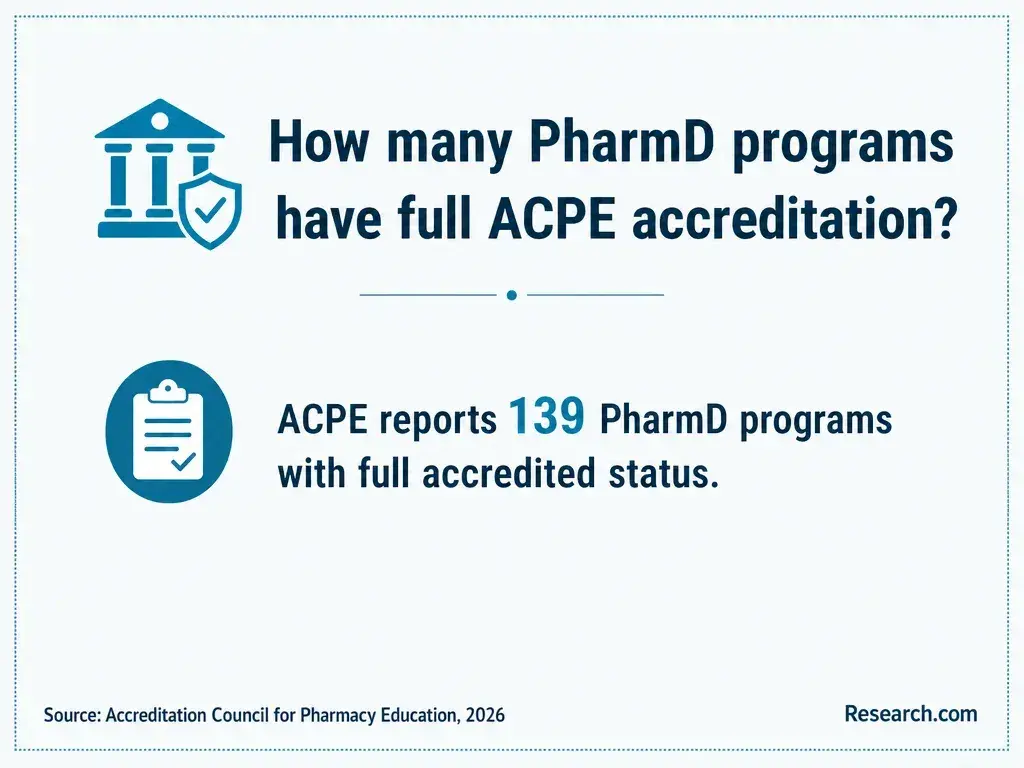
For a U.S. professional Pharm.D., check the Accreditation Council for Pharmacy Education (ACPE) program record and its current status. Professional-program accreditation is distinct from an institution's accreditation and from authorization to enroll distance-learning students in your state.
Confirm all relevant statuses directly with the school and the responsible agencies, especially if you may relocate or complete a placement across state lines. Also ask the state pharmacy board where you intend to train or practice about applicable intern registration and eventual pharmacist licensing requirements.
Earning a Pharm.D. does not itself grant a license: graduates must meet jurisdiction-specific requirements, which generally include the NAPLEX and may include a jurisprudence examination or other steps. Likewise, meeting a school's pharmacy degree entry requirements says nothing by itself about program accreditation or state authorization.
How can you choose an online pharmacy program that fits your schedule?
Request a sample term calendar, current course sequence, live-attendance rules, campus-visit dates, and the clinical education handbook from each program. Ask whether sessions are recorded, which activities require attendance at a specific time, who approves rotations, and what students must do if no suitable placement is available nearby.
Then build a trial calendar for a classroom term and a rotation term using your actual work and family commitments. If either trial week only works by assuming missed classes, unapproved local rotations, or uninterrupted full-time employment, treat that as a mismatch to resolve before paying a deposit.
For applicants still narrowing their choices, understanding pharmacy school admissions matters too: confirm the school's current prerequisites and application process separately from its schedule. The best timetable is one you can sustain through the least flexible parts of the program, not merely its first online term.
Other Things You Should Know About PharmD
Only if the course permits it. A recording may be provided for review without replacing required live attendance or participation.
Convert every required meeting to your local time before enrolling, including assessments and group work. Ask the program which time zone controls deadlines.
Students can contact the school's disability services office to discuss its accommodation process. An approved accommodation does not automatically eliminate essential course or clinical requirements.
Leave and reentry policies vary by school. Ask how a break would affect course sequencing, financial aid, and the timing of clinical placements before making plans.
- An Advanced Pharmacy Practice Experience in a University's Office of Experiential Education - PMC https://pmc.ncbi.nlm.nih.gov/articles/PMC10159452/
- Planning Your Studies - Fisher Pharm.D. Online | SJF-PHA https://onlinepharmd.sjf.edu/academics/planning-your-studies/
- Experiential Education | University of Saint Joseph CT https://www.usj.edu/academics/sppas/pharmacy/experiential-education/
- Course dates and times | psu.edu https://sites.psu.edu/smealonlineprograms/calendar/
- Experiential Education | Washington State University https://pharmacy.wsu.edu/pharmd/experiential-services/
- Study Strategies for Health Professional Students | nova.edu https://libguides.nova.edu/c.php
- Distance Doctor of Pharmacy | University of Findlay https://pharmdonline.findlay.edu/programs/online-pharm-d
- PharmD Remote Pathway | CU School of Pharmacy https://pharmacy.cuanschutz.edu/degreesandprograms/pharmd/remote-pharmd
- What's the Difference Between Asynchronous and Synchronous Learning? | Ohio State Online https://online.osu.edu/content-hub/blogs/whats-the-difference-between-asynchronous-and-synchronous-learning/
- Studying for Memory & Comprehension | Barnard College https://barnard.edu/studying-memory-comprehension