How to Compare PharmD Programs by NAPLEX Outcomes

Co-Founder and Chief Data Scientist
A pharmacy school's NAPLEX pass rate can look like a clear verdict on program quality. It is more useful as one piece of evidence. If you are choosing a Doctor of Pharmacy (Pharm.D.) program, you need to know whose results were counted, whether students reached graduation, and what the program will cost you to complete. This guide shows you how to compare published outcomes on equal terms, identify questions a pass rate cannot answer, and build a shortlist that reflects both licensure readiness and your circumstances.
Key Things You Should Know
- Compare the same NAPLEX testing year and first-time attempt category, and check the number of test takers before interpreting a pass-rate gap.
- Read exam results alongside cohort graduation and attrition: a strong pass rate describes test takers, not everyone who entered the Pharm.D. program.
- Verify ACPE professional-program status and your intended state's licensing rules, then weigh total cost and clinical-placement logistics; passing the NAPLEX alone does not grant a license.
What Are NAPLEX Pass Rates and Why Do They Matter?
The North American Pharmacist Licensure Examination (NAPLEX) assesses knowledge relevant to entry-level pharmacy practice. A school's pass rate reports the share of its counted candidates who passed during a specified reporting period.
The National Association of Boards of Pharmacy (NABP) publishes school-level performance data; read the report's definitions before comparing its figures with a school's own disclosures.
A pass rate is a useful signal about how well students who reached the exam were prepared. It is not a measure of every student admitted, and it cannot establish why candidates passed or failed.
For pharmacy programs for career changers, that distinction matters: undergraduate prerequisites come before the professional Pharm.D. curriculum, while NAPLEX eligibility and state licensure come later. A different pharmacy-related degree does not automatically qualify its holder to become a pharmacist.
How Can You Compare PharmD Programs' NAPLEX Pass Rates Fairly?
Start with the latest available NABP school-level report and record the reporting year, candidate category, pass rate, and number tested for every school. A rate from a small group can change sharply after only a few results; a single-year lead should not settle the decision.
This worksheet keeps the evidence in comparable units. Fill both school columns from reports covering the same period, and mark anything the schools do not disclose.
| Comparison field | Program A | Program B |
| Reporting period and source | ________ | ________ |
| First-time NAPLEX pass rate | ________ | ________ |
| First-time candidates tested | ________ | ________ |
| Earlier reporting periods checked | ________ | ________ |
| Entering-cohort graduation outcome | ________ | ________ |
| Estimated total educational cost | ________ | ________ |
Once the fields are filled, use the following sequence to turn the numbers into a decision rather than a ranking.
- Compare first-time results for matching periods, then inspect several available periods for consistency.
- Check candidate counts and ask how the school defines and reports graduation, attrition, and delayed completion.
- Ask what academic support changed after any unusually weak year, without assuming the change has already improved outcomes.
- Compare the remaining schools on accreditation, clinical placements, cost, and location requirements before choosing.
A small pass-rate advantage may not justify a substantially higher cost or a difficult rotation commute. Use pharmacy degree affordability and completion time as separate comparison criteria, not as substitutes for verified NAPLEX outcomes.
Is ACPE Accreditation Required for NAPLEX Eligibility?
For the standard U.S.-educated route, graduating from a Pharm.D. program recognized for licensure under the applicable Accreditation Council for Pharmacy Education (ACPE) and state-board rules is central to exam eligibility.
Check the specific program in ACPE's current professional-program records and confirm eligibility with the board where you intend to seek a license. If a program has candidate or other developing status, do not assume it is equivalent to full accreditation for every applicant or jurisdiction.
ACPE professional-program accreditation is different from a university's institutional accreditation and from authorization to enroll online students in a particular state. None of those statuses, by itself, issues a pharmacist license. Internationally educated applicants may face a different certification and board-review pathway.
Apply the same verification to shortened Doctor of Pharmacy pathways: a shorter schedule does not remove professional education, examination, or state requirements.
Yes, but do not treat them as interchangeable. First-time results most directly show how candidates performed on their initial attempt. A figure that includes repeat attempts answers a different question and may use a different denominator or reporting method. Check the source's definition before placing the figures side by side.
When a school reports both, ask how it supports graduates who do not pass initially and whether its figures count people or exam attempts. A later pass can move a graduate closer to licensure, but a retake may add expense and delay employment that requires a license. Published guides to online pharmacy degree duration should not be read as promises about the time needed to become licensed.
A NAPLEX pass rate excludes students who never graduate and therefore never reach the exam. Consider two schools with similar first-time exam results: the one whose entering students more often finish the professional program offers a different picture of the path to licensure.
Ask each school for an entering-cohort graduation measure, its expected completion window, and what happened to students who left or graduated late. Then check whether the reported cohort includes transfers. A graduation cohort and a NAPLEX testing group usually cover different people and periods, so do not multiply their rates to manufacture a "chance of licensure."
If prior coursework affects your plans, distinguish acceptance of undergraduate prerequisites from admission with credit toward the professional curriculum. Policies featured in pharmacy degree programs for transfer students still require confirmation with the receiving school; assumed credit can change both completion time and cost.
Look for a curriculum that develops and assesses applied knowledge throughout the professional program, rather than relying solely on a review course near graduation.
Relevant evidence includes how students practice medication-related calculations, clinical decision-making, drug information, and patient-safety reasoning, plus how the school identifies and supports students who fall behind. Ask for documented support and assessment policies, not a promise that a particular feature causes a higher pass rate.
Experiential learning matters, but its components serve different purposes. Introductory pharmacy practice experiences (IPPEs) introduce supervised practice; advanced pharmacy practice experiences (APPEs) provide more extensive clinical rotations.
Ask who arranges placements, how sites are approved, and what travel, intern registration, health, or background-check requirements may apply. Students considering Pharm.D. programs for chemistry majors should also ask how the curriculum bridges prior science study to patient-care applications.
Use the same reporting-period, first-time-attempt, and candidate-count checks for both formats. Do not assign a school-wide pass rate to its online pathway unless the school publishes separately defined outcomes for that pathway. Nor does a difference between schools prove that instructional format caused it; admissions, student support, cohort size, and other factors may differ.
An online Pharm.D. pathway may still require scheduled classes, campus labs or immersions, and in-person IPPEs and APPEs. Before using an online pharmacy program comparison, confirm the actual timetable, placement responsibilities, state authorization, and intended board's licensure requirements with the school. Flexibility in lectures does not necessarily extend to rotations or a full-time job.
Pharm.D. applicants generally complete specified undergraduate pre-pharmacy prerequisites before entering the professional curriculum, but schools set their own courses, lab rules, minimum grades, and deadlines.
A bachelor's degree is not universally required. Check each school's current admissions page and, where applicable, its PharmCAS directory entry; not every school uses PharmCAS. The Pharmacy College Admission Test (PCAT) was retired in January 2024, so an old PCAT requirement is a reason to seek current instructions.
Compare pharmacy program applicant requirements against your transcript, then ask admissions staff whether in-progress, repeated, community-college, online-lab, or older coursework satisfies that program's rules. Meeting a published minimum does not guarantee admission, and the strongest NAPLEX rate is of little practical use if you cannot enter or complete the program on a workable schedule.
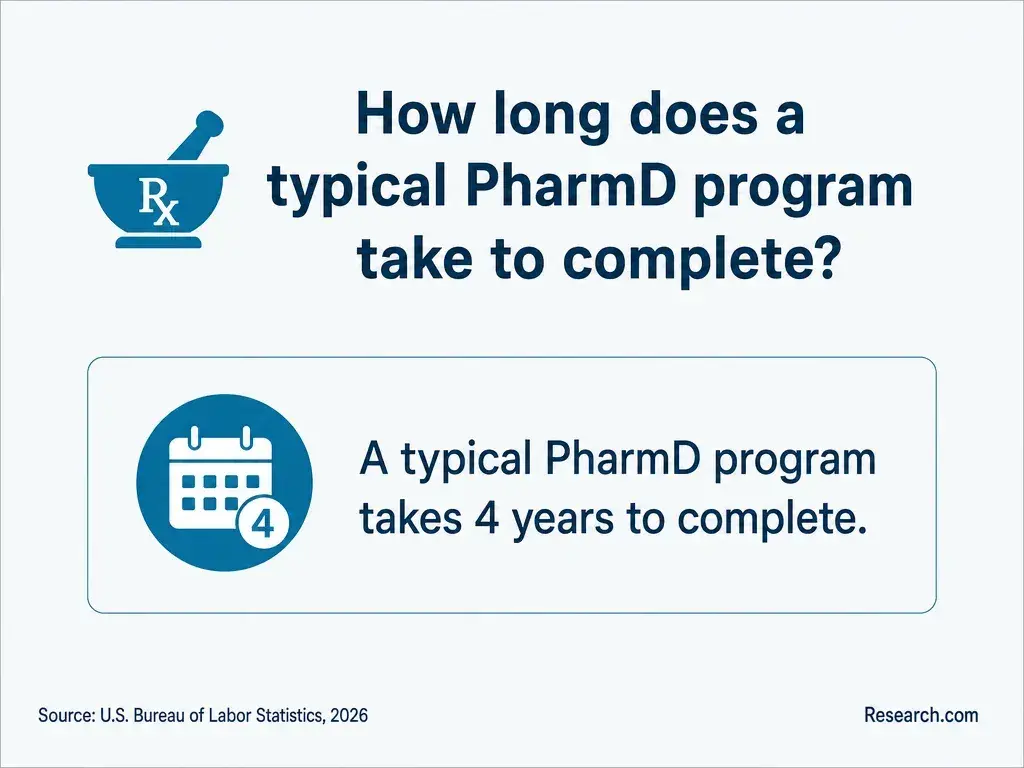
Length depends on the school's prerequisite pathway and professional-program schedule; an accelerated curriculum can compress the calendar without eliminating required learning or rotations.
Compare published tuition using the same unit and academic year, then request a full cost-of-attendance estimate. These commonly overlooked costs can change which program is financially workable:
- Mandatory fees, books, clinical references, technology, and required testing materials.
- Prerequisite courses and any extra terms caused by course sequencing or delayed completion.
- Campus-visit expenses, rotation travel or housing, health requirements, and background checks.
- Licensure application and examination expenses after graduation.
Use online pharmacy school cost options to identify questions, then obtain each school's current charges and placement expectations directly.
Ask its financial aid office which borrowing rules apply to your entry date and student classification: federal rules changed for many new graduate and professional borrowers beginning July 1, 2026, so older loan-limit or Grad PLUS advice may not describe your options.
What Career Outcomes Follow From PharmD and NAPLEX Success?
A Pharm.D. degree and a NAPLEX pass are steps toward pharmacist practice, not a license. Your state board may also require supervised experience, an application, and a jurisdiction-specific law assessment; do not assume every jurisdiction uses the MPJE, as some began transitioning to the UMPJE in 2026. Verify the current requirements where you intend to work.
The U.S. Bureau of Labor Statistics reports median annual pay for pharmacists of $140,910 in May 2025 and projects 5% employment growth, 2025-2035, with about 12,500 openings per year. These occupation-wide figures offer career context, not an expected starting salary or a return guaranteed by any school's pass rate.
Some graduates enter practice after licensure; others pursue residency, fellowship, or later specialty board certification for particular goals. Those are distinct from a state license and are not universally required. If your aim is research rather than pharmacist practice, comparing accelerated online doctoral education may make sense - but a non-Pharm.D. doctorate is not a substitute for the pharmacist licensure pathway.
Other Things You Should Know About PharmD
Yes. Ask for recent placement results and their denominator, including whether the school counts applicants, matched applicants, or all graduates. Residency placement measures a different outcome from NAPLEX performance.
NAPLEX results are primarily part of the licensing process, not a general school-ranking credential. Ask a prospective employer what evidence of licensure or examination progress it requires.
NABP has a score-transfer process, subject to its rules and the receiving board's requirements. Check deadlines and eligibility before you test; transferring a result does not itself grant another state's license.
Retesting may be possible under current NABP and board policies, including waiting periods and attempt limits. Confirm the rules that apply to you and ask your school what graduate support remains available.
- Association Between NAPLEX Preparation Program... - PMC https://pmc.ncbi.nlm.nih.gov/articles/PMC10159439/
- PharmD Student Outcomes | Pacific University https://www.pacificu.edu/pharmacy-pharmd/pharmd-student-outcomes
- Student Learning Outcomes NAPLEX | Southwestern Oklahoma State University https://swosu.edu/pharmacy/student-learning-outcomes/naplex.php
- PharmD Program Quality Indicators | buffalo.edu https://pharmacy.buffalo.edu/about-us/pharmd-program-quality-indicators.html
- NAPLEX Performance and Program Outcomes | Regis University https://www.regis.edu/academics/colleges-and-schools/rueckert-hartman/pharmacy/academic-career-success
- Program Measurements | University of Health Sciences and Pharmacy in St. Louis https://www.uhsp.edu/academics/pharmd-program/program-measurements/
- Comparing Student Performance on the Old vs New Versions of the NAPLEX - ScienceDirect https://www.sciencedirect.com/science/article/abs/pii/S0002945923019083
- NCLEX Pass Rates | NCSBN https://www.ncsbn.org/exams/exam-statistics-and-publications/nclex-pass-rates.page
- Impact of Pharmacy School Characteristics on NAPLEX First-time Pass Rates - American Journal of Pharmaceutical Education https://www.ajpe.org/article/S0002-9459(23)01531-0/fulltext
- NAPLEX Scoring and Results - The Complete Guide (2026) | UWorld RxPrep Pharmacy https://pharmacy.uworld.com/naplex/scoring-guide/