PharmD Online Learning Readiness Self-Assessment

Co-Founder and Chief Data Scientist
An online Pharm.D. can reduce routine trips to campus, but it cannot remove scheduled classes, hands-on training, or clinical rotations. Before applying, you need to know whether your study habits, technology, finances, and location can support those commitments.
This guide gives prospective U.S. pharmacy students a usable readiness scorecard, then explains the program and licensing facts that could change the decision. Use it to identify what you can fix, what to ask schools, and when a campus program or a different pharmacy pathway may be the better choice.
Key Things You Should Know
- Online instruction does not eliminate in-person labs or supervised clinical experiences; treat required attendance and rotation availability as pass-or-pause conditions, not minor preferences.
- Check a program's Accreditation Council for Pharmacy Education (ACPE) status, permission to enroll students in your state, and your intended licensing board's rules separately. None of these alone grants a pharmacist license.
- Use the eight-item, 0-16 readiness scorecard below to identify gaps, but do not let a high score override an unaffordable budget or an impossible clinical schedule.
What Is an Online PharmD Learning Readiness Self-Assessment?
It is a check of whether you can complete a professional Doctor of Pharmacy (Pharm.D.) program delivered partly online - not a prediction of admission or academic success. Rate each statement 2 if you can demonstrate it now, 1 if you have a specific, achievable plan, or 0 if it remains unresolved. Keep evidence beside your answers, such as a work-schedule agreement or written response from a school.
Score all eight statements. Items involving mandatory attendance, clinical access, and affordability also act as independent decision gates.
- I can reserve dependable weekly study time and attend required live classes or assessments.
- I can learn independently, ask for help promptly, and keep up without daily in-person reminders.
- I have suitable internet, a private study space, and a computer that meets the school's specifications.
- I can use video meetings, learning platforms, electronic resources, and required exam-security tools.
- I can attend every required campus session and hands-on lab, including associated travel.
- I can complete supervised introductory and advanced clinical experiences, even if they conflict with my job.
- I have checked accreditation, state enrollment authorization, and the licensing rules where I intend to practice.
- I can fund the full pathway, including prerequisites, travel, rotations, and living costs, without relying on unconfirmed aid.
Add the scores. 13-16 suggests you are ready to compare specific programs; 9-12 suggests resolving your lowest-scoring items before applying; 0-8 suggests building a more substantial preparation plan or comparing another format. These are planning bands, not validated admissions cutoffs. Any 0 for required attendance, clinical access, or funding means pause until you have a workable solution.
If unfinished prerequisites are your main gap, investigate pharmacy programs before all requirements are complete, then confirm each school's actual application and matriculation rules.
Is an Online PharmD Program Right for Your Learning Style?
Online study may suit you if you can follow a fixed course sequence, prepare before live discussions, practice patient communication with classmates, and seek feedback without being prompted. It may be a poor fit if you need frequent in-person structure or cannot protect study time from work and caregiving. "Online" does not necessarily mean asynchronous, self-paced, or available at any hour.
Test your answer before paying an application fee: follow a two-week mock schedule with fixed class meetings, independent science study, group work, and an uninterrupted exam period. Record which commitments slipped and why. Then compare the actual attendance rules of Doctor of Pharmacy distance learning programs; a format label alone cannot tell you how flexible a particular school is.
What Accreditation Should Online PharmD Programs Have?
For a U.S. professional Pharm.D., check the specific program's current status in ACPE's official program directory. ACPE accredits professional pharmacy degree programs, not individual pharmacists. Also verify the institution's recognized institutional accreditation, which is a different review, and whether the school may enroll distance-learning students in your state. Authorization to enroll you does not automatically approve a clinical site there or establish eligibility for licensure in another state.
Ask the school to identify the exact degree, campus or pathway, ACPE status, state-enrollment eligibility, and how it handles placements in your location. Confirm licensure requirements with your intended state board before committing. A listing of online doctorate program length is not evidence that a shorter doctoral degree is an ACPE-accredited Pharm.D. or a pharmacist-licensure route.
The professional learning goals and supervised patient-care requirements still matter in either format. The practical difference is where and when instruction, labs, assessments, and clinical experiences occur. Use the comparison below to decide which questions matter most for your circumstances; individual schools may differ from either description.
| Decision factor | Online or hybrid pathway: confirm | Campus pathway: confirm |
| Weekly instruction | Live-session times and required attendance | On-campus class and lab schedule |
| Hands-on work | Campus visits, location, and travel frequency | Lab attendance and commuting demands |
| Clinical experiences | Placement support, approved locations, and travel | Placement support, approved locations, and travel |
| Personal cost | Tuition plus technology, immersions, and rotation travel | Tuition plus commuting, housing, and rotation travel |
| Day-to-day support | Remote access to faculty, peers, and academic services | In-person access and service hours |
Favor a hybrid pathway if its scheduled obligations and placements work with your location and you learn well remotely. Favor a campus pathway if regular in-person practice and access to classmates outweigh commuting costs. Compare pharmacy degree affordability and completion time cautiously: a shorter or cheaper pharmacy-related credential may prepare you for a different role, not pharmacist licensure.
You should be able to navigate a learning management system, submit assignments, join live video discussions, search drug-information resources, protect patient information, and troubleshoot common connection problems. Programs may also use remote proctoring, virtual patient cases, simulations, or electronic health record training. Do not assume that mentioning a tool means the school supplies access or that simulations replace hands-on assessment.
Request the current device, operating-system, internet, webcam, and exam-proctoring specifications. Try the required tools before enrollment, check whether they work in your study space, and ask what happens during an outage. Put live sessions and technology-dependent assessments on the same calendar as the school's online Pharm.D. program timelines; a workable computer does not fix an unworkable schedule.
Undergraduate pre-pharmacy prerequisites are distinct from the professional Pharm.D. curriculum. Pharm.D. students typically study how medicines work, how to select and monitor drug therapy, medication safety, calculations, patient counseling, and pharmacy law while developing supervised practice skills. Introductory pharmacy practice experiences (IPPEs) introduce practice settings; advanced pharmacy practice experiences (APPEs) involve more intensive rotations later in the program. Exact courses, hours, and sequencing depend on the school.
Ask which labs require campus attendance, when IPPEs and APPEs occur, who finds or approves sites and preceptors, and whether travel or relocation may be necessary. Students may also need intern registration, immunizations, background checks, or site-specific clearances. A current job cannot be assumed to replace a rotation. Applicants with strong science preparation can use Pharm.D. programs for chemistry majors as a starting point, but should still check patient-care and communication demands as well as prerequisite equivalencies.
Schools set their own prerequisite courses, laboratory policies, minimum grades or GPA, interview requirements, and deadlines. A bachelor's degree is not universally required. Some schools use the Pharmacy College Application Service (PharmCAS); others may have different application processes or additional requirements. The Pharmacy College Admission Test (PCAT) was retired in January 2024, so do not prepare for it as a currently available entrance exam.
Before applying, match your transcript course by course against the current school policy, including rules for online labs, older coursework, and classes still in progress. Check pharmacy program applicant requirements against each school's current admissions page and PharmCAS directory entry where applicable. Meeting a published minimum does not guarantee admission.
Completion time depends on prerequisite work, the school's professional curriculum, and whether its schedule is accelerated or otherwise structured. Online delivery does not remove required courses or clinical experiences, and rotations can limit paid-work hours. Ask for the current academic calendar rather than assuming you can speed up a cohort-based program.
Build a full budget with published tuition and mandatory fees, then add prerequisites, technology, books and clinical resources, campus travel, lab costs, rotation travel or housing, background checks, and licensing expenses. For Pharm.D. tuition planning, request a program-specific cost of attendance and written aid estimate. Federal borrowing rules changed for many new graduate and professional borrowers beginning July 1, 2026; confirm your classification, eligibility, applicable limits, and any transitional rules with the financial aid office rather than assuming older Grad PLUS options remain available.
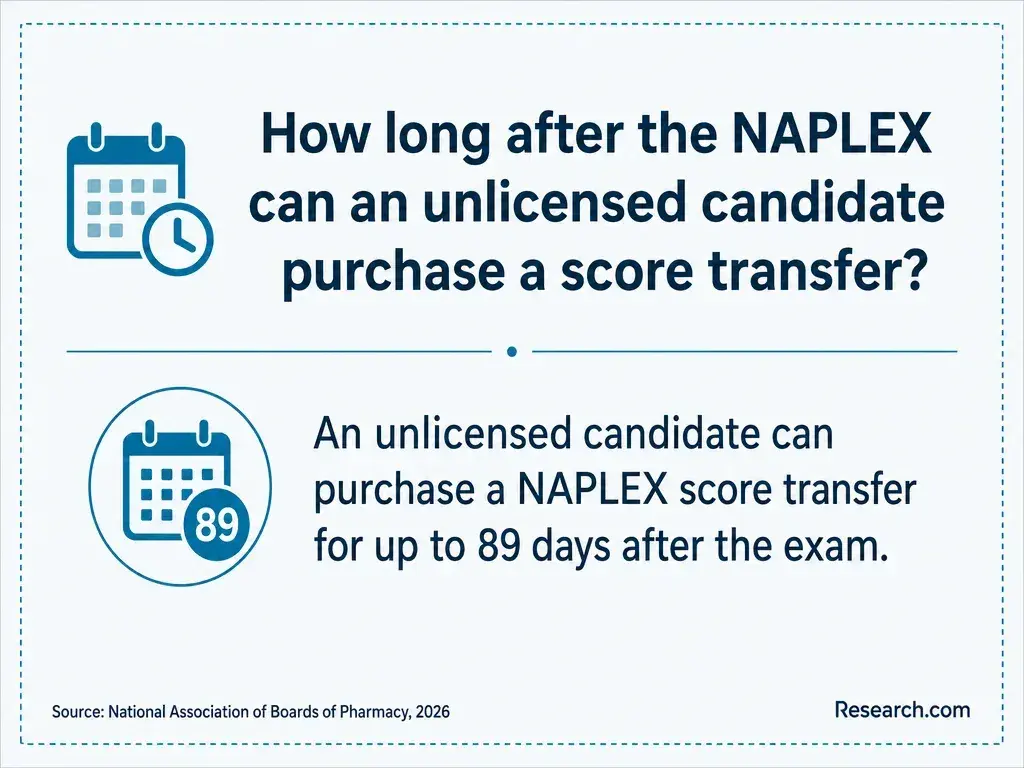
Graduation and pharmacist licensure are separate steps. U.S.-educated graduates generally pursue the North American Pharmacist Licensure Examination (NAPLEX), subject to their licensing board's eligibility rules. A jurisdiction may also require a law examination, such as the Multistate Pharmacy Jurisprudence Examination (MPJE), the Uniform Multistate Pharmacy Jurisprudence Examination (UMPJE), or another assessment; requirements vary, and some jurisdictions began transitioning to the UMPJE in 2026. Boards may impose additional application, internship, or background-check requirements. Passing an exam alone does not issue a license.
Before enrollment, ask your intended state board which education, intern registration, exams, and applications it requires. Be skeptical of claims that online pharmacy programs under two years provide a shortcut to pharmacist licensure: a shorter pharmacy-related credential is not interchangeable with an ACPE-accredited Pharm.D.
What Careers, Salaries, and Job Outlook Can PharmD Graduates Expect?
Licensed pharmacists work in settings such as community pharmacies, hospitals, health systems, and ambulatory care, with responsibilities that vary by employer and state practice law. The Bureau of Labor Statistics reports pharmacists' median annual pay was $140,910 in May 2025. That occupation-wide median is not a starting salary or a promised outcome for an online graduate; location, setting, experience, and hours matter.
BLS projects 5% growth for pharmacists, 2025-2035, with about 12,500 openings per year. A postgraduate residency may help with some clinical roles; fellowships commonly serve different training goals, and specialty board certification is distinct from both training and state licensure. None is universally required for pharmacist jobs. If you are changing careers, ask the receiving school how it evaluates transfer credits for pharmacy school before counting on prior coursework to shorten your path. If your goal is a pharmacy technician role rather than pharmacist practice, compare that separate occupation's education requirements before committing to a Pharm.D.
Other Things You Should Know About PharmD
Possibly during some coursework, but do not assume you can throughout the program. Ask for the actual class, lab, and rotation calendar, then discuss protected time and leave with your employer.
Ask the program about approved testing locations and proctoring rules before enrolling. A library or workplace room may help only if it meets the school's privacy and technical requirements.
Only if the program approves the site and experience under its policies. Employment alone does not make a workplace an eligible rotation or replace required supervision and evaluation.
Yes. Replace assumptions with written program answers and a realistic budget. A changed score is useful, but resolve any mandatory attendance, placement, or funding barrier before accepting an offer.
- Advanced Pharmacy Practice Experiences (APPE) | Veterans Affairs https://www.va.gov/loma-linda-health-care/work-with-us/internships-and-fellowships/advanced-pharmacy-practice-experiences-appe/
- Assuring Quality in Pharmacy Education During a Time of Crisis | nih.gov https://pmc.ncbi.nlm.nih.gov/articles/PMC7334348/
- Distance Doctor of Pharmacy | University of Findlay https://pharmdonline.findlay.edu/programs/online-pharm-d
- Pharm D Practice Experience Curriculum | Presbyterian College https://www.presby.edu/graduate-programs/pharmacy/pharmd/practice-experience/
- Can You Really Earn a Pharm.D. Online? Here's What to Expect - Lake Erie College of Osteopathic Medicine https://lecom.edu/can-you-really-earn-a-pharm-d-online-heres-what-to-expect/
- PharmD Online Frequently Asked Questions - Pharmacy | Extended & Distance Education https://www.su.edu/pharmacy/programs/pharmd-traditional-program/pharmd-online-frequently-asked-questions/
- PharmD Remote Pathway | CU School of Pharmacy https://pharmacy.cuanschutz.edu/degreesandprograms/pharmd/remote-pharmd
- Do All Pharmacy Programs Offer Experiential Education? | Belmont University https://www.belmont.edu/stories/articles/2024/pharmacy-program-experiential-education.html
- Computer Hardware, Software, and Internet Requirements | ufl.edu https://cpe.pharmacy.ufl.edu/resources/additional-resources/computer-req/
- PharmD Distance Pathway | Western New England University https://wne.edu/pharmacy-and-health-sciences/academics/pharmd/distance-pathway.cfm