PharmD Medicinal Chemistry Coursework Overview

Co-Founder and Chief Data Scientist
Medicinal chemistry can sound like a detour from patient care, but it helps pharmacy students understand why a drug works, how the body handles it, and when differences between related drugs matter. If you are comparing Doctor of Pharmacy (Pharm.D.) programs, course titles alone will not tell you how well that science connects to clinical decisions.
This guide explains the usual coursework, the preparation it requires, and the questions to ask about delivery, accreditation, and cost so you can choose a program that teaches chemistry in a way you can use.
Key Things You Should Know
- Pharm.D. medicinal chemistry connects molecular structure and drug properties to pharmacology, drug disposition, and therapeutic decisions; programs may teach it as a standalone course or within integrated modules.
- Undergraduate chemistry prerequisites prepare you for this professional coursework but do not replace it. Compare syllabi and assessments, not just course titles or credits.
- A typical Pharm.D. pathway includes pre-professional study followed by approximately four years of professional education; accelerated formats exist, but shorter schedules do not eliminate required experiential training or state licensure steps.
What Is Medicinal Chemistry in a PharmD Program?
Medicinal chemistry examines how a drug's molecular structure and chemical properties influence its biological effects. In a Pharm.D. program, the emphasis is generally on using that knowledge to understand medicines, rather than training students primarily to invent or synthesize new compounds.
Schools organize the subject differently. One curriculum may have a course called "Medicinal Chemistry"; another may teach the same concepts alongside pharmacology and therapeutics in organ-system modules. When reviewing Doctor of Pharmacy pathways for career transitions, applicants with a chemistry background should check how their previous work prepares them for these modules without assuming it replaces professional coursework.
The useful comparison is whether students must apply chemical principles to drug examples and clinical cases - not whether "medicinal chemistry" appears as a separate line on the transcript.
What Does PharmD Medicinal Chemistry Coursework Cover?
Content varies by school, but these themes show what to look for in a syllabus. The table also shows why each theme matters beyond a chemistry exam.
| Common topic | What students examine | Connection to pharmacy learning |
| Structure-activity relationships | How changes in a molecule affect its activity | Understanding similarities and differences within drug classes |
| Functional groups and physicochemical properties | Ionization, solubility, and related properties | Explaining absorption, formulation, and distribution |
| Drug metabolism | How structural features affect metabolic pathways | Recognizing potential differences in drug exposure and interactions |
| Drug targets | How molecules interact with receptors, enzymes, or other targets | Connecting chemical properties with mechanisms of action |
A strong course asks students to interpret unfamiliar examples as well as recognize established drugs. Previous classes or pharmacy school prior learning credits may satisfy an admission prerequisite if a school approves them, but applicants should not assume those credits waive a professional medicinal chemistry module. The receiving program decides how prior coursework applies.
How Does Medicinal Chemistry Support Pharmacy Practice?
Medicinal chemistry gives pharmacists a way to reason about drug behavior rather than relying only on memorized facts. For example, understanding ionization and solubility can make differences in absorption more intelligible; understanding metabolism can help explain why related drugs have different interaction concerns. Clinical decisions still require patient information, current evidence, prescribing information, and professional judgment. A chemical resemblance alone is not a basis for substituting one medication for another.
This connection is especially useful when evaluating pharmacy school application eligibility: meeting a chemistry prerequisite is an admissions question, while being ready to use chemistry in patient-care coursework is a learning question. Applicants who struggled with organic chemistry should look for tutoring, faculty support, and case-based practice before committing to a demanding course sequence.
Before professional medicinal chemistry, Pharm.D. applicants commonly complete undergraduate general and organic chemistry, often with laboratories. Biology, biochemistry, and other prerequisites may also matter. There is no single nationwide list of courses, credit hours, minimum grades, or rules for older coursework: each pharmacy school sets its admissions requirements and professional-course sequence. A completed bachelor's degree is not universally required.
Use the current admissions requirements for each school to distinguish courses needed to apply from courses that must be finished before enrollment. Ask whether a laboratory must be in person, whether substitutions or community-college credits are accepted, and whether a course can be in progress when you apply. Resources on pharmacy program admission planning can help frame those questions, but the school must confirm its own policy in writing. Do not treat a minimum admission requirement as proof that the professional coursework will be easy.
Students generally complete prerequisite undergraduate study before entering a professional Pharm.D. curriculum that commonly takes four academic years. Some schools offer accelerated calendars or other pathways with different schedules. Compare the full timeline from your current academic standing: unfinished prerequisites can add time before the professional program begins.
In a faster program, medicinal chemistry may be taught in compressed terms or integrated with concurrent pharmacology and therapeutics. Compare pharmacy degree programs with accelerated timelines by weekly workload, breaks, course sequencing, and the timing of clinical experiences - not just the advertised graduation date. Introductory pharmacy practice experiences (IPPEs) and advanced pharmacy practice experiences (APPEs) are supervised training, and an accelerated classroom schedule does not make those commitments optional.
Online instruction can be suitable for learning chemical principles, especially when students work through structures, cases, and instructor feedback. "Online," however, does not mean self-paced or entirely remote. A program may require live classes, in-person laboratories or campus sessions, and supervised IPPEs and APPEs at approved practice sites.
When using an online pharmacy program comparison, ask how medicinal chemistry is assessed, which activities require travel, and how clinical placements are arranged or approved. Confirm whether the program can enroll you in your state and whether its required placements are feasible there. State authorization for distance education, placement permission, and eligibility for pharmacist licensure are separate questions; none should be inferred from an online label.
The Accreditation Council for Pharmacy Education (ACPE) accredits professional pharmacy degree programs against education standards. Its standards address the curriculum and experiential education, among other areas, but do not prescribe one universal medicinal chemistry course title. Check the specific program's current ACPE status rather than assuming that a university's institutional accreditation covers its Pharm.D. program.
Accreditation is a starting point, not a ranking of teaching quality or value. Ask for the curriculum map or syllabi to see where drug-structure concepts are taught and assessed, then compare support services and full attendance costs. This is particularly important when considering budget-friendly pharmacy degree programs: lower advertised tuition does not reveal fees, travel, or how well the coursework fits your learning needs. ACPE program accreditation is also distinct from a school's authorization to offer distance education in a particular state.
Finishing a Pharm.D. does not itself grant a pharmacist license. A U.S.-educated graduate must meet the requirements of the state or other jurisdiction where they seek licensure. These generally include graduation from an eligible pharmacy program, required supervised experience, the North American Pharmacist Licensure Examination (NAPLEX), and any applicable jurisprudence examination or other board requirements. Jurisdictions differ, including in whether they use the Multistate Pharmacy Jurisprudence Examination (MPJE), the Uniform MPJE (UMPJE), or another approach.
Before enrolling, check the relevant board's current rules for education, intern registration, experience, examinations, and application steps. Be especially careful with claims about online pharmacy degree duration: a shorter online credential is not automatically a licensure-qualifying Pharm.D., and passing an exam alone does not issue a license.
Licensed pharmacists use medicinal chemistry as part of a wider clinical knowledge base in community, hospital, ambulatory care, and specialty pharmacy settings. Its relevance may be especially visible when evaluating drug-class differences, formulations, metabolism, and medication information. Employers hire for more than this one subject: communication, clinical reasoning, and safe practice remain central.
Some graduates pursue postgraduate residency for concentrated practice training or a fellowship for research- or industry-oriented experience; requirements and expectations vary by role. Board certification is a separate professional credential, not a substitute for a state license. If your primary goal is laboratory drug discovery rather than pharmacist practice, compare pharmaceutical-sciences training and shorter online doctorate pathways against the actual qualifications employers request. A Pharm.D. is not automatically the most direct route to a research position.
What Are Pharmacist Salaries and Job Outlook After a PharmD?
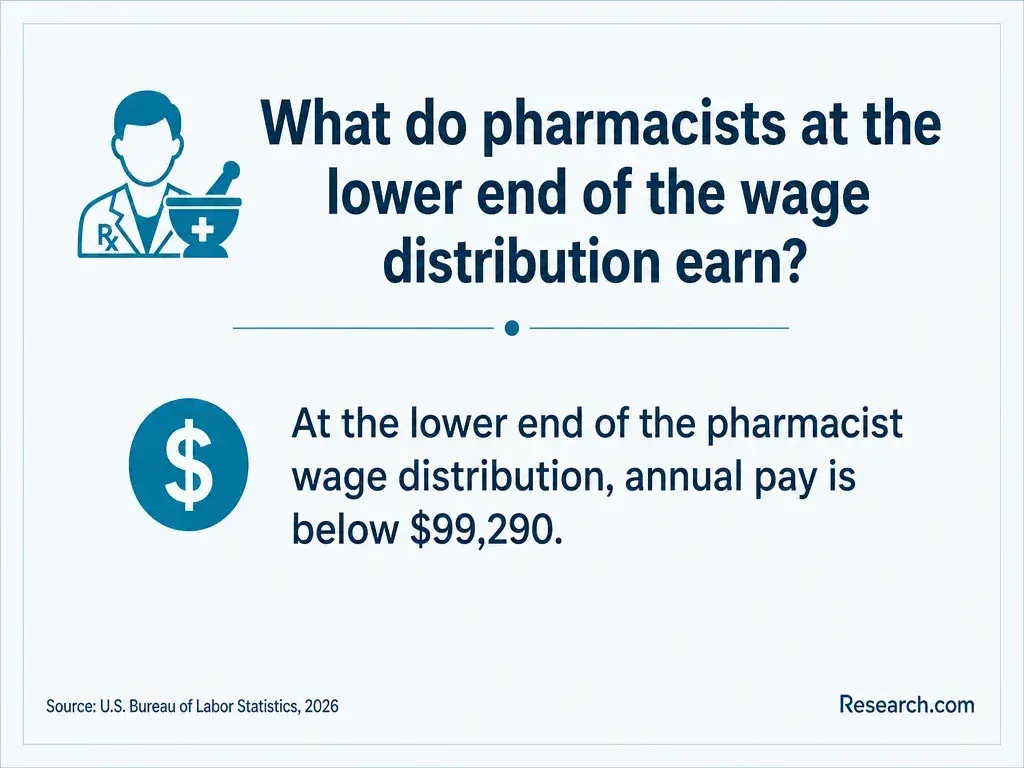
The U.S. Bureau of Labor Statistics reports median annual pay of $140,910 in May 2025 for pharmacists and projects 5% job growth for 2025-2035, with about 12,500 openings per year. These occupation-wide figures are context for a career decision, not a prediction of a new graduate's pay or the return from a particular program.
For a meaningful financial comparison, estimate tuition and required fees alongside prerequisite coursework, supplies, campus travel, rotation-related travel or housing, and licensure costs. Then consider time away from paid work. Guides to lower-cost pharmacy degree pathways can help identify options, but confirm current charges and your financial-aid eligibility with each school. If you plan to borrow, seek advice based on the rules that apply to your enrollment and aid year rather than assuming an older student-loan arrangement still applies.
Other Things You Should Know About PharmD
Possibly. Assessment methods vary: one course may emphasize identifying structural features, while another expects students to draw selected structures. Request a recent syllabus or sample learning objectives if that distinction affects your preparation.
No. Medicinal chemistry focuses on drug structures, properties, and biological activity. Compounding focuses on preparing medications; its coursework draws on additional subjects, including pharmaceutics and applicable safety standards.
The school's progression policy controls whether and when you can repeat it and how the result affects later courses or rotations. Review that policy before enrolling, particularly in a tightly sequenced or accelerated program.
Its main purpose is usually to help future pharmacists understand existing medicines. Some programs may include laboratory or drug-development content, but students seeking extensive synthesis training should inspect the curriculum rather than assume it is part of the Pharm.D.
- Implementation of the Pharmacists' Patient Care Process in a Medicinal Chemistry Course - PMC https://pmc.ncbi.nlm.nih.gov/articles/PMC7092791/
- PharmD Curriculum | CU School of Pharmacy https://pharmacy.cuanschutz.edu/degreesandprograms/pharmd/curriculum
- FAQ | OSU College of Pharmacy - Oregon State University https://pharmacy.oregonstate.edu/programs-admissions/pharm-d/faq
- Pharmaceutical Science (PHSC) | Northeastern University Academic Catalog https://catalog.northeastern.edu/course-descriptions/phsc/
- PharmD Curriculum - Texas A&M College of Pharmacy https://pharmacy.tamu.edu/pharmd/curriculum.html
- Doctor of Pharmacy (PharmD) - Prospective Students https://www.pharmacy.umaryland.edu/academics/pharmd/prospective-students/
- Curriculum - UW School of Pharmacy https://sop.washington.edu/pharmd/curriculum/
- What is Medicinal Chemistry? | Michigan Technological University https://www.mtu.edu/chemistry/undergraduate/medicinal/what/
- Pharmacy | Pre-Health Advising https://prehealth.ucmerced.edu/health-careers/pharmacy
- PharmD Handbook: Curriculum - School of Pharmacy https://www.pharmacy.pitt.edu/pharmd-student-handbook/pharmd-handbook-curriculum