PharmD programs with no bachelor's degree requirement

Co-Founder and Chief Data Scientist
You may be able to start a Doctor of Pharmacy (Pharm.D.) program without first earning a bachelor's degree - but you cannot skip the required college coursework. For students planning a route into pharmacy, that distinction can save time and tuition. This guide explains where to look for prerequisite-based admission, what to check before applying, and how the professional degree leads toward pharmacist licensure. It also covers scheduling and costs that can make a seemingly shorter pathway a poor fit.
Key Things You Should Know
- Some U.S. Pharm.D. programs admit applicants who complete specified undergraduate prerequisites without earning a bachelor's degree; each school sets its own course and credit rules.
- A common planning model is about two years of prerequisite study followed by a four-year professional program, but admission, scheduling, and graduation timelines vary.
- The Pharm.D. is a step toward licensure, not a license. The U.S. pharmacist median annual pay was $140,910 in May 2025, according to the Bureau of Labor Statistics; that figure is not a starting-salary promise.
Which PharmD programs do not require a bachelor's degree?
Many U.S. pharmacy schools offer a prerequisite-based admission route: applicants complete designated undergraduate courses and credits, then enter the professional Pharm.D. curriculum without finishing a bachelor's degree. The University of Minnesota College of Pharmacy and the University of Florida College of Pharmacy are examples to investigate. Before relying on either option, check its admissions requirements for your application cycle; a school may change prerequisites or set additional conditions for a particular pathway.
"No bachelor's required" does not mean "apply straight from high school" or "any two years of college will do." A direct-entry or early-assurance arrangement may also have different progression rules from regular admission. Use pharmacy degree eligibility options to identify possible routes, then confirm the exact credential, entry point, and requirements with each school.
What prerequisites are required for PharmD admission without a bachelor's degree?
Expect undergraduate science and general education requirements before the professional program begins. Schools commonly specify subjects such as chemistry, biology, mathematics, and communication, but their required courses, labs, credit totals, minimum grades, and grade-point-average rules differ. A published minimum establishes eligibility to apply, not a guarantee of admission.
Compare your transcript against each school's current course-by-course checklist rather than matching course titles by eye. Ask admissions staff whether your planned labs, community-college credits, repeated courses, and courses still in progress will count - and when every requirement must be finished. The receiving school makes the final credit determination. Pharmacy school acceptance criteria can help frame a comparison, but the school's current admissions policy controls your application.
Can you become a pharmacist without earning a bachelor's degree?
Yes, if you enter and complete an appropriate Pharm.D. pathway and then meet your state's licensing requirements. The undergraduate prerequisites are preparation for admission; the Pharm.D. is the professional degree. Neither completing the prerequisites nor receiving the degree alone authorizes you to practice as a pharmacist.
This route can make sense for someone certain about pharmacist practice who would otherwise take extra undergraduate courses solely to finish a bachelor's degree. A bachelor's may still be worthwhile if you want a separate credential or a fallback career before pharmacy school. Career changers should compare their existing credits with current prerequisites; Doctor of Pharmacy pathways for career transitions may help them organize that comparison.
A common route is roughly two years of undergraduate prerequisites followed by four years in a professional Pharm.D. program. This is a planning model, not a universal minimum: course sequencing, admissions timing, summer study, and the school's professional curriculum can change the total. Entering without a bachelor's degree generally removes a credential requirement, not a portion of the Pharm.D. curriculum.
Some schools offer a differently paced professional curriculum. When comparing how accelerated Pharm.D. programs work, examine the actual calendar: compressed terms can leave less time for paid work, even if graduation comes sooner. Ask when prerequisites must be complete and when full-time clinical rotations begin before estimating your own finish date.
The pathway has two distinct academic stages. Pre-pharmacy coursework builds the science, quantitative, and communication foundation required for admission. The professional Pharm.D. curriculum then develops knowledge and supervised skills in areas such as pharmacology, therapeutics, medication safety, patient assessment, and pharmacy law. Specific courses and their sequence depend on the school.
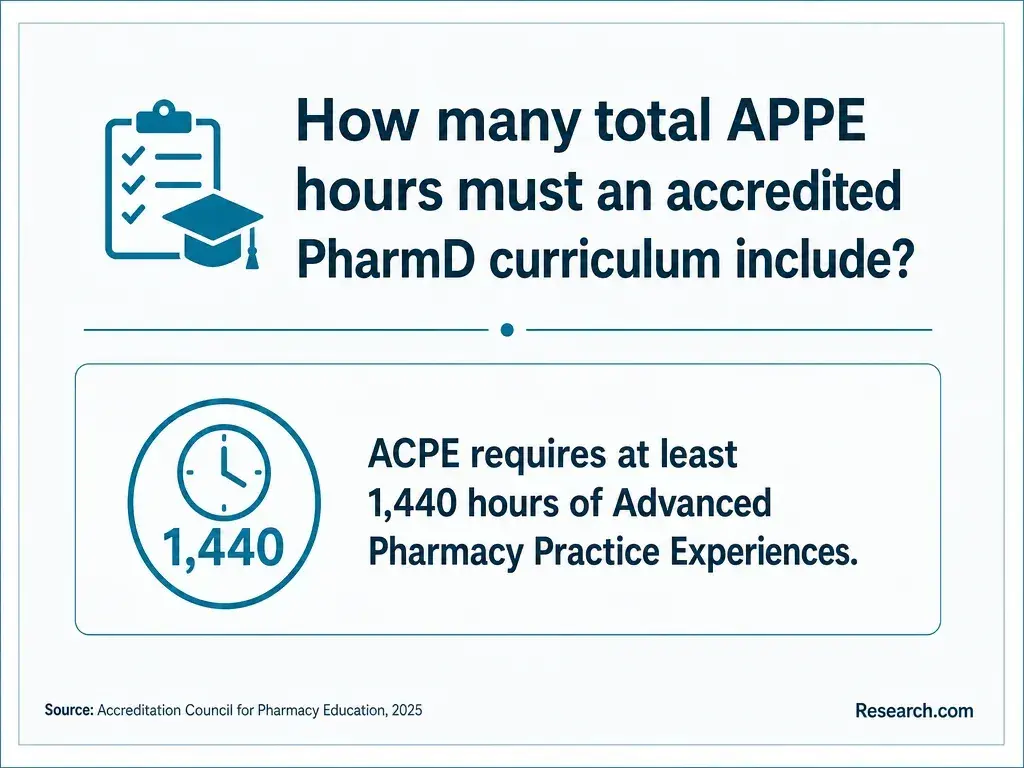
Professional study also includes introductory pharmacy practice experiences (IPPEs) and more advanced pharmacy practice experiences (APPEs). These are supervised, in-person training - not permission to practice independently. Prior undergraduate courses ordinarily satisfy prerequisites rather than replace professional Pharm.D. courses. If you hope to move between schools, review pharmacy programs with transfer pathways and request a written evaluation from the receiving program before assuming any professional credits will transfer.
Some Pharm.D. pathways deliver part of their instruction online and admit students through prerequisite-based routes. Online instruction does not make the degree fully remote: a program may require scheduled live classes, campus labs or immersions, in-person assessments, and supervised IPPE and APPE placements. Availability of a clinical site near your home should not be assumed.
Before you choose an online Pharm.D. program, ask who finds and approves rotation sites, whether travel is required, and what students must arrange themselves. Confirm the school's authorization to enroll students in your state separately from its ability to support clinical placements there and your eventual eligibility for state licensure. Rotation schedules may also make full-time employment impractical.
There is no single price for this route. Skipping a bachelor's degree may eliminate courses you do not need for Pharm.D. admission, but you still pay for prerequisites and the professional program. Advertised tuition can omit substantial expenses, so compare each school's current cost of attendance and the costs you would personally incur.
The following categories make an online Pharm.D. cost comparison more useful than a tuition-only ranking:
- Remaining prerequisite tuition, required labs, and fees.
- Professional tuition and mandatory school charges, including technology or lab expenses.
- Travel and housing for campus requirements or clinical rotations, plus reduced earnings if rotations prevent regular work.
- Books, clinical resources, immunizations, background checks, and eventual licensing-exam costs.
Ask the financial aid office for an estimate based on your entry term and student classification. Federal borrowing rules changed for many new graduate and professional borrowers beginning July 1, 2026; do not budget using an older Grad PLUS assumption or someone else's loan eligibility.
For the standard U.S.-educated route to pharmacist licensure, attending a professional Pharm.D. program accredited by the Accreditation Council for Pharmacy Education (ACPE) is essential. Verify the specific program and its current status in ACPE's official program records before enrolling. ACPE accredits education programs; it does not license pharmacists.
Keep three checks separate: ACPE professional-program accreditation, the institution's accreditation, and any state authorization relevant to online enrollment or clinical placement. None substitutes for the others. A low advertised price is not strong value if the program cannot support your intended licensure route; use that distinction when evaluating pharmacy programs that may offer strong value.
After graduating, a U.S.-educated candidate generally applies through a state board of pharmacy, satisfies that jurisdiction's internship or practical-experience and administrative requirements, and passes the North American Pharmacist Licensure Examination (NAPLEX). A jurisdiction may also require a pharmacy-law assessment, but do not assume it uses the Multistate Pharmacy Jurisprudence Examination (MPJE): requirements vary, and some jurisdictions began transitioning to the Uniform Multistate Pharmacy Jurisprudence Examination (UMPJE) in 2026. Check the board and the National Association of Boards of Pharmacy for the rules that apply when you apply.
Passing an exam does not itself issue a license; the board must approve the application. Likewise, programs presented as ways to finish an online pharmacy degree sooner should not be assumed to award a licensure-qualifying Pharm.D. Check the exact credential before treating a shorter program as a substitute.
What jobs, salaries, and outlook follow a PharmD degree?
Licensed pharmacists work in settings including community pharmacies, hospitals, ambulatory care, and specialty pharmacy. Responsibilities and hiring preferences differ by role and employer. The Bureau of Labor Statistics reports pharmacist median annual pay of $140,910 in May 2025, with 5% projected job growth, 2025-2035 and about 12,500 openings per year projected. Those occupation-wide figures are useful for evaluating the field, but they do not predict a new graduate's offer or the return on a particular school's tuition.
A residency can provide structured postgraduate clinical training; a fellowship generally serves a different, often industry-focused purpose. Neither is universally required for pharmacist employment. Specialty board certification is a separate credential, not a state license. If your goal is research, administration, or another job that does not require pharmacist licensure, compare that goal with shorter online doctorate pathways before committing to Pharm.D. prerequisites and clinical training. Pharmacy technician work is also a separate occupation and does not ordinarily require a Pharm.D.
Other Things You Should Know About PharmD
No current applicant can take the Pharmacy College Admission Test (PCAT); it was retired in January 2024. Check each school's current application instructions for any other assessments it requires.
Not necessarily. Requirements and preferences differ by school. Relevant experience may help you assess the profession, but do not mistake a recommendation for an admission requirement.
Not automatically. Some institutions may offer an additional degree option, but you should confirm its separate requirements if receiving a bachelor's credential matters to you.
Possibly. The pharmacy school decides whether it accepts the coursework and what transcript evaluation it requires. Ask for its international-credit policy before paying for replacement courses.
- Requiring a Bachelor's Degree for PharmD Programs - PMC https://pmc.ncbi.nlm.nih.gov/articles/PMC4891870/
- U.S. Graduate Pharmacy References | EducationUSA https://educationusa.state.gov/your-5-steps-us-study/research-your-options/graduate/graduate-student/what-graduate-programs-a-4
- Pharm.D. Tuition & Fees | University of Health Sciences and Pharmacy in St. Louis https://www.uhsp.edu/admissions/pharmd-tuition-fees/
- FAQ | OSU College of Pharmacy - Oregon State University https://pharmacy.oregonstate.edu/programs-admissions/pharm-d/faq
- Tuition and Fees for Doctor of Pharmacy (PharmD) Year 1 | UNT Health Fort Worth https://www.unthealth.edu/tuition-and-fees/cop-tuition-and-fees/pharmd-year-1.html
- PharmD FAQs - UNC Eshelman School of Pharmacy https://pharmacy.unc.edu/education/pharmd/pharmd-admissions-faqs/
- Regular Admission Requirements | ufl.edu https://admissions.med.ufl.edu/admission-requirements/regular-admission-requirements/
- Cost of Attendance " Pharm.D. Admissions " | ufl.edu https://admissions.pharmacy.ufl.edu/financial-aid/anticipated-expenses/