
PharmD total cost with and without transfer credits

Co-Founder and Chief Data Scientist
Transfer credits can lower the cost of becoming a pharmacist - but only if a Pharm.D. program applies them to requirements you would otherwise pay to complete. Previously earned prerequisite credits and credits accepted into the professional curriculum can have very different effects on your bill and graduation date. This guide is for prospective students comparing offers or considering a transfer. You'll learn how to calculate the full cost of each route, identify savings that are real rather than assumed, and get the written answers you need before committing.
Key Things You Should Know
- Prerequisite credits may eliminate courses you still need to take, but they usually do not reduce the tuition charged for the professional Pharm.D. curriculum.
- Professional-course transfer credits reduce future costs only if the receiving school accepts them toward required courses and lets you skip a billed term or credits; cohort sequencing may prevent an earlier graduation.
- Compare each school's remaining tuition, required fees, living and rotation costs, and applicable aid - not its advertised tuition alone. Federal borrowing rules changed for many new professional students beginning July 1, 2026.
What Is the Total Cost of a PharmD With and Without Transfer Credits?
There is no reliable nationwide "with transfer credits" price. Total cost depends on which credits a particular school accepts, how it charges tuition, and whether acceptance changes the number of terms you must attend. Start by distinguishing cost from today forward, which helps you choose between offers, from total pathway cost, which also includes money already spent on applicable coursework.
The comparison below shows which charges can change. It also prevents a common mistake: subtracting the price of previously completed courses from a professional program's tuition when that tuition will not change.
| Cost component | Without applicable transfer credits | With applicable transfer credits |
| Remaining prerequisites | Pay for every course still required before entry. | Pay only for unmet requirements; previously paid tuition remains part of total pathway cost. |
| Professional tuition and mandatory fees | Pay for the full required curriculum under the school's billing policy. | Pay less only if accepted professional credits remove billed credits or terms; transfer-evaluation fees may apply. |
| Living and attendance expenses | Budget for the full attendance period. | May fall if graduation occurs sooner; may not fall if the graduation date stays the same. |
| Books, equipment, travel, and licensure | Budget for required purchases, clinical placements, and post-degree licensing. | Many of these costs remain even when coursework transfers. |
For each offer, add remaining prerequisite tuition + remaining professional tuition and fees + expected living, materials, and placement costs + licensing expenses. Then subtract only grants, scholarships, or employer payments you are actually eligible to use; loans finance costs rather than erase them. For a lifetime comparison, add prior coursework spending separately to both relevant paths. To reduce the cost of pharmacy school, compare itemized attendance budgets and the amount you would need to borrow, not tuition headlines alone.
How Much Can Transfer Credits Reduce PharmD Tuition and Program Length?
Tuition savings are not the same as credits accepted. At a per-credit program, an approved professional course may remove a future tuition charge. At a flat-rate, per-term program, accepting that course may leave the term's bill unchanged. Either way, required courses offered only in sequence can keep a student in the same graduating cohort.
Prerequisite credits work differently: they can prevent additional pre-entry tuition and may allow earlier admission, but they do not automatically shorten the professional program. Previously paid coursework is a sunk cost for a decision made today, although it belongs in a calculation of everything spent on the pathway.
Request two written graduation plans - one using every proposed credit and one without them - alongside term-by-term bills. Check whether a skipped term also eliminates housing costs or time away from paid work. Pharmacy degree programs with accelerated timelines may provide another route to an earlier finish, but compare their full schedules and costs rather than assuming transfer credits create the same result.
How Many Credits Can Transfer Into a PharmD Program?
No single credit limit applies to every U.S. Pharm.D. program. A school may accept prior undergraduate courses toward its admission prerequisites while accepting few - or no - courses toward its professional curriculum. Another may consider professional credits individually, subject to course equivalence, grades, recency, residency requirements, and available places in the receiving cohort.
For a closer look at how pharmacy programs review transfer credits, keep the distinction between admission eligibility and professional-course placement at the center of your comparison.
Requirements depend on whether you are bringing undergraduate prerequisites into a first-year Pharm.D. application or seeking entry after starting a professional pharmacy program. Schools set their own prerequisite subjects and labs, minimum grades, GPA rules, application materials, and policies for courses still in progress. A bachelor's degree is not universally required.
Applicants transferring between professional programs may also need good academic standing, detailed course syllabi, evidence of completed experiential work, and an available seat at the appropriate stage. Admission and credit approval are separate decisions. The retired Pharmacy College Admission Test (PCAT) is not a currently available admissions exam.
If your academic history is less conventional, research pharmacy programs for nontraditional applicants without treating a published minimum as an admission guarantee. Confirm the current school-specific rules and whether the application goes through PharmCAS or directly to the institution.
Admissions staff typically compare prerequisite courses by subject, level, laboratory work, grade, and sometimes course age. Evaluating a prior professional pharmacy course is more demanding: the receiving school must determine whether its content, competencies, credits, assessments, and experiential components satisfy a particular requirement in its own curriculum. An elective credit may count toward a credit total without replacing a required course.
Before paying an enrollment deposit or withdrawing from your current school, obtain a written evaluation. The following sequence turns an informal "credits may transfer" response into a usable cost comparison:
- Send official transcripts and, when requested, syllabi, lab descriptions, and documentation of completed pharmacy practice experiences.
- Ask for a course-by-course decision that distinguishes prerequisites, professional requirements, and elective credit.
- Request the resulting term schedule, expected graduation date, and tuition-and-fee bill for each remaining term.
- Ask which approvals are final, which depend on completing in-progress courses, and whether a seat is available in the required cohort.
Students considering pharmacy programs for applicants still completing requirements should also confirm the deadline by which outstanding courses must be finished. Permission to apply with coursework in progress is not permission to begin the program without meeting its matriculation conditions.
Delivery format can shift costs without changing the credential's academic or clinical obligations. Online instruction may reduce routine commuting, while required campus labs, live meetings, examinations, and in-person clinical rotations can add travel, lodging, or time away from work. "Online" does not necessarily mean self-paced or fully remote.
For each format, compare the school's itemized tuition and fees with the cost of required visits and placements. Ask who arranges introductory and advanced rotations, whether a site near home is possible, and what happens if travel is necessary. Also confirm any state authorization needed for distance enrollment and any separate rules governing clinical placements. When you choose an online Pharm.D. program, use its actual attendance and rotation calendar - not the delivery label - to estimate what you will spend and when you can work.
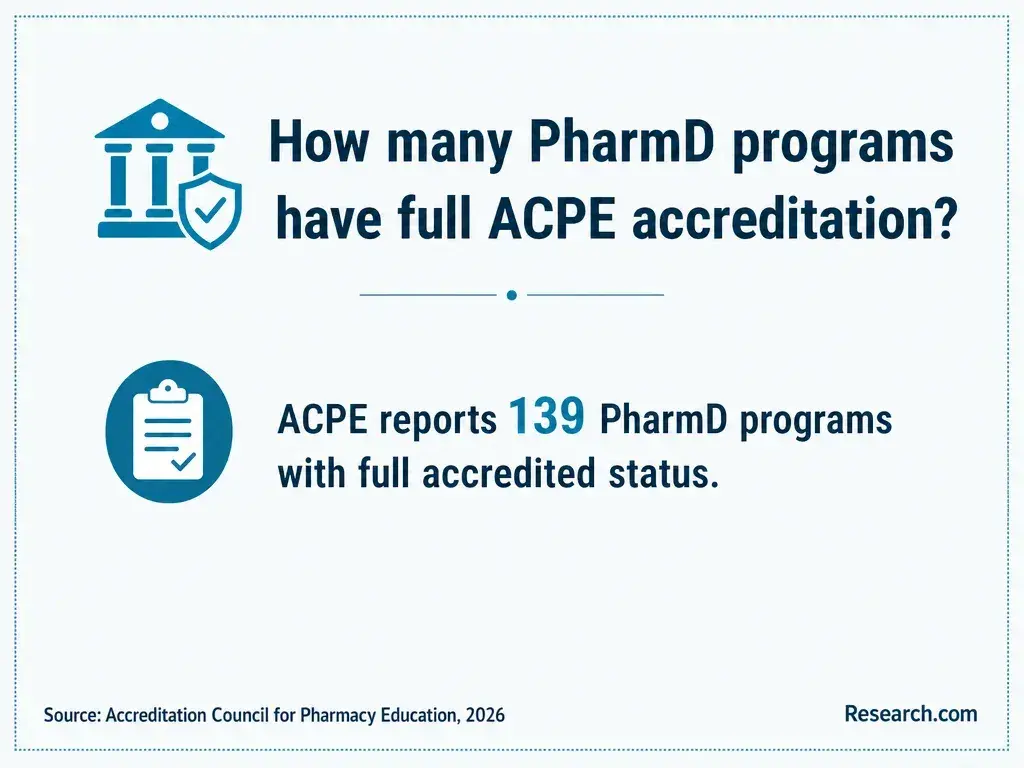
For the standard U.S.-educated pharmacist pathway, verify the professional Pharm.D. program's status in the Accreditation Council for Pharmacy Education (ACPE) directory and check the licensing rules of the state where you intend to practice. ACPE accredits programs, not individual pharmacists. Institutional accreditation and authorization to enroll online students answer different questions; neither substitutes for professional-program accreditation or a state license.
This check matters when a shorter doctorate or pharmacy-related degree appears cheaper than a Pharm.D. General guides to online doctorate completion periods cannot establish that a program satisfies pharmacist-licensure education requirements. If a school's accreditation status or your intended state's eligibility rules are unclear, resolve that uncertainty before comparing prices.
The professional curriculum builds on undergraduate prerequisites. It typically develops knowledge of medicines and disease, pharmacotherapy, patient assessment, drug information, communication, and medication safety, alongside supervised practice. Introductory pharmacy practice experiences (IPPEs) occur during the curriculum; advanced pharmacy practice experiences (APPEs) are more intensive rotations later in the program. Exact schedules and placement arrangements vary by school.
That progression explains why a prior biology or chemistry course may satisfy an admission requirement without replacing a professional patient-care course or rotation. If you are transitioning into a Doctor of Pharmacy program, map each prior course to the school's prerequisites first, then ask separately whether any professional requirement can be fulfilled. Budget for rotation-related travel, background checks, immunizations, and any required intern registration under the applicable rules.
A Pharm.D. is a degree, not a license. Graduates seeking U.S. pharmacist licensure generally must meet their state board's eligibility and application requirements and pass the North American Pharmacist Licensure Examination (NAPLEX). Jurisprudence requirements vary: depending on the jurisdiction, an applicant may encounter the MPJE, the newer UMPJE, another law assessment, or a different process. Check the current board and National Association of Boards of Pharmacy instructions before budgeting exam and application fees.
Exam attempts, license applications, and any required preparation add costs after tuition ends. A quicker or less expensive pharmacy-related credential is not automatically a shortcut: accelerated online pharmacy degree pathways may prepare students for roles other than licensed pharmacist. Internationally educated applicants may face a different certification and licensing route. Passing an exam or completing a degree alone does not issue a pharmacist license.
What Salaries and Career Paths Are Available After a PharmD?
Licensed pharmacists work in community, hospital, ambulatory care, specialty, and other settings; the work and hiring preferences differ by employer. The Bureau of Labor Statistics reports median annual pay of $140,910 in May 2025 for pharmacists and projects 5% growth, 2025-2035, with about 12,500 openings per year. Those occupation-wide figures are context for weighing educational expense, not a prediction of an individual graduate's pay or job offer.
A residency offers structured postgraduate practice training; a fellowship generally emphasizes a different, often research- or industry-oriented, training path. Board certification is a separate specialty credential, not a state license. None is universally required for pharmacist employment. If your intended work does not require pharmacist licensure, compare low-cost and shorter pharmacy degree programs against the role's actual entry requirements. Pharmacy technician work, for example, is a separate occupation that does not ordinarily require a Pharm.D.
For a final decision, favor the transfer offer only when its written credit evaluation, remaining-term bills, clinical schedule, and aid eligibility produce a better overall path. A lower sticker price that extends attendance or creates substantial placement travel may cost more in practice.
Other Things You Should Know About PharmD
Usually, an institution's scholarship does not automatically move with you. Ask the new school for a written aid offer and check the original award's terms before comparing your net costs.
Possibly, but eligibility depends on the student, expenses, enrollment, and applicable tax rules. Tax credits do not reduce the school's bill upfront; consult current IRS guidance or a qualified tax professional.
That depends on the school's deposit agreement. Obtain the refund deadline and the conditions for a changed credit decision in writing before paying.
Leaving or transferring can affect enrollment-based loan status and repayment timing. Contact your loan servicer and both schools' financial aid offices before withdrawing; a new school's aid offer does not cancel debt you already incurred.
- Transfer Students | New York State Education Department https://www.nysed.gov/standards-instruction/transfer-students
- Transfer Students and Remaining Eligibility | ed.gov https://fsapartners.ed.gov/knowledge-center/fsa-handbook/2025-2026/vol7/ch6-transfer-students-and-remaining-eligibility
- Understanding College Costs | studentaid.gov https://studentaid.gov/resources/prepare-for-college/students/choosing-schools/consider-costs
- Cost of Attendance " Pharm.D. Admissions " | ufl.edu https://admissions.pharmacy.ufl.edu/financial-aid/anticipated-expenses/
- PharmD Prerequisites - Doctor of Pharmacy https://pharmacy.wisc.edu/pharmd/prerequisites/
- Academic Advising & Transfer Credits | nyu.edu https://cas.nyu.edu/newstudents/transfer-transition-students/external-transfers/academic-advising.html
- Pharm.D. Tuition & Fees | University of Health Sciences and Pharmacy in St. Louis https://www.uhsp.edu/admissions/pharmd-tuition-fees/
- Tuition, Fees, Scholarships - OSU College of Pharmacy https://pharmacy.oregonstate.edu/programs-admissions/pharm-d/tuition-fees-scholarships
- Cost of Attendance - Texas One Stop https://onestop.utexas.edu/managing-costs/cost-tuition-rates/cost-of-attendance/
- Cost of Attendance | PharmD Program | Financial Aid | USF Health https://health.usf.edu/financial-aid/pharmd-program/cost-of-attendance


