
How to Balance Pharm.D. Coursework With Caregiving

Co-Founder and Chief Data Scientist
A Pharm.D. schedule can change from week to week; caregiving often cannot. If you care for a child, parent, partner, or other family member, the decision is not simply whether you can study after bedtime. You need to know when attendance is mandatory, how clinical rotations are assigned, and what happens when care falls through.
This guide helps prospective and current Doctor of Pharmacy students build a realistic schedule, assess program flexibility, and decide whether starting, continuing, or delaying enrollment is workable.
Key Things You Should Know
- Plan around mandatory labs and in-person clinical rotations, not just lecture hours; a typical Pharm.D. professional curriculum spans four academic years, though programs vary.
- Before enrolling, get written answers about attendance, rotation locations, schedule changes, and leave or reentry policies. "Online" does not mean fully remote or self-paced.
- Budget for backup care, travel, and reduced work hours alongside tuition. Federal borrowing rules changed for many new professional students beginning July 1, 2026, so confirm your own aid eligibility rather than assuming loans will cover every gap.
How can you balance PharmD coursework with caregiving responsibilities?
Build your plan around the least flexible commitments first: required labs, exams, and supervised pharmacy practice. Then test whether care coverage, travel time, study time, and paid work fit around them. A plan that works only when nobody is sick is not yet a workable plan.
Use this sequence before each term and repeat it before clinical rotations, when schedules may change substantially:
- Put every known mandatory session, commute, and care handoff on one calendar. Ask the program which dates and rotation hours are still subject to change.
- Assign a primary and backup caregiver for each mandatory block. Confirm how much notice each person needs and what coverage will cost.
- Reserve recurring study blocks for reading, calculations, and exam preparation; treat them as appointments rather than time left over after care.
- Tell the appropriate course or experiential coordinator about foreseeable conflicts early. Ask what the written attendance, make-up, and absence policies permit rather than relying on an informal assurance.
- Recheck the plan whenever work hours, a dependent's needs, or a rotation site changes. If the revised schedule has no reliable care coverage, discuss a reduced load or approved leave before missing requirements.
Compare pharmacy programs balancing cost and time carefully, a faster calendar may compress coursework and increase the weekly hours for which you need care.
What does a PharmD program involve for students who provide caregiving?
A Doctor of Pharmacy (Pharm.D.) is the professional degree used for the standard U.S.-educated pharmacist licensure pathway. It is distinct from undergraduate pre-pharmacy prerequisites, which applicants complete before entering the professional curriculum. Professional study combines medication and disease knowledge with calculations, patient communication, hands-on skills, assessments, and supervised practice. Schools set their own course sequences and attendance rules.
Experiential education typically includes introductory pharmacy practice experiences (IPPEs) during the curriculum and advanced pharmacy practice experiences (APPEs) later in training. Both involve supervised work at approved sites; neither should be assumed to happen remotely, at your workplace, or near your home. A student moving from pharmacy education after undergraduate science coursework should account for this change from relatively selectable class times to site-dependent practice hours.
Caregiving does not make success impossible, but it changes the threshold for a sustainable schedule. Estimate coverage for travel and preparation as well as scheduled instruction, and ask how far in advance the school releases rotation assignments.
How can you choose an accredited PharmD program that supports caregivers?
First confirm the professional Pharm.D. program's current status in the Accreditation Council for Pharmacy Education (ACPE) program directory. ACPE professional-program accreditation is different from a university's institutional accreditation. For a distance pathway, also verify the school's authorization to enroll you in your state and whether required clinical placements there are permitted. None of these checks alone establishes future pharmacist licensure eligibility.
Then ask each school the same caregiver-specific questions: Which sessions require live or campus attendance? When are schedules published? Who finds and approves IPPE and APPE sites? Can students state geographic preferences, and what happens if no suitable local site is available? What are the rules for a missed lab, rotation absence, reduced course load, and return from leave? Request the relevant handbook provisions, not just a recruiter's description of flexibility.
If prior study might shorten your path, ask the receiving school to evaluate it. Pharmacy programs that accept transfer credits may apply previous coursework differently to prerequisites and to the professional curriculum; neither type of credit transfers automatically. Prefer the program whose documented schedule and placement options work with your care plan, even if another appears more flexible in its advertising.
Some Pharm.D. pathways deliver part of their instruction online or in a hybrid format. That can reduce routine travel, but "online" does not establish whether lectures are recorded, meetings are live, exams are scheduled, or campus visits are required. Hands-on activities and supervised clinical experiences can still require substantial in-person time.
When evaluating pharmacy doctorate programs with distance learning, request a term-by-term calendar showing live sessions, campus immersions, exams, and expected rotation periods. Ask who arranges or approves sites, whether travel may be required, and whether your state permits enrollment and the proposed placements. Do not assume that current pharmacy employment can replace a required rotation.
A hybrid program may help if your main constraint is commuting to lectures. It may offer little advantage if your hardest problem is finding daytime care for full clinical shifts. Compare the hours you can actually control, not the share of instruction labeled online.
The hardest commitments to move are usually scheduled labs, assessments, and supervised experiences. The pattern below helps identify where dependable care coverage matters most; exact sequencing and hours depend on the school.
| Curriculum component | Typical scheduling constraint | Caregiving implication |
| Pharmacotherapy and related coursework | Substantial reading, case preparation, and examinations alongside classes | Needs protected study time, even when lectures can be replayed |
| Skills, compounding, and patient-care labs | Scheduled hands-on participation and assessments | May require care coverage for fixed campus or lab hours |
| IPPEs | Supervised practice at approved sites during the professional curriculum | Site hours and commuting may not match a regular class schedule |
| APPEs | Extended supervised rotations across required practice settings | Can require sustained daytime coverage, travel, or temporary changes to paid work |
Ask for your prospective program's actual sequence before committing to a faster option. Online Pharm.D. program timelines are useful for comparing calendars, but an accelerated path can leave less room to absorb a caregiving disruption.
Expect school-specific undergraduate prerequisites, application materials, and possibly an interview. Requirements for a bachelor's degree, science labs, minimum grades, course age, and courses still in progress vary; a bachelor's degree is not universally required. PharmCAS is a common application service, but not every school uses it, and participating schools can impose additional requirements and deadlines. The Pharmacy College Admission Test (PCAT) was retired in January 2024, so it is not a current exam to schedule.
Start with each school's current admissions page and PharmCAS directory entry, where applicable, rather than treating a general list of pharmacy program application requirements as a substitute for school policy. Ask whether prerequisite labs may be taken online, when unfinished courses must be completed, and whether interview dates offer any alternatives. A stated minimum is an eligibility threshold, not an admission promise.
If you need to complete prerequisites while caregiving, map their lab times before choosing an application cycle. Delaying an application to finish them with reliable care coverage may be more practical than starting a professional curriculum with an unresolved scheduling gap.
The professional Pharm.D. curriculum commonly takes four academic years after prerequisites; some programs use a shorter, more intensive calendar. Your total timeline also depends on prerequisite work, course sequencing, any approved leave, and whether missed requirements are offered again soon enough. Shorter does not necessarily mean fewer hours of care coverage.
Compare the full cost of attendance, not tuition alone. Add mandatory fees, books and technology, immunizations or screening, campus travel, clinical-placement travel or housing, dependent care, and potential lost earnings. Published pharmacy doctorate tuition and fees are a starting point; obtain each school's current aid-year budget and your own program-specific estimate before borrowing.
Federal aid eligibility depends on the student and program. Rules for many new graduate and professional borrowers changed beginning July 1, 2026, including access to Grad PLUS, with transitional provisions that may matter to some students. Ask the financial aid office which rules apply to your entry date and status, and whether documented dependent-care expenses can be considered in your cost-of-attendance budget. Do not assume loans will cover every caregiving cost.
Look for support that solves a specific scheduling or academic problem: accessible tutoring, recorded material where allowed, early rotation planning, a clear absence process, counseling, and a student-caregiver or family resource office. Availability does not mean a student can skip required in-person instruction or supervised hours.
Ask the experiential education office how placement preferences are handled and whom to contact when a site changes hours. Ask an academic adviser how a reduced load or leave would affect course sequencing and reentry. The financial aid office can explain how a change in enrollment might affect aid; a campus family resource office may identify childcare options or emergency support without guaranteeing a place.
If you are considering pharmacy admission pathways for nontraditional students, distinguish flexibility before admission from support once professional classes and rotations begin. A useful program can explain both in writing.
Graduating from an ACPE-accredited professional Pharm.D. program does not itself grant a pharmacist license. For the standard U.S.-educated pathway, applicants generally must satisfy their state board's requirements, including the North American Pharmacist Licensure Examination (NAPLEX), applicable law-exam requirements, and any required intern registration, practical experience, background checks, or other conditions.
Confirm the rules with the board in the state where you intend to practice. Do not assume every jurisdiction uses the Multistate Pharmacy Jurisprudence Examination (MPJE): requirements differ, and some jurisdictions began transitioning to the Uniform MPJE (UMPJE) in 2026. Passing an exam alone does not issue a license. An online or hybrid program's authorization to teach students in your state is also a separate question from your eligibility for licensure there.
Other shorter online doctorate pathways should not be treated as substitutes for the professional Pharm.D. when pharmacist licensure is the goal.
What careers, salaries, and job outlook can PharmD graduates expect?
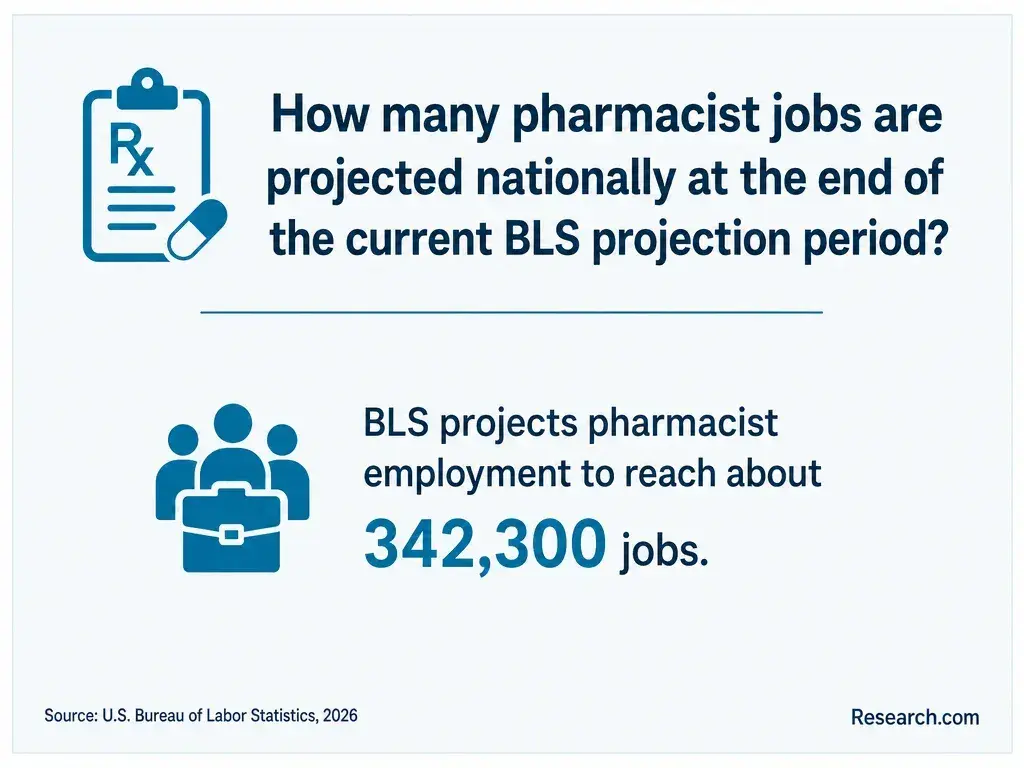
Licensed pharmacists work in settings including community pharmacies, hospitals, and other patient-care organizations; responsibilities and hiring preferences vary by role. The U.S. Bureau of Labor Statistics reports pharmacist median annual pay of $140,910 in May 2025 and projects 5% job growth, 2025-2035, with about 12,500 openings per year. Those national figures describe the occupation, not a starting salary or a return promised to a particular graduate.
Some roles favor postgraduate residency training. A postgraduate year one (PGY1) residency provides broad practice training, while a postgraduate year two (PGY2) residency develops a narrower area; fellowships commonly emphasize other specialized work, such as research or industry. These are distinct from optional specialty board certification and from state licensure. They are not universal requirements for pharmacist employment, and additional training may extend the period in which dependable care coverage is needed.
If your goal is to enter a pharmacy workplace sooner rather than practice as a pharmacist, compare the duties and requirements of pharmacy technician roles. Online pharmacy programs under two years may lead to different credentials, but they do not replace a Pharm.D. for pharmacist licensure. Choose the longer route only if the pharmacist's responsibilities justify its time, cost, and caregiving demands for you.
Other Things You Should Know About PharmD
It can help explain your responsibilities and skills, but schools decide how they evaluate experience. Describe specific examples of organization, communication, or advocacy honestly; do not present family caregiving as supervised pharmacy practice.
Do not assume so. Campus safety rules and clinical-site policies may prohibit visitors. Ask the school and site before making plans, and arrange separate care unless permission is explicit.
Title IX protections can apply to pregnancy and related conditions at covered institutions. Contact the school's Title IX coordinator for its process and applicable protections; parenting status does not automatically excuse clinical or degree requirements.
Federal cost-of-attendance rules can allow eligible dependent-care expenses, subject to the school's review and applicable limits. Ask the financial aid office what documentation it requires and whether a budget adjustment would actually change your available aid.
- Undergraduate/PharmD Pharmacy Programs FAQs | Purdue University College of Pharmacy https://pharmacy.purdue.edu/undergraduate-pharmd-pharmacy-programs-faqs/
- Backup Care - Students - Arizona Life/Work Connections https://lifework.arizona.edu/backup-care-students
- Emergency/Backup Family Care | Washington University in St. Louis https://hr.wustl.edu/items/emergency-backup-family-care/
- Dependent Care Flexible Spending Accounts | umich.edu https://hr.umich.edu/benefits-wellness/financial/flexible-spending-accounts/dependent-care-flexible-spending-accounts
- Admissions Frequently Asked Questions and Tips | ucsf.edu https://pharmd.ucsf.edu/admissions/faq-tips
- PharmD FAQs - UNC Eshelman School of Pharmacy https://pharmacy.unc.edu/education/pharmd/pharmd-admissions-faqs/
- Backup Child Care | MIT Human Resources https://hr.mit.edu/worklife/child-care/backup
- PharmD Student Voices: A Clinical Training Explainer | Doctor of Pharmacy https://pharmacy.wisc.edu/2025/08/13/pharmd-student-voices-a-clinical-training-explainer/
- Pharm D Practice Experience Curriculum | Presbyterian College https://www.presby.edu/graduate-programs/pharmacy/pharmd/practice-experience/
- Backup Care & Caregiving Supports - Human Resources https://hr.jhu.edu/benefits-worklife/families-caregiving/backup-care/


