
Pharmacy residency match process and key dates

Co-Founder and Chief Data Scientist
A pharmacy residency application can fail because of a missed deadline, but meeting every deadline is only part of the decision. Applicants also need to choose programs they would genuinely accept and rank them correctly. This guide is for Pharm.D. students and pharmacists considering U.S. postgraduate training. It explains the Match calendar, application systems, eligibility, ranking, and options after an unsuccessful Phase I result so you can build a realistic program list and act on time.
Key Things You Should Know
- The ASHP Resident Matching Program has separate Phase I and Phase II deadlines; check the official calendar for your cycle rather than reusing last year's dates.
- Apply to programs through PhORCAS and register separately with National Matching Services (NMS) for the Match. Submitting an application does not submit a rank list.
- Rank only programs where you would accept a position, in your genuine order of preference. An unsuccessful Phase I applicant may pursue available Phase II positions.
What Is the Pharmacy Residency Match Process?
The ASHP Resident Matching Program pairs applicants with participating postgraduate year one (PGY1) and postgraduate year two (PGY2) pharmacy residencies. Applicants apply to programs, interview, and submit a confidential rank-order list. Programs rank applicants separately. The matching algorithm then produces results according to those preferences and available positions.
A residency is supervised postgraduate training, not another Pharm.D. degree or a pharmacist license. The route into the profession starts with a professional pharmacy degree and state licensure requirements; applicants still exploring online pharmacy education options should distinguish those steps from residency. Some PGY2 programs also fill positions through an early-commitment process for eligible PGY1 residents, so check each program's recruitment route before assuming it has Match positions.
What Are the Key Pharmacy Residency Match Dates?
Exact dates change each cycle, and individual programs set their own application and interview deadlines. Use the current ASHP match calendar, PhORCAS schedule, and each program's listing as your controlling sources. This planning sequence shows when the major decisions generally arise; it is not a substitute for published deadlines:
| Typical period | Milestone | Decision affected |
| Fall | Review programs; PhORCAS and match registration become relevant | Which eligible programs merit an application? |
| Winter | Program application deadlines and interviews | Whether you can submit a complete application and assess program fit |
| Late winter to spring | Phase I rank-list deadline and match results | Your final preference order and initial outcome |
| Spring | Phase II applications, rankings, and results; possible post-match vacancies | Whether to pursue remaining positions or another route |
Set reminders for both systems' deadlines and for each program's earlier document requirements. A Pharm.D. graduation or online pharmacy course completion timelines do not determine Match deadlines; applicants must plan backward from the residency cycle they intend to enter.
How Do PGY-1 and PGY-2 Pharmacy Residencies Differ?
PGY1 develops broad patient-care and pharmacy practice competence after the Pharm.D. PGY2 builds focused expertise in an area such as oncology, critical care, or ambulatory care and ordinarily follows PGY1 or qualifying equivalent experience under the applicable program and accreditation rules. Both are typically yearlong, full-time training commitments; neither grants a pharmacist license.
The comparison below helps identify the right application level before you invest in interviews:
| Consideration | PGY1 | PGY2 |
| Usual applicant | New Pharm.D. graduate or eligible pharmacist seeking broad postgraduate training | PGY1 resident or pharmacist who meets the program's advanced-entry criteria |
| Training focus | Generalized practice and patient-care foundations | Focused specialty practice |
| Best fit | Applicant exploring or building toward clinical practice | Applicant with a defined specialty goal and relevant preparation |
Do not confuse these postgraduate years with Doctor of Pharmacy accelerated tracks, which concern the time spent earning the professional degree. A fellowship generally emphasizes a different training objective, often research or industry work; compare its actual duties with a residency before choosing either.
Requirements depend on the program and position. Typically, applicants must earn a Pharm.D. from an eligible pharmacy program by the residency start date and meet the program's pharmacist licensure conditions within its stated timeframe. Programs may also require specific prior training for PGY2, work authorization, background screening, or other employment clearances. Read the listing and ask the program directly about any eligibility uncertainty.
Separate admission to pharmacy school from eligibility for postgraduate employment. Pharmacy degree entry requirements concern the earlier educational step; meeting them does not establish residency eligibility. Likewise, completing a Pharm.D. or passing a licensure examination does not itself issue a state pharmacist license. Confirm the board requirements for the state where you would train and the program's deadline for obtaining that license.
PhORCAS is the centralized application service used by participating pharmacy residency programs to receive materials. National Matching Services (NMS) administers Match registration, rankings, and results. These are distinct tasks: a PhORCAS application tells a program you want to be considered, while an NMS rank list expresses your preferences among programs for the matching process.
Confirm that every program you select participates in the relevant Match phase and follow its PhORCAS instructions. Track application completion, interview invitations, Match registration, and rank submission separately. PhORCAS should not be confused with PharmCAS, the pharmacy school admissions service; readers considering an earlier educational step can review how competitive is pharmacy school admission, but pharmacy school admissions practices do not predict residency selection.
Participating programs commonly request a curriculum vitae, letter of intent, pharmacy school transcript, and references through PhORCAS. The number and type of references, essay prompts, transcript rules, and any supplemental materials vary. Check each listing before asking a recommender to submit a letter or adapting an essay.
Use this sequence to avoid a technically submitted but incomplete application:
- Record each program's deadline, prompts, reference requirements, and any separate submission instructions.
- Request transcripts and references early enough for other people and institutions to complete their steps.
- Tailor the letter of intent to the program's actual training opportunities and explain the experience you would bring.
- Confirm the application shows all required materials as received before the program's deadline.
Academic transcripts document prior education; they do not imply that residency training accepts course credit transfers. If you are still completing your Pharm.D., pharmacy degree transfer credit policies are set by the receiving school and are separate from residency document requirements.
After interviews, applicants rank programs in their true order of preference through NMS. Programs submit their own confidential rankings. Rank a program only if you would accept its position under the match rules; do not move a less-preferred program above a preferred one because you think it is a "safer" choice. Review the current match agreement and submit your list before the phase-specific deadline.
To settle close calls, compare the clinical experiences, preceptors, staffing expectations, location, licensure timeline, and support you learned about during interviews. A strong science background may shape your interests, but it should not substitute for assessing the residency itself. For someone still choosing a professional degree, online pharmacy programs for science-background students address a different, earlier decision.
An unmatched Phase I applicant can review positions available in Phase II, subject to that phase's eligibility and deadlines. Phase II involves applications, interviews where offered, and a new rank list; it is not an automatic placement or simply an extension of the Phase I list. Vacancies may also remain after Phase II under the applicable post-Match process.
Act promptly, but do not apply indiscriminately. Identify programs whose location, licensure conditions, and training still work for you; ask a mentor to review your application and interview approach; and prepare an employment or future-cycle plan if the remaining positions are not a fit. Budget matters as well: an unmatched graduate comparing work, later training, or additional schooling may find lower-cost pharmacy degree pathways useful only if another degree actually advances their goal. It does not replace pharmacist licensure or a clinical residency.
Start with the work you hope to do after training, then assess whether a program offers repeated, supervised experience in that work. Verify its current ASHP accreditation status where relevant, rather than assuming every listed opportunity has the same status. Ask how residents select rotations, receive feedback, meet licensure deadlines, and handle staffing and research obligations.
Compare the practical costs too: residency stipend, local housing, relocation, application and interview expenses, benefits, and the earnings you may forgo by delaying another job. A stipend figure alone cannot show what you will have left after expenses. If educational debt shapes your decision, review online pharmacy degree affordability separately from the financial terms of a residency; advertised degree tuition and resident compensation measure different things.
A useful final test is whether you could explain why each ranked program is preferable to direct employment for your particular career goal. If you cannot identify the experience it adds—or cannot meet its licensure and living-cost demands—reconsider that application or ranking.
What Careers and Salary Opportunities Follow a Pharmacy Residency?
Residency training can support applications for clinical, hospital, ambulatory care, and specialty pharmacy roles, depending on the training completed and an employer's requirements. It can also lead to PGY2 training. Residency is not universally required for pharmacist employment, and a specialty title does not automatically mean residency or board certification is legally required. Board of Pharmacy Specialties certification is a separate credential with its own eligibility rules; state pharmacist licensure remains separate from both.
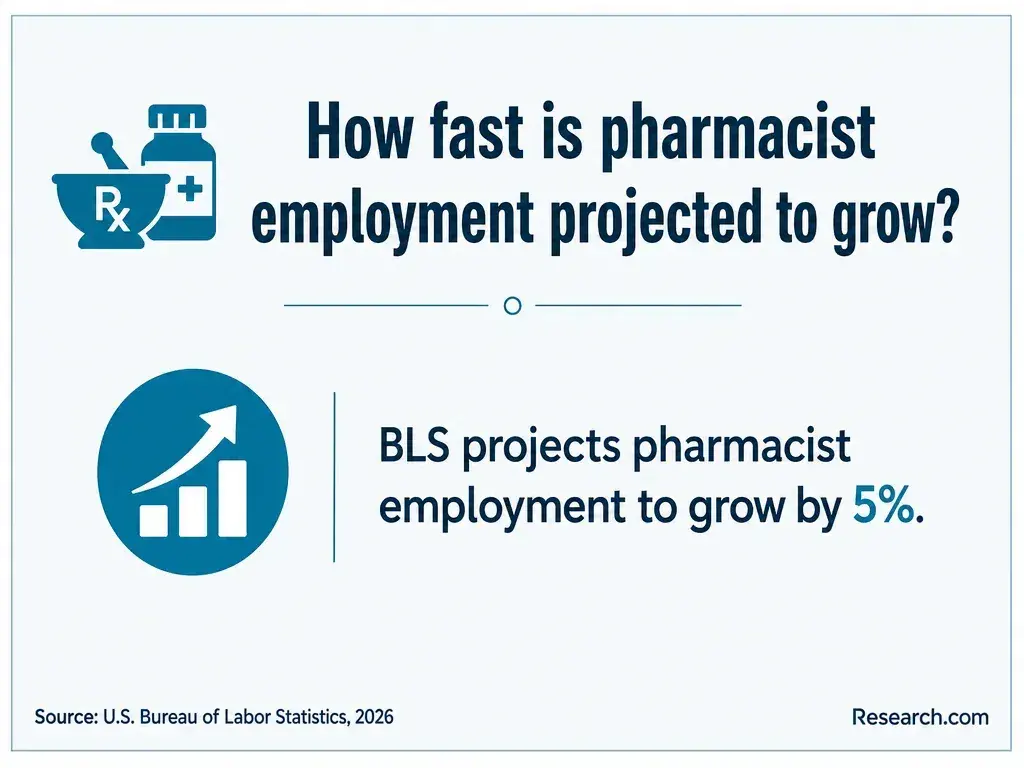
The Bureau of Labor Statistics reports a pharmacist median annual pay of $140,910 in May 2025 and projects 5% growth, 2025-2035, with about 12,500 openings per year. Those figures describe pharmacists as an occupation, not residency graduates or any particular specialty; they cannot establish a residency salary premium.
Choose residency when its supervised experience is important for the jobs you intend to pursue and worth the year of training and its opportunity cost. Direct employment may be the better next step when your target role does not call for postgraduate training. Likewise, researching how long online doctoral programs take addresses a different educational choice, not a shortcut to the clinical experience supplied by residency.
Other Things You Should Know About PharmD
Some opportunities recruit outside the Match. Verify the position's recruitment process, accreditation status, training terms, and deadlines directly with the program rather than assuming PhORCAS or NMS applies.
No. Interview format is program-specific and may change by cycle. Confirm whether the interview is virtual or on-site and whether travel is required before accepting an invitation.
Do not assume so. A Match result carries obligations under the applicable Match rules, and any proposed change requires discussion with the program and the appropriate Match administrator.
That depends on the program's employment policy, schedule, and applicable law. Ask about outside-work restrictions before ranking a program if you need supplemental income.
- The Match | University of Maryland School of Medicine https://www.medschool.umaryland.edu/osa/advising/residency-application-manual/the-match/
- Admissions | Pharmacy Residency Programs https://pharmacyresidencyprograms.ucsf.edu/admissions
- PGY1/PGY2 Application Process - Pharmacy | OHSU Admission Requirements and Application Process https://www.ohsu.edu/pharmacy/pgy1-pgy2-application-process
- Programs | Match Overview https://natmatch.com/ashprmp/programs/program-overview.html
- PGY1 Pharmacy Practice Residency Program | Harris Health System https://jobs.harrishealth.org/pgy1
- General Information - Liaison International https://help.liaisonedu.com/PhORCAS_Applicant_Help_Center/ASHP_Match/01_General_Information


