How ACPE Accreditation Applies to PharmD Programs

Co-Founder and Chief Data Scientist
Before committing to a Doctor of Pharmacy (Pharm.D.) program, check what its accreditation status means for your education and your ability to pursue a pharmacist license. The Accreditation Council for Pharmacy Education (ACPE) evaluates professional pharmacy programs, but accreditation is not the same as admission approval, state authorization, or licensure.
This guide explains the distinctions, what ACPE standards cover, and how to verify a program's status before comparing its schedule, costs, and clinical placements.
Key Things You Should Know
- ACPE accredits professional Pharm.D. programs - not individual pharmacists or every degree offered by a pharmacy school. Confirm the specific program's current status before enrolling.
- An ACPE-accredited Pharm.D. is the standard U.S. educational route toward pharmacist licensure, but graduates must still meet their licensing board's examination and other requirements.
- Accreditation does not settle cost, online-study logistics, or outcomes: compare total expenses, required in-person training, and published licensure-exam results separately.
What is ACPE accreditation for PharmD programs?
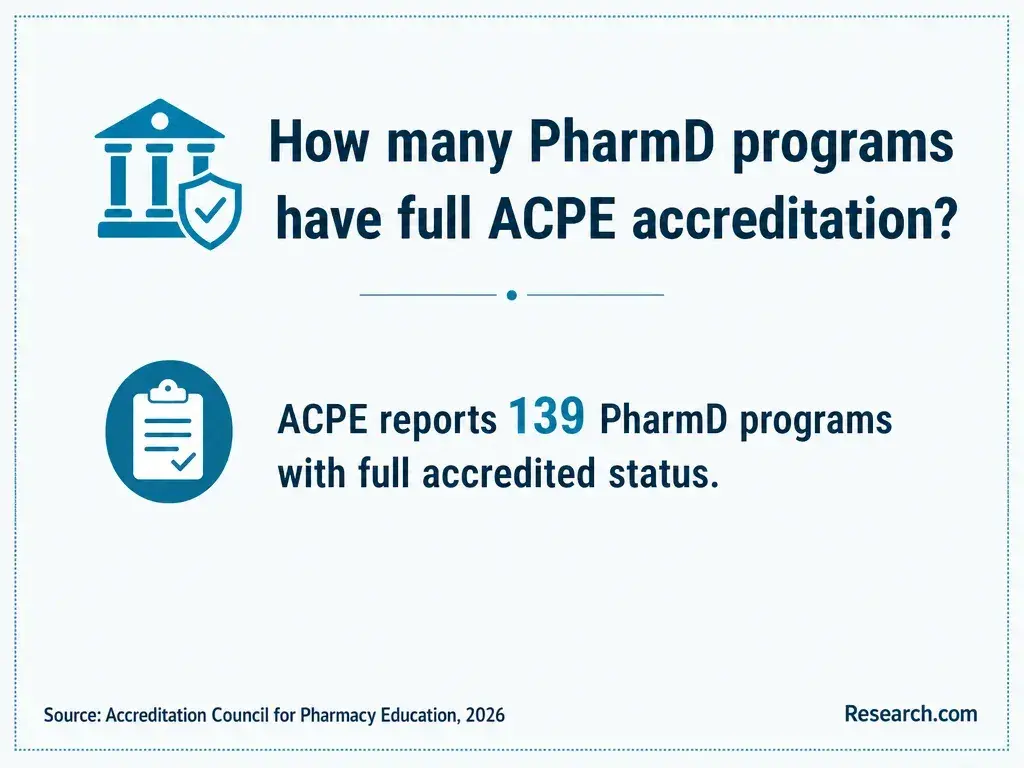
ACPE accreditation is an external review of a professional Pharm.D. program against standards for its curriculum, faculty, resources, student support, assessment, and experiential education. It applies to the program, not automatically to every credential awarded by its institution. Institutional accreditation evaluates the college or university under a different process; neither designation replaces the other.
ACPE's published status matters more than a school's general claim that it is "accredited." The distinctions below help applicants read a program listing without treating developing-program status as identical to full accreditation.
| ACPE status | What it means for an applicant |
| Accredited | The established professional program has met ACPE's accreditation requirements, subject to continuing review. |
| Candidate | A developing program has advanced through ACPE's process but has not yet received full accreditation. Confirm its current status and implications for your expected graduation date. |
| Pre-candidate | An early-stage program has entered ACPE's process; progress to later statuses is not assured. Ask about the risks before committing. |
For a pharmacist career, the relevant question is whether the professional Pharm.D. has an appropriate ACPE status. A listing of accelerated online doctoral education is not evidence that a doctorate qualifies its graduates for pharmacist licensure.
Why does ACPE accreditation matter for PharmD students?
Accreditation gives students a way to check whether a program is held to profession-specific educational standards rather than relying on its advertising. It is particularly important if a school is new, changing its delivery format, or describing accreditation as pending. ACPE review does not, however, guarantee admission to postgraduate training, an examination pass, a job, or a particular clinical placement.
Use accreditation as a first filter, then compare what students actually must do and pay. A program with a lower advertised tuition may involve substantial travel for campus sessions or rotations; a guide to online pharmacy degree affordability can help frame that comparison, but obtain a complete, current cost estimate from each school.
How does ACPE accreditation affect pharmacist licensure?
Graduating from an appropriately ACPE-accredited U.S. Pharm.D. program is the standard educational route toward a pharmacist license. It does not issue one. Each applicant must satisfy the licensing board in the jurisdiction where they intend to practice, which may include intern experience or registration, the North American Pharmacist Licensure Examination (NAPLEX), a jurisdiction-specific law examination, and other application requirements.
Do not assume every jurisdiction uses the Multistate Pharmacy Jurisprudence Examination (MPJE). Requirements differ, and some jurisdictions began transitioning to the Uniform Multistate Pharmacy Jurisprudence Examination (UMPJE) in 2026. Check the relevant board and the National Association of Boards of Pharmacy (NABP) before planning exams or a move. Passing an exam alone does not confer a license.
A shorter pharmacy-related credential may lead to different work, but it does not substitute for the professional degree when pharmacist licensure is the goal. Compare shorter pharmacy programs with career potential only if you are open to roles other than pharmacist.
ACPE standards address whether a program can prepare students for entry-level pharmacist practice. They encompass the professional curriculum and its assessment, qualified personnel, student services, educational resources, governance, and supervised practice experiences. Accreditation is continuing oversight, not a one-time endorsement that every student or placement will have the same experience.
For applicants, the most useful test is how a school implements those standards. Ask how it evaluates patient-care skills, secures and supervises clinical sites, responds to student feedback, and supports students who struggle. An accelerated Pharm.D. degree option still needs to meet applicable ACPE standards; a shorter calendar is not evidence that experiential or academic requirements disappear.
The professional curriculum builds on prerequisite undergraduate science and general education coursework; those prerequisites are not themselves the Pharm.D. degree. Students study how medicines work, evaluate drug therapy and evidence, communicate with patients and other clinicians, address medication safety, and apply pharmacy law and professional responsibilities. Schools differ in course sequence and electives.
Supervised introductory pharmacy practice experiences (IPPEs) develop early practice skills. Advanced pharmacy practice experiences (APPEs) require students to apply their learning in clinical and other pharmacy settings later in the program. The school approves placements and evaluates performance, while students may need to arrange transportation, satisfy site health and background-check requirements, and obtain intern registration where required.
Prior coursework can prepare an applicant without replacing professional training. Students considering an online Pharm.D. for students with prior science study should ask which prerequisites are satisfied and whether any prior work can actually apply to the professional curriculum.
Some Pharm.D. programs include online instruction and hold ACPE professional-program accreditation. Delivery format does not establish accreditation status: check the exact program in ACPE's directory. "Online" also does not necessarily mean asynchronous or fully remote. Scheduled classes, campus-based skills sessions, and in-person IPPEs and APPEs may be required.
Before choosing among pharmacy schools offering online Pharm.D. study, get written answers about live attendance, campus visits, rotation-site approval, and likely travel. Separately confirm that the school may enroll you from your state and whether the pathway meets the educational requirements of the state where you plan to seek licensure. ACPE accreditation, distance-education state authorization, and licensure eligibility answer different questions.
Requirements vary by school. Applicants commonly need specified undergraduate prerequisite courses, including sciences, but the required credits, laboratories, minimum grades, GPA rules, and course-age limits are program-specific. Some schools admit qualified applicants without a completed bachelor's degree. Meeting published minimums does not guarantee admission.
Check each school's current admissions page and, if it participates, its PharmCAS listing for deadlines, recommendations, interviews, transcripts, and any supplemental application. Not every school uses PharmCAS. The Pharmacy College Admission Test (PCAT) was retired in January 2024, so it is not a current exam applicants can schedule.
If your record is unusual, compare policies rather than guessing from an acceptance-rate label. Information about how competitive pharmacy school admission may be can provide context, but only the school can confirm how it will evaluate your courses and application.
Many professional Pharm.D. curricula run for four academic years after prerequisites; some use accelerated calendars. The time needed to finish prerequisite coursework is additional and depends on what you have already completed. Compare calendars by required attendance and rotation timing, not just the advertised graduation date.
Published tuition is only part of the price. Budget for mandatory fees, materials, required technology, immunizations and background checks, campus travel, and possible housing or transportation during rotations. Request each school's current cost-of-attendance information and a breakdown for your residency and enrollment status before comparing offers.
Federal borrowing rules changed for many new graduate and professional borrowers beginning July 1, 2026. Confirm your own eligibility and current loan limits with the financial aid office rather than assuming Grad PLUS or an older borrowing limit is available. If time and debt outweigh the benefit of pharmacist licensure for your goals, shorter online pharmacy study options may be worth examining - but they are not substitutes for a Pharm.D.
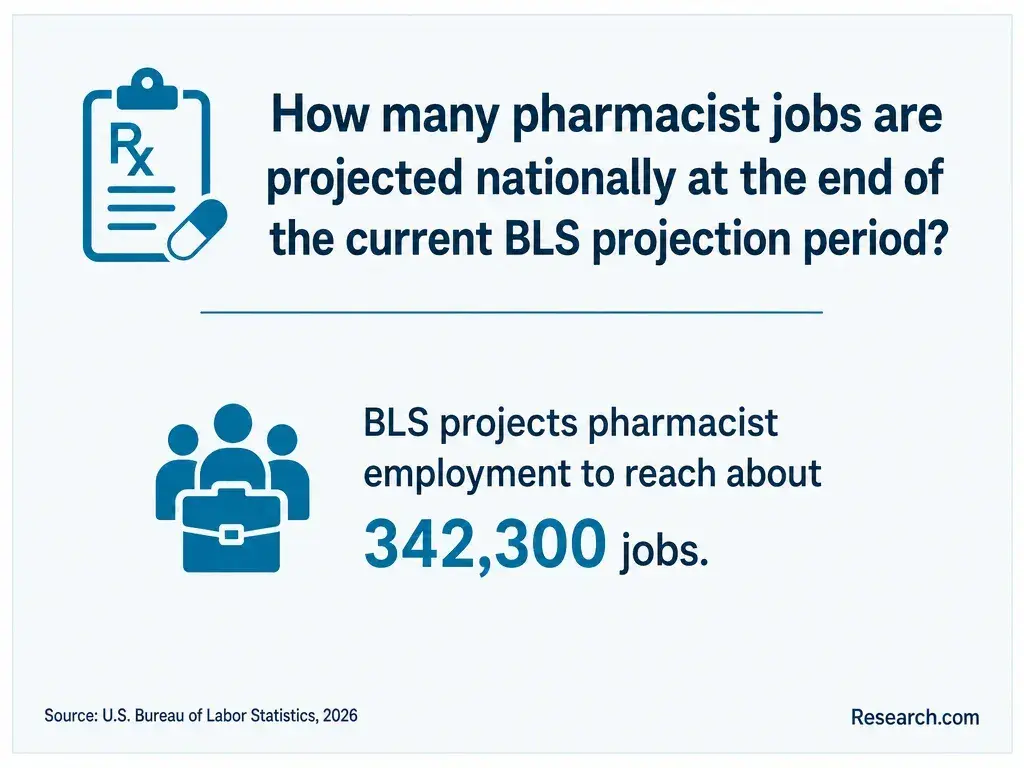
After meeting state licensure requirements, pharmacists may work in community, hospital, ambulatory care, specialty, or other settings; responsibilities and hiring expectations differ. The Bureau of Labor Statistics reports median annual pay for pharmacists of $140,910 in May 2025. That occupation-wide median is not a starting salary or a promise to Pharm.D. graduates. BLS projects 5% growth from 2025-2035, with about 12,500 openings per year; local opportunities and practice settings can differ from the national outlook.
Some pharmacists pursue a postgraduate residency for structured clinical training or a fellowship for a particular research or industry path. Specialty board certification is a separate credential with its own eligibility rules. None replaces state licensure, and none is required for every pharmacist position.
If pharmacist is the goal but you lack an admission requirement, investigating pharmacy programs with flexible entry requirements may be more relevant than switching to a different occupation. Confirm what must be completed before matriculation; flexible entry does not waive professional-program or licensing requirements.
How can you verify a PharmD program's ACPE accreditation status?
Check status before paying a deposit, particularly for a new program or a newly advertised online pathway. ACPE's official professional-program directory is the primary place to confirm the program and its current designation. A school webpage can explain its plans, but "seeking accreditation" is not the same as holding it.
Use these checks to connect the accreditation record to the specific offer you are considering:
- Find the institution and professional Pharm.D. program in ACPE's directory; record the status shown and check for any accompanying notices.
- Ask the school to confirm that the campus or online pathway you would enter falls under that program's ACPE status, especially if it is new or changing.
- If the program has candidate or pre-candidate status, ask what status is expected when your class graduates and what happens if the program does not advance as planned.
- Confirm institutional accreditation, your state's distance-education and clinical-placement rules if relevant, and the licensing board's educational requirements separately.
- Compare published NAPLEX results, full costs, and rotation arrangements alongside accreditation rather than treating accreditation as an outcome guarantee.
Finally, have the school evaluate any previous coursework in writing. A resource on how to evaluate credits for pharmacy prerequisites can help you prepare questions, but the receiving school decides whether prior credits satisfy its prerequisites or apply to its professional curriculum.
Other Things You Should Know About PharmD
ACPE also accredits providers of pharmacist continuing education. That is a separate activity from accrediting a professional Pharm.D. program; a provider's status does not establish a degree program's status.
Pharmacy residency accreditation is a separate process associated with organizations such as the American Society of Health-System Pharmacists (ASHP). A Pharm.D. program's ACPE status does not establish a residency's accreditation.
Ask the school immediately for its written teach-out or transfer arrangements and contact ACPE and your intended licensing board about the implications for your education. Do not assume another program will accept all completed credits.
Not automatically. Internationally educated pharmacists generally face a distinct eligibility pathway, which may include NABP's Foreign Pharmacy Graduate Examination Committee (FPGEC) certification, depending on the jurisdiction. Check the relevant state board and NABP requirements for your circumstances.
- What's Next in the ACPE Accreditation Standards Revision Process? - PMC https://pmc.ncbi.nlm.nih.gov/articles/PMC3631724/
- Accreditation Status - School of Pharmacy https://pharmacy.ku.edu/accreditation-status
- Successful ACPE Focused Site Visit Confirms Continued Accreditation Through June 2031 | Pacific University https://www.pacificu.edu/magazine/successful-acpe-focused-site-visit-confirms-continued-accreditation-through-june-2031
- College News | College of Pharmacy | University of Houston https://uh.edu/pharmacy/news-and-events/news-releases-2025/february/acpe-reaccredits-uhcop-pharmd/
- School of Pharmacy achieves next to final step in attaining full accreditation | Chapman Newsroom https://news.chapman.edu/2016/07/11/school-of-pharmacy-achieves-next-to-final-step-in-attaining-full-accreditation/
- Program Lookup | Accreditation Council for Pharmacy Education https://www.acpe-accredit.org/program-lookup/